
What if the traditional barriers to entry in the UAE property market are actually your greatest competitive advantage in 2026? While many...

What if the traditional barriers to entry in the UAE property market are actually your greatest competitive advantage in 2026? While many international investors hesitate due to perceived regulatory hurdles, the reality is that securing a dubai mortgage for non residents has become a meticulous, well-defined path for those with the right professional guidance. You likely understand that the UAE Central Bank maintains strict oversight to ensure market stability, yet the complexity of cross-border documentation can still feel like a daunting hurdle to clear from thousands of miles away.
We promise to transform this anxiety into quiet confidence by providing a professional roadmap to property financing that is both aspirational and grounded in reality. You’ll master the intricacies of the current 50% Loan-to-Value (LTV) limits for first-time non-resident buyers and learn how to navigate interest rate fluctuations with ease. This guide offers a clear, step-by-step application path that allows you to secure a premium asset while enjoying a truly hands-off experience; we ensure your investment remains a source of prestige rather than a logistical burden.
Key Takeaways
- Identify the specific eligibility frameworks and international income requirements necessary to enter the 2026 Dubai property market with professional ease.
- Explore the strategic advantages of leveraging debt over cash to maximize your Return on Equity and accelerate your portfolio growth through capital recycling.
- Navigate the essential five-step acquisition process, including how to secure a dubai mortgage for non residents through a seamless Approval in Principle.
- Uncover the benefits of a bespoke mortgage consultation that provides a meticulous, hands-off transition from initial property sourcing to final ownership.
- Gain peace of mind by learning how to structure your global assets to meet the sophisticated standards and prestige of UAE lending institutions.
Navigating the Dubai Mortgage Landscape for International Investors
Entering 2026, the UAE property sector remains a beacon for global capital, offering a sophisticated environment for wealth expansion. Investors seeking a dubai mortgage for non residents find a landscape defined by stability, transparency, and rigorous institutional oversight. The UAE Central Bank dictates the lending framework, ensuring a secure environment that protects international wealth while fostering sustainable growth. Understanding the historical trajectory of Dubai’s Real Estate Market provides the essential context for these strategic financing decisions.
A foreign investor is technically defined as any individual residing outside the Emirates who does not hold a valid residency visa. By 2026, the market has matured into a phase of predictable appreciation, making it a pivotal year to secure competitive margins. This period represents a unique window for those prioritizing long-term asset security, reliable income, and premium rental yields in a globalized economy.
To better understand the potential of these premium investments, watch this helpful video showing the transformation of high-end villa assets:
Key Benefits of Financing Dubai Property Remotely
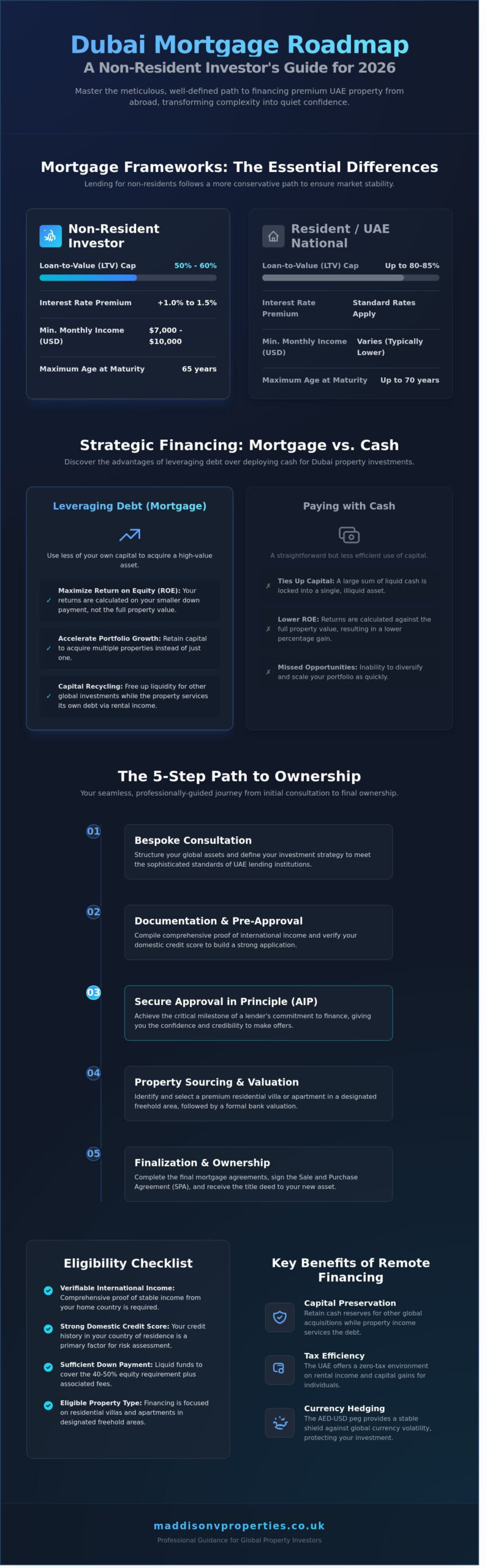
- Capital preservation: Financing allows for meticulous liquidity management. You retain your cash reserves for further global acquisitions while the property generates income to service the debt.
- Tax efficiency: The UAE offers a tax-free environment on rental income and capital gains. This creates a bespoke advantage for investors managing complex international tax residences.
- Currency hedging: The AED-USD peg provides a seamless shield against global volatility. Your debt remains stable, predictable, and protected from the fluctuations common in other emerging markets.
Non-Resident vs. Resident Mortgages: The Essential Differences
Lending for non-residents follows a more conservative path to ensure market stability. While residents might access higher leverage, a dubai mortgage for non residents typically features Loan-to-Value (LTV) caps between 50% and 60%. This higher equity requirement serves as a protective buffer, ensuring your investment portfolio remains resilient against market shifts.
Interest rates often include a non-resident premium, usually ranging from 1% to 1.5% above the rates offered to local residents. Banks also apply specific eligibility criteria, including a minimum monthly income threshold of approximately $7,000 to $10,000 USD and age limits that typically cap out at 65 years. These meticulous standards ensure that the financing process remains professional, secure, and perfectly aligned with the premium nature of the Dubai property sector.
Eligibility and the Non-Resident Mortgage Framework
Securing a dubai mortgage for non residents requires a meticulous approach to documentation and a clear understanding of the UAE Central Bank’s regulatory environment. Lenders prioritize stability, liquid wealth, and a verifiable track record of fiscal responsibility. While the process is streamlined, it remains rigorous. You’ll need to provide comprehensive proof of income from your home country, whether you’re based in London, Geneva, or Singapore. Your domestic credit score acts as a primary barometer for risk, directly influencing your interest rates and loan approval chances.
The framework distinguishes between property types. Residential villas and apartments in freehold areas are the primary focus for international lenders. Commercial financing remains available but often carries stricter criteria and higher interest rates. Investors seeking a bespoke property management solution often secure their residential financing first to ensure their capital is deployed with maximum efficiency.
Financial Thresholds for Global Investors
Minimum monthly income requirements are the first hurdle. Most UAE banks require a minimum salary of AED 25,000 (approximately £5,400 or €6,300) for non-resident applicants. Documentation standards differ significantly based on your employment status:
- Salaried Applicants: You’ll need original bank statements for the last six months, a formal salary certificate, and your latest tax returns (P60 for UK residents).
- Self-Employed Applicants: Banks require two years of audited financial statements for your company, along with personal bank statements and a certificate of registration.
The Debt Burden Ratio (DBR) is a critical metric. UAE law mandates that your total monthly debt repayments, including the new Dubai mortgage and any existing global liabilities like home-country mortgages or credit cards, cannot exceed 50% of your gross monthly income. This ensures a sustainable, premium investment experience without over-leveraging.
Financing Off-Plan vs. Completed Properties
The rules for off-plan investments in high-demand areas like Downtown Dubai or Palm Jumeirah have evolved. For non-residents, the maximum Loan-to-Value (LTV) ratio is generally capped at 50%. This means you must cover half the property value as a down payment plus associated closing costs.
The “Completion Milestone” is a vital distinction in the 2026 market. For off-plan builds, a mortgage typically doesn’t kick in until the project reaches a specific construction stage, often 50% completion. Until that point, investors follow the developer’s payment plan. Once the milestone is reached, the bank settles the remaining balance with the developer. This seamless transition allows you to leverage bank capital to finalize the purchase of a luxury asset while maintaining your personal liquidity during the initial construction phases.
Leveraging Debt: Mortgage vs. Cash for Dubai Investments
Deciding between a cash purchase and a dubai mortgage for non residents requires a shift from viewing debt as a burden to seeing it as a precision tool for wealth creation. While cash offers simplicity, strategic financing unlocks the power of leverage. By committing only 50% of the property value as a down payment, you can effectively double your exposure to the Dubai market. This approach transforms a steady 7% rental yield into a double-digit Return on Equity, allowing your capital to work with greater intensity and focus.
The 2026 landscape favors a meticulous approach to interest rates. Most lenders provide fixed terms of three to five years before transitioning to a variable rate based on the 3-month EIBOR. This Emirates Interbank Offered Rate serves as the regional benchmark, reflecting the liquidity within the UAE banking system. Choosing a fixed-rate product provides the peace of mind, stability, and predictability essential for long-distance property management. It allows you to lock in costs while the market continues its upward trajectory.
Strategic investors often utilize a capital recycling strategy to build a multi-property portfolio. Instead of sinking all available funds into a single penthouse, they distribute their capital across two or three premium units. This diversification creates a resilient, high-quality, and scalable investment structure. It ensures that your eggs aren’t in one basket while maximizing the potential for capital appreciation across different districts. For those simultaneously managing UK property assets alongside their Dubai holdings, our buy-to-let mortgage guide for 2026 provides the essential framework for navigating high-yield borrowing and the latest tax-efficient financing strategies across both markets.
The Math Behind the Investment
A cash buyer avoids the 1% bank arrangement fee and the standard valuation costs, which typically range from 2,500 to 3,500 AED. However, the mortgaged investor gains a significant advantage in liquidity. When you secure a dubai mortgage for non residents, your rental income often covers the monthly repayments while leaving a healthy surplus. This creates a self-sustaining asset that grows in equity without further capital injection. It’s a bespoke, seamless, and meticulous way to grow wealth. Sophisticated investors who want to deepen their understanding of how residential debt is pooled and traded in global capital markets can explore what is a mortgage bond and how property-backed securities drive liquidity in the prime real estate landscape.
Mitigating Risks in International Financing
Managing a variable-rate market requires foresight and a disciplined strategy. UAE law mandates life insurance for all mortgage holders, ensuring your investment remains secure and protected for your heirs. Most banks also require comprehensive property insurance to safeguard the structural integrity of your asset. You should examine the early repayment charges closely. Central Bank regulations cap these fees at 1% of the outstanding balance or 10,000 AED, whichever is lower. This flexibility allows you to exit or refinance your position with minimal friction and total confidence.
The 5-Step Process to Securing Your Dubai Home Loan
Securing a dubai mortgage for non residents requires a structured, meticulous approach to ensure your capital is deployed with precision. The journey begins with the Approval in Principle (AIP). This document defines your purchasing power before you view a single villa or luxury apartment. In 2026, most Tier 1 banks provide this certification within 72 hours, giving you a 60-day window to commit to a property with total confidence.
Once you identify a premium asset, you’ll sign the Memorandum of Understanding (MOU), also known as Form F. This contract outlines the specific terms of the sale and typically involves a 10% security deposit held by a licensed broker. Following this, the bank initiates a professional property valuation. This is a critical juncture. The bank’s independent surveyor ensures the purchase price aligns with current market data from the last 12 months. If the valuation falls short of the agreed price, you’ll need to bridge the financial gap with personal funds.
Upon a successful valuation, the lender issues the Final Offer Letter (FOL). This is your definitive mortgage contract. The final stage is the formal registration at a Dubai Land Department (DLD) Trustee office. Here, the mortgage is registered, the loan is drawn down, and the title deed is issued in your name. It’s a polished, legal conclusion to your investment journey.
Document Checklist for a Seamless Application
Meticulous preparation is the hallmark of a successful application. You’ll need to provide original documents that reflect your financial stability and personal identity. Most lenders require:
- Six months of original personal bank statements.
- Latest three months of payslips or audited company accounts.
- A valid passport copy with at least six months’ validity.
- Proof of residential address, such as a utility bill from the last 90 days.
For investors from non-English speaking jurisdictions, every document must undergo certified translation and legalisation at the UAE Embassy. A dedicated mortgage consultant acts as your sophisticated advocate during this phase. They manage the bank bureaucracy and ensure your profile meets the specific criteria of Dubai’s lending institutions, saving you from the frustration of administrative delays.
Timeline: What to Expect from Application to Keys
The path from your initial application to receiving the keys typically spans 35 to 45 days. While the process is efficient, bottlenecks can occur during the valuation phase or if DLD appointments are at peak capacity during the busy Q1 and Q4 cycles. In 2026, roughly 85% of transactions for a dubai mortgage for non residents are managed remotely. By using a Power of Attorney (POA), you can complete the entire acquisition without leaving your home country. This remote flexibility ensures your investment remains a hands-off, premium experience from the very first signature. Investors expanding beyond the UAE who are also exploring a uk mortgage for international buyers will find that the same disciplined documentation approach applies equally to navigating the British lending system in 2026.
Ensure your investment remains a stress-free asset with the bespoke property management services at Maddison V Properties.
Structuring Your Global Property Portfolio with MaddisonV
MaddisonV Properties bridges the gap between the structured reliability of London’s financial markets and the high-growth potential of the UAE. We understand that securing a dubai mortgage for non residents requires more than just a lender; it demands a strategic partner who understands international tax implications and cross-border wealth management. Our bespoke mortgage consultation service caters to private clients who value discretion and precision. We don’t just find a loan. We engineer a financial structure that aligns with your 2026 tax planning and long-term capital appreciation goals.
Our “Hands-Off” promise is the cornerstone of our service. We recognize that our clients are often managing global interests and cannot be bogged down by the administrative friction of a foreign property purchase. By integrating financing with our premier property sourcing and facilities management, we provide a seamless transition from initial inquiry to monthly rental income. We handle the meticulous details, from document verification to developer liaison, so you enjoy the rewards of your investment without the operational burden.
Beyond the Loan: Full-Cycle Investment Support
Investing in Dubai is a multi-stage journey that extends far beyond the initial transaction. Our team identifies high-yield off-plan opportunities where 2026 and 2027 delivery dates align with projected 6.5% annual capital growth in prime districts. We ensure every selected property meets strict bank lending criteria before you commit. Once the keys are handed over, our management team takes the lead. We handle everything from rigorous tenant vetting to consistent rent collection. Managing the complexities of a dubai mortgage for non residents is simplified when your management team understands the bank’s requirements for debt-service coverage. Periodic portfolio reviews help determine if a refinance or a strategic exit is the best path forward for your equity.
Next Steps: Your Path to Dubai Property Ownership
Our London-based advisory team provides a familiar point of contact for your international expansion. We operate on a success-based fee structure for property acquisition, which ensures our interests remain perfectly aligned with your investment performance. This transparent approach removes the guesswork from your entry into the UAE market. You can secure your bespoke Dubai mortgage consultation today to begin tailoring your 2026 investment strategy. We manage the meticulous details so you can enjoy the rewards of a truly hands-off global portfolio.
Master Your Global Portfolio in the 2026 Dubai Market
The 2026 landscape offers a unique window for international investors to maximize capital efficiency. By understanding the specific eligibility framework for a dubai mortgage for non residents, you can transition from simple ownership to sophisticated portfolio scaling. Leveraging finance rather than deploying 100% cash allows you to capitalize on the Dubai Economic Agenda D33, which targets a total economic output of 32 trillion AED by 2033. Success requires a meticulous approach to off-plan selection and a seamless transition from acquisition to long-term management.
MaddisonV Properties serves as your boutique, London-based advisory with a global reach that spans the most lucrative districts. We specialize in high-yield luxury off-plan investments and provide comprehensive, hands-off property management solutions to ensure your peace of mind. Our team handles the complex details so you can enjoy the rewards of a premium investment. Book your bespoke mortgage consultation with our expert advisors today. Your path to a secure, high-performing property legacy starts with a single, well-informed step.
Frequently Asked Questions
Can I get a Dubai mortgage without a UAE residency visa?
Yes, you can secure a dubai mortgage for non residents without holding a UAE residency visa. International investors typically access bespoke financial products through major lenders like Emirates NBD or HSBC, which are tailored for overseas buyers. These solutions offer a seamless, secure, and prestigious entry into the market, ensuring your investment journey is well-managed from afar.
What is the maximum Loan-to-Value (LTV) for a non-resident in Dubai?
Non-resident investors can typically access a maximum Loan-to-Value (LTV) of 50%. While residents may access up to 80%, the 50% threshold for international buyers ensures a stable, low-risk entry into the Dubai property sector. This requirement reflects a meticulous approach to financial security, providing peace of mind for both the lender and the sophisticated investor.
Do I need to travel to Dubai to sign my mortgage documents?
You don’t need to be physically present in Dubai to finalize your mortgage documentation. By utilizing a notarized Power of Attorney or the Dubai Land Department’s remote registration systems, the entire process becomes a hassle-free, remote experience. This digital-first approach ensures a premium, efficient service that respects your time and global commitments.
What are the typical interest rates for non-resident mortgages in 2026?
In 2026, interest rates for non-residents generally range between 4.5% and 6.5% depending on the lender and loan term. These rates often track the 3-month or 6-month EIBOR (Emirates Interbank Offered Rate) plus a fixed bank margin. This structured pricing provides a clear, predictable, and transparent pathway for managing your international property portfolio with absolute confidence.
Can I use a mortgage to buy an off-plan property in Dubai?
You can utilize a mortgage for off-plan properties, though banks typically limit financing to 50% of the purchase price. Most lenders require the developer to have completed at least 20% of the construction before approving the loan. This meticulous standard ensures your investment is protected, offering a secure, high-quality route to capital appreciation in Dubai’s most desirable neighborhoods.
How much is the minimum salary required for a non-resident mortgage?
Most UAE banks require a minimum monthly income of AED 25,000 for international applicants to qualify for a dubai mortgage for non residents. Some premium lenders may set this threshold at AED 50,000 to ensure a robust financial profile. This requirement guarantees a seamless, reliable, and professional partnership between the investor and the institution, maintaining the high standards of the local market.
Are there age limits for international borrowers in the UAE?
Borrowers must be at least 21 years old at the time of application to qualify for financing. The mortgage term must typically conclude before the borrower reaches the age of 65 for salaried individuals or 70 for self-employed investors. These clear, established boundaries provide a stable framework for long-term financial planning, ensuring your investment remains a prestigious and manageable asset.
What fees are involved in a Dubai mortgage application?
Expect to pay a 4% Dubai Land Department transfer fee and a 0.25% mortgage registration fee. Banks typically charge an arrangement fee of 1% plus a property valuation fee ranging from AED 2,500 to AED 5,000. These costs are a necessary part of a meticulous acquisition process, ensuring your property is registered correctly and your interests are fully protected.

Sign Up Now
Want to read more great articles and blogs subscribe to our newsletter