
What if the most significant risk to your 2026 portfolio isn't a market shift, but a mortgage offer that expires six months before your London...

What if the most significant risk to your 2026 portfolio isn’t a market shift, but a mortgage offer that expires six months before your London penthouse is even finished? For many sophisticated investors, the allure of securing a prime asset in Dubai or the UK is often overshadowed by the anxiety of valuation drops or the misalignment of developer payment plans with institutional lending cycles. You’re likely aware that timing is everything in high-end real estate, yet the path to securing financing for off-plan property is rarely a straight line.
We believe that your investment journey should be bespoke, seamless, and meticulous. This guide provides an expert roadmap to mastering the complexities of unbuilt luxury assets, ensuring you have the tools to secure capital without the stress of shifting timelines. You’ll learn how to navigate the specific requirements of 2026 lenders, protect your equity against construction phase volatility, and finalize your high-yield acquisition with absolute confidence. We’ll explore the strategic frameworks that turn complex financial hurdles into a structured, successful path toward ownership.
Key Takeaways
- Understand how specialized loan structures for unbuilt assets differ from traditional mortgages to ensure your capital is deployed with precision.
- Compare the nuances of global payment structures, from Dubai’s developer-led plans to London’s stage-based deposits, to optimize your liquidity.
- Master the art of financing for off-plan property by learning to mitigate the risks of mortgage offer expiration and market-driven valuation gaps.
- Discover a meticulous step-by-step roadmap to securing pre-approval and identifying lender-approved developers for a seamless acquisition journey.
- Leverage bespoke advisory services that bridge the gap between asset selection and financial execution for a truly hands-off investment experience.
The Fundamentals of Financing for Off-Plan Property
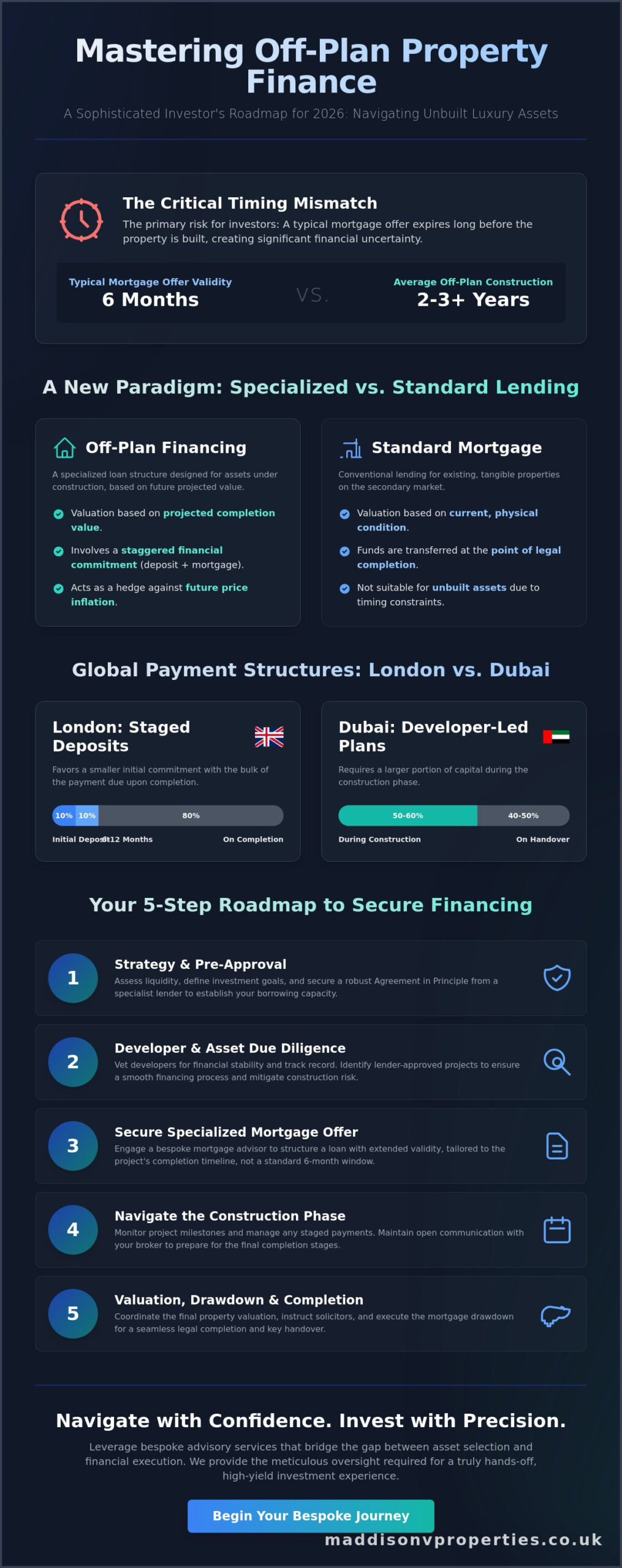
Securing financing for off-plan property represents a strategic departure from traditional lending. It’s a specialized loan structure designed for assets currently under construction or in the pre-construction phase. Unlike standard secondary market mortgages that evaluate a finished, tangible structure, off-plan financing relies on the projected value of the completed development. This forward-looking approach allows investors to secure prime real estate at current market rates for delivery in 2026 or later, effectively hedging against future price inflation in competitive urban centers.
Investors often consult professional resources to understand what is off-plan property before committing capital. The primary distinction lies in the timing of the funds. While a traditional mortgage completes upon the transfer of an existing deed, off-plan financing often involves a staggered commitment. This includes an initial deposit followed by a mortgage offer that remains valid through the construction period. It’s a sophisticated method of acquiring high-quality assets while maintaining liquidity for other ventures.
To better understand the mechanics of deposits and lending in this sector, watch this helpful video:
Why Leverage Matters in the Off-Plan Market
The allure of the off-plan sector is rooted in the power of leverage. By paying a 10% or 20% deposit, an investor gains exposure to the capital growth of the property’s full market value. If a £500,000 apartment appreciates by 5% during a two-year build cycle, the £25,000 gain represents a significant return on the initial £50,000 deposit. This “hands-off” period during construction is particularly attractive for busy professionals. It provides a seamless window where the asset grows in value without the immediate demands of tenant management. For those looking toward the completion date, consulting a buy-to-let mortgage guide is essential for structuring long-term debt effectively.
The Role of the Mortgage Broker in Luxury Acquisitions
Navigating the criteria of specialist lenders requires a bespoke advisory approach. A mortgage broker provides the quiet confidence needed to secure high-value loans in a market where standard high-street banks might hesitate. Their role involves meticulous due diligence, vetting developers for financial stability and past performance to satisfy lender requirements. This professional oversight ensures that the financing for off-plan property is as robust as the building itself. Brokers act as the bridge between ambitious investment goals and the practical realities of non-standard lending; they ensure every detail is handled with precision and care.
Navigating Payment Plans and Loan-to-Value (LTV) Ratios
Securing effective financing for off-plan property requires a meticulous understanding of how capital is deployed across different global jurisdictions. In Dubai, developers frequently utilize 50/50 or 60/40 payment structures. These models require the investor to remit 50% to 60% of the purchase price during the construction phase, with the remaining balance due upon handover. This differs significantly from the UK model. London developers typically favor a staged approach: a 10% initial deposit, a second 10% installment six to twelve months later, and the final 80% balance settled at completion.
The calculation of Loan-to-Value (LTV) ratios presents a unique challenge for unbuilt assets. Lenders generally base their leverage on the lower of the original purchase price or the professional valuation at the time of completion. If the property value appreciates by 15% during a three-year build cycle, the investor gains significant equity, yet the initial mortgage offer remains anchored to the contract price. Investors must account for mortgage risks for new-build homes, particularly the standard six-month validity of most UK mortgage offers. If construction delays push the completion date beyond this window, a reassessment is required, potentially under different interest rate conditions.
Financing Structures in the London Market
Securing an “offer in principle” early in the sourcing process is essential for any serious investor. This document provides the confidence needed to commit to a reservation fee. When evaluating opportunities, lenders often distinguish between a new build vs existing property, as some institutions limit their exposure to specific developments to 20% or 25% of the total units. Once the “notice to complete” is served, usually 10 working days before handover, the 80% balance must be ready for transfer. This requires a seamless coordination between your solicitor and lender to avoid daily penalty interest charges.
Leveraging Luxury Off-Plan Apartments in Dubai
For international investors targeting luxury off-plan apartments Dubai, the regulatory landscape is distinct. Non-residents typically face a 50% mortgage cap on off-plan properties, meaning the final handover payment is often the only portion eligible for traditional bank financing. To mitigate this, major lenders like Emirates NBD and HSBC have introduced “mortgage-at-booking” models. These products allow investors to lock in a pre-approval at the start of the project, providing a clear roadmap for the final 50% payment. All financed capital is protected by Law No. 8 of 2007, which mandates that developer payments are held in regulated Escrow accounts, ensuring funds are only released as construction milestones are verified by the Dubai Land Department.
Our team provides a bespoke approach to portfolio management that ensures your transition from construction to rental income remains entirely seamless and stress-free.
Managing the Risks of Financing Unbuilt Assets
Investing in unbuilt assets requires vision, precision, and patience. While the potential for capital growth is significant, understanding the off-plan property pros and cons is essential for any serious portfolio builder. The primary concern for most remains the fluidity of the financial landscape during the build phase. Rising interest rates can alter the affordability of a loan between the point of exchange and the final handover. For example, the transition from the low-rate environment of 2021 to the 5.25% base rate seen in 2024 demonstrated how quickly the market can shift. Securing robust financing for off-plan property means planning for these fluctuations with a buffer that protects your liquidity.
The Mortgage Expiry Dilemma
A standard mortgage offer rarely lasts longer than six months. If a development faces a delay of 12 or 18 months, your initial offer will expire, leaving you to re-apply in a potentially different economic climate. Sophisticated investors mitigate this by ensuring their solicitor negotiates a “long-stop date” into the contract. This clause allows the buyer to rescind the contract if the build isn’t finished by a specific date, providing a vital safety net. Meticulous timing is the hallmark of a professional investment advisory. We recommend re-engaging with lenders at least four months before the projected completion to ensure a seamless transition between offers. Professional investors often use these windows to:
- Review updated credit profiles to secure more competitive rates.
- Switch from residential to buy-to-let products if their strategy has evolved.
- Extend existing offers through specialist “new build” desks at major banks.
Mitigating Valuation Volatility
The “valuation gap” occurs when a lender’s surveyor values the finished unit at less than the original purchase price. This is a rare occurrence in prime London postcodes, where historical capital growth often outpaces the broader market, but it remains a risk. To manage this, we advise maintaining a capital reserve of 10% to 15% of the property value. This liquidity ensures you can cover any shortfall without compromising the acquisition. Relying on bespoke data from the Land Registry for areas like Marylebone or Mayfair can provide the reassurance lenders need to finalize the deal. A proactive approach to financing for off-plan property treats the valuation not as a hurdle, but as a final verification of the asset’s premium status. By preparing for a range of outcomes, you maintain the “hands-off” experience that defines a successful, high-end investment journey.
A Step-by-Step Guide to Securing Off-Plan Finance
Securing capital for an unbuilt asset requires a methodical, disciplined approach that mirrors the quality of the investment itself. The process for obtaining financing for off-plan property is more nuanced than a standard residential loan, demanding a higher level of coordination between the lender, the developer, and your legal counsel. Following a structured timeline ensures the journey remains seamless and predictable.
- Step 1: Financial Health Check and Pre-Approval. Before engaging with developers, secure a pre-approval from a specialist lender. This establishes your purchasing power and demonstrates your status as a serious, sophisticated buyer.
- Step 2: Identifying the Asset. Focus your search on lender-approved developers. Financial institutions maintain strict lists of builders with proven track records, such as those with a 100% completion rate over the last ten years, to mitigate their underlying risk.
- Step 3: Reservation and Memorandum of Sale. Once you select a unit, you’ll pay a reservation fee, often ranging from £2,000 to £10,000. This triggers the issuance of the Memorandum of Sale, which serves as the foundational document for your mortgage application.
- Step 4: Managing the Application Window. Most mortgage offers are valid for six months. For a 2026 completion, you must strategically time your formal application or select a “long-stop” mortgage product specifically designed for extended build schedules.
- Step 5: Final Valuation and Funds Release. Roughly 14 to 21 days before completion, the lender conducts a final valuation. Once the Certificate of Occupancy is issued, the funds are released to the developer via your solicitor.
Preparing Your Documentation Portfolio
For high-net-worth individuals, the paperwork phase should be meticulous, seamless, and premium. Lenders in global hubs like London and Dubai now require exhaustive Know Your Customer (KYC) and Anti-Money Laundering (AML) documentation. This includes certified proof of wealth and three to six months of detailed bank statements. A hands-off experience starts with a well-prepared mortgage consultation; having your portfolio ready avoids the friction of back-and-forth requests and positions you as a low-risk client.
Synchronizing with Developer Milestones
Investors must track construction progress closely to trigger specific financing stages. Your solicitor plays a vital role here, verifying the “notice to complete” once the building reaches its final inspection. This notice typically gives you 10 working days to finalize the mortgage drawdown. Transitioning from off-plan finance to a standard mortgage happens at this junction, allowing you to move from the construction phase into a long-term, stable interest rate. This synchronization ensures your capital is deployed exactly when the asset is ready to perform.
Ready to secure your next high-yield investment with a partner who understands the details? Discover how we provide a hands-off experience for sophisticated landlords.
The MaddisonV Advantage: Bespoke Mortgage Advisory and Sourcing
Navigating the complex financial landscape of 2026 requires more than just capital; it demands a deliberate synergy between asset selection and capital structure. MaddisonV acts as the definitive bridge for investors who value precision over guesswork. We don’t just identify buildings. We architect the entire financial journey. By aligning your acquisition strategy with specialized financing for off-plan property, we ensure your portfolio remains resilient, liquid, and poised for growth. This partnership offers the quiet confidence that comes from knowing every variable is managed by experts who prioritize your legacy over a simple transaction.
Our Seamless Integration of Sourcing and Finance
Our team identifies opportunities that are pre-vetted by major tier-one lenders, which significantly reduces the risk of valuation shortfalls when the project reaches completion. With a footprint spanning the high-growth corridors of London and Dubai, we provide our global network with access to exclusive debt instruments tailored for multi-market portfolios. We maintain meticulous attention to detail in every mortgage arrangement, ensuring that the legal and financial frameworks are as robust as the physical structures they support. This integrated approach allows you to secure favorable terms in 2025 for completions scheduled throughout 2026 and beyond.
- Pre-vetted Assets: We only source properties that meet the stringent criteria of institutional lenders.
- Global Reach: Seamless coordination between UK and UAE financial markets for international investors.
- Risk Mitigation: Strategic planning to manage interest rate fluctuations during the construction phase.
Beyond the Purchase: Ensuring Long-Term Yield
Securing the right loan is only the first step toward a high-yield legacy. True wealth preservation depends on professional management and consistent tenant retention once the keys are handed over. We promise a stress-free journey that transforms an unbuilt plot into a high-performing rental asset through our comprehensive management suite. Our focus on premium aesthetic standards and superior guest experiences ensures your property remains a top-tier choice in any market cycle. By handling the complex, gritty details of property management, we allow you to enjoy the rewards of your investment without the operational burden.
The transition from a construction site to a revenue-generating asset should be effortless. Our team manages the handover, the interior styling, and the ongoing corporate letting strategy to ensure your debt is serviced by consistent, high-quality rental income. It’s a holistic lifecycle approach designed for the modern, sophisticated investor who demands excellence at every touchpoint. You can book your bespoke mortgage consultation today to begin structuring your 2026 portfolio with a partner who values integrity and long-term relationships as much as financial performance.
Securing Your Legacy in the 2026 Off-Plan Market
Navigating the global property landscape requires a blend of foresight and precision. By mastering the nuances of payment plans and LTV ratios, you position yourself to capture significant capital growth before construction completes. Success in today’s market hinges on your ability to secure competitive financing for off-plan property while mitigating the inherent risks of unbuilt assets. It’s about turning potential into a tangible, high-yielding reality through strategic planning and expert oversight.
Maddison V Properties brings over £500m in property assets sourced and managed to your investment journey. We provide exclusive access to Tier-1 developer financing models and offer specialist advisory across both London and Dubai markets. Our approach is meticulous, seamless, and entirely focused on your long-term wealth. We handle the complex details so you can enjoy the rewards of a premium international portfolio. Secure your next investment with a bespoke mortgage consultation today. Your path to a sophisticated, hands-off investment experience starts with a single, expert conversation.
Frequently Asked Questions
Can I get a mortgage on a property that hasn’t been built yet?
You can certainly secure a mortgage for a property still under construction through specialized new-build products. These bespoke financial instruments are designed to accommodate the unique timeline of a development, often providing longer offer periods than standard residential loans. Most major UK lenders now offer these dedicated paths to ensure your transition from exchange to completion remains seamless, secure, and entirely professional.
How much deposit do I need for an off-plan property in 2026?
Investors typically require a cash deposit ranging from 10% to 30% of the total purchase price. For most premium London developments, you’ll pay a 10% deposit upon the exchange of contracts, with another 5% or 10% due at a set milestone, such as 12 months into construction. Lenders generally require a minimum 25% equity stake to provide the most competitive financing for off-plan property in the current market.
What happens if my mortgage offer expires before the property is finished?
If your offer expires, you’ll need to request an extension or reapply for a new mortgage product. While standard offers last 90 to 180 days, many specialist lenders provide a one-time 6-month extension to account for construction delays. It’s vital to maintain your credit profile during this window to ensure the final transition remains meticulous and stress-free when the building reaches legal completion.
Is financing for off-plan property more expensive than a standard mortgage?
Interest rates for off-plan products are largely comparable to existing home loans, though some specialized offers carry a slight premium for their extended validity. Data from 2024 industry reports indicates that new-build rates might sit 0.25% higher than standard products to compensate for the lender’s long-term commitment. This small investment provides the peace of mind needed when navigating complex, high-end property acquisitions.
Can international investors secure financing for London off-plan properties?
International investors can access financing for off-plan property through private banks and specialist offshore lenders. These institutions often offer Loan-to-Value ratios of 60% to 70% for non-residents, provided the property is located in a Tier 1 development. This global approach ensures that sophisticated investors from any territory can enjoy a premium, hands-off investment experience in the UK capital without unnecessary complexity.
How do developer payment plans work alongside a bank mortgage?
Developer payment plans function as a structured schedule for your initial capital contribution, while the mortgage covers the final balance at completion. You’ll typically follow a 20/80 structure, where 20% of the price is paid in stages during the build and the remaining 80% is settled by your bank once the surveyor signs off the finished unit. This meticulous arrangement allows you to manage cash flow effectively while securing a high-quality asset.

Sign Up Now
Want to read more great articles and blogs subscribe to our newsletter