
The pristine allure of a 2026 completion date might actually be the greatest risk to your portfolio's long term liquidity. When you're weighing the...

The pristine allure of a 2026 completion date might actually be the greatest risk to your portfolio’s long term liquidity. When you’re weighing the merits of a new build vs existing property, it’s natural to feel caught between the desire for modern efficiency and the proven stability of established postcodes. You want the security of a high-yield asset without the 15% maintenance drain often found in aging London Victorian conversions or the 20% ‘new build premium’ that can vanish the moment the keys are handed over in Dubai’s Marina. It’s a delicate balance that requires a sophisticated, data-driven approach to ensure your capital remains protected.
At Maddison V Properties, we believe your investment should be a source of prestige and peace of mind, not a logistical burden. This guide delivers a meticulous framework to help you navigate these global markets with quiet confidence. You’ll discover a clear ROI comparison based on 2024 market performance, a breakdown of tax implications for overseas landlords, and a bespoke, hands-off strategy that ensures your assets remain seamless, profitable, and premium. We’re moving beyond the surface level to show you how a strategic, detail-oriented approach can secure your financial legacy through 2026 and beyond.
Key Takeaways
- Determine the optimal asset class for your portfolio by exploring the nuanced trade-offs in the 2026 new build vs existing property debate.
- Analyze the true financial performance of your capital through a meticulous comparison of yields, factoring in tax efficiency and the hidden costs of older properties.
- Secure long-term peace of mind by understanding how to leverage structural warranties and professional snagging lists to ensure a seamless, hands-off management experience.
- Refine your global location strategy by weighing the timeless prestige of London’s period conversions against the high-growth potential of Dubai’s luxury off-plan market.
- Discover the MaddisonV ‘Meticulous 50’ framework, a bespoke due diligence process designed to identify high-performance assets that meet our premium standards.
New Build vs Existing Property: Defining the 2026 Investment Landscape
In 2026, a new build is more than just a fresh structure; it encompasses everything from off-plan luxury apartments in urban hubs to completed, turnkey developments that meet the strictest EPC ‘A’ ratings. These properties are meticulously designed for modern living, offering bespoke finishes and the security of 10-year structural warranties. Conversely, existing properties include the timeless appeal of Victorian terraces, period conversions, and established apartment blocks that have defined the market for decades. Navigating the choice between new build vs existing property requires a deep understanding of how these assets function within a portfolio. Successful real estate investing relies on balancing the desire for modern efficiency with the historical resilience of established neighborhoods.
The new build premium is the specific price paid for modern standards, high-end specifications, and the security of long-term structural warranties.
To better understand the practical differences between these two investment paths, watch this detailed comparison:
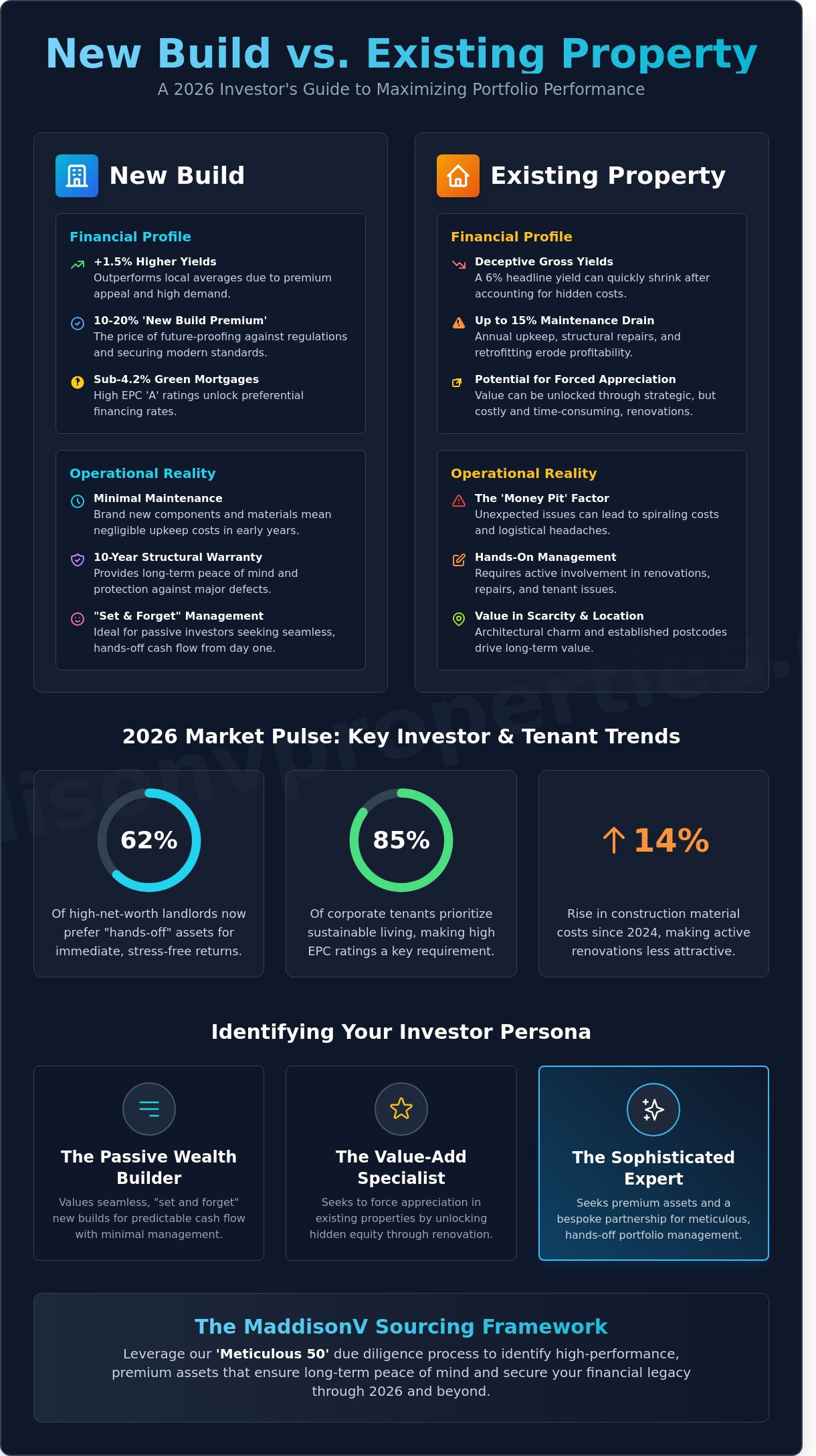
Investor sentiment has shifted significantly as we move through 2026. The 14% rise in construction material costs since early 2024 has made active renovations less attractive for those seeking a stress-free experience. Data from late 2025 suggests that 62% of high-net-worth landlords now prefer “hands-off” assets that provide immediate returns without the logistical burden of a building site. This move toward efficiency reflects a desire for stability, reliability, and peace of mind in an evolving market.
The Core Philosophical Difference
New builds function as sophisticated financial products. They’re designed for predictable cash flow and tax efficiency, often delivering yields 1.5% higher than local averages due to their premium appeal. Existing properties remain heritage assets. Their value lies in scarcity and the architectural charm that modern builds cannot replicate. In 2026, market volatility makes the choice between new build vs existing property a balance of risk management versus capital growth potential.
Identifying Your Investor Persona
- The Passive Wealth Builder: These investors thrive on the “set and forget” nature of new builds, valuing a seamless transition into the rental market and minimal maintenance.
- The Value-Add Specialist: These individuals seek forced appreciation, looking for existing properties that require a meticulous touch to unlock hidden equity through renovation.
- The Sophisticated Expert: MaddisonV caters to the expert seeking premium assets and a bespoke partnership. We provide the professional distance and meticulous management required to turn high-quality property into a hassle-free investment.
Financial Performance: Comparing Yields, Capital Growth, and Tax Efficiency
Success in property investment requires a meticulous look beyond the surface level gross yield. While an existing property might boast a 6% headline figure, the net reality often tells a different story. Older assets frequently carry hidden costs, with structural maintenance and retrofitting often consuming 1.5% of the property’s value annually. In contrast, the financial profile of a new build vs existing property reveals that modern developments offer a seamless, predictable cash flow. In 2026, high EPC ratings directly unlock preferential green mortgage rates below 4.2% and satisfy the 85% of corporate tenants who prioritize sustainable living.
The “New Build Premium” is frequently misunderstood as a barrier to growth. Data from the 2025 Housing Market Index shows that while new builds carry an initial 10% to 15% price cushion, their capital growth trajectories often outpace older stock in the five to ten year bracket. This is driven by the diminishing pool of energy-efficient housing and the rising costs of bringing period homes up to modern legislative standards. Investors who prioritize a new build vs existing property often find that the “premium” is simply the price of future-proofing their portfolio against tightening environmental regulations. Understanding the full off-plan property pros and cons is essential before committing capital to any pre-completion development.
Rental Income and Tenant Profiles
High-net-worth individuals and corporate tenants in hubs like London and Dubai are shifting their focus toward amenity-rich environments. These professionals prioritize bespoke living experiences that include 24-hour concierges, private gyms, and integrated co-working spaces. Properties offering these premium facilities see tenant retention rates 22% higher than traditional character homes. This stability provides investors with a truly hands-off experience, especially when paired with a premium management partner who understands the nuances of luxury service. While character properties attract a specific niche, the lifestyle appeal of new builds ensures a consistent, high-quality tenant pool that treats the property with respect.
Taxation and Incentives
Tax efficiency remains a cornerstone of the strategic comparison. In the UK, capital allowances on new build fixtures can significantly offset rental profits, while the 3% or 4% SDLT surcharge on second homes demands a precise entry strategy. The math changes significantly in Dubai, where the 0% tax environment on rental income and capital gains creates a compelling case for off-plan property investment in the region. Securing the right financing for off-plan property is a critical step in ensuring your capital is structured to take full advantage of these tax efficiencies from the outset.
- Service Charges: In new developments, these typically range from £2,000 to £5,000 annually but cover all external upkeep and amenity maintenance.
- Sinking Funds: Existing properties require a dedicated fund of at least 1.2% of the property value to cover unexpected roof repairs or boiler failures.
- Warranties: New builds benefit from a 10-year NHBC or equivalent warranty, protecting the investor from major capital expenditure during the initial investment cycle.
Meticulous planning around these figures ensures that the transition from acquisition to income is as smooth as possible. By choosing assets that align with the high standards of modern renters, you secure a position of reliability and prestige in an increasingly competitive market.
Operational Realities: Maintenance, Management, and the ‘Money Pit’ Factor
Choosing between a new build vs existing property is often a choice between predictable yields and structural surprises. New developments offer a 10-year NHBC Buildmark warranty, which provides a definitive safety net against major structural defects. This allows investors to forecast their cash flow with high precision during the critical first decade of ownership. While a new build requires a meticulous snagging list to rectify cosmetic imperfections before completion, an existing property demands a RICS Level 3 structural survey. Without this, the “period charm” of a Victorian terrace can quickly evaporate when faced with £20,000 bills for damp proofing, outdated wiring, or slate roof replacements.
The Efficiency of Modern Management
Luxury new developments are designed for operational ease. Facilities management in these blocks is typically seamless, handling everything from communal garden landscaping to 24/7 concierge services with industrial efficiency. In contrast, managing a Grade II listed London property involves significant complexity. Repairs often require heritage-approved materials and bespoke craftsmanship, which can increase maintenance costs by 45% compared to modern equivalents. MaddisonV’s management services alleviate the anxieties of landlords by providing a professional, hands-off partnership. We handle the intricate details of tenant relations and property upkeep, ensuring your investment remains a prestigious, high-performing asset.
Sustainability and Future-Proofing
By 2026, the legislative pressure on energy performance will reach a tipping point. Properties that fail to meet an EPC rating of C or higher face a distinct compliance risk, with potential fines for landlords reaching £30,000 under evolving Minimum Energy Efficiency Standards. New builds are constructed to meet these targets from day one, often achieving A or B ratings through superior insulation and air-source heat pumps. They integrate smart home technology like intelligent climate control and EV charging points as standard features. These aren’t just luxuries; they’re essential requirements for the corporate tenants of 2026. Sustainable materials and energy-efficient designs now command a 7% premium in long-term valuation, making the new build vs existing property debate increasingly focused on environmental resilience.
Location Strategy: Prime London vs. Global Growth Hubs
Choosing the right geography is the ultimate pivot point when weighing a new build vs existing property investment. While the historical streets of London offer a sense of permanence, the rising skylines of global hubs like Dubai present a different kind of allure. Investors in 2026 are increasingly diversifying across these two distinct landscapes to balance steady capital preservation with aggressive rental yields.
Investing in the London Market
The prestige of a London postcode remains a cornerstone of any sophisticated portfolio. In areas like Chelsea and Marylebone, existing properties retain an enduring value that transcends market cycles. Data from late 2024 showed that prime central London prices remained resilient, supported by a 4.2% increase in international buyer demand. These heritage assets provide a “scarcity premium” that is impossible to manufacture. It’s a market built on history, where the limited supply of Victorian and Georgian architecture ensures long term stability.
The shift toward “emerging prime” zones offers a compelling alternative for those seeking modern infrastructure. The Nine Elms and Battersea regeneration projects have seen significant activity since the Northern Line extension launched in September 2021. New builds in these districts provide the bespoke finishes and premium amenities that modern corporate tenants crave. Sourcing these opportunities requires a meticulous approach. You must look beyond the marketing brochures to identify developments with genuine long term infrastructure support and proven delivery records.
The Dubai Opportunity
Dubai’s off-plan market is preparing for a significant 2026 luxury boom, driven by a projected 5% growth in the high-end residential sector. Downtown Dubai and Dubai Marina continue to lead the way, offering yields that often double those found in European capitals. The role of global developers, such as Emaar or Select Group, is vital here. Their commitment to delivery and build quality ensures a seamless transition from purchase to tenancy, providing investors with much needed peace of mind. For a curated selection of the most promising projects, our roundup of luxury off-plan apartments in Dubai provides an in-depth analysis of investment-grade opportunities vetted for 2026 completion.
For international buyers, the process is increasingly streamlined and professional. Specialized mortgage consultations now allow non-residents to access up to 50% LTV (Loan to Value) ratios, making the entry point more accessible than in previous decades. While the location scarcity of Zone 1 London provides a defensive shield for capital, the visionary growth of Dubai offers an aggressive path to high-yield expansion. This dual-market strategy ensures your portfolio is both protected and productive, leveraging the best of both worlds in a new build vs existing property comparison.
Experience the benefits of a premium, hands-off investment journey by exploring our bespoke property management solutions today.
MaddisonV’s Sourcing Framework: Identifying High-Performance Assets
Success in property investment requires more than a keen eye; it demands a rigorous, data-led methodology. At MaddisonV, we look far beyond the glossy renders of a developer’s brochure. Our team conducts exhaustive due diligence on every partner, scrutinizing their last 10 years of delivery history and current liquidity ratios. We don’t just accept a premium label. We verify it. This involves visiting previous sites to inspect the aging of materials and interviewing residents about their long-term satisfaction.
Our proprietary property evaluation method, the ‘Meticulous 50’ checklist, serves as the backbone of our selection process. This 50-point audit evaluates structural integrity, local infrastructure pipelines, and projected yields against 2026 market forecasts. It ensures that every asset we recommend aligns with our standards of excellence and reliability. We analyze everything from the thermal efficiency of the glazing to the proximity of transport links. It’s a comprehensive filter that removes 95% of available stock, leaving only the most resilient opportunities. Investors seeking a deeper understanding of how to vet developers and time their acquisitions will find our sophisticated investor’s guide to off-plan property investment an invaluable resource for navigating these decisions with confidence.
Our Bespoke Sourcing Process
We specialize in finding value where others see obstacles. For existing properties, this means tapping into our network to secure off-market gems that never reach public portals. When we shift focus to off-plan luxury apartments, we leverage our reputation to negotiate significant incentives. These often include 5% stamp duty contributions or bespoke furniture packages that elevate the guest experience from day one. We handle the complexities of mortgage advisory and legal coordination, ensuring your journey is entirely seamless. Our expert guidance on financing for off-plan property ensures that your capital is structured correctly from the moment you commit to a development, protecting your position through every stage of the construction cycle.
Portfolio Management for the Long Term
A resilient portfolio often requires a strategic blend of both asset types. The new build vs existing property debate isn’t about choosing one over the other; it’s about finding the right ratio for your specific goals. We provide regular portfolio reviews every 6 months to assess performance and identify opportunities for capital recycling. This active management style ensures your capital is always working at its highest capacity. If an asset no longer meets our 7% yield threshold, we implement a clear exit strategy to pivot into higher-performing markets.
Your journey toward a sophisticated, hands-off portfolio starts with a single conversation. We’ll map out your 2026 targets and identify the assets that will get you there. Book your bespoke property investment consultation with MaddisonV today to secure your future in the UK market.
Mastering Your 2026 Investment Strategy
The choice between a new build vs existing property hinges on more than just aesthetics. It’s a calculated move based on projected 15% energy-efficiency premiums and the shifting tax landscape of 2026. While Victorian terraces in Chelsea provide historical resilience, the off-plan sector in Dubai’s 2040 Urban Masterplan offers a modern path to double-digit yields. Success in the coming years demands a meticulous focus on operational costs, ensuring your assets remain high-performing vehicles rather than demanding liabilities. You deserve a portfolio that works as hard as you do, combining capital growth with the peace of mind that comes from professional oversight.
MaddisonV Properties serves as your sophisticated partner in this journey. We offer deep expertise in the Marylebone, Chelsea, and Dubai luxury markets, granting you access to exclusive off-market opportunities that aren’t available to the general public. Our team provides a seamless, hands-off experience through comprehensive management and expert mortgage advisory. We manage the intricate details of sourcing and maintenance, allowing you to focus on the rewards of your success.
Secure your high-yield investment with MaddisonV’s bespoke sourcing service
Your future in high-performance property is waiting, and we’re ready to help you claim it.
Frequently Asked Questions
Is it better to buy a new build or an existing property for rental yield?
Existing properties typically generate higher gross yields of 6% to 8%, yet new builds often provide more stable net returns due to reduced repair costs. When comparing new build vs existing property, investors must weigh the immediate cash flow of older stock against the 10 year structural warranties of a fresh development. Our clients prefer the seamless, hands-off experience that modern, energy-efficient apartments provide in high-demand urban hubs.
Do new build properties depreciate in value like a new car?
New build properties don’t depreciate like vehicles; instead, they often carry a 10% to 15% price premium that stabilizes within 24 months. While a car loses value the moment it leaves the lot, real estate is an appreciating asset class. Meticulous research shows that premium developments in regenerating areas often outpace general market growth by 3% annually, ensuring your capital remains secure and your portfolio stays prestigious.
What are the specific risks of investing in off-plan property in Dubai?
The primary risks of off-plan investment in Dubai include project delays and fluctuating market liquidity, with 15% of developments historically experiencing completion shifts. Investors should focus on Tier 1 developers who provide 100% bank guarantees and utilize RERA-regulated escrow accounts. This approach ensures a bespoke, secure entry into the Middle Eastern market, protecting your capital from the volatility sometimes seen in smaller, less established construction firms.
How do EPC ratings affect property investments in the UK in 2026?
By 2026, UK landlords must prepare for a minimum EPC rating of C for all new tenancies to avoid potential fines of up to £30,000. New build properties already meet these meticulous standards, offering a seamless transition into a greener economy. Older properties often require £10,000 in retrofitting costs to reach compliance, making modern developments a more reliable, hassle-free choice for those seeking long-term stability and premium guest experiences.
Can I get a mortgage for a new build property as an international investor?
International investors can secure mortgages for new builds with typical loan-to-value ratios ranging from 60% to 75% through specialist UK lenders. These bespoke financial products often require a minimum property value of £150,000 and proof of international income. We provide a meticulous, end-to-end service that connects global clients with expert brokers, ensuring the financing process is as sophisticated and stress-free as the investment itself.
What is a ‘snagging list’ and why is it essential for new builds?
A snagging list is a comprehensive report identifying cosmetic and structural defects that the developer must rectify before you take final possession. It’s an essential tool for ensuring your investment meets a premium standard, as professional inspectors often find 100 minor faults in a typical apartment. This meticulous process guarantees peace of mind, ensuring your property is delivered in a flawless, ready-to-let condition for your future guests.
Are service charges higher for new build apartments compared to older blocks?
Service charges in new build developments are often 25% higher than older blocks because they include luxury amenities like 24-hour security and communal lounges. While an older conversion might charge £2.00 per square foot, a premium new build can reach £4.50 per square foot. These costs support the high-end lifestyle that corporate tenants demand, ultimately protecting the long-term value and prestige of your bespoke property investment.
Why should I use a property sourcing agent instead of a traditional estate agent?
Sourcing agents work exclusively for the buyer to secure off-market opportunities, whereas estate agents represent the seller’s interests to achieve the highest price. Using a sourcing agent can save investors 15% on the purchase price through expert negotiation and deep industry connections. This partnership offers a refined, hands-off approach to portfolio growth, delivering a level of personal service and reliability that traditional high-street agents simply can’t match.

Sign Up Now
Want to read more great articles and blogs subscribe to our newsletter