
While London’s prime central districts offer reliable stability, Dubai’s 2026 market is delivering gross rental yields as high as 7.5%, nearly...

While London’s prime central districts offer reliable stability, Dubai’s 2026 market is delivering gross rental yields as high as 7.5%, nearly doubling the returns found in traditional safe havens like Mayfair or Singapore. You’ve likely noticed that the allure of a tax-free environment is often clouded by the complexity of entry, especially when navigating the total cost of buying property in dubai for foreigner investors. It’s natural to feel concerned about opaque fee structures or the recent 2026 regulatory shifts within the Dubai Land Department; these variables require a meticulous approach to ensure capital security and peace of mind.
This intelligence report provides a definitive breakdown of the total capital outlay required, ensuring your transition into this high-growth market is both seamless and transparent. We’ll examine the mandatory 4% DLD transfer fee, the updated AED 2 million Golden Visa thresholds, and the subtle transactional costs that dictate your true net yield. By moving logically through the acquisition lifecycle, you’ll gain the strategic insight necessary to secure your financial legacy in the Middle East’s most prestigious investment hub.
Key Takeaways
- Discover why Dubai remains a premier safe haven in 2026, offering a unique 0% income and capital gains tax environment for global investors.
- Gain a precise breakdown of the total cost of buying property in dubai for foreigner acquisitions, including the 4% Dubai Land Department (DLD) transfer fee and trustee registration levies.
- Compare the financial nuances of off-plan versus secondary purchases, specifically regarding ‘Oqood’ registration and the capital benefits of post-handover payment plans.
- Master the long-term holding costs by calculating RERA-approved service charges and sinking funds to safeguard your net rental yields.
- Learn how bespoke property sourcing and London-standard due diligence can reveal off-market opportunities that bypass traditional price premiums.
The Strategic Financial Framework of Dubai Real Estate in 2026
In 2026, global capital is undergoing a profound migration. As shifting tax regimes and fiscal uncertainty tighten their grip on Western markets, Dubai has solidified its status as the ultimate safe haven for international wealth. This migration is driven by a sophisticated legal framework that guarantees a 0% tax environment on both personal income and capital gains. For the ultra-high-net-worth investor, this isn’t merely about luxury; it’s a strategic play for wealth preservation and aggressive net growth. A comprehensive Dubai real estate market overview reveals that the emirate’s maturation has moved beyond speculative volatility into a phase of institutional-grade security.
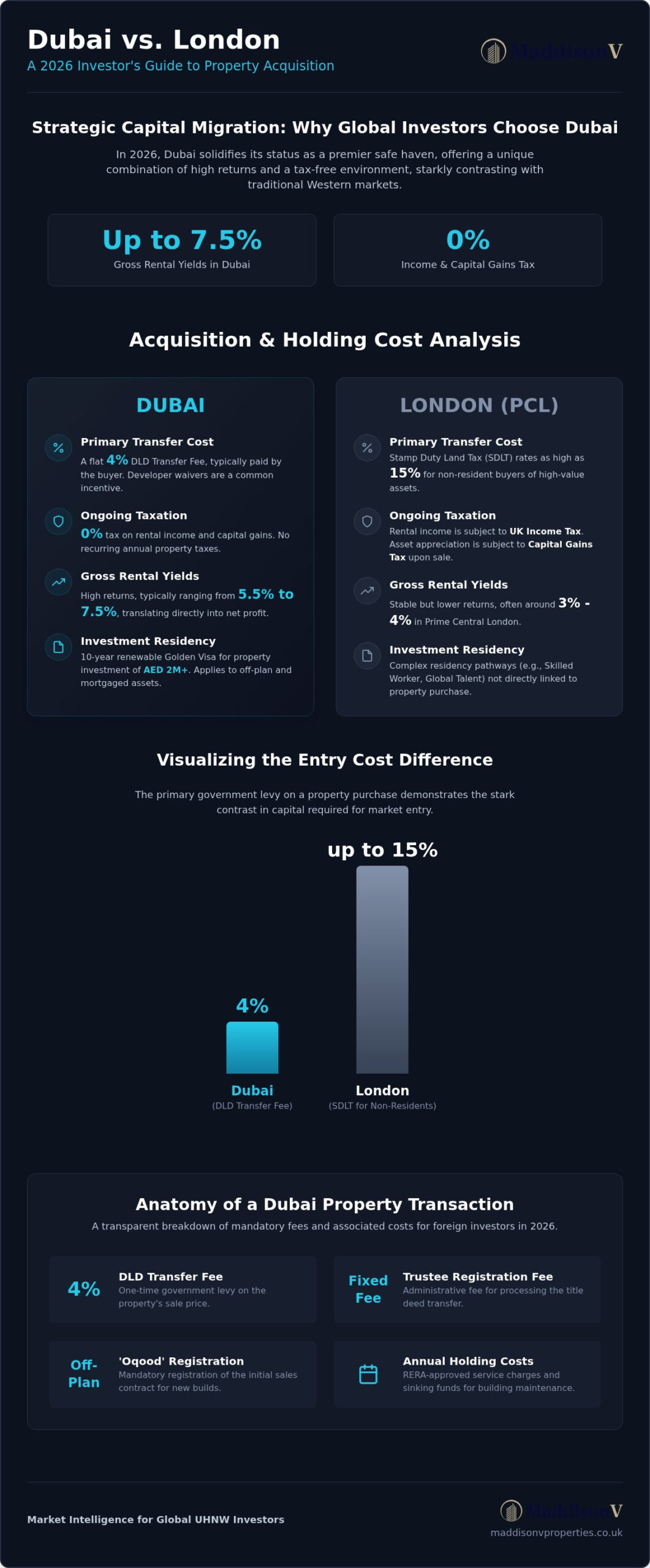
When evaluating the cost of buying property in dubai for foreigner investors, the fiscal immunity the emirate provides is the most compelling value proposition. Unlike traditional hubs, there are no recurring annual property taxes, ensuring that your gross rental yields, often ranging between 5.5% and 7.5%, translate directly into high net returns. The 2026 Golden Visa update further enhances this appeal. Investors can now secure a 10-year renewable residency with a minimum property value of AED 2,000,000, even for off-plan or mortgaged assets, without the previous requirement of a 50% upfront payment. This regulatory shift makes the cost of buying property in dubai for foreigner buyers a gateway to long-term regional stability.
To better understand the financial nuances of this market, watch this helpful video:
Macro Drivers: The 2026 Market Maturity
The Dubai 2040 Urban Master Plan continues to dictate asset pricing, focusing on sustainable density and world-class infrastructure. This roadmap has transitioned the market from a cycle of speculative flipping to one dominated by institutional-grade rental demand, providing investors with predictable cash flows. The 2026 market is defined as a period of regulated stability compared to previous cycles. This maturity ensures that while prices continue to appreciate, the growth is underpinned by genuine utility and a growing population of high-earning expatriates.
Dubai vs. London: A Comparative Acquisition Cost
The contrast between Dubai and London’s Prime Central London (PCL) market is starkest at the point of entry. While a non-resident buyer in the UK may face Stamp Duty Land Tax (SDLT) rates as high as 15% for high-value assets, Dubai maintains a flat 4% Dubai Land Department (DLD) transfer fee. Additionally, the AED-USD peg offers a layer of currency protection that is increasingly rare, allowing investors to hedge against the volatility often found in the Sterling or Euro. For those looking to diversify, our Invest in Dubai Property: The Definitive Investor’s Guide for 2026 provides the comparative data needed to make an informed transition between these two global hubs.
Primary Transactional Costs: Navigating Government Fees and Levies
The transactional journey in Dubai is remarkably efficient, but it requires a precise understanding of government levies to avoid capital friction. For most international investors, the primary cost of buying property in dubai for foreigner participants is the Dubai Land Department (DLD) transfer fee. While the legal framework technically allows for a split between buyer and seller, market convention in 2026 dictates that the purchaser typically assumes the full 4% obligation. This payment is settled at the point of transfer, ensuring the immediate issuance of the title deed in the investor’s name. It’s a one-time levy that replaces the recurring annual property taxes common in London or New York, providing a cleaner path to long-term profitability.
The DLD Transfer Fee: 2026 Regulations
In the current market, developers often leverage ‘DLD Waivers’ as a high-tier incentive for luxury off-plan assets, essentially absorbing the 4% fee to lower the initial entry barrier for global capital. Beyond the headline percentage, you must account for specific administrative costs that facilitate the registration process. In 2026, the DLD administrative fee stands at approximately AED 580, while property registration fees are tiered based on the asset’s value. For properties exceeding AED 500,000, the registration fee is AED 4,000 plus 5% VAT; for those below this threshold, it’s AED 2,000 plus VAT. These figures are non-negotiable and must be cleared before the Trustee office can finalise the title deed issuance.
Professional and Legal Representation
Securing a prime asset involves more than government fees. Real estate agency commissions are standardised at 2% of the purchase price, subject to 5% VAT. In the secondary market, a No Objection Certificate (NOC) from the developer is mandatory to confirm all service charges are settled; these typically range from AED 500 to AED 5,000 depending on the master developer’s internal policies. While the process is streamlined, UHNWIs often require bespoke legal due diligence that transcends standard agency services. A dedicated sales progression officer or conveyancer, typically costing between AED 6,000 and AED 15,000, provides the oversight necessary for complex international transfers. Our team at MaddisonV Properties specialises in this level of bespoke property sourcing, ensuring every transactional nuance is handled with clinical precision. This meticulous approach protects your capital and ensures a fluid transition from research to ownership, allowing you to enjoy the rewards of your investment without the burden of operational oversight.
Off-Plan vs. Secondary Market: Comparing Entry Costs for Foreigners
The decision between acquiring a pre-construction asset or a completed residence involves more than just a timeline; it dictates your entire liquidity strategy. When calculating the total cost of buying property in dubai for foreigner portfolios, the entry mechanics of off-plan developments often prove more capital-efficient for those looking to scale. Conversely, the secondary market provides the certainty of an existing structure and immediate cash flow, albeit with a steeper upfront requirement and less flexible payment structures.
Investing in the Off-Plan Luxury Corridor
For investors targeting high-growth areas like Business Bay and Downtown Dubai, the off-plan route offers a unique financial advantage through ‘Oqood’ registration. This is essentially the pre-title deed registration with the DLD, which costs 4% of the purchase price. The true benefit lies in the payment plan structures. Many 2026 developments offer post-handover payment plans, allowing you to settle a significant portion of the asset value over three to five years after the building is completed. This structure reduces your initial capital outlay and significantly enhances your return on equity. Identifying the ‘Golden Hour’ during the initial launch phase ensures you secure the lowest possible price per square foot before construction milestones trigger price hikes. For a deeper analysis of these strategies, consult The Sophisticated Investor’s Guide to Off-Plan Property Investment in 2026.
Secondary Market: Immediate Yield vs. Higher Entry Costs
The secondary market requires a more robust upfront commitment. Beyond the purchase price, you must budget for the 2% agency commission and the 4% DLD fee as immediate cash payments. If your acquisition involves international financing, banks require a professional property valuation. In 2026, these valuation fees typically range from AED 2,500 to AED 3,500 plus VAT. Mature districts like Dubai Marina offer established lifestyle amenities, but older assets may require refurbishment to maintain competitive rental yields. Sophisticated buyers factor in these renovation costs alongside the standard ‘Transfer of Ownership’ fees to determine the true net entry price. While the secondary market lacks the flexible payment plans of off-plan projects, it eliminates construction risk and allows for immediate tenant placement. This immediate utility is a vital component when assessing the cost of buying property in dubai for foreigner investors who prioritising instant cash flow over long-term capital appreciation.
Beyond the Purchase Price: Financing and Holding Costs
Securing a prime asset is only the first chapter of a long-term wealth strategy. While the initial cost of buying property in dubai for foreigner investors is often lower than in other global hubs, the true measure of success lies in the meticulous calculation of ongoing holding costs. These recurring expenses dictate your net rental yield and ensure your property remains an institutional-grade asset. In 2026, sophisticated investors prioritising passive involvement must account for finance levies, service charges, and utility structures to protect their capital growth.
Financing the Acquisition: Non-Resident Mortgages
Leveraging debt in Dubai is a common path for international buyers looking to preserve liquidity. In 2026, non-resident investors typically find Loan-to-Value (LTV) ratios between 60% and 75%, depending on the asset type and the buyer’s tax residency. Beyond the interest rate, you must budget for a mortgage registration fee of 0.25% of the loan amount paid to the DLD. Banks also charge an arrangement fee, usually 1% of the loan value plus VAT. For a deeper analysis of current rates and eligibility, explore The Sophisticated Investor’s Buy-to-Let Mortgage Guide (2026 Edition). Remember that life insurance is almost universally mandatory for UAE mortgages, adding a small but necessary monthly premium to your holding costs.
Holding Costs and Professional Management
Service charges are the pulse of your investment’s net performance. These are calculated per square foot and cover the maintenance of common areas, security, and lifestyle amenities. In 2026, rates vary significantly between districts; Downtown Dubai and Emaar Beachfront command higher premiums for their elite concierge services compared to mid-market hubs like JVC. A portion of these fees is allocated to a ‘Sinking Fund,’ a critical reserve for long-term structural repairs that preserves the building’s aesthetic and functional standards. The RERA Service Charge Index provides a transparent, regulated framework for calculating these costs, ensuring owners aren’t subject to arbitrary spikes in maintenance levies.
Utility structures also play a pivotal role in yield protection. Choosing a ‘Chiller-Free’ building, where the landlord is exempt from air conditioning consumption charges, can increase your net income by as much as 10%. Conversely, properties using district cooling require a fixed capacity charge regardless of occupancy. To ensure your asset remains a hands-off, high-performing vehicle, factoring in a 5% to 10% management fee for professional oversight is essential. Our team provides the effortless oversight required for global landlords through our portfolio management services, handling everything from tenant relations to RERA compliance with clinical precision. This approach transforms a complex international asset into a source of mental tranquility and financial security.
The MaddisonV Edge: Optimising Your Dubai Acquisition
Successfully navigating the cost of buying property in dubai for foreigner investors requires more than a standard checklist; it demands a partner who operates with clinical precision and a deep understanding of market sentiment. At MaddisonV Properties, we bridge the gap between the London and Dubai markets, bringing a level of bespoke due diligence that is often absent in high-velocity environments. Our approach is built on transparency, integrity, and a success-based model that ensures our interests are perfectly aligned with your long-term portfolio growth. We believe that a sophisticated investment should be a source of mental tranquility, not operational anxiety.
Bespoke Property Sourcing and Advisory
The most lucrative opportunities in 2026 rarely reach the public portals. We specialise in identifying off-market properties that allow our clients to bypass competitive price premiums and secure assets with superior capital growth potential. Our team is adept at negotiating developer incentives, often securing full DLD waivers or extended post-handover payment plans that fundamentally alter the entry economics of an acquisition. By applying rigorous market intelligence, we guide you away from oversupplied districts and toward high-yield corridors that promise enduring value. For those accustomed to the standards of the UK market, our Property Sourcing Agents London: The Investor’s Guide to Prime Acquisitions in 2026 illustrates the meticulous methodology we bring to every international search.
Passive Portfolio Management for Global Investors
True wealth is preserved through effortless oversight and the mitigation of holding cost anxieties. Once an acquisition is finalised, our role transitions into one of stewardship, where we manage the operational complexities so you don’t have to. We provide regular, data-driven reporting on service charge optimisation and rental growth forecasts, ensuring your net yields are protected against market shifts. This passive nature of our partnership allows you to enjoy the rewards of a high-performing asset while we handle the intricate details of RERA compliance and tenant relations. Our The Sophisticated Investor’s Guide to Property Management in 2026 provides a comprehensive look at how we maintain the visual and functional standards of your portfolio.
Beyond the property itself, we streamline the lifestyle transitions for UHNW families, facilitating residency applications and the opening of UAE bank accounts with professional speed and discretion. This all-encompassing solution ensures that the cost of buying property in dubai for foreigner investors is a calculated step toward a secure, high-prestige future. We handle the complex operational details so you can focus on the rewards of your global legacy.
Securing Your Legacy in the 2026 Dubai Real Estate Market
The migration of global capital toward Dubai’s tax-neutral environment represents a fundamental shift in how sophisticated investors preserve their wealth. By mastering the cost of buying property in dubai for foreigner portfolios, you transition from a passive observer to a strategic market participant. You now understand that while government fees like the 4% DLD transfer are mandatory, the true value lies in navigating developer incentives and protecting your net yields through RERA-regulated service charges. It’s a level of clarity that allows you to move forward with the quiet confidence that your investment is both secure and aspirational.
MaddisonV Properties serves as your expert bridge in the London-Dubai investment corridor, offering bespoke sourcing of exclusive off-plan luxury developments. We provide comprehensive portfolio management for UHNW international clients, handling the complex details so you don’t have to. Our success-based model aligns our interests with your long-term growth, promising an effortless, transparent, and secure oversight experience that prioritises your mental tranquillity.
Secure your high-yield Dubai investment with MaddisonV today.
The 2026 market offers a rare intersection of institutional stability and aggressive growth. We look forward to guiding you through a seamless and rewarding ownership journey.
Frequently Asked Questions
What is the total percentage of fees when buying property in Dubai for foreigners?
Foreign buyers should budget for additional costs of approximately 5% to 9% of the property’s purchase price to cover all transactional fees and taxes. This comprehensive figure includes the mandatory 4% Dubai Land Department transfer fee, real estate agency commissions, and various administrative registration levies. While the initial capital outlay is higher than the sticker price, the absence of recurring property taxes makes the cost of buying property in dubai for foreigner investors highly competitive on a long-term net basis.
Do foreigners pay more tax or higher fees than UAE nationals when buying property?
There’s no disparity in government transaction fees between international investors and UAE nationals. Both parties are subject to the same 4% Dubai Land Department (DLD) transfer fee and standard registration costs. The primary distinction lies in geographic eligibility; international investors are permitted to purchase property specifically in designated freehold areas. These districts include prime locations like Palm Jumeirah and Downtown Dubai, ensuring global capital has access to the emirate’s most prestigious and high-yield residential environments.
How much is the DLD fee in 2026, and can it be waived?
In 2026, the DLD transfer fee remains fixed at 4% of the property’s purchase price. While this is a mandatory government levy, many developers in the luxury off-plan sector offer DLD waivers as a strategic incentive to attract global investors. These waivers can cover 50% or even 100% of the fee, effectively reducing your initial acquisition cost. It’s essential to verify these incentives during the negotiation phase with a specialist advisor to optimise your entry capital.
What are the hidden costs of owning a rental property in Dubai?
Beyond the acquisition, investors must account for RERA-approved service charges, which cover building maintenance and communal amenities. These fees vary by district and are calculated per square foot. Additionally, a sinking fund is often required for long-term structural upkeep. Professional property management fees, typically ranging from 5% to 10% of the annual rent, are also vital for those seeking a truly passive income stream while ensuring their asset maintains its high-end aesthetic standards and functional integrity.
Can a foreigner get a mortgage in Dubai, and what are the associated costs?
International investors can readily access mortgage products in Dubai, typically with Loan-to-Value ratios up to 75%. Associated costs include a bank arrangement fee of 1% and a mortgage registration fee of 0.25% paid to the DLD. You should also budget between AED 2,500 and AED 3,500 for a professional property valuation. These financing costs are a necessary consideration when calculating the total cost of buying property in dubai for foreigner portfolios using leveraged capital to preserve liquidity.
Is there a capital gains tax for foreigners selling property in Dubai?
Dubai doesn’t impose capital gains tax on residential property sales for foreigners or residents. This fiscal immunity is a cornerstone of the emirate’s appeal as a global safe haven for wealth. Whether you hold the asset for two years or ten, the appreciation in value remains entirely yours. This absence of exit taxes, combined with 0% income tax on rental returns, provides a level of financial security and net profitability that traditional Western markets simply can’t match.
How do service charges affect the net rental yield of a Dubai investment?
Service charges directly impact your net rental yield by acting as an annual operating expense. While Dubai offers high gross yields between 5.5% and 7.5%, the net return is determined after deducting these maintenance levies. Choosing buildings with chiller-free status or efficient facilities management can significantly protect your margins. We recommend using the RERA Service Charge Index to accurately forecast these costs, ensuring your investment remains a high-performing vehicle for long-term wealth preservation and financial growth.
What is the minimum investment for a Dubai Golden Visa in 2026?
In 2026, the minimum investment threshold for a 10-year renewable Golden Visa is AED 2,000,000. A significant regulatory shift now allows eligibility based on the total property value, removing the previous requirement to have paid a minimum of 50% upfront for mortgaged or off-plan assets. This change simplifies the pathway to residency for international families, allowing them to secure a long-term foothold in the UAE while maintaining liquidity for other strategic investments and lifestyle pursuits.

Sign Up Now
Want to read more great articles and blogs subscribe to our newsletter