
Why do the most discerning investors often bypass the highest headline yields in favour of a more nuanced, strategic metric? While the national...

Why do the most discerning investors often bypass the highest headline yields in favour of a more nuanced, strategic metric? While the national average gross yield has reached a compelling 7.21% in early 2026, the true art of building a prime London portfolio lies in mastering the delicate balance of rental yield vs capital growth uk. You likely recognize the tension between securing immediate cash flow and pursuing the significant appreciation that defines the city’s most prestigious postcodes. It is a choice that requires both clinical precision and an eye for lifestyle excellence.
This article provides a professional framework to help you navigate these complexities with quiet confidence and absolute clarity. We’ll explore the 2026 high-growth zones within Battersea and Nine Elms, define a sophisticated methodology for calculating Total Return, and examine how bespoke property management preserves your asset’s value. By the end of this guide, you’ll have the insight needed to choose a strategy that aligns with your liquidity needs while ensuring your investments remain resilient, profitable, and prestigious.
Key Takeaways
- Master the sophisticated balance of rental yield vs capital growth uk to ensure your portfolio provides both immediate liquidity and enduring wealth preservation.
- Learn to look beyond gross marketing figures by applying a professional Total Return framework that accounts for the reality of net yields and hidden costs.
- Identify the high-growth London zones, including Nine Elms and Canary Wharf, where regeneration and infrastructure continue to drive superior asset appreciation in 2026.
- Discover how expert property sourcing uncovers off-market opportunities, allowing you to secure luxury assets that outperform standard market expectations.
- Understand the vital role of asset maintenance and professional management in safeguarding your property’s long-term value and premium aesthetic standards.
The Investor’s Dilemma: Defining Rental Yield and Capital Growth
Every sophisticated property investment begins with a fundamental choice. Do you prioritise the immediate pulse of monthly income or the long-term horizon of asset appreciation? This decision defines the core of rental yield vs capital growth uk. Rental yield is the annual return on your investment generated from tenant payments, expressed as a percentage of the property’s total value. Conversely, capital growth represents the increase in the asset’s market value over time. It’s the difference between the price you paid and the price the market commands today.
In the current 2026 landscape, balancing these two forces is no longer a luxury; it’s a necessity. With the Bank of England interest rate at 3.75% and new Making Tax Digital requirements for landlords with income over £50,000, your strategy must be more precise than ever. The UK market typically presents an inverse relationship known as the yield-growth trade-off. Properties in regional hubs might offer high monthly returns, but they often lack the explosive value increase found in prime London postcodes. To combat inflation and evolving tax structures, you must look at both metrics to ensure your portfolio remains resilient.
To better understand how these strategies interact when managing a property with existing tenants, watch this helpful video:
Rental Yield: The Foundation of Cash Flow
Rental yield represents the operational pulse of a real estate asset. For many, high-yield properties are essential for comfortably servicing a buy-to-let mortgage guide and covering the 4.71% average interest rates seen in early 2026. This consistent cash flow provides a vital layer of psychological security, especially for international buyers seeking a reliable hedge against currency fluctuations. It ensures the property remains self-sustaining, allowing you to enjoy the rewards of ownership without the stress of constant capital injections. When your yield is healthy, your investment breathes on its own.
Capital Growth: The Engine of Generational Wealth
While yield provides the stability you need today, capital growth is what truly scales your wealth for tomorrow. In supply-constrained markets like London, asset appreciation historically outpaces inflation, preserving your purchasing power across decades. A professional Real estate appraisal often reveals how infrastructure projects, such as the Northern Line Extension into Battersea, act as catalysts for value. For high-net-worth individuals, this growth is frequently more tax-efficient than rental income. Capital gains are only realised upon the sale of the asset, providing you with greater control over your fiscal liability and the timing of your returns.
Calculating Total Return: Moving Beyond Simple Arithmetic
Gross yield is a marketing figure; net yield is your reality. While a developer may quote an attractive headline percentage, the sophisticated investor understands that the true measure of success is Total Return. This comprehensive metric accounts for every pound moving in and out of your portfolio. To calculate your actual performance, use the following formula: (Net Annual Rent + Annual Capital Appreciation) / Total Investment Cost. This calculation transforms a simple income stream into a clear picture of wealth creation.
When determining your Total Investment Cost, you must look beyond the purchase price. In 2026, this figure includes Stamp Duty Land Tax (SDLT), legal fees, and professional property sourcing commissions. Omitting these entry costs artificially inflates your perceived returns. Consider the strategic difference: a property with a 3% yield and 5% annual growth often outperforms a high-yield asset with 7% income but 0% growth. The former builds equity and compounds wealth, while the latter merely provides a taxable income stream that may struggle to outpace inflation.
The Net Yield Deep Dive for Luxury Assets
Luxury new builds in London offer unparalleled prestige, but they require a meticulous approach to service charges. Your net yield must account for concierge services, gym maintenance, and high-tier service charges. In 2026, properties with top-tier EPC ratings command rental premiums, yet they also require proactive oversight to maintain those standards. Engaging professional property management is the most effective way to reduce void periods and protect your net figure, ensuring your investment remains effortless and profitable.
Gross vs. Net vs. Total Return Comparison
The following table illustrates the impact of location and strategy on your bottom line. It highlights why the rental yield vs capital growth uk debate is won by those who focus on the total horizon. Note how leverage through a mortgage amplifies capital growth returns significantly more than it does for yield, as interest costs directly erode your monthly margins.
| Metric | High-Yield Regional Asset | Prime London New Build |
|---|---|---|
| Gross Rental Yield | 7.2% | 3.8% |
| Service Charges & Voids | 1.5% | 1.0% |
| Annual Capital Growth | 1.2% | 5.5% |
| Total Annual Return | 6.9% | 8.3% |
Net Yield is the only figure that ensures your investment is self-sustaining and capable of covering its own operational costs. Refining your strategy with a bespoke portfolio review ensures your capital works as hard as you do, providing the mental tranquility that comes with a well-considered financial plan.
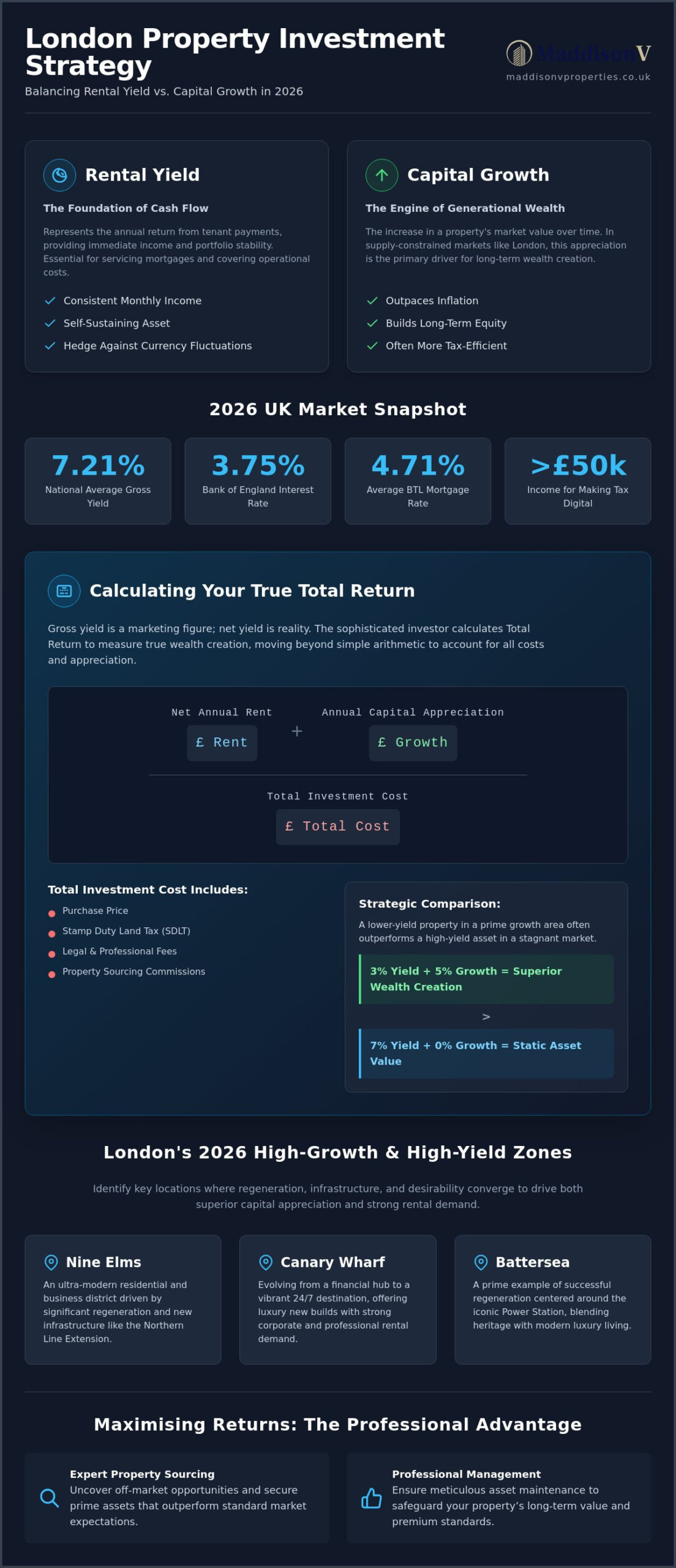
The Strategic Balance: Yield vs. Growth in the 2026 UK Market
A common objection among international investors is whether London’s yields are too low to be viable. While northern regional markets might advertise gross yields exceeding 7%, these figures often come with higher volatility and lower liquidity. In contrast, the prime London market represents a “Flight to Quality.” These assets provide a level of stability that is unmatched during periods of economic shifting. You aren’t just buying a rental stream; you’re securing a global reserve asset that preserves its core value when other markets falter. This is the sophisticated reality of rental yield vs capital growth uk.
Building a resilient portfolio in 2026 requires a “Barbell” approach. This strategy involves balancing high-yield units in corporate hubs like Canary Wharf with high-growth flagship assets in regenerating districts. With the Bank of England maintaining interest rates at 3.75%, the pressure on yield requirements has intensified. You must ensure your rental income covers the 4.71% average buy-to-let mortgage rates while still allowing for capital appreciation to drive your total return toward the forecasted 8.5% for prime property. This balance ensures your portfolio remains both liquid today and significantly more valuable tomorrow.
When to Prioritise Rental Yield
Prioritising yield is essential if you require immediate income to fund a lifestyle or supplement a pension. It’s also the primary focus for high-leverage strategies where the rent must comfortably cover mortgage repayments and the mandatory 125 to 145% rental coverage tests required by lenders. We identify specific “Yield Pockets” in London, such as Canary Wharf, where the concentration of corporate professionals maintains high demand and strong monthly returns. These areas provide the consistent cash flow needed to keep your portfolio liquid, ensuring your investment remains a passive source of financial security.
When to Prioritise Capital Growth
If your objective is long-term wealth preservation for future generations, capital growth takes precedence. This strategy often involves off-plan property investment, which allows you to capture built-in equity as the development progresses from planning to completion. By focusing on real estate in england london districts undergoing massive regeneration, such as Nine Elms and Battersea, you benefit from infrastructure-led appreciation. This growth acts as a powerful engine for wealth, often proving more tax-efficient than a high-income strategy for high-net-worth individuals who prefer to realise gains at a time of their choosing.
Location Spotlight: Where Yield Meets Growth in London
Theory provides the framework, but location dictates the execution. In the complex ecosystem of the London market, the specific tilt of your portfolio depends heavily on the postcode you select. While the national debate over rental yield vs capital growth uk often focuses on regional averages, prime London operates on its own set of rules. Here, transport connectivity and lifestyle amenities aren’t just perks; they’re the primary drivers of both tenant retention and asset appreciation. Selecting the right district requires an understanding of how regeneration cycles and infrastructure projects mature over time.
Westminster and Chelsea remain the “Blue Chip” plays for those focused on capital preservation. These areas offer a level of stability that acts as a hedge against global market shifts. While gross yields in these historic districts may sit at the lower end of the spectrum, the scarcity of available land and the enduring prestige of the addresses ensure long-term value growth. For the modern investor, success lies in identifying where these established standards meet new, high-growth opportunities in regenerating zones.
Canary Wharf: The Yield Powerhouse
Canary Wharf has successfully transitioned from a purely commercial hub into a high-yield residential destination. The district attracts a high concentration of affluent professional tenants, which significantly reduces the risk of void periods. For investors also monitoring the rise of professional-centric real estate in emerging markets, LetMeSeat provides a comprehensive directory of coworking and coliving spaces across India’s major cities. The Elizabeth Line has been a transformative force, providing rapid access to the West End and Heathrow, which cements the area’s long-term capital resilience. New-build luxury apartments here command a substantial rental premium, often outperforming older stock due to their superior amenities and energy efficiency. It’s a location that offers the liquidity of high monthly returns without sacrificing the potential for steady appreciation.
Nine Elms & Battersea: The Appreciation Play
The ongoing transformation of the Nine Elms and Battersea Power Station district represents one of Europe’s most ambitious regeneration projects. The Northern Line Extension continues to drive capital appreciation as the area matures into a fully realised lifestyle destination. Brand association with luxury developments and the presence of major global tech headquarters have created a secondary market with significant upward pressure on prices. For 2026, projected capital growth benchmarks for these districts remain among the highest in the city, making them the ideal choice for investors seeking to build substantial equity. To identify the most promising opportunities in these fast-moving districts, consider our professional property sourcing services to secure off-market luxury deals.
Maximising Your Returns: The Professional Sourcing Advantage
Navigating the 2026 London market requires more than just capital; it demands an insider’s perspective. While the broader debate over rental yield vs capital growth uk often centres on public data, the most lucrative opportunities frequently exist away from the open market. A professional sourcing agent provides the technical expertise needed to identify off-market luxury deals that defy standard averages. By accessing these exclusive acquisitions, you secure assets with built-in advantages that aren’t available to the casual buyer.
The role of due diligence is paramount when evaluating new build properties. It’s essential to verify developer-quoted yields against the ground truth of current market demand and local competition. We provide the clinical analysis required to separate marketing projections from sustainable financial reality. This meticulous approach ensures that your acquisition is grounded in fact, providing the quiet confidence that comes from knowing every detail has been scrutinised by an expert partner.
Sourcing for “Hidden” Value
True value is often found in the nuances of a development. Professional sourcing involves negotiating purchase prices that instantly improve your gross yield calculation, providing a stronger financial foundation from day one. It also means identifying specific units within a building that offer the most efficient floor plans for rental demand. Whether it’s a corner plot with superior light in Marylebone or a high-floor apartment with specific views in Canary Wharf, these details drive tenant preference. Our deep local expertise in Chelsea and Westminster allows us to uncover these subtle advantages, ensuring your property remains a highly desirable asset in any market cycle.
The Management-Yield Correlation
Securing the right property is only the first step; maintaining its performance requires ongoing, professional oversight. Proactive facilities management is the most effective way to prevent yield-eroding emergency repairs and preserve the high aesthetic standards required for long-term capital growth. When a property is managed with meticulous attention to detail, it attracts a higher calibre of tenant. We focus on sophisticated tenant profiling to ensure high retention rates and consistent income streams, which are vital in a high-interest environment.
By handling the complex operational details, we allow you to enjoy the rewards of your portfolio without the burden of daily oversight. Our commitment to service ensures your investment remains a prestigious and passive asset, protected by a partner that values integrity and long-term success. Optimise your UK portfolio strategy and secure your financial future. Contact MaddisonV Properties today to begin a bespoke consultation tailored to your specific investment needs.
Building Your Legacy in the London Market
Success in the current landscape requires a departure from simple arithmetic. By shifting your focus toward Total Return, you align your assets with the sophisticated reality of the prime London market. Whether you prioritise the immediate liquidity found in corporate hubs or the generational wealth creation offered by the Battersea and Nine Elms regeneration zones, your strategy must reflect a precise balance of rental yield vs capital growth uk. This nuanced approach ensures that your portfolio remains resilient against market shifts while providing the passive income you deserve.
MaddisonV Properties serves as your premium partner in this journey, offering a comprehensive sourcing-to-management service tailored for the discerning international client. We specialise in identifying high-growth off-plan luxury developments and maintaining them to the highest visual and functional standards. Our deep expertise in London’s most prestigious districts ensures that your investment experience is effortless, secure, and prestigious. Secure Your High-Yield London Investment with MaddisonV and take the first step toward a more refined property strategy today.
Frequently Asked Questions
What is a good rental yield for a London property in 2026?
In 2026, a gross rental yield between 3.5% and 4.5% is considered strong for prime London districts. While northern regional markets may offer higher headline figures, London’s value lies in its stability and the quality of its tenant base. Achieving a yield in this range ensures that your property remains self-sustaining while you wait for the city’s characteristic capital appreciation to drive your total return toward the forecasted 8.5%.
Does capital growth or rental yield offer better tax advantages in the UK?
Capital growth is often more tax-efficient for high-net-worth individuals because gains are only realised and taxed upon the sale of the asset. Rental income is subject to income tax, which for many investors reaches the higher or additional rates, especially with the 2026 dividend tax increases. Capital Gains Tax rates for residential property disposals remain at 18% or 24%, allowing for more strategic fiscal planning compared to monthly income streams.
How do service charges in luxury new builds affect net rental yield?
Service charges for premium developments can significantly compress your net yield if not accounted for during the sourcing phase. These fees cover essential lifestyle amenities like 24-hour concierge services, private gyms, and communal gardens, which are necessary to attract high-calibre tenants. While these costs reduce immediate cash flow, they preserve the asset’s aesthetic standard and long-term value, ensuring that the property remains a “Blue Chip” investment that commands premium rents.
Can I achieve both high yield and high capital growth in a single property?
While the two metrics usually exist in an inverse relationship, you can find a strategic balance in regeneration zones like Nine Elms or Canary Wharf. These areas currently offer the best of the rental yield vs capital growth uk debate by combining modern infrastructure with high professional demand. Identifying off-market deals through professional sourcing is often the only way to secure a property that defies the standard trade-off and delivers across both metrics.
How does the “Total Return” calculation change for off-plan properties?
For off-plan acquisitions, the Total Return calculation must account for the “built-in” equity gained between the exchange of contracts and completion. This period often sees a rise in market value before you even take possession, which effectively lowers your total investment cost relative to the final asset value. You should also factor in the lack of immediate rental income during construction, balancing this against the lower entry price typically offered by developers.
Which London districts are currently seeing the highest capital growth?
Nine Elms and Battersea continue to lead the city in capital appreciation due to the ongoing maturity of the Northern Line Extension and the Power Station district. Westminster and Chelsea also remain top performers for long-term growth, acting as stable reserve assets for international families. These districts benefit from severe supply constraints and an enduring global prestige that protects their value even during periods of broader market volatility.
How do interest rate changes in 2026 affect the yield vs growth debate?
With the Bank of England rate sitting at 3.75% in 2026, there is increased pressure to secure higher yields to cover the 4.71% average buy-to-let mortgage interest. This environment makes a yield-focused strategy more attractive for those using significant leverage. However, for cash-rich investors, the focus remains on growth, as property appreciation continues to act as a more effective hedge against inflation than taxable rental income in a high-interest landscape.
Why do overseas investors often prioritise growth over immediate yield?
Overseas investors typically view London property as a safe-haven asset for long-term wealth preservation rather than a primary income source. The city’s history of steady capital appreciation provides a reliable hedge against currency fluctuations and domestic economic instability. By prioritising growth, international buyers focus on building a high-quality legacy portfolio that offers mental tranquility and financial security, valuing the asset’s enduring prestige over high-maintenance monthly cash flow.

Sign Up Now
Want to read more great articles and blogs subscribe to our newsletter