
Holding physical property will not inherently protect your balance sheet against persistent monetary erosion. A genuinely resilient inflation hedge...

Holding physical property will not inherently protect your balance sheet against persistent monetary erosion. A genuinely resilient inflation hedge property investment requires distinct pricing power, severe supply constraints, and prime location fundamentals. When inflation accelerates, standard residential holdings often struggle under elevated borrowing costs and rising maintenance outlays, leaving gross yields vulnerable.
You’ve likely watched unallocated cash shed purchasing power while volatile equities introduce unwelcome turbulence to your liquid wealth. Protecting your family’s future shouldn’t involve relentless operational management or market anxiety; it should deliver lasting stability, structural security, and financial calm. In this 2026 guide, you’ll discover how prime real estate preserves capital and generates inflation-resilient returns during volatile macroeconomic cycles. We explore the essential strategies for selecting scarce assets with sustained supply imbalances, structuring rental income to counter inflation, and establishing passive portfolio oversight that protects generational prosperity.
Key Takeaways
- Understand how escalating replacement costs and structural supply constraints naturally shield your capital against ongoing currency debasement.
- Compare physical property against gold, equities, and fixed income to identify which assets maintain purchasing power during stagflationary cycles.
- Discover why pricing power makes prime residential acquisitions the foundation of a successful inflation hedge property investment, whereas secondary holdings falter.
- Learn how to structure fixed-rate borrowing so inflation steadily diminishes your real debt liabilities while underlying asset values appreciate.
- See how bespoke property sourcing and turnkey management secure resilient, passive wealth preservation without operational burdens.
How Real Estate Operates as an Inflation Hedge
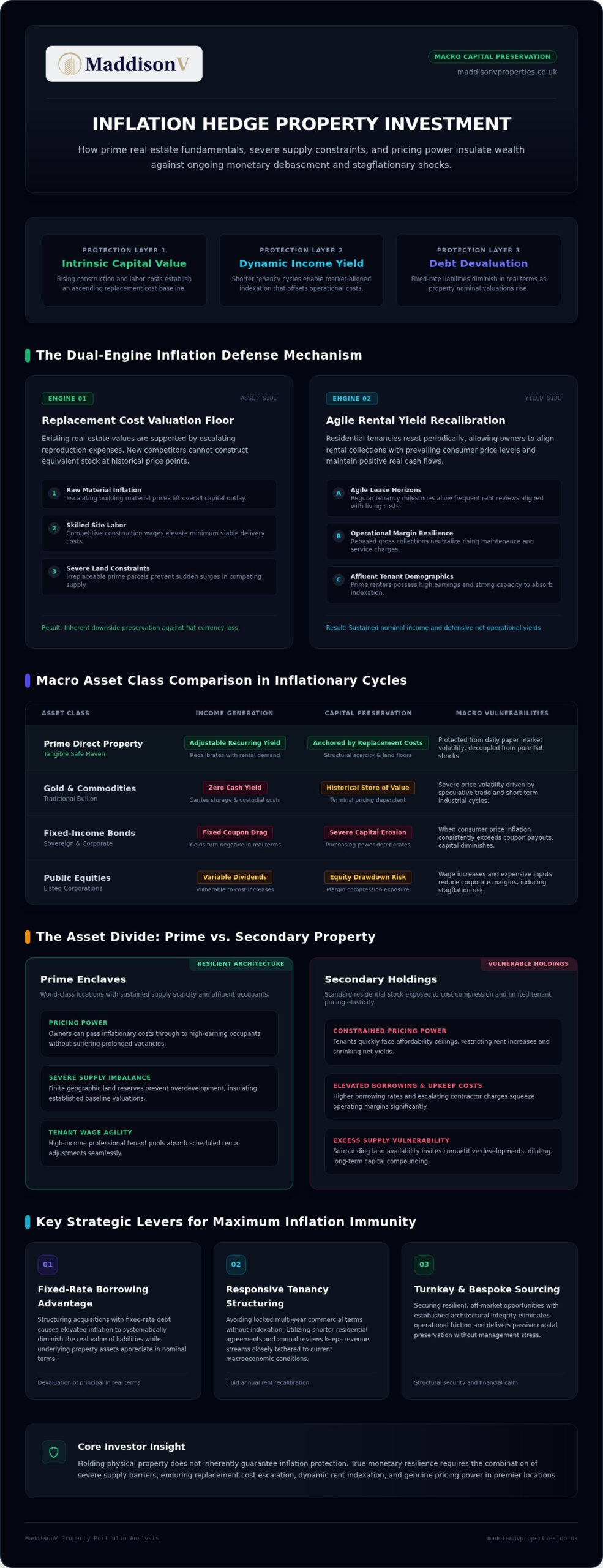
When central banks expand monetary supply and fiat currencies shed purchasing power, capital seeks refuge in tangible assets. A disciplined inflation hedge property investment operates through a dual-engine mechanism, defending balance sheets via intrinsic capital preservation while generating sustained nominal income. Paper holdings and liquid reserves remain acutely vulnerable to macroeconomic shocks; by contrast, prime real estate compounds wealth steadily across multi-decade cycles. Exploring what is an inflation hedge reveals that physical scarcity and real utility decouple high-grade property from systemic currency depreciation.
The Mechanics of Intrinsic Asset Value and Replacement Cost
Construction inflation establishes a resilient baseline for prime real estate values. As the prices of raw materials, skilled site labor, and regulatory compliance accelerate, the capital outlay required to build a competing structure rises proportionally. This dynamic creates an enduring valuation floor for existing buildings. Investors benefit because prospective competitors cannot reproduce established architecture at yesterday’s prices. In world-class enclaves, severe land shortages amplify this protection, ensuring established properties retain long-term value without the threat of unexpected supply surges.
Rental Income Growth and Contractual Rent Indexation
Rental yields provide the operational counterpart to capital appreciation in an inflation hedge property investment. Fixed-income coupons lose real purchasing power during inflationary spikes, but residential real estate maintains agility through regular tenancy cycles. Shorter residential agreements allow owners to rebase collections to reflect current economic conditions, protecting net revenue over time:
- Agile lease horizons: Annual tenancy reviews permit fluid, market-aligned rent recalibrations that keep pace with broader living costs.
- Operational resilience: Consistent upward rent adjustments shield operational cash flows, neutralizing higher maintenance and supplier charges.
- Affluent tenant demographics: High-earning professionals in prime districts possess substantial wage resilience, absorbing rent updates while preserving low vacancy rates.
This steady repricing capability bridges the gap between passive capital protection and active yield preservation, delivering peace of mind regardless of wider fiscal pressures.
Real Estate vs. Alternative Inflation Hedges: Asset Class Comparison
Sustained inflation challenges conventional wealth preservation, forcing family offices and private investors to scrutinize how their capital is distributed. Liquid cash reserves rapidly lose purchasing power in high-cost environments, while conventional paper assets frequently react unpredictably to macroeconomic shifts. Evaluating how alternative classes perform reveals why an inflation hedge property investment offers rare structural equilibrium.
Direct Property vs. Gold and Commodities
Gold and broad raw commodities have historically served as traditional safe havens against monetary debasement. However, bullion produces zero ongoing cash flow. Investors holding precious metals depend entirely on speculative terminal pricing, absorbing storage charges and custodial expenses without receiving recurring distributions. Raw commodities carry severe price volatility tied to short-term industrial cycles. By contrast, prime residential assets provide continuous utility, housing high-earning occupants and generating operational cash yields that adjust upwards as local price pressures rise.
Property vs. Fixed-Income Bonds and Equities
Sovereign and corporate bonds face substantial challenges during extended inflationary periods. Fixed coupons yield negative real returns when consumer price indices consistently exceed bond distributions, permanently eroding capital. Public equities offer growth potential, but high input costs and wage pressures often trigger margin compression, leading to public equity drawdowns during stagflation. Macroeconomic evaluations, including central bank reviews analyzing real asset behavior and commercial real estate price indexes, show how unhedged portfolios face severe drawdowns during stagflationary regimes.
Direct real estate shields private balance sheets from these acute vulnerabilities through several balanced attributes:
- Absence of daily market volatility: Physical property avoids the psychological swings of public stock exchanges, promoting disciplined, long-term wealth compounding.
- Contractual cash flow: Yields provide regular distributions that cushion total returns during periods of broader economic stagnation.
- Defensive capital positioning: Institutional-grade residential properties sustain occupancy because high-caliber housing represents an indispensable human necessity.
Investors seeking to stabilize their exposure across shifting global cycles can explore curated solutions through bespoke property sourcing to acquire unlisted, defensively positioned residences.
Why Not All Real Estate Protects Wealth: Prime vs. Secondary Assets
A common misconception in wealth management is treating all brick-and-mortar holdings as an equal shield against purchasing power erosion. Aggregate housing statistics often mask deep structural divides between top-tier enclaves and secondary developments. While secondary properties can offer tempting nominal yields on paper, they frequently succumb to operational cost inflation, debt pressures, and tenant distress during economic contractions. A successful inflation hedge property investment hinges on genuine pricing power, structural scarcity, and uncompromised location fundamentals.
The Crucial Role of Supply Constraints in Prime Enclaves
Scarcity drives defensive outperformance. In established heritage districts across tier-one cities, planning restrictions, conservation zones, and geographical limits prevent the construction of excessive competing stock. When developers cannot readily expand supply, existing prime residences retain resilient value floors even during macroeconomic contractions. Investors studying real estate in england london can clearly see how historically protected neighborhoods insulate invested capital from the broad supply waves that weaken outer peripheral regions.
Tenant Quality, Affordability, and Rental Pricing Power
Rental indexation succeeds only when the resident possesses the fiscal capacity to pay higher rates. In generic, mass-market developments, tenants often allocate high percentages of income to non-discretionary necessities like energy, food, and transport. As consumer prices climb, their disposable income shrinks, creating severe affordability ceilings that block rent reviews and increase arrears. Prime residential markets operate under entirely distinct dynamics:
- Affluent tenant demographics: High-net-worth professionals, international executives, and corporate assignees retain deep financial buffers, absorbing inflation-adjusted rent revisions without sacrificing lifestyle quality.
- Superior retention and minimal voids: Chronic under-supply in elite postal codes ensures continuous tenant competition, practically eliminating prolonged vacancy cycles.
- Net operating income preservation: Strong gross collections comfortably surpass rising property maintenance, service fees, and administrative charges.
Balancing rising borrowing costs against long-term asset expansion requires strategic discipline. When high-grade real estate combines resilient pricing authority with irreplaceable addresses, the investor secures an inflation hedge property investment that protects multi-generational wealth while outlasting turbulent fiscal transitions.
Strategic Mechanisms to Maximise Inflation Resilience
Generating inflation-beating returns requires deliberate structural planning rather than passive optimism. Sophisticated capital allocators configure their physical acquisitions to harness macroeconomic tailwinds while dampening operational friction. By aligning prudent financing, high-specification architecture, and currency diversification, a well-orchestrated inflation hedge property investment actively protects balance sheets against systemic monetary dilution.
Leveraging Debt: The Real Value Erosion of Borrowed Capital
Fixed-rate debt serves as an effective mechanism for capital expansion during inflationary regimes. While headline price levels and underlying asset valuations escalate, the nominal value of fixed-rate borrowing remains frozen. Inflation devalues the real burden of the mortgage balance over time, allowing the investor’s equity position to expand organically. With average five-year fixed mortgage rates hovering around 5.9% in late 2026, structuring sustainable loan-to-value ratios protects portfolios against refinancing shocks. You can consult our buy-to-let mortgage guide to evaluate bespoke lending options tailored to complex holding structures.
Mitigating Maintenance Inflation via Modern Building Standards
Operational cost leakage is often the hidden flaw in standard real estate holdings. Aging historical housing stock carries heavy refurbishment liabilities, leaving owners vulnerable to surging contractor rates, materials inflation, and heightened energy performance mandates. Allocating capital toward prime contemporary developments neutralizes these overhead spikes:
- Reduced capital expenditure: Modern construction warranties and newly installed mechanical systems eliminate unbudgeted repair costs for initial holding periods.
- Superior energy efficiency: High thermal ratings lower tenant utility outlays, preserving disposable income for contractual rent adjustments.
- Immediate aesthetic appeal: Turnkey interior architecture attracts corporate tenants seeking friction-free, high-end living.
Reviewing our analysis of off-plan property investment details how entering developments early locks in pricing before post-construction revaluations occur.
Geographic and Currency Diversification Strategies
Relying on a single domestic currency exposes wealth to local fiscal shifts and central bank policy errors. Allocating capital across premier global hubs balances mature governance with high-growth dynamics. While prime London residential property offers unmatched institutional rule of law, choosing to invest in dubai property introduces high-yielding, tax-efficient distributions denominated in dollar-pegged assets.
To structure an acquisition strategy aligned with your long-term wealth objectives, schedule a private consultation with our portfolio advisory team today.
Executing a Resilient Property Investment Strategy with MaddisonV
Securing authentic capital protection requires transitioning from abstract economic theory into meticulous execution. Prime real estate operates as a dependable barrier against currency depreciation only when assets are acquired at compelling valuations and managed with operational precision. MaddisonV Properties acts as a premier partner for private family offices and discerning global investors, bridging complex institutional analysis with bespoke, highly personalized advisory services.
Bespoke Property Sourcing and Off-Market Acquisition
Publicly listed properties often carry competitive retail premiums that erode gross yields before ownership even begins. MaddisonV Properties unlocks off-market opportunities across prestigious London enclaves such as Chelsea and Marylebone, alongside high-performing international markets. Our acquisition methodology combines discreet negotiation, forensic structural inspection, and stringent cash-flow modeling. By partnering with dedicated property sourcing agents London, investors avoid costly public bidding wars while securing residences engineered to thrive across economic cycles.
Comprehensive Property and Facilities Management
An inflation hedge property investment demands active, high-standard maintenance to sustain real net income over decades. MaddisonV Properties provides turnkey facilities and lettings management designed to eliminate daily operational headaches while protecting property fundamentals:
- Proactive rent reviews: Regular contractual indexations align rental collections with prevailing market inflation, preventing yields from stagnating.
- Preventative facilities management: Early infrastructure audits, routine servicing, and vetted vendor contracts suppress sudden repair surcharges.
- Curated tenant selection: Thorough vetting secures dependable corporate professionals, fostering high retention rates and safeguarding baseline cash flows.
Entrusting day-to-day oversight to specialist property management ensures your holdings remain physically pristine and commercially resilient. The outcome is effortless, truly passive wealth preservation that defends your family’s balance sheet across generations.
Safeguarding Generational Capital Across Changing Economic Cycles
Preserving family prosperity against aggressive currency devaluation requires deliberate, tangible positioning. A genuinely resilient inflation hedge property investment relies on structural scarcity, uncompromising asset quality, and verifiable pricing authority. When you anchor capital in prime enclaves, mitigate operational liabilities through modern building standards, and capture regular rental growth, your private balance sheet naturally outpaces fiscal volatility.
Achieving sustained capital preservation demands an exacting, relationship-driven approach. MaddisonV serves as a boutique advisory across prime London developments and premier global investment corridors, uniting tailored property sourcing, mortgage consultations, and comprehensive management under one exacting standard. We navigate complex operational details on your behalf, delivering the financial security and quiet tranquility your wealth deserves. Secure your wealth with MaddisonV Properties today to establish an enduring, high-performing foundation for generations to come.
Frequently Asked Questions
How does real estate investment protect against inflation compared to equities?
Real estate safeguards purchasing power through intrinsic tangible value and contractual cash flows, avoiding the psychological volatility of public markets. Equities frequently face margin compression during inflationary cycles as input prices and wage demands accelerate. Physical property benefits directly from higher replacement costs and annual tenancy reviews, providing consistent income alongside capital preservation without unexpected equity market drawdowns.
Can rising interest rates negate the inflation hedging benefits of property?
Rising interest rates can reduce returns if acquisitions rely on excessive or floating-rate debt. However, disciplined investors structure acquisitions with conservative loan-to-value ratios and fixed-term borrowing. When managed properly, a prime inflation hedge property investment outpaces financing costs because severe housing shortages allow owners to rebase rents upward, protecting net operational yields despite tighter monetary conditions.
What types of residential property offer the strongest hedge against inflation?
Prime residential assets situated in supply-constrained enclaves offer the most dependable defense. Premium homes catering to affluent professionals provide genuine pricing power, allowing landlords to execute regular rent increases without elevating default risks. Newly constructed apartments with high energy efficiency also outperform generic stock by protecting rental yields from escalating utility and contractor bills.
How does fixed-rate debt benefit real estate investors during inflationary periods?
Fixed-rate debt locks financing liabilities at a static nominal amount while inflation steadily erodes the real value of money. Investors effectively repay fixed mortgage obligations with depreciated currency. Meanwhile, nominal property valuations and rental income expand alongside broader price levels, steadily increasing your net equity position while maintaining predictable debt servicing outlays.
Is new-build property a more reliable inflation hedge than older period homes?
Modern luxury properties typically offer superior operational resilience during inflationary periods. While historic architecture holds enduring prestige, older properties expose investors to escalating material prices, rising contractor fees, and costly energy retrofits. Contemporary new builds incorporate comprehensive structural warranties and high thermal ratings, eliminating unforeseen maintenance surcharges and protecting real net returns.
What role does location play in determining an asset’s inflation resilience?
Location establishes the fundamental pricing power that underpins an inflation hedge property investment. Prestigious global enclaves protected by geographic limits and planning controls prevent oversupply, sustaining long-term capital values. Furthermore, tier-one locations attract high-earning tenants who possess the discretionary income required to absorb inflation-adjusted rents without disruption.

Sign Up Now
Want to read more great articles and blogs subscribe to our newsletter