
The most lucrative investment in the London skyline often exists only on paper, yet the financial bridge to secure it remains the greatest hurdle for...

The most lucrative investment in the London skyline often exists only on paper, yet the financial bridge to secure it remains the greatest hurdle for even the most seasoned investors. You likely understand that buying property off-plan with a mortgage offers a unique opportunity to capture capital growth before the first brick is even laid, but the anxiety of a mortgage offer expiring during a construction delay is a reality many face. It’s a delicate balance of timing, precision, and foresight that requires more than just a standard lending product.
This guide promises to help you master the intricacies of financing unbuilt luxury assets, ensuring your capital remains protected from the risk of down-valuations at completion. We’ll explore how to synchronize lender flexibility, construction timelines, and valuation security in high-growth districts like Nine Elms and Canary Wharf. By examining 2026 market data, such as the 4.33% five-year fixed rates currently available from lenders like Barclays, you’ll learn to secure a mortgage that offers stability, growth, and a truly passive acquisition experience.
Key Takeaways
- Understand the conservative Loan-to-Value (LTV) limits lenders apply to unbuilt London apartments to ensure your financial framework is robust from exchange to completion.
- Learn to navigate the “valuation gap” and manage mortgage offer expiries to protect your capital against potential construction delays.
- Master the strategic timing of buying property off-plan with a mortgage by aligning lender commitments with the specific development cycles of high-growth districts.
- Identify why Nine Elms, Battersea, and Canary Wharf remain the premier locations for securing significant capital growth in the 2026 market.
- Discover how an integrated approach to property sourcing and mortgage advisory creates a seamless, passive acquisition process for the sophisticated investor.
Defining the Off-Plan Mortgage: A High-Yield Strategy for London Property
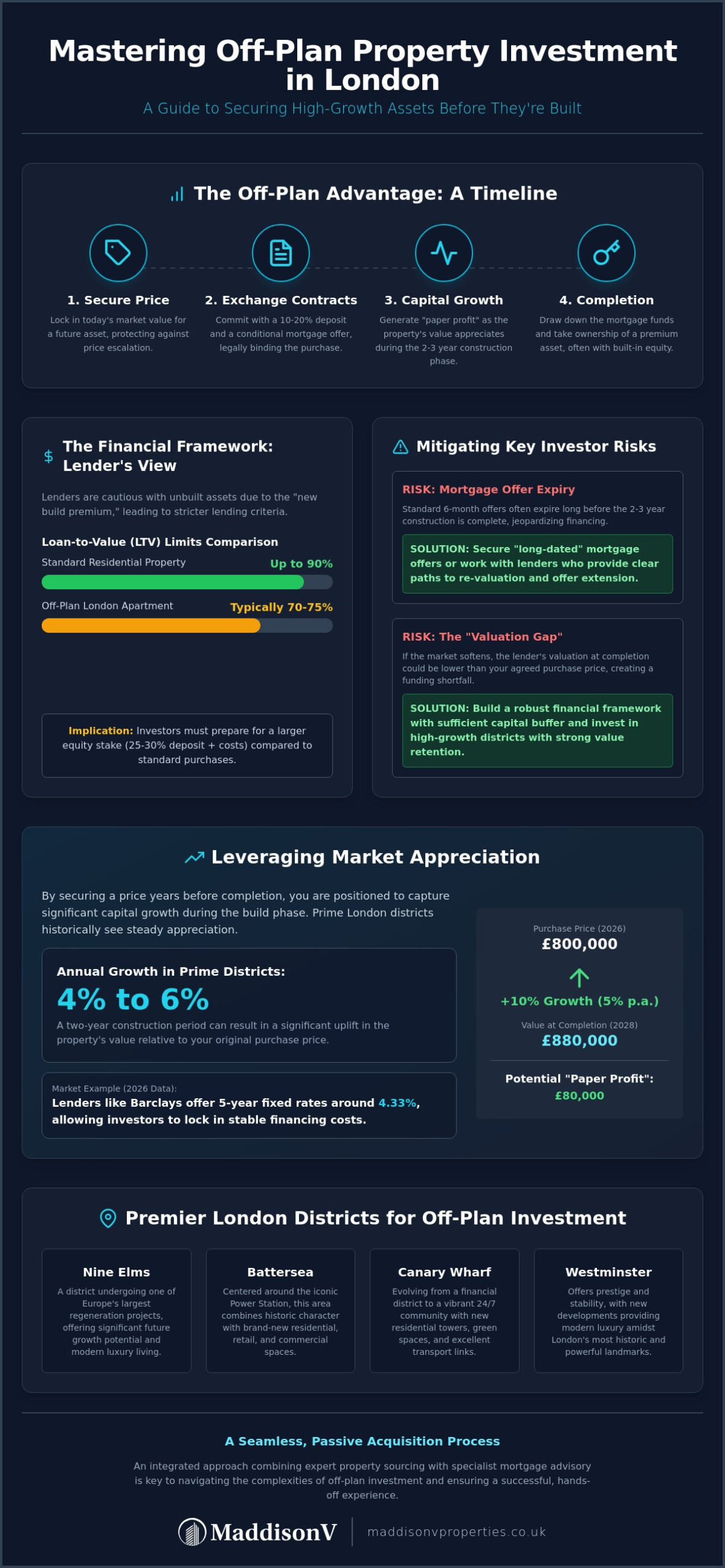
The London skyline is a canvas of perpetual evolution, where the most astute investors look beyond finished structures to the blueprints of the future. At its core, an off-plan mortgage is a conditional commitment from a lender to provide finance for a property that hasn’t yet reached completion. Unlike a standard purchase, buying property off-plan with a mortgage involves securing a price today for an asset that may not be habitable for another two to three years. This requires a lender who understands the nuances of the London development cycle and is willing to issue an offer based on architectural plans and projected valuations.
To understand the foundational concepts, it’s helpful to clarify what ‘off-plan’ means in the context of high-end real estate. Most developers require a commitment in the form of a 10% or 20% deposit at the point of exchange, which serves as your stake in the project. This initial capital “locks in” the current market value, protecting you from the price escalations that typically occur as a development nears completion. Sophisticated investors utilize this model to bypass the competitive friction of the secondary market, ensuring they hold a premium asset in a prime location before it’s even available to the general public.
To better understand the practical implications of this strategy, watch this helpful video:
The Mechanics of Exchange and Completion
While the actual funds aren’t drawn until the building is physically ready, a lender’s mortgage offer is usually a prerequisite for the exchange of contracts. This creates a legal obligation; you’re committing to the purchase based on the strength of that financing. It’s a rhythmic dance of timing, as these offers often have expiry dates that must be managed alongside construction schedules. For a deeper dive into these strategic timing considerations, consult The Sophisticated Investor’s Guide to Off-Plan Property Investment in 2026.
Capital Growth Potential During Construction
One of the most compelling reasons for buying property off-plan with a mortgage is the ability to leverage market appreciation. By securing a 2026 price for a 2028 completion, you’re effectively generating “paper profit” during the build phase. If the London market follows its historic trajectory of steady appreciation, your equity position strengthens before you even receive the keys. In a market where prime districts often see annual growth of 4% to 6%, a two-year construction period can result in a significant uplift in the property’s value relative to your original purchase price.
The Financial Framework: How Lenders View New Build Developments
High-street lenders often approach unbuilt developments with a degree of caution that can surprise the unprepared investor. While they’re comfortable with existing bricks and mortar, the “new build premium”—the price uplift associated with brand-new fixtures and modern amenities—can lead to more conservative valuations. This often translates to stricter Loan-to-Value (LTV) limits. While a standard residential purchase might command a 90% LTV, buying property off-plan with a mortgage in London frequently requires a larger equity stake, with lenders often capping their exposure at 70% or 75% for high-rise apartments.
Securing a “long-dated” mortgage offer is a critical component of this framework. Most standard mortgage offers expire after six months, yet many flagship developments in areas like Westminster or Chelsea have construction timelines that extend far beyond this window. Without a lender who provides extended offers or a clear path to re-valuation, investors risk their financing falling away before the property is ready for occupation. While some government-backed schemes offer support for specific buyer profiles, the high-end investor typically requires more tailored solutions that account for these extended timescales.
Specialist vs. High-Street Lending
Boutique and specialist lenders often possess a deeper understanding of the London new build sector than their high-street counterparts. These institutions are more adept at valuing the lifestyle benefits and long-term capital potential of a development in Marylebone or Nine Elms. At MaddisonV, we prioritize identifying these flexible lending partners, ensuring our clients access products that align with their specific portfolio goals. For a more detailed look at financing models, our The Sophisticated Investor’s Buy-to-Let Mortgage Guide (2026 Edition) provides comprehensive insights into current market rates and lender criteria.
Criteria for International and Non-Resident Investors
For global clients, the financial framework becomes slightly more complex. Lenders will scrutinize the source of funds and the stability of the investor’s home jurisdiction with meticulous detail. Currency fluctuations also play a significant role; a sudden shift in the exchange rate can impact your perceived affordability and final LTV. Navigating these cross-border complexities requires a level of precision that only a dedicated mortgage consultation can provide. Bespoke advisory is an absolute necessity for international mortgage sourcing to ensure that your global wealth is recognized and leveraged effectively within the UK banking system.
Mitigating the Risks: Valuations, Expiries, and Long-Stop Dates
Investing in unbuilt luxury assets requires a strategic mindset that prioritizes risk mitigation as much as capital appreciation. While the financial framework discussed previously provides a solid foundation, the execution phase introduces variables that demand meticulous oversight. The most prominent of these is the “valuation gap,” a scenario where the final RICS valuation at completion falls below the purchase price agreed at exchange. Because lenders base their final loan amount on the lower of the two figures, a shortfall can emerge. Buying property off-plan with a mortgage requires a contingency plan; sophisticated investors often maintain a liquidity buffer or arrange pre-approved bridge financing to ensure the acquisition remains secure even if the market fluctuates during the build.
Timing is the second critical pillar of risk management. Standard mortgage offers typically carry a validity period of six to twelve months, yet flagship London developments often face construction delays due to supply chain shifts or complex engineering requirements. If your offer expires before the “notice to complete” is served, you may find yourself reapplying in a different interest rate environment. Managing this transition requires a lender who offers flexible extension clauses or a dedicated advisor who can pivot your financing strategy at the final stage to prevent the loss of your deposit.
The RICS Valuation Process for Off-Plan Assets
Surveyors face a unique challenge when assessing a property that only exists as a digital render or a skeletal frame. In high-density districts like Canary Wharf, they rely heavily on “comparables”—recent sales data from neighboring high-rise developments that mirror the specification and floor level of your asset. This is why professional sourcing agents are vital; they ensure your entry price is grounded in reality rather than developer optimism. A realistic valuation at the start significantly reduces the likelihood of a stressful shortfall when the building finally reaches its practical completion.
Contractual Safeguards and Long-Stop Dates
Your purchase contract should serve as a shield, not just a commitment. The “long-stop date” is a vital legal protection that sets a definitive deadline for the developer to finish the project. If they miss this date, you generally have the right to rescind the contract and reclaim your deposit in full. When buying property off-plan with a mortgage, it’s essential to ensure your lender’s offer period is aligned with these contractual milestones. We often advise clients to seek “offer extension” clauses within their mortgage agreements, providing a layer of mental tranquility that remains unshaken by minor construction setbacks.
District Spotlight: Leveraging Mortgages in Battersea and Nine Elms
Lenders don’t just value the building; they value the ecosystem surrounding it. When buying property off-plan with a mortgage, the geographical context is often as significant as your personal credit profile. Major infrastructure improvements, such as the Northern Line extension, provide a tangible sense of security for RICS surveyors. These developments create a “regeneration premium” that supports higher valuations, making it easier for lenders to justify the Loan-to-Value ratios required for premium London assets. By selecting a district with proven institutional investment, you’re effectively de-risking the mortgage application from the outset.
Nine Elms and Battersea: The South Bank Transformation
Nine Elms has evolved into a global benchmark for urban regeneration, offering a price spectrum that caters to diverse investment strategies. As of July 2026, new build properties in Nine Elms start from £395,000 and can reach £12,000,000 for flagship penthouses. The presence of Apple’s UK headquarters and the US Embassy provides a psychological and financial floor for lenders, who view these corporate anchors as guarantees of long-term rental demand and resale liquidity. For a broader perspective on how these districts fit into the national picture, our guide on Real Estate in England: The Definitive Guide to the London Market in 2026 offers deep-dive analytics into the SW8 and SW11 markets.
Canary Wharf and the Docklands: A Modern Financing Hub
The high-rise residential sector in Canary Wharf attracts a high volume of professional buy-to-let investors, largely due to the district’s exceptional transport links and high-specification builds. Financing luxury apartments in E14 often involves specialist mortgage criteria, particularly regarding floor levels and cladding certifications. Lenders are generally more comfortable with high-density developments here because the area has a mature secondary market. The unique resale liquidity of off-plan assets in the Docklands ensures that your exit strategy is as robust as your entry, providing comfort to both the investor and the provider of the mortgage funds. To secure an asset in these high-growth zones, our property sourcing team provides the local intelligence needed to navigate the London market with confidence.
Westminster continues to be the ultimate choice for long-term capital preservation. While the yields may be more modest than in the emerging South Bank, the scarcity of new build opportunities in this historic district creates a natural hedge against market volatility. Lenders view Westminster assets as “blue-chip” security, often offering more competitive terms to investors who can demonstrate a commitment to this prestigious enclave. Whether you’re looking for growth or stability, aligning your mortgage strategy with the specific regeneration goals of these districts is the hallmark of a sophisticated acquisition.
Bespoke Financing: The MaddisonV Approach to Off-Plan Acquisitions
Navigating the intricate landscape of buying property off-plan with a mortgage requires more than a standard brokerage service. It demands a partnership that bridges the gap between clinical financial management and a genuine appreciation for high-end aesthetics. At MaddisonV, we provide an integrated model that handles the operational friction so you can enjoy the rewards of a premier London portfolio. This level of specialized attention is essential for all high-value acquisitions; for example, those seeking tailored finance for luxury vehicles or commercial assets often turn to experts like Motorlend to ensure their broader portfolio is equally well-managed. Our approach is defined by precision, reliability, and a deeply personal commitment to your financial security. By aligning our property sourcing expertise with bespoke mortgage consultations, we ensure that every acquisition is seamless, stable, and strategically sound.
The true value of our service lies in our ability to unlock doors that remain closed to the general market. We provide our clients with access to off-market developments and exclusive lender rates that aren’t available through traditional high-street channels. This exclusivity is a cornerstone of the MaddisonV experience, allowing you to secure assets in Canary Wharf or Battersea with terms that reflect your unique financial profile. We manage the entire process with meticulous detail, overseeing everything from the initial mortgage application at exchange to the final valuation at the key handover, ensuring nothing is left to chance.
The Private Client Journey
- Step 1: Strategic Consultation and Portfolio Analysis. We begin by understanding your long-term ambitions, evaluating your current holdings, and defining your risk appetite to create a tailored investment roadmap.
- Step 2: Sourcing Prime Off-Plan Opportunities. Our team identifies high-growth assets in districts like Canary Wharf and Nine Elms, focusing on developments that offer superior user experiences and strong capital potential.
- Step 3: Securing Bespoke Financing. We leverage our network of specialist lenders to secure a mortgage product with flexible terms, specifically designed to accommodate the timelines of new build developments.
Beyond the Purchase: Long-Term Asset Management
Our commitment to your investment doesn’t end when the construction finishes. The transition from a building site to a habitable luxury residence requires expert oversight to maintain the visual and functional standards of your portfolio. Through our dedicated facilities management and property management services, we ensure high tenant retention and effortless oversight for the owner. This holistic approach provides the mental tranquility you need, knowing that your asset is being preserved by professionals who value quality as much as you do. To begin your journey toward a secured, high-yield London portfolio, secure your London investment future with a bespoke mortgage consultation today.
Securing Your Future in the London Skyline
Mastering the complexities of buying property off-plan with a mortgage requires a blend of market foresight and technical precision. You’ve seen how synchronizing lender flexibility with construction timelines in districts like Nine Elms and Marylebone can protect your capital and unlock significant growth. Success isn’t just about finding a rate; it’s about managing the valuation gap and ensuring your financial framework remains robust until the final key handover.
As a London-headquartered partner, MaddisonV provides exclusive access to premium developments and comprehensive management that spans from initial sourcing to long-term facilities upkeep. We handle the operational details so you can focus on the rewards of a high-tier portfolio. Your investment deserves the quiet confidence that comes from expert oversight and a seamless, passive acquisition process.
Book Your Bespoke Off-Plan Mortgage Consultation
The path to a sophisticated London investment is clear when you have a partner who understands that nothing should be left to chance. We’re ready to help you build a legacy in the world’s most dynamic property market.
Frequently Asked Questions
Can I get a mortgage for an off-plan property as an international buyer?
Yes, international buyers can secure financing, though lenders typically apply more conservative criteria to non-residents. You’ll likely face a maximum Loan-to-Value (LTV) of 60% to 70% and require a specialist lender who understands global income structures. Buying property off-plan with a mortgage as an overseas investor requires meticulous documentation to satisfy UK anti-money laundering regulations and rigorous source-of-wealth checks.
What happens if my mortgage offer expires before the building is finished?
If your mortgage offer expires before the developer serves the notice to complete, you’ll need to apply for an extension or a completely new product. This is a common challenge in the London market where construction timelines can shift due to complex engineering. It’s vital to maintain a constant dialogue with your advisor to ensure your financing remains valid through to the actual move-in date.
How much deposit do I need for an off-plan property in London?
Most London developers require a deposit of 10% to 20% of the purchase price at the point of exchanging contracts. This capital is held by the developer’s solicitor, often protected by a guarantee scheme, until the building reaches practical completion. The remaining balance is then covered by your mortgage funds and any additional personal equity you’ve committed to the acquisition at the final stage.
What is a “valuation gap” and how can I avoid it?
A valuation gap occurs when the surveyor’s assessment at completion is lower than the price you agreed to pay at exchange. You can mitigate this risk by investing in high-demand zones like Battersea or Westminster where regeneration supports price stability. If a gap emerges, you’ll need to cover the shortfall with additional cash to maintain your required LTV ratio and secure the property.
Are mortgage rates higher for off-plan new build properties?
Mortgage rates for off-plan properties are generally comparable to standard new build rates, though the product range is narrower. Some lenders offer “green mortgages” with slightly lower rates for energy-efficient new builds that meet specific EPC ratings. The main difference isn’t usually the interest rate itself, but rather the conservative LTV limits that lenders apply when you’re buying property off-plan with a mortgage.
Can I sell my off-plan property before the mortgage is fully drawn (flipping)?
You can often sell your interest in the property before completion through a process known as an “assignment of contract.” This allows you to realize capital growth without ever drawing down the full mortgage funds. However, you must ensure the original purchase contract permits assignment and obtain the developer’s formal consent before proceeding. This strategy requires precise legal timing to ensure a seamless transition between buyers.
What is a long-stop date in an off-plan contract?
The long-stop date is a definitive contractual deadline that protects you if the developer fails to finish the building on time. If the property isn’t ready by this date, you generally have the legal right to cancel the contract and receive your full deposit back. It’s a crucial safeguard that prevents your capital from being tied up indefinitely in a project that has faced significant delays.
How do lenders value a property that is not yet built?
Lenders instruct RICS-qualified surveyors to value the property based on the architectural plans, internal specifications, and the current market value of similar completed homes. They look at “comparables” within the immediate vicinity, such as Canary Wharf or Nine Elms, to ensure the projected price aligns with local market realities. This ensures the lender isn’t over-exposed on an asset that hasn’t yet reached practical completion.

Sign Up Now
Want to read more great articles and blogs subscribe to our newsletter