
What if the most strategic moment to exit your London property investment is years before the keys are even cut? Many sophisticated investors find...

What if the most strategic moment to exit your London property investment is years before the keys are even cut? Many sophisticated investors find their capital remains tied up in long-term builds across Nine Elms or Battersea, often feeling constrained by shifting developer restrictions and the looming weight of Stamp Duty. Successfully assigning an off-plan property contract uk offers a refined path to liquidity, allowing you to capture capital growth and realize a profit uplift without the need for final completion. It is a process that demands precision, foresight, and a deep understanding of contractual control.
We recognize that the uncertainty of developer consent and complex tax obligations can be daunting for even the most seasoned buyer. This guide provides the clarity you need to navigate these intricacies with confidence and poise. You’ll learn how to manage the legal requirements of an assignment, understand the impact of the new 2026 disclosure regulations, and streamline the consent process. This exploration of the current market ensures you can secure your financial interests, minimize your administrative burden, and maximize your investment potential.
Key Takeaways
- Understand the essential roles of the Assignor and Assignee to ensure a legally sound and seamless transfer of your property rights.
- Learn why securing formal developer consent is the non-negotiable foundation for any successful exit strategy before building completion.
- Navigate the complex financial landscape of Stamp Duty Land Tax and premium payments to protect your investment margins and financial security.
- Discover the strategic advantages of assigning an off-plan property contract uk within London’s high-growth districts like Canary Wharf and Nine Elms.
- Master a structured, step-by-step approach to reviewing contracts and obtaining the necessary permissions for a professional and profitable assignment.
What is Off-Plan Property Assignment in the UK?
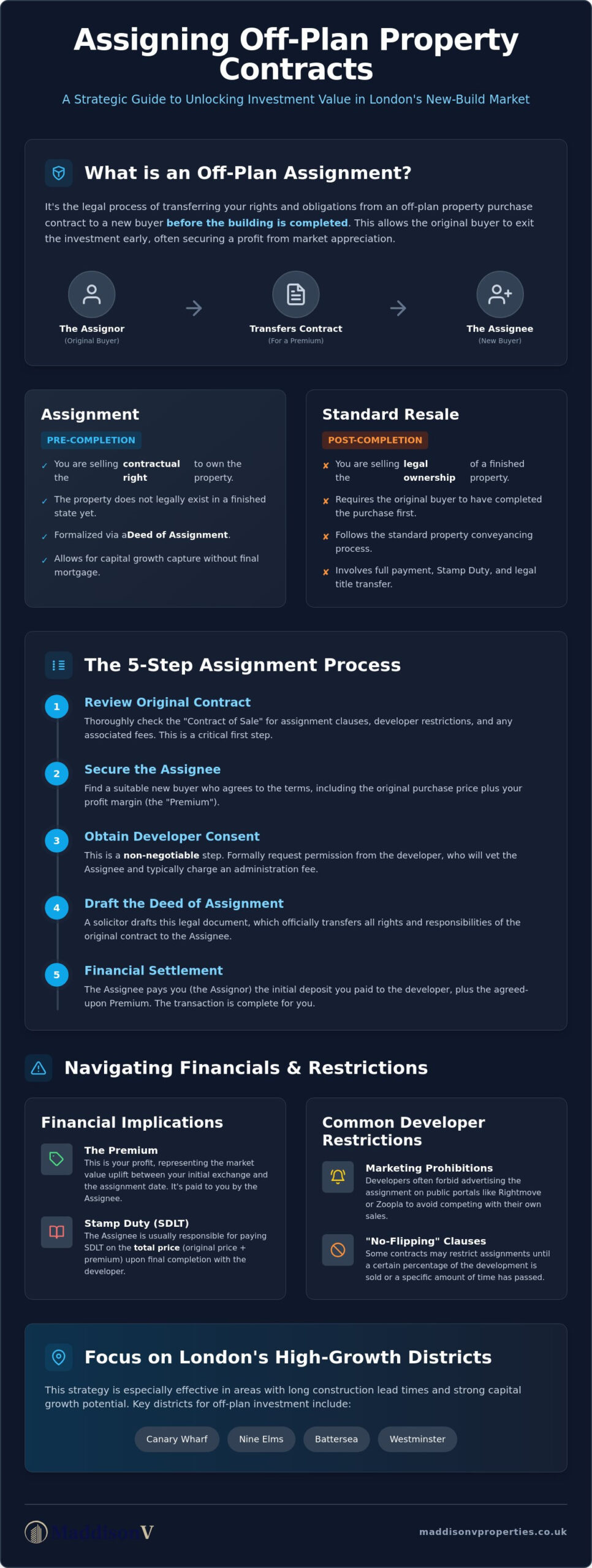
In the high-stakes environment of London’s new-build market, the ability to pivot before a project reaches completion is a mark of a truly agile investor. At its core, What is off-plan property assignment? It is the legal process of transferring the rights and obligations of a purchase contract to a new buyer before the building is physically finished. By assigning an off-plan property contract uk, the original purchaser, known as the Assignor, exits the deal early. Simultaneously, the new purchaser, the Assignee, steps into their shoes to complete the transaction with the developer upon the building’s completion.
This strategy is particularly prevalent in prestigious districts like Nine Elms or Canary Wharf, where long construction lead times allow for significant capital growth. Investors often use this as a flipping mechanism, aiming to capture the uplift. This uplift represents the increase in market value that occurs between the initial exchange of contracts and the final handover. It’s a method that prioritizes liquidity, capital efficiency, and strategic flexibility, allowing you to move onto your next acquisition without the need for a full mortgage or the payment of final completion funds.
To gain a deeper perspective on the financial nuances of this strategy, watch this insightful overview:
Key Terminology for Off-Plan Investors
A successful assignment requires a meticulous grasp of the underlying paperwork. The Contract of Sale is the primary document being traded; it contains the original price and specifications agreed with the developer. Within this, the long-stop date is vital. It represents the ultimate deadline for the developer to complete the build, providing a safety net for both parties if delays occur. Finally, the Premium is the specific profit amount the Assignee pays the Assignor, representing that hard-earned market appreciation.
The Difference Between Resale and Assignment
While they may seem similar, an assignment is fundamentally different from a standard property resale. A resale occurs after the first buyer has taken legal ownership; an assignment happens strictly pre-completion. Because the property doesn’t yet exist in a finished legal state, you aren’t selling bricks and mortar, but rather the contractual right to own them. This transfer is formalised through a Deed of Assignment, a sophisticated legal instrument that ensures the developer recognizes the new buyer as the legitimate successor to the original contract. Understanding this distinction is essential for assigning an off-plan property contract uk with confidence and legal certainty.
The Legal Framework and Developer Consent Requirements
Successfully assigning an off-plan property contract uk requires more than just finding a willing buyer; it demands a precise alignment with the developer’s own legal and commercial interests. The “Consent to Assign” is the cornerstone of this process. It isn’t merely a courtesy but a non-negotiable requirement. Developers typically hold the right to refuse an assignment if they believe it might undermine their remaining sales or if the new buyer doesn’t meet their stringent standards. This vetting process ensures the Assignee possesses the financial standing and transparency required for a high-value transaction in the London market.
Most developers charge an assignment fee to cover the administrative and legal costs associated with the transfer. These fees are standard practice, ensuring that the developer’s internal teams can process the change of ownership without financial loss. Beyond the fee, you must be aware of the specific restrictions embedded within your original contract. Developers often prohibit marketing on mainstream portals like Rightmove or Zoopla. This is done to prevent “shadow” competition with their own unsold units, which could potentially devalue the development’s brand or price point before completion.
Navigating Developer Restrictions
Many contracts include “no-flipping” clauses that prevent an assignment until a certain percentage of the development is sold or until a specific timeframe has passed. These hurdles make it essential to work with a specialist property sourcing agent London who understands the nuances of off-market transactions. They can connect you with private networks of investors, bypassing the need for public portals while respecting the developer’s marketing embargo. This discreet approach maintains the prestige of the asset and ensures a smoother path to consent.
The Tripartite Relationship
An assignment creates a unique tripartite relationship between the Assignor, the Assignee, and the Developer. Your solicitor plays a pivotal role here, acting as the conductor for this three-way communication. They ensure the original deposit is correctly accounted for, whether it’s reimbursed by the Assignee or held in escrow. It’s also vital to understand the “Guarantee” clause. In many UK contracts, the Assignor remains secondary liable if the Assignee fails to complete the purchase. This means your choice of buyer isn’t just about the price; it’s about their reliability and financial security. The Assignee must also prepare for their own legal obligations, including the eventual payment of Stamp Duty Land Tax (SDLT) based on the final acquisition price.
If you’re looking to refine your exit strategy or require professional oversight for your next acquisition, our team provides the expert portfolio management needed to navigate these complex legal waters with ease.
Financial Implications: Premiums and Stamp Duty (SDLT)
Financial clarity is the bedrock of any successful exit. When assigning an off-plan property contract uk, the primary financial objective is often the realization of the premium. This premium, or “uplift,” is the difference between your initial purchase price and the property’s current market valuation. Typically, the Assignee pays this amount alongside the reimbursement of your original deposit upon the formal assignment of a contract. This ensures your capital is released early, providing the liquidity needed for subsequent ventures in London’s prime developments. It’s a structured exchange that requires meticulous accounting to ensure all parties are protected and the transfer is legally robust.
The mechanics of the reimbursement process are designed to restore your initial investment while securing the new buyer’s commitment. Because the Assignee is stepping into an existing contract, they essentially “buy out” your financial stake. This includes the 10% or 20% deposit you’ve already committed to the developer. For the Assignor, this represents a complete recovery of capital plus profit, often years before the building is even finished. It’s a capital-efficient strategy that minimizes long-term exposure while maximizing the returns generated by London’s high-growth districts.
Stamp Duty Considerations for the New Buyer
For the Assignee, the Stamp Duty Land Tax (SDLT) obligations are calculated on the total consideration. This includes the original contract price plus the premium paid to the Assignor. In the 2026 tax landscape, additional property buyers face a 5% surcharge on top of standard residential rates. This means an investor acquiring a high-value asset in Westminster or Battersea must account for significant tax outlays. For instance, the portion of the value between £250,001 and £925,000 attracts a 10% rate for second-home buyers. Securing professional mortgage consultations is essential here. It ensures that the total acquisition cost, including these tax burdens, is fully funded and sustainable from the outset.
Capital Gains Tax for the Investor
The Assignor must treat the realized uplift as a capital gain. For the 2026/2027 tax year, the annual exempt amount for individuals is £3,000. Any profit exceeding this threshold is taxed at 18% for basic rate taxpayers or 24% for higher and additional rate individuals. However, you can optimize your position by deducting allowable expenses. These include legal fees, developer assignment charges, and sourcing agent commissions. Timing is also a strategic factor. Aligning the assignment with your wider tax year strategy can help manage your overall liability. Navigating these requirements with professional oversight ensures your profit remains protected and your compliance is absolute.
The Step-by-Step Process of Assigning Your Contract
Executing a successful exit through assigning an off-plan property contract uk requires a disciplined approach that balances legal precision with commercial timing. The process is a hallmark of sophisticated portfolio management, ensuring that every transition is seamless, secure, and sophisticated. It begins with a meticulous review of your original purchase agreement to identify any restrictive covenants or specific windows for assignment. Once the contractual path is clear, you must secure written “Consent to Assign” from the developer’s solicitors. This document is the green light that allows the formal marketing of your interest to begin.
With consent in hand, the focus shifts to the following operational milestones:
- Secure a New Buyer: Identifying an Assignee who possesses the financial liquidity and readiness to step into a high-value London contract.
- Instruct Solicitors: Engaging legal experts to draft the Deed of Assignment, which acts as the bridge between the original contract and the new owner.
- Exchange and Completion: The pivotal moment where the Assignee pays the premium and reimburses your initial deposit, effectively releasing your capital.
- Serve Notice: Formally notifying the developer that the rights have been transferred, ensuring all future build updates are directed to the new buyer.
Finding the Right Buyer Off-Market
In the upper echelons of the London market, the most lucrative assignments rarely appear on public portals. Instead, they are orchestrated through private property investment advisory networks. These exclusive channels target international investors who are often seeking immediate entry into sold-out developments in Westminster or Nine Elms. To attract this caliber of buyer, we utilize high-definition CGI and professional photography that brings the unfinished unit to life. This creates an aspirational narrative that justifies the premium and secures a swift commitment from global capital.
Legal Completion and Final Handover
The assignment process concludes legally when the “Notice of Assignment” is served, but the physical journey ends on the day of the building’s completion. On this day, the Assignee pays the remaining balance to the developer and takes possession of the keys. For a truly effortless transition, it’s vital to ensure that facilities management and ongoing property management are already in place. This foresight guarantees that the new owner enjoys a turnkey experience from the first moment of ownership, preserving the prestige of the asset and your reputation as a professional investor.
If you’re ready to unlock the value in your portfolio, our experts can assist you in sourcing and managing premier off-plan investment opportunities across London’s most iconic developments.
Strategic Acquisitions in London’s Prime Districts
In contrast, Battersea and Westminster offer an allure rooted in prestige and iconic architecture. Capitalising on developments like the Battersea Power Station regeneration requires a more nuanced approach. These assets are often held by investors who value the long-term heritage and global recognition of the address. Identifying ‘under-market’ opportunities in these districts involves a deep understanding of developer pricing cycles and early-access incentives. By securing a New Build Property at the first release, you position yourself to offer a compelling value proposition to future assignees who missed the initial launch but remain eager for a foothold in London’s most storied neighborhoods.
Spotlight on Nine Elms and Battersea
The transformation of the South Bank has created an unprecedented investment corridor. Battersea Power Station stands as a global landmark, attracting a sophisticated demographic that prizes aesthetics, convenience, and status. Nine Elms continues to be a magnet for international assignees, bolstered by its superior transport links and modern infrastructure. As we look toward 2026 and beyond, growth projections for these districts remain robust. However, a successful Property Investment must account for the 5% Stamp Duty surcharge for additional properties and the new transparency regulations taking effect in 2027. These shifts demand a more meticulous approach to financial planning and contractual disclosure.
The Sophisticated Investor’s Conclusion
At MaddisonV, our approach is defined by a commitment to sourcing, securing, and managing high-yield assets that reflect your ambitions. We handle the intricate operational details so you can enjoy the rewards of a well-timed Property Investment. Contact MaddisonV Properties for bespoke off-plan sourcing and advisory.
Elevating Your London Investment Strategy
Successfully assigning an off-plan property contract uk is a sophisticated maneuver that transforms a long-term build into an immediate liquidity event. It requires a precise balance of legal diligence, developer alignment, and market timing. By mastering the nuances of the tripartite relationship and navigating the evolving tax landscape, you can protect your capital while realizing the uplift of London’s premier districts. This process allows you to remain agile, capital-efficient, and ready for your next acquisition without the burden of final completion funds.
Achieving these results requires a partner who values integrity, precision, and long-term relationships. We offer the expert oversight needed to manage complex operational details, ensuring your experience is fluid and your financial security is absolute. Our specialists provide bespoke London property sourcing, luxury new-build expertise, and comprehensive portfolio management to elevate your investment journey. Secure Your Next Prime London Investment with MaddisonV and enjoy the tranquility of a professionally managed portfolio. Your path toward a high-yield London legacy is clear, rewarding, and entirely within reach.
Frequently Asked Questions
Is assigning an off-plan contract legal in the UK?
Yes, assigning a property contract is a perfectly legal and established practice in the UK. It is a contractual right that allows the original buyer to transfer their obligations to a new party before the build is complete. Most new-build contracts in London’s prime districts include specific clauses that outline how this process should be handled. You must ensure your specific agreement contains an assignment clause to proceed with legal certainty.
How much does it cost to assign an off-plan property contract?
The costs involved typically include legal fees for your own solicitor and the developer’s legal team, alongside a developer administrative fee. These administrative charges are standard and cover the work required to vet the new buyer and update the contract records. You should also account for any commissions paid to sourcing agents or advisors who facilitate the sale off-market. These expenses are often deductible from your capital gains when reporting the profit to HMRC.
Can a developer refuse my request to assign a contract?
Developers hold the right to refuse an assignment if the request doesn’t meet the criteria set out in the original contract. They may restrict assignments until a specific sales milestone is reached or if they have concerns regarding the new buyer’s financial transparency. This is why obtaining written “Consent to Assign” is the most critical step in the process. Working with an expert advisor helps ensure your request is presented professionally and meets the developer’s high standards.
Who pays the Stamp Duty in an off-plan assignment?
The new buyer, or Assignee, is responsible for the Stamp Duty Land Tax (SDLT) upon final completion of the building. They must calculate this tax based on the total purchase price, which includes the original contract price plus any premium paid to you. In the 2026 tax landscape, buyers of additional properties face a 5% surcharge. This makes it essential for the new buyer to secure a thorough mortgage consultation to cover the full acquisition cost, including these tax obligations.
Do I need a mortgage to assign my off-plan contract?
No, you don’t need a mortgage to assign your contract because the transaction occurs before legal completion. When assigning an off-plan property contract uk, you are selling the right to purchase the asset rather than the physical asset itself. You exit the deal before the final funds are due to the developer. The new buyer will be the one who needs to secure financing or provide cash to complete the purchase when the building is finished.
What is the ‘uplift’ in a property assignment?
The uplift is the financial profit you realize when the current market value of the property exceeds your original purchase price. It represents the capital growth that has accumulated during the construction phase in high-growth areas like Nine Elms or Canary Wharf. This premium is paid to you by the new buyer when the assignment deed is formalised. It allows you to release your capital and your profit early, providing liquidity for your next investment venture.
Can I market my off-plan assignment on Rightmove or Zoopla?
Most developers strictly prohibit the marketing of assignments on mainstream portals like Rightmove or Zoopla. They do this to protect the value of their own remaining units and to maintain the exclusivity of the development. Instead, successful assignments are usually handled through private investment networks and specialist sourcing firms. This off-market approach ensures you reach qualified international buyers while remaining in full compliance with your developer’s marketing restrictions.
How long does the assignment process typically take?
The legal process of assigning a contract usually takes between four to eight weeks once a suitable buyer has been identified. This timeline depends on the efficiency of the solicitors involved and the speed of the developer’s administrative department. It’s wise to begin the process well in advance of the building’s completion date. Early preparation ensures all paperwork is in order and the “Consent to Assign” is secured without causing unnecessary stress or delays for either party.

Sign Up Now
Want to read more great articles and blogs subscribe to our newsletter