
Could a property you own overseas change the tax due on a London purchase? The stamp duty land tax for second homes 2026 can depend on more than...

Could a property you own overseas change the tax due on a London purchase? The stamp duty land tax for second homes 2026 can depend on more than whether you consider the new property a second home. Your ownership situation, where you’re buying and whether you’re classed as a non-UK resident may all affect the calculation.
A general SDLT calculator may not give a straightforward answer if you haven’t entered the right details. Additional-property rates and the non-UK resident surcharge are separate considerations, and both may apply. In England and Northern Ireland, the additional-property surcharge is 5%; the 2% non-resident surcharge may also apply. Scotland and Wales have different property transaction taxes.
This guide explains which ownership details matter, how replacing your main residence and transaction timing may affect the outcome, and how to check your estimate against current HMRC guidance. You’ll also learn how MaddisonV Properties’ stamp duty calculator can help you make an initial estimate. With a clearer view of the tax alongside property selection and financing, you can plan your purchase with greater confidence.
Key Takeaways
- Use the ownership checklist to assess whether your circumstances could count as an additional dwelling, including property held outside the UK.
- Assess additional-property status separately from non-UK resident treatment. Your circumstances may need to be checked against both sets of rules.
- For stamp duty land tax for second homes 2026, calculate the relevant price bands portion by portion rather than applying one rate to the full purchase price.
- Check the completion date, transaction details and any potential refund route against current HMRC guidance before relying on an estimate.
- Include a verified SDLT estimate in your wider purchase planning alongside property selection and financing. Use a calculator as a starting point.
Stamp Duty Land Tax for Second Homes: What the Higher Rates Mean
Buying another home can bring an additional tax cost, but first establish where the property is located. Stamp Duty Land Tax (SDLT) applies to property transactions in England and Northern Ireland. For relevant purchases of additional residential properties there, a 5% surcharge is added to the standard residential SDLT rates. In practical terms, the tax is calculated using the applicable standard bands, with an extra five percentage points applied to each portion of the price.
The surcharge applies to relevant transactions completing on or after 31 October 2024. The Stamp Duty Land Tax (SDLT) in the UK overview also provides background on the tax and its additional-property surcharge. This guide covers England and Northern Ireland only. The property’s location determines which transaction tax applies.
For a brief visual introduction to property tax rules, watch:
What makes a purchase an additional residential property?
The key question is whether you’re replacing your main residence or acquiring another dwelling while retaining your existing home. If you sell your current main home and buy a new one as a direct replacement, the purchase is treated differently from adding another property to your holdings. If you buy the new home before selling the old one, higher rates may apply at completion. A refund may be available if the relevant conditions are met.
Ownership circumstances matter. Property owned elsewhere in the world may be relevant, and married couples and civil partners are treated as a single unit for this test. Joint purchases and company acquisitions can involve different considerations, so don’t assume the answer is the same for every buyer. The eligibility checks in the next section explain what to consider.
Which UK property tax applies to the purchase?
SDLT applies to residential purchases in England and Northern Ireland. Scotland uses Land and Buildings Transaction Tax (LBTT), while Wales uses Land Transaction Tax (LTT). These are separate regimes with their own rules. Confirm the property’s location before calculating tax, and don’t use SDLT bands or terminology for a property in Scotland or Wales.
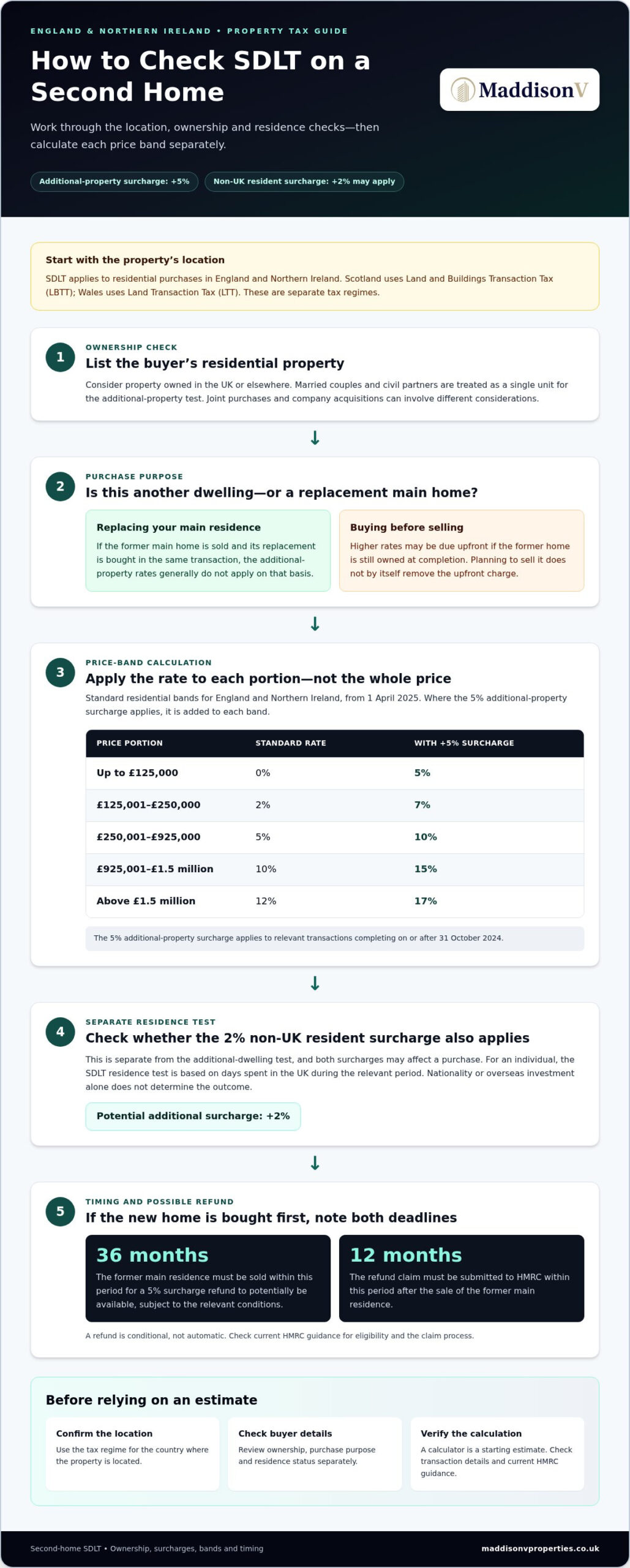
For an England or Northern Ireland purchase, the standard residential bands from 1 April 2025 are 0% up to £125,000, 2% on the portion from £125,001 to £250,000, 5% from £250,001 to £925,000, 10% from £925,001 to £1.5 million and 12% above that. The higher rates add five percentage points to each band. For example, on a £300,000 additional-property purchase, the higher rates apply separately to each portion, not as one rate on the full price.
That distinction is central to estimating stamp duty land tax for second homes 2026. MaddisonV Properties’ online stamp duty calculator can provide a practical estimate. Before relying on the figure, check the buyer’s circumstances and current HMRC guidance.
Does the Higher SDLT Rate Apply to Your Second Home?
A property’s marketing description doesn’t determine its SDLT treatment. SDLT eligibility depends on the transaction facts, not simply a buyer’s label for the property. Before relying on a rate estimate, establish where the property is, who is buying it, what residential property the buyer owns and whether the purchase replaces a main residence.
Use this checklist to organise the details that can shape the assessment:
- Property location: Confirm the property is in England or Northern Ireland, where SDLT applies.
- Buyer and ownership: Identify the legal buyer and consider residential property owned in the UK or elsewhere. Married couples and civil partners are treated as a single unit for the additional-property test.
- Purchase purpose: Establish whether the acquisition adds a dwelling to existing ownership or is intended to replace the buyer’s main residence.
- Residence status: Assess the separate SDLT test for non-UK residents. Nationality or overseas investment alone doesn’t determine the outcome.
Check these details before selecting a rate table. Official UK government guidance on SDLT residential property rates sets out the current residential rules, including higher rates and the non-UK resident surcharge. The two surcharges address different circumstances and may both affect a purchase.
Buying another property or replacing your main residence?
If you sell your former main residence and buy its replacement in the same transaction, the additional-property rates generally don’t apply on that basis. If you buy the new home before selling the old one, the timing changes the initial calculation: higher rates are due upfront, but a refund of the 5% surcharge may be claimed if the previous main residence is sold within 36 months. The claim must be submitted to HMRC within 12 months of that sale. A refund is conditional, not automatic, so check the eligibility requirements and process.
For example, if you complete on a new main home while still owning your former one, budget for the higher amount at completion. Then assess whether the sale and claim meet HMRC’s requirements. Planning to sell the former home doesn’t by itself remove the upfront charge.
How non-UK residence can affect an SDLT calculation
The non-UK resident surcharge is separate from the additional-dwelling test. For an individual, the SDLT residence test is based on days spent in the UK during the 12 months before the purchase: fewer than 183 days means the buyer is treated as non-UK resident for this purpose. This is a specific SDLT test, not a general conclusion about tax residency, nationality or where someone invests.
A 2% non-resident surcharge can apply in addition to other SDLT rates, including the 5% additional-property surcharge. Review ownership and residence separately, then combine any applicable charges only after checking the transaction facts. For a preliminary estimate, use MaddisonV Properties’ online stamp duty calculator, then verify the result against current HMRC guidance.
How to Calculate SDLT on a Second Home in 2026
A useful estimate starts with the right facts, not just the purchase price. The stamp duty land tax for second homes 2026 depends on the property’s location, the buyer’s circumstances and the rules in force for the transaction. Follow these steps, then compare your working with current official guidance.
- Identify the property’s location. Use the SDLT process only for residential property in England or Northern Ireland. A home in Scotland or Wales falls under a separate tax regime.
- Establish the buyer’s circumstances. Note who is purchasing, what residential property they own and whether the new purchase replaces a main residence. Consider the non-UK resident test separately if it’s relevant.
- Check the current bands and rates. Confirm the rules that apply on the transaction date, including any additional-property or non-resident rates that may affect the calculation.
- Calculate each portion of the price. Apply each rate only to the slice of the purchase price within that band, then add the amounts together.
Which details should you have ready before calculating?
Gather the agreed purchase price, property location, expected completion date and information about the buyer’s residential property ownership. Establish whether the purchase adds another dwelling or replaces a main home, and whether the former home has already been sold. For an individual buyer, residence status may also matter under the separate SDLT test. Clear inputs make it easier to understand the assumptions behind a calculator’s result.
How to check the result against current SDLT rates
Use MaddisonV Properties’ stamp duty calculator for an initial estimate, then cross-check it with the official HMRC SDLT calculator and the rate guidance for your transaction date. Make sure your inputs reflect additional-property status and, where relevant, non-UK residence. A calculator can process the information entered, but it can’t correct an inaccurate assumption about ownership, replacing a residence or the buyer’s status.
For illustration, a £400,000 additional-home purchase in England or Northern Ireland, with no non-UK resident surcharge, would be calculated using the higher-rate bands. The calculation is:
- 5% of the first £125,000: £6,250
- 7% of the next £125,000: £8,750
- 10% of the remaining £150,000: £15,000
The illustrative total is £30,000. Each percentage applies to its own portion, rather than one rate being charged across the full £400,000. If the buyer’s circumstances trigger another applicable rate or a different treatment, the figure changes. Use the example to understand the method, not as a substitute for checking your own purchase against current HMRC rules.
Before Completion: Check Timing, Reliefs and Possible Corrections
An SDLT estimate is only as reliable as its assumptions. Before completion, confirm the property’s location, expected completion date, agreed purchase details and buyer circumstances used in the calculation. Rules can change, so don’t rely on an older article, a remembered budget announcement or an estimate prepared for a different transaction date.
Keep a clear record of your calculation. Note the price, the answers entered into each calculator, the rate guidance used and when you checked it. If the purchase details or timing change, this record makes it easier to revisit the estimate and identify which assumption needs reviewing.
What to verify before the transaction completes
Use this short review to align your calculation with the transaction:
- Tax regime: Confirm the property’s location and the relevant UK transaction tax.
- Transaction date: Check the expected completion date against the rules in force for the purchase.
- Purchase details: Recheck the agreed price and the nature of the residential property being acquired.
- Buyer circumstances: Review the ownership and residence information used in the estimate.
- Calculation record: Save the calculator inputs, result and official guidance consulted.
For SDLT purchases in England and Northern Ireland, the return must be filed and tax paid within 14 days of completion. Include this in the transaction timetable so the filing step is planned alongside completion.
When a refund or correction may be relevant
A refund may be relevant if higher rates were paid and the buyer later meets HMRC’s conditions for a qualifying main-residence replacement. As explained above, selling a home alone doesn’t establish a right to repayment. Review your circumstances and HMRC’s current claim instructions before taking action. Keep supporting transaction records together so the basis for any claim is clear.
If you spot a possible error in a calculation or submitted return, check HMRC’s current instructions for the appropriate correction process and any applicable time limits. Keep the original and revised figures, along with the transaction details that support them. This helps distinguish an input error from a genuine change in the purchase circumstances.
Tax is one part of a considered acquisition, alongside financing and property selection. For wider market context, MaddisonV’s UK property investment guide can help frame your research. You can also use MaddisonV’s stamp duty calculator for an initial estimate, then check the assumptions against official guidance.
Build Second-Home SDLT into a Considered Property Purchase
A second-home purchase is easier to assess when the tax estimate is one part of the decision, rather than an isolated figure. For stamp duty land tax for second homes 2026, start with a calculation based on verified transaction details, then consider it alongside the property’s purchase price, financing plan and investment objectives.
If you’re comparing properties, prepare a separate assessment for each one using its own price, location, ownership circumstances and completion timing. This makes each SDLT estimate more meaningful and helps prevent assumptions from one potential purchase carrying over to another.
Compare the purchase decision using verified figures
Keep each part of your assessment distinct. SDLT is an acquisition cost; financing terms affect the capital required and ongoing commitments; rental yield depends on income and costs; and future market performance is uncertain. Combining these figures into a single headline return can obscure important differences between properties.
A clear comparison might record:
- Purchase details: the agreed price, location and expected completion date.
- Tax estimate: the SDLT figure calculated using the buyer and transaction details, then checked against current official guidance.
- Financing: the relevant mortgage assumptions and expected funding requirements.
- Property assessment: the expected rental income, costs and other investment considerations, kept separate from the tax calculation.
For example, a property’s SDLT estimate may differ because of its price or the buyer’s circumstances, while another property may have different financing needs or rental assumptions. The tax outcome alone doesn’t establish whether either purchase is suitable or profitable. Review the figures together, but don’t treat an estimate of tax or rent as a promise of investment returns.
If borrowing forms part of your decision, consider the assumptions behind the proposed mortgage alongside the acquisition costs. MaddisonV’s buy-to-let mortgage guide offers relevant context for reviewing financing as part of a property purchase. Keep SDLT calculations grounded in current official guidance, rather than treating a calculator or property investment discussion as tax advice.
Where MaddisonV fits into the acquisition process
Buying assistance can bring structure to the wider transaction, from property search and mortgage consultations to conveyancing guidance and solicitor referrals. MaddisonV Properties’ team brings over 50 years of combined experience to its property work. This support can help organise your purchase, while tax eligibility and liability should be verified against official guidance.
Build a verified SDLT estimate into your acquisition plan alongside property selection and financing. Explore MaddisonV’s property consultancy services for support with your property purchase.
Make Your Next Property Decision with Clarity
A well-planned purchase starts with a clear view of the people, process and priorities involved. Use your stamp duty land tax for second homes 2026 estimate as one part of the wider decision, alongside your financing plans and the qualities you want in a property. Keep your assumptions organised and revisit them if your plans change.
MaddisonV Properties brings over 50 years of combined experience across the team. Its buying assistance covers property search, mortgage consultations, conveyancing guidance and solicitor referrals, while its online stamp duty calculator provides a practical starting point for an estimate. These resources can help structure your acquisition planning, but they don’t replace official tax guidance.
Prepare your figures, check them against current guidance and take your next step with a clear plan. Explore MaddisonV’s property consultancy services for support with your property purchase.
Frequently Asked Questions
What is the higher rate of Stamp Duty Land Tax on a second home in 2026?
For qualifying additional residential purchases in England and Northern Ireland, the higher-rate bands are 5%, 7%, 10%, 15% and 17%, applied to the corresponding portions of the price. One headline rate won’t tell you the full bill. A purchase below £40,000 is excluded from the higher rates on additional properties, though that threshold alone doesn’t establish whether other SDLT is due.
Do I pay the higher SDLT rate if I am buying a new main home?
It depends on the sequence and circumstances of the sale and purchase. Before setting your budget, note the expected completion dates for both transactions and whether you’ll still own the former home when the new purchase completes. If the order changes, revisit the estimate rather than assuming the original calculation still applies. Check HMRC’s replacement-residence conditions before relying on an exception or refund.
Do non-UK residents pay an extra SDLT charge on a second home?
An additional charge may apply under the separate non-UK resident rules, alongside any applicable additional-property rates. The relevant test is specific to SDLT, so don’t infer the answer from nationality, an overseas address or ownership of a home abroad. If your circumstances involve more than one buyer or a company, review the relevant HMRC guidance for that buyer structure rather than assuming an individual’s test applies.
How is SDLT calculated on a second home?
Apply the relevant rate bands to each portion of the purchase price, then add the amounts together. To cross-check the result, compare the details entered into a calculator with your transaction documents, especially the agreed price and buyer information. Multiple Dwellings Relief, which previously affected some purchases of several dwellings in one transaction, was abolished for transactions from 1 June 2024.
Does SDLT apply to second homes across the whole UK?
No. SDLT is the relevant property transaction tax in England and Northern Ireland. Scotland and Wales operate separate regimes, Land and Buildings Transaction Tax and Land Transaction Tax respectively. If your portfolio spans more than one UK nation, assess each property under the regime for its location. Don’t use an England or Northern Ireland SDLT estimate as a proxy for a home elsewhere in the UK.
Can I reclaim higher-rate SDLT if I sell my previous home?
A refund may be available in qualifying circumstances, but selling your former home doesn’t by itself establish entitlement. If you believe you qualify, keep the purchase and sale records together and follow HMRC’s current claim process. Check the required information and applicable deadline before submitting a claim, and retain a copy of the claim and supporting documents.
When should I calculate SDLT for a second-home purchase?
Estimate the tax while comparing properties, then review it against the final transaction details before completion. Save the date, inputs and result so you can see which assumptions informed your budget. If the agreed price, buyer details or transaction timing changes, update the calculation and compare it with current official guidance. A calculator is a planning aid, not a determination of your tax liability.

Sign Up Now
Want to read more great articles and blogs subscribe to our newsletter