If you hold a property title in a foreign jurisdiction, do you truly own the land beneath it, or are you merely a long-term guest of the state? For...

If you hold a property title in a foreign jurisdiction, do you truly own the land beneath it, or are you merely a long-term guest of the state? For international investors, the distinction between freehold vs leasehold property dubai often feels like a legal labyrinth, particularly when compared to the familiar leasehold systems of London. You likely prioritize the absolute security of your family’s legacy and the fluidity of your asset’s exit strategy. It’s natural to feel a sense of hesitation when local laws differ from the Western frameworks you trust.
This guide provides the definitive clarity you need to move capital with confidence. We’ll dismantle the complexities of Law No. 7 of 2006 and show how your choice of tenure directly dictates your eligibility for the Dubai Golden Visa. You’ll gain a sophisticated understanding of current designated zones, inheritance protections for non-residents, and strategic forecasts through 2030. We handle the intricate details so you can focus on the rewards of a high-yield, passive investment.
Key Takeaways
- Understand the foundational legal protections of Law No. 7 and why Dubai continues to serve as a premier safe haven for international capital in 2026.
- Master the strategic nuances of freehold vs leasehold property dubai to determine which structure best supports your specific capital growth or rental yield targets.
- Identify how freehold title provides perpetual sovereignty and simplified inheritance pathways for your family’s global legacy.
- Evaluate the 99-year leasehold framework as a sophisticated, tactical entry point for high-yield investment opportunities in designated zones.
- Learn how professional property sourcing and management can bridge the gap between your London and Dubai portfolios with effortless oversight.
The Evolution of Dubai Property Law: Contextualising Ownership in 2026
The introduction of Law No. 7 in 2006 marked a transformative shift in the Middle Eastern real estate landscape. It provided the legal architecture necessary for non-GCC nationals to acquire property in the emirate, effectively ending the era of uncertainty for foreign capital. By 2026, this framework has matured into a robust system that balances state interests with private ownership rights, offering a level of transparency that rivals the world’s most established markets.
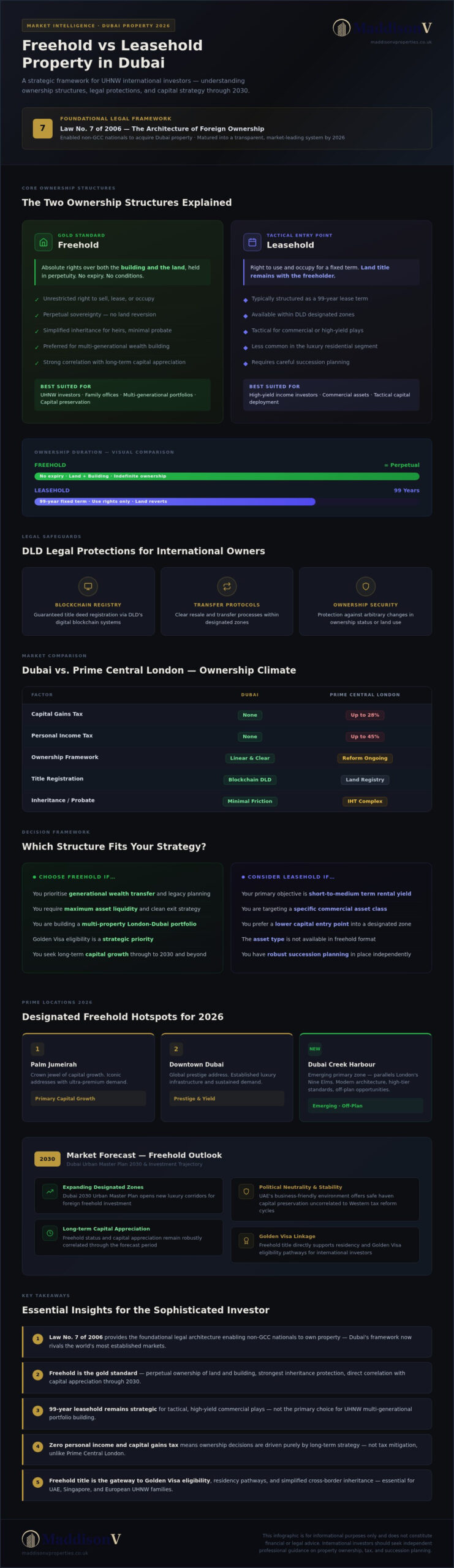
Understanding the distinction between freehold vs leasehold property dubai is the first step toward building a resilient portfolio. Freehold ownership grants the buyer absolute rights over both the building and the land it occupies in perpetuity. It’s the gold standard for those seeking generational wealth and total control. Conversely, leasehold ownership provides the right to use and occupy a property for a fixed term, typically 99 years, while the land title remains with the freeholder. While less common in the luxury segment, it remains a tactical choice for specific commercial or high-yield plays.
The Role of ‘Designated Areas’ for Foreign Investors
The Dubai Land Department (DLD) strictly regulates where international buyers can exercise these rights through “Designated Areas.” These zones have expanded significantly under the Dubai 2030 Urban Master Plan, opening up new luxury corridors for investment. Legal protections for international owners are comprehensive, ensuring that once a title is registered with the DLD, the owner’s rights are indisputable. Investors benefit from several key safeguards:
- Guaranteed registration of title deeds through the DLD’s digital blockchain systems.
- Clear protocols for property resale and transfer within designated zones.
- Protection against arbitrary changes in ownership status or land use.
Comparative Stability: Dubai vs. Global Real Estate Hubs
Dubai’s property market offers a level of clarity that often surprises those accustomed to the historical complexities of Prime Central London (PCL). While the UK navigates intricate leasehold reforms and shifting tax structures, Dubai’s system remains refreshingly linear. Dubai serves as a premier safe haven for 2026 investors due to its unique blend of high-yield potential, political neutrality, and ironclad property rights. The UAE’s business-friendly tax environment, which lacks personal income or capital gains tax on property, ensures that ownership choices are driven by long-term strategy rather than tax mitigation. This stability allows you to focus on the aesthetic and functional standards of your portfolio while we handle the operational complexities.
Freehold Ownership: Perpetual Sovereignty in Dubai’s Prime Zones
Freehold title provides the ultimate level of legal control, granting you the unrestricted right to sell, lease, or occupy your property indefinitely. For a family office or a high-net-worth individual, this isn’t merely a residential choice; it’s a permanent stake in a global financial hub. Unlike the complex leasehold structures often found in Prime Central London, Dubai’s freehold system offers a clean, perpetual ownership of both the structure and the land. This absolute sovereignty is the primary reason UHNW investors prioritize freehold assets when building multi-generational portfolios.
One of the most significant advantages for international owners is the clarity regarding succession and inheritance. Freehold assets can be passed to heirs with minimal local probate friction, offering the same level of security one might expect from a Georgian townhouse in Mayfair or a luxury apartment in Knightsbridge. This legal simplicity removes the common anxieties associated with cross-border asset management. As we look toward the 2030 market forecast, the correlation between freehold status and long-term capital appreciation remains robust, making it the preferred vehicle for capital preservation in 2026.
Designated Freehold Hotspots for 2026
While Palm Jumeirah and Downtown Dubai remain the crown jewels of capital growth, the 2026 landscape features a shift toward sophisticated new-build developments. Dubai Creek Harbour has emerged as a primary interest for those familiar with London’s Nine Elms, offering a similar blend of modern architecture and high-tier standards. For investors seeking off-plan investment opportunities, these freehold zones provide a balanced risk-to-reward ratio. Identifying these high-yield, off-market opportunities requires a deep understanding of the freehold vs leasehold property dubai divide to ensure your capital is positioned in the most resilient sectors.
Ownership and the Dubai Golden Visa Pathway
The relationship between property ownership and residency is a critical factor for international buyers. Holding a freehold title deed is the primary facilitator for the Dubai Golden Visa, provided the asset meets the required investment threshold for 2026. This 10-year renewable residency provides a strategic second base for Singaporean, American, and European investors, allowing for fluid travel and lifestyle flexibility. It caters to families by securing a long-term presence near elite educational institutions and private members’ clubs. Our team at MaddisonV Properties acts as a global bridge for investors, ensuring that your property acquisition aligns perfectly with your residency, tax, and estate planning goals.
Leasehold Realities: Navigating the 99-Year Framework
While freehold ownership is the primary target for many international buyers, leasehold structures offer a tactical alternative for specific investment goals. In this framework, you aren’t purchasing the “dirt” itself but rather the legal right to use and occupy the property for a fixed duration, typically 99 years. This distinction is vital for those managing diverse portfolios; leasehold is a right of use rather than absolute land sovereignty. For the sophisticated investor, the question isn’t whether leasehold is a wasting asset, but how it fits into a broader capital allocation strategy.
The Dubai Land Department (DLD) oversees these arrangements with the same level of digital transparency found in freehold zones. Renewal rights are generally protected, and the DLD provides clear pathways for lease extensions, alleviating the anxieties often associated with fixed-term ownership. These properties are frequently located in established, cultural districts where freehold title isn’t available to non-GCC nationals, providing a unique entry point into “old money” neighborhoods that boast high occupancy rates and mature infrastructure.
Dubai Leasehold vs. London Mansion Blocks
Investors familiar with Prime Central London (PCL) will find striking parallels between Dubai’s 99-year framework and the leasehold system governing London’s iconic Mansion Blocks in areas like Marylebone or Knightsbridge. In both markets, owners are responsible for service charges and ground rent, though Dubai’s modern infrastructure often results in more predictable maintenance costs. A 99-year lease in Dubai is functionally equivalent to freehold for most investment horizons, as a century-long term easily accommodates multi-generational planning and multiple market cycles. Unlike the UK, where lease extensions can involve complex legal negotiations, Dubai’s regulatory environment is designed for speed and clarity.
Niche Yield Opportunities in Leasehold Districts
Leasehold assets often present a compelling case for rental yield optimization. Because the entry price for a leasehold property is generally lower than its freehold equivalent, the net ROI can be significantly higher, particularly in high-demand commercial hubs or districts targeting short-term professional stays. However, risk assessment is paramount. We advise our clients to consider the following when evaluating leasehold liquidity:
- Remaining Term: Resale liquidity typically remains stable until the lease term drops below 30 to 40 years.
- Location Maturity: Leasehold is most effective in established areas where land is scarce and demand is inelastic.
- Portfolio Balance: Use leasehold for tactical cash flow while anchoring your legacy in freehold assets.
Deciding between freehold vs leasehold property dubai requires a nuanced look at your exit strategy. While freehold dominates the capital appreciation narrative, leasehold remains a sophisticated tool for investors who prioritize immediate income and strategic positioning in Dubai’s most historic enclaves.
Freehold vs Leasehold: A Strategic Decision Framework for Investors
Selecting the right tenure between freehold vs leasehold property dubai is a decision that should align with your specific wealth management objectives. While the legal definitions are clear, the real-world impact is felt in your portfolio’s liquidity and your level of operational control. In the 2026 market, freehold assets remain the dominant force for capital appreciation. Investors looking toward the 2030 horizon favor freehold because it offers total sovereignty over the land, which historically correlates with higher resale values and superior secondary market liquidity. It’s the standard choice for those who view Dubai as a safe haven for long-term capital preservation.
Leasehold properties can serve as a tactical tool for investors who prioritize immediate cash flow over generational legacy. Because leasehold entry prices are often lower, the net rental yield can be higher on a percentage basis. However, you must weigh this against the loss of control. Freeholders typically influence building management and renovation schedules through owners’ associations. Leaseholders have limited say in these operational details, which can affect the long-term aesthetic and functional standards of the asset. For the UHNW investor, the ability to maintain a high-quality experience for end-users often justifies the premium associated with freehold ownership.
The Investor’s Matrix: Yield vs. Legacy
We categorize assets into two distinct streams: legacy assets and tactical yield plays. Legacy assets are almost exclusively freehold, designed for generational wealth transfer and permanent residency. Tactical yield plays may include leasehold units in established commercial hubs where occupancy is high and the 99-year term is more than sufficient for a 20-year exit strategy. A sophisticated off-plan property investment in a freehold zone often provides the best of both worlds, capturing early-stage capital growth while securing perpetual rights. Understanding this freehold vs leasehold property dubai matrix is essential for balancing a global portfolio that spans both London and the UAE.
Financing and Mortgages in 2026
Lender appetite in 2026 remains significantly stronger for freehold assets, particularly for non-resident buyers from the USA, Singapore, and Europe. Most banks offer more competitive Loan-to-Value (LTV) ratios for freehold properties because the underlying land provides better collateral security. If you’re looking to leverage your investment, freehold title often unlocks lower interest rates and more flexible repayment terms. We recommend reviewing our buy-to-let mortgage guide to understand how your choice of ownership affects your financing power. Our team at MaddisonV can help you source high-yield off-market opportunities that align with your financing and residency goals, ensuring every detail is managed with professional precision.
Securing Your Legacy: How MaddisonV Navigates Dubai’s Ownership Structures
At MaddisonV Properties, we recognize that the choice between freehold vs leasehold property dubai is rarely about the legal definition alone; it’s about how that choice integrates into a wider global wealth strategy. Our boutique advisory acts as a sophisticated bridge between the London and Dubai markets, applying the same rigorous “Market Intelligence” approach to both. We alleviate the anxieties of property ownership by handling every operational detail, from initial sourcing to long-term facilities management. This allows our clients to enjoy the rewards of their portfolio with total mental tranquility and effortless oversight.
Our commitment to excellence ensures that nothing is left to chance. Whether you’re acquiring a mansion block in Knightsbridge or a waterfront villa in Dubai Creek Harbour, our team provides a seamless, high-tier experience. We specialize in identifying off-market opportunities that align with your lifestyle prestige and financial goals, positioning us as the premium partner for UHNW families moving capital between these two global hubs.
Comprehensive Sourcing and Due Diligence
Success in the Dubai market requires more than just capital; it requires meticulous due diligence. We verify every title deed and ownership status within designated zones to ensure your investment is legally ironclad. Our property sourcing agents London apply stringent UK standards to the UAE landscape, providing a level of transparency that’s often missing in traditional brokerage models. We guide you through the entire lifecycle of the acquisition, including:
- Identifying exclusive, off-market freehold assets in high-growth corridors.
- Managing complex conveyancing processes with professional precision.
- Facilitating seamless UK and UAE bank account setups for international investors.
- Providing expert mortgage consultations to optimize your LTV ratios.
The Future of Your Portfolio (2026–2030)
As we look toward the 2030 Dubai Urban Master Plan, the importance of strategic positioning cannot be overstated. We don’t just look at current rental yields; we forecast long-term capital growth and market shifts to ensure your portfolio remains a safe haven for your capital. This forward-looking perspective includes detailed estate planning and inheritance tax considerations, ensuring your assets are protected for future generations without local probate friction. Our success-based fee model reflects our confidence in identifying high-yield opportunities that stand the test of time. You can secure your 2026 investment strategy with MaddisonV and experience a partnership defined by integrity, prestige, and ambitious growth.
Positioning Your Global Portfolio for 2030
Mastering the freehold vs leasehold property dubai landscape requires more than legal knowledge; it demands a clear vision of your family’s financial future. Whether you prioritize the absolute sovereignty of a freehold villa on the Palm or the tactical yield of a leasehold asset in an established cultural district, your choice should reflect a commitment to quality and stability. Dubai’s status as a safe haven for international capital remains indisputable, offering a level of transparency and digital security that matches the world’s most elite markets.
We understand that the complexities of cross-border investment can be daunting. As specialists in both Prime Central London and Dubai luxury, MaddisonV Properties provides the bespoke portfolio management and expert residency advisory you need to thrive. Our boutique approach ensures your assets are handled with the same creative enthusiasm and clinical precision we apply to our own standards. It’s time to move from active management toward effortless oversight. Secure your 2026 investment strategy with MaddisonV Properties and build a legacy that transcends borders. We look forward to guiding you through this rewarding journey.
Frequently Asked Questions
Can a foreigner own 100% of a property in Dubai in 2026?
Foreigners can indeed enjoy 100% ownership in designated areas. This right was codified in 2006, allowing non-residents to hold title deeds in their own names. It removes the need for a local partner, providing the same level of security you’d expect in Prime Central London. This absolute control is a cornerstone of the freehold vs leasehold property dubai comparison for UHNW families seeking a permanent global base.
What happens to a leasehold property in Dubai after 99 years?
At the end of a 99-year term, the right of use typically reverts to the landowner. However, the Dubai Land Department has established clear, transparent protocols for lease extensions. For most investors in 2026, a century-long horizon is functionally equivalent to perpetual ownership. It comfortably covers multiple generations; though we recommend freehold for those building a permanent family legacy that transcends a fixed timeline.
Are there any taxes on freehold property ownership for international investors?
Dubai remains a tax-efficient sanctuary for international capital. You won’t face personal income tax, capital gains tax, or recurring wealth taxes on your holdings. The primary cost is a one-time 4% Dubai Land Department transfer fee during acquisition. This business-friendly environment contrasts sharply with the complex Stamp Duty and Capital Gains regimes found in the UK, reinforcing Dubai’s reputation as a premier safe haven for 2026.
Which areas in Dubai are designated as freehold for expats?
Several iconic districts allow for full expat ownership. These include established hubs like Palm Jumeirah, Downtown Dubai, and Dubai Marina. Under the 2030 Urban Master Plan, newer luxury corridors such as Dubai Creek Harbour and Emaar Beachfront have also been designated as freehold zones. These areas are specifically designed to meet the high-tier standards of international investors, offering a blend of architectural history and modern, concierge-style living.
Can I get a Golden Visa if I buy a leasehold property?
Residency is indeed accessible through property investment. You can apply for a 10-year renewable Golden Visa regardless of whether your title is freehold or leasehold, provided the asset value exceeds the current government threshold. While both structures facilitate residency, freehold title is the preferred choice for many Singaporean and European families. It offers the mental tranquility of knowing your home and land rights are held in perpetuity.
How does the Dubai freehold system compare to the UK leasehold system?
Dubai’s freehold system is significantly more linear than the UK’s complex tenure structures. London’s Prime Central London market relies heavily on leaseholds with varying terms and ground rents, but Dubai freehold grants absolute ownership of the “dirt” itself. Dubai’s leasehold model is akin to a London mansion block lease but benefits from a modern, digital registry that ensures total transparency in all property transactions.
Is it easier to get a mortgage for a freehold or leasehold property in Dubai?
Financing is generally more accessible for freehold properties. Local and international lenders have a higher appetite for freehold assets because the permanent land title provides superior collateral. You’ll likely secure more competitive Loan-to-Value (LTV) ratios and lower interest rates for a freehold villa compared to a leasehold unit. It’s a critical consideration for investors using leverage to expand their global property portfolios in 2026.
What are the hidden costs of leasehold vs freehold in terms of service charges?
Service charges are a standard part of ownership in both structures. These fees cover facilities management, security, and the maintenance of high-end aesthetics in your building. While freehold owners only pay these community fees, leasehold properties may occasionally involve ground rent. We always advise a thorough audit of the sinking fund to ensure long-term structural repairs are adequately funded, preventing unexpected financial liabilities for the passive investor.

Sign Up Now
Want to read more great articles and blogs subscribe to our newsletter