
What if the most lucrative exit from a luxury development occurs months before the keys are even cut? For the sophisticated investor, the traditional...

What if the most lucrative exit from a luxury development occurs months before the keys are even cut? For the sophisticated investor, the traditional buy-to-hold model is only one path to success. You likely recognize the growing complexity of contract assignment laws and the pressure of the 24% Capital Gains Tax rate. These hurdles, combined with market volatility, mean a robust off-plan property resale strategy is no longer optional. It’s the cornerstone of a resilient, high-growth portfolio in 2026.
This article promises to demystify these challenges, providing you with a roadmap to capture capital appreciation during the 2026-2030 cycle. We’ll outline a clear path for contract assignments that prioritizes financial security, tax efficiency, and effortless execution. You’ll gain a deep understanding of market timing in prestigious neighborhoods like Marylebone and Nine Elms, ensuring your capital remains protected against shifting SDLT surcharges and the 2026 Building Safety Levy. We’ll preview the essential steps to maximize your net returns, compare London’s performance against Dubai’s luxury sector, and position your investments within a framework of absolute prestige, professional oversight, and long-term stability.
Key Takeaways
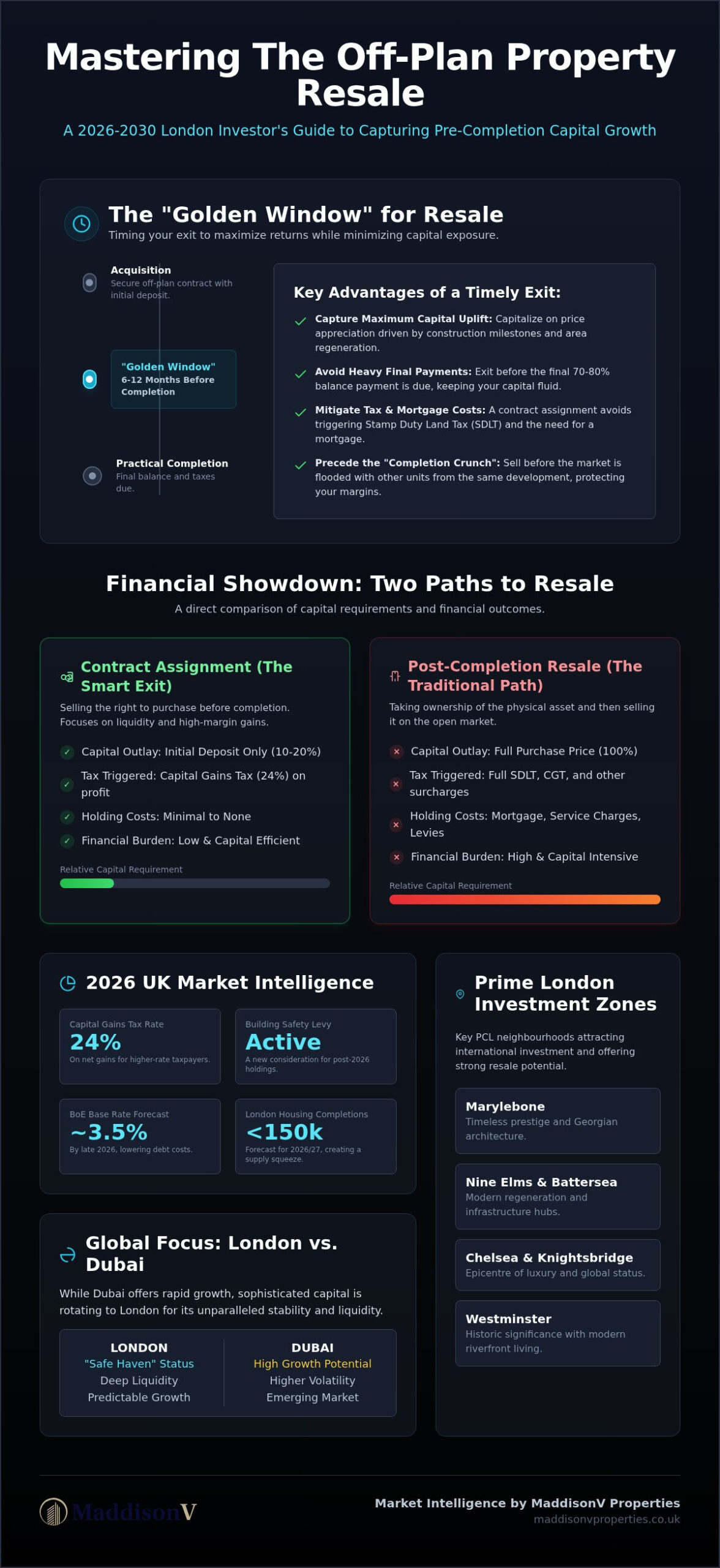
- Identify the “Golden Window” for resale by timing your exit 6-12 months prior to practical completion to capture price step-ups triggered by infrastructure milestones.
- Master the mechanics of contract assignment to secure significant capital appreciation while avoiding the heavy financial burden of final balance payments and mortgage costs.
- Implement a data-driven off-plan property resale strategy that accounts for the 2026 UK tax landscape, including the 24% Capital Gains Tax rate and non-resident Stamp Duty surcharges.
- Compare the superior ROI potential of reselling during the construction phase versus post-completion holding to ensure your capital remains fluid and high-performing.
- Leverage off-market intelligence and bespoke property sourcing to secure exclusive opportunities in Prime Central London neighborhoods like Nine Elms, Marylebone, and Chelsea.
Understanding the Off-Plan Resale Landscape in 2026
The 2026 real estate market has redefined the parameters of capital growth for the global elite. Understanding off-plan property is the first step toward mastering the secondary market, where an off-plan resale involves selling your contractual interest in a property before the building reaches completion. Unlike traditional disposals, this approach allows you to capitalize on the “uplift” in value during the construction phase. It’s a specialized off-plan property resale strategy that focuses on liquidity and high-margin gains without the complexities of long-term management or full completion costs.
London’s Prime Central London (PCL) sector remains the premier choice for this maneuver. In a world of fluctuating currencies, the UK’s capital offers a “Safe Haven” status that continues to attract capital from Singapore, Dubai, and New York. While other markets may offer rapid growth, London provides the depth of liquidity required for a swift and secure exit. Whether you’re holding a luxury apartment in Marylebone or a modern suite in Nine Elms, the ability to find a secondary buyer is underpinned by the city’s enduring prestige and architectural heritage.
The Mechanics of Contract Assignment
A contract assignment is the legal substitution of one party for another before completion. This vehicle is the engine of an effective off-plan property resale strategy. You aren’t selling the physical asset; you’re selling the right to purchase that asset at an agreed price. It’s vital to verify the “Right to Assign” clause in your developer agreement before listing. Working with an independent property sourcing agent in London ensures these legal nuances are vetted before you commit your initial deposit, protecting your exit potential from the outset.
Market Momentum: London vs. Dubai in 2026
The 2026-2030 cycle reveals a fascinating rotation of capital. While Dubai Creek Harbour offers impressive growth, sophisticated investors are pivoting back to London’s historic Mansion Blocks and warehouse conversions. Stability is the primary driver. As the Bank of England base rate is forecast to cut to 3.5% by late 2026, lower debt costs are revitalizing PCL liquidity. London’s Nine Elms provides a predictable trajectory for appreciation compared to more volatile emerging markets. The scarcity of new-build permits in traditional zones makes existing contracts in Battersea highly sought-after for incoming international buyers.
Strategic Market Timing: The Golden Window for Resale
Precision in timing is the hallmark of the elite investor. While many focus on the initial acquisition, the true artistry of an off-plan property resale strategy lies in identifying the “Golden Window” for disposal. This period typically occurs 6 to 12 months prior to practical completion. At this stage, the architectural vision is tangible and the building’s silhouette is established, yet the original purchaser avoids the final 70-80% balance payment and the associated Stamp Duty Land Tax (SDLT). This window captures the maximum capital uplift while maintaining a lean, efficient balance sheet.
Infrastructure milestones act as powerful catalysts for value step-ups. In areas like Nine Elms and Battersea, the full integration of transport links and luxury retail hubs has historically triggered significant price adjustments. As we look toward the 2026-2030 cycle, capital appreciation is projected to peak as London’s housing completions are forecast to fall to just over 150,000 homes in 2026/27. This supply squeeze creates a favorable environment for those holding contracts in high-demand developments. However, one must remain wary of the “Completion Crunch.” Attempting to exit simultaneously with hundreds of other units in a large-scale phase can erode margins. Strategic sellers monitor these timelines to ensure their exit precedes the final rush of available stock.
Integrating these insights into broader real estate investment strategies allows for a more diversified and secure approach to wealth preservation. If you are looking to refine your timing, our team offers bespoke off-plan investment opportunities tailored to your specific liquidity needs and long-term financial goals.
London Postcode Analysis for 2026
Marylebone and Chelsea continue to serve as the gold standard for “Safe Haven” investments. These neighborhoods offer a unique blend of architectural history and modern luxury that remains resilient against market volatility. In Battersea and Nine Elms, the focus shifts to managing the supply-demand balance. Investors are increasingly targeting family-sized apartments, where proximity to elite educational institutions like Westminster School or easy transit to Harrow and Eton provides a significant resale premium.
Dubai Market Forecasts: 2026 and Beyond
The Dubai sector remains a compelling counterpart to London, driven by the ongoing appeal of the Golden Visa and a tax-efficient environment. For those executing a resale strategy in 2026, the key is identifying developments with genuine lifestyle prestige rather than speculative volume. Strategic exit points in the UAE allow for tax-free capital gains, provided the timing aligns with construction milestones. By rotating capital between London’s stability and Dubai’s growth, investors achieve a balanced, high-yield portfolio.
Assignment vs. Post-Completion Resale: A Financial Comparison
The financial architecture of a successful off-plan property resale strategy hinges on a single, pivotal decision: whether to assign the contract or hold for completion. For the ultra-high-net-worth investor, this isn’t merely a matter of preference but a calculated move in capital efficiency. By opting for an assignment, you effectively trade on the total value of the asset while only committing a 10% to 20% deposit. This creates a high-velocity exit that bypasses the need for the final 80% balance payment, mortgage valuations, and the logistical friction of a traditional completion.
Liquidity is the primary advantage of the assignment route. Accessing your capital and profit 12 months before completion allows you to rotate those funds into new opportunities, perhaps in the burgeoning Dubai luxury sector or a different London postcode. This strategy also serves as a robust risk mitigation tool. With over 3,800 construction insolvencies recorded in England and Wales in the 12 months leading up to March 2026, exiting early protects your capital from potential developer delays or the “Completion Crunch” mentioned previously. You secure your gains while the market momentum is in your favor, rather than risking a cooling period during the final months of construction.
The Benefits of Flipping via Assignment
Transactional efficiency is significantly higher when you exit via assignment. You avoid a second round of Stamp Duty Land Tax (SDLT), as the tax liability falls solely on the final assignee who completes the purchase. Assignment allows for leveraged gains on the total property value using only the initial deposit. This means a modest 5% increase in the property’s market value can translate into a 25% to 50% return on your actual cash outlay. Selling before completion also allows you to capture the “New Build Premium” while the unit is still considered pristine, off-plan stock, rather than competing with lived-in secondary market properties that may show signs of wear.
When Holding Until Completion Makes Sense
There are scenarios where holding the asset post-completion is the superior move, particularly in high-demand hubs like Canary Wharf or Battersea. If the objective is long-term wealth preservation and stable rental yields, completing the purchase allows you to benefit from the UK’s robust legal framework and safe haven status. In these instances, the value of professional property management is vital. It ensures your portfolio remains a passive source of income, handling everything from tenant vetting to facilities oversight while you focus on global acquisitions. Balancing your portfolio with completions in London and strategic holdings in Dubai provides a sophisticated hedge against currency fluctuations and regional market shifts through 2030.
Tax Mitigation and Legal Due Diligence for Resale
Success in the luxury market depends as much on fiscal precision as it does on property selection. A sophisticated off-plan property resale strategy must account for the intricate web of UK tax obligations and developer-imposed restrictions. For international investors, the 2026 landscape requires a proactive approach to Capital Gains Tax (CGT). Non-resident individuals are subject to a 24% rate on gains for residential property, with a mandatory reporting and payment window of 60 days from the date of completion. Failing to prepare for this liquidity requirement can significantly erode the net returns of a high-margin flip.
Legal due diligence is equally paramount. Many prestige developers in Prime Central London include “Anti-Flipping” clauses in their initial contracts. These provisions may prohibit the assignment of the contract until a specific percentage of the development is sold or until a certain construction milestone is reached. Navigating these hurdles requires a specialized conveyancing solicitor who understands cross-border transactions and can negotiate developer consent fees. These fees are often a fixed cost or a small percentage of the resale price, and they must be factored into your initial ROI calculations to ensure financial transparency.
If you are looking to optimize your exit, our experts provide bespoke portfolio management services to ensure your transition from acquisition to resale is seamless and tax-efficient.
Tax Efficiency for International Entities
Choosing the right holding structure is a cornerstone of wealth preservation. While personal ownership is straightforward, many ultra-high-net-worth investors utilize offshore companies to manage their London and Dubai portfolios. However, you must weigh the benefits of privacy against the 2% Stamp Duty Land Tax (SDLT) surcharge for non-UK residents and the potential for higher inheritance tax (IHT) exposure. In 2026, the standard IHT rate remains 40% on the value of the estate above the £325,000 nil-rate band. Professional structuring can help mitigate these liabilities, ensuring more of your capital appreciation remains within your estate.
Developer Relations and Resale Restrictions
Maintaining a positive relationship with the developer is a strategic advantage. You should aim to negotiate the right to market your unit through your own channels before the developer has exhausted their remaining inventory. This prevents your unit from being buried in a mass-market campaign. Managing the “Reservation Agreement” is also vital. It ensures a smooth transition of the initial deposit from the original buyer to the new assignee, providing the financial security needed to move your capital into the next high-yield opportunity without delay.
Executing Your Exit: The MaddisonV Advisory Approach
The final phase of a successful off-plan property resale strategy isn’t found in a marketing brochure; it’s forged through exclusive networks and clinical market analysis. While developers often encourage investors to use in-house resale teams, a clear conflict of interest exists. A developer’s primary obligation is to clear their own unsold inventory, often at the expense of an individual investor’s exit price. Navigating this requires the expertise of an independent property sourcing agent in London who represents your interests exclusively. MaddisonV provides this layer of protection, ensuring your disposal is timed to capitalize on peak demand rather than developer convenience.
Our approach identifies high-yield opportunities with optimal exit potential long before the first stone is laid. By maintaining a global network of ultra-high-net-worth buyers in the UAE, Singapore, and the USA, we facilitate off-market transactions that bypass the noise of the public secondary market. This bespoke advisory ensures your resale strategy aligns with your broader wealth goals, whether you’re rotating capital into new Marylebone developments or diversifying into Dubai’s luxury sector. We focus on discretion, precision, and global reach to protect your equity.
Market Intelligence and Data-Driven Exits
We utilize real-time Prime Central London (PCL) data to ensure your exit is as precise as your entry. This intelligence allows us to monitor the supply-demand balance in neighborhoods like Nine Elms and Battersea, protecting your margins from the “Completion Crunch” discussed earlier. For a broader perspective on how these micro-markets interact, our Definitive Guide to the London Market provides the essential context required for UHNW decision-making. Independent advisory offers the clarity and objectivity that developer-led sales simply cannot match.
The Lifecycle of Your Investment
From initial sourcing to the final contract assignment, we provide a seamless, passive experience. We handle the complex operational details so you can enjoy the financial rewards. If your strategy shifts toward completion for long-term yield, our mortgage consultations support those transitioning into long-term hold models. We bridge the gap between clinical management and a genuine appreciation for high-quality environments. To secure your position in the 2026-2030 cycle, Contact MaddisonV Properties for a bespoke off-plan resale consultation today.
Mastering Your Portfolio’s Future Growth
Navigating the 2026 luxury market requires more than just capital; it demands a refined off-plan property resale strategy that prioritizes timing and tax efficiency. By identifying the golden window for contract assignment, you can capture significant capital appreciation while maintaining the liquidity needed for your next acquisition. Whether you’re rotating funds between Prime Central London and Dubai or securing a legacy in Marylebone, the key lies in professional oversight and market intelligence.
MaddisonV Properties specializes in these high-stakes transitions. We’re specialists in the Prime Central London and Dubai luxury sectors, offering a success-based fee structure for sourcing and advisory that aligns our interests with yours. Trusted by UHNW investors across the UAE, Singapore, and Europe, we ensure your portfolio remains a source of passive wealth and mental tranquility. Don’t leave your exit to chance or developer-led sales teams. We invite you to Secure Your Strategic Property Consultation with MaddisonV to ensure your investments continue to perform at the highest tier. Your path to effortless oversight and superior returns begins with a single, expert conversation.
Frequently Asked Questions
What is the best time to resell an off-plan property?
The most advantageous window is 6 to 12 months prior to practical completion. This timing allows you to capitalize on the “uplift” in market value as the project nears handover while avoiding the final 70% to 80% balance payment. It also ensures you exit before the “Completion Crunch” when a sudden influx of units can saturate the local secondary market and depress prices during the final weeks.
Can I sell my off-plan property before construction is finished?
Yes, you can sell your interest through a process known as contract assignment. This legal maneuver allows you to transfer your rights and obligations to a new buyer before the building is physically completed. It is the primary vehicle for a high-margin off-plan property resale strategy, allowing you to capture capital appreciation without ever taking legal title or paying the associated Stamp Duty Land Tax.
What are the tax implications of reselling off-plan in the UK as an international investor?
International investors must account for Capital Gains Tax (CGT) on any profit made from an assignment. As of 2026, non-residents are subject to a 24% rate for residential gains. You must report and pay this within 60 days of the transaction completion. Additionally, while the incoming buyer pays the Stamp Duty, your initial purchase price should reflect the 2% non-resident surcharge to remain attractive to the secondary market.
Do developers allow the assignment of off-plan contracts?
Most developers allow assignments, but they often impose specific conditions within the initial purchase agreement. You might find “Anti-Flipping” clauses that prevent resale until the developer has sold a certain percentage of their own inventory. It is vital to have your solicitor verify the “Right to Assign” clause early. Some developers also require a consent fee, which is typically a fixed administrative cost or a small percentage of the sale.
How is Capital Gains Tax calculated on an off-plan contract assignment?
Capital Gains Tax is calculated on the net profit of the assignment, which is the difference between your original contract price and the resale price. You can deduct allowable expenses like legal fees and developer consent charges. For the 2026/27 tax year, individuals have a £3,000 annual exempt amount. Sophisticated investors often structure these holdings through offshore entities to manage their broader tax exposure and inheritance tax liabilities.
Is it more profitable to sell before or after completion?
Selling before completion via assignment is often more profitable from a Return on Investment (ROI) perspective. Because you only commit a 10% to 20% deposit, any increase in the total property value is significantly leveraged. Post-completion resales require you to pay the full purchase price, Stamp Duty, and mortgage costs, which can dilute your net gains unless you plan to hold the asset for long-term rental yield and capital growth.
What fees are involved in reselling an off-plan property?
Several costs impact your net return. These include developer consent fees for the assignment, specialized conveyancing solicitor fees for cross-border legal work, and commissions for your property sourcing agent. You should also budget for any marketing costs if your unit isn’t sold off-market. Factoring these into your initial off-plan property resale strategy ensures you have a transparent view of your potential liquidity and final profit margins after all expenses.
How does the Dubai off-plan resale market compare to London in 2026?
London remains the premier “safe haven” for UHNW investors, with the Bank of England base rate forecast to fall to 3.5% by late 2026. This supports long-term liquidity in neighborhoods like Marylebone. Dubai offers a faster-paced, tax-free growth environment driven by the Golden Visa program. While Dubai provides rapid capital expansion, London’s Prime Central London sector offers the depth of market and legal stability required for high-value wealth preservation.

Sign Up Now
Want to read more great articles and blogs subscribe to our newsletter