
What if the equity in your home could help you buy another property, but wasn’t money you could put down as a deposit yet? For anyone exploring using...

What if the equity in your home could help you buy another property, but wasn’t money you could put down as a deposit yet? For anyone exploring using equity to buy another property uk, that distinction matters. Your property’s value and mortgage balance help estimate your equity, but the amount you can access depends on whether a lender approves further borrowing and on what terms.
It’s understandable to want a clear figure before taking the next step, especially when extra borrowing could affect your monthly repayments and financial resilience. This guide explains how accessible equity differs from cash in hand, then compares remortgaging, a further advance and a second-charge mortgage. It also covers the costs, affordability and property risks to weigh before committing.
There’s no single route that suits every homeowner or investment plan. A considered approach brings financing into the wider picture, including the target property, acquisition due diligence and your long-term obligations. Mortgage consultations and property sourcing can help connect those decisions, while appropriate financial, legal and tax advice can clarify the implications before you proceed.
Key Takeaways
- When using equity to buy another property uk, distinguish your estimated equity from the funds a lender may actually release.
- Follow a measured sequence: review your finances, estimate your equity, compare borrowing routes and plan the acquisition.
- Compare remortgaging, a further advance and a second-charge mortgage by how each could affect your existing mortgage and finances.
- Prepare a clear picture of your mortgage balances, income, commitments and investment objectives before assessing affordability.
- Assess the proposed property’s investment suitability separately from your ability to borrow, then connect funding decisions with market analysis and due diligence.
Using equity to buy another property in the UK: what it means
Using equity to buy another property in the UK can sound like a straightforward way to fund a deposit. But equity is an ownership stake, not automatically spendable cash. A simple calculation gives you a starting estimate. A lender must still assess the property, your finances and the proposed borrowing before deciding whether to release funds.
Total equity is the estimated value of a property minus the mortgage balance secured against it; accessible equity is the amount a lender may agree to release after its assessment. Keeping these figures separate helps you plan without treating an estimate as money already available for a purchase.
For a visual overview, this video discusses releasing equity to buy another UK property:
How to estimate equity in a property
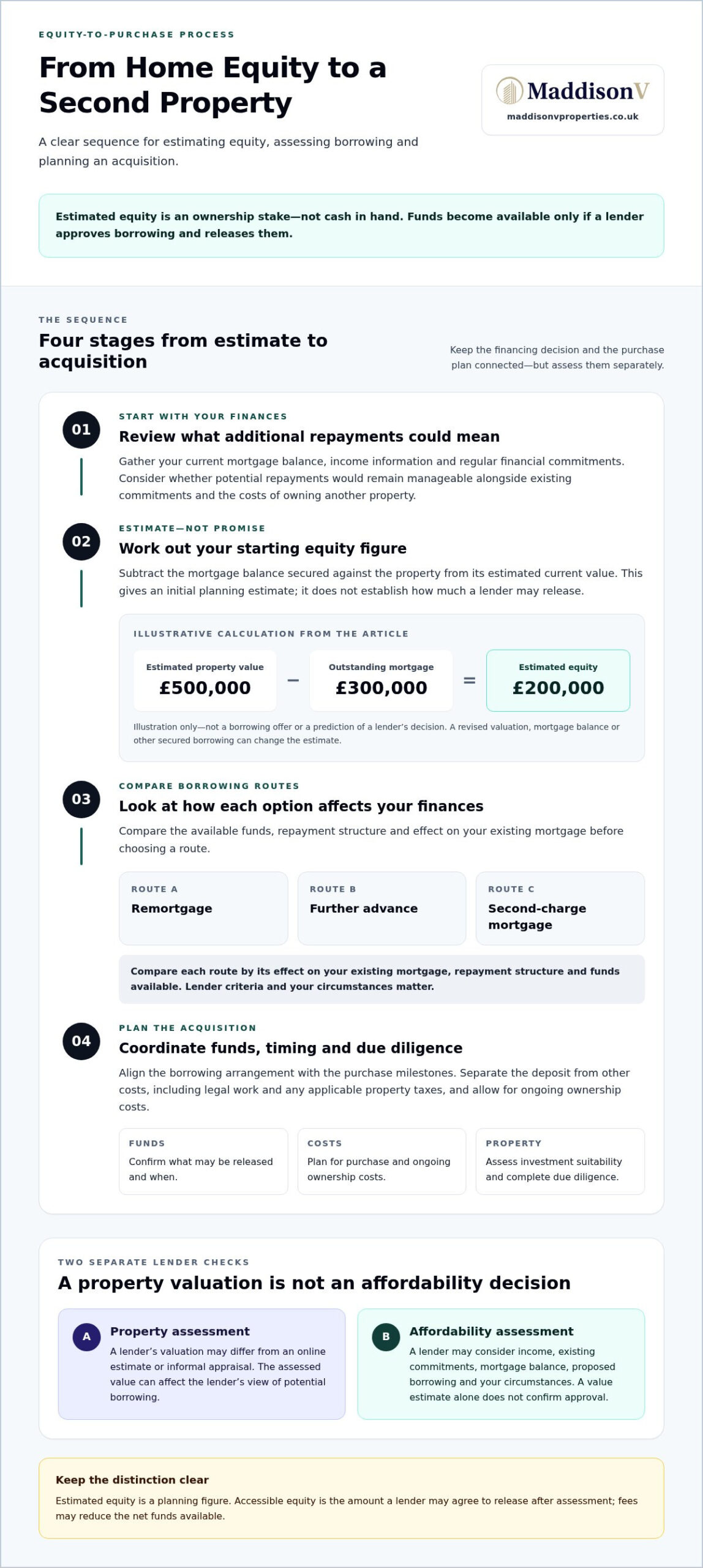
Estimate the property’s current value, then subtract the mortgage balance secured against it. For example, if a property is estimated to be worth £500,000 and the outstanding mortgage is £300,000, the calculation gives £200,000 in estimated equity. This is an illustration, not a borrowing offer or a prediction of a lender’s decision.
The estimate can change. A revised valuation affects the property value, while mortgage payments or other changes affect the balance. An online estimate or informal appraisal can help with early planning, but it may differ from the formal valuation a lender uses. The lender’s assessment may produce a different view of the property’s value.
Why equity and a deposit are not the same
Equity generally becomes usable only after a borrowing arrangement is agreed and the funds are released. Until then, it remains tied to the property rather than available in your bank account for a deposit or purchase costs.
The amount you can borrow may be lower than your estimated equity. Lenders assess affordability and apply their own criteria, considering your income, commitments and the property. Existing borrowing secured against the home can also affect the calculation, and fees may reduce the net funds available. A larger equity figure alone doesn’t guarantee eligibility or approval.
Treat the estimate as a planning tool, not a spending budget. Before relying on potential released funds, consider whether the resulting repayments would remain manageable alongside your existing commitments and the costs of owning another property. This distinction gives you a sounder basis for comparing borrowing routes and assessing the purchase as a whole.
Equity-to-purchase: from valuation to completion
Turning potential equity release into a completed purchase involves two linked decisions: arranging funds against your current property and acquiring the next one. A clear sequence helps keep expectations grounded and avoids committing to a purchase before the financing picture is clear.
Accessible equity depends on both the property’s assessed value and a lender’s borrowing assessment, not on an estimate of value alone. An indicative estimate, a formal valuation and an affordability decision each have a different role. The estimate helps you plan; the valuation and affordability assessment form part of a lender’s decision.
- Review your finances. Gather your current mortgage balance, income information and regular financial commitments to understand what additional repayments could mean for your budget.
- Assess the property and potential equity. Use a current estimate as an initial guide, then allow for the valuation process required by the lender.
- Compare borrowing routes. Consider how each option could affect your existing mortgage, repayment structure and available funds.
- Plan the acquisition. Align the timing of any borrowing arrangement with the proposed property’s purchase milestones, and account for other costs and due diligence.
What lenders may assess before releasing funds
A lender may consider your income, existing financial commitments, mortgage balance and its assessment of the property’s value. It will also assess affordability in light of the proposed borrowing and your circumstances. Criteria differ between lenders and can change, so establish the current requirements as part of the financing process. No single estimate confirms how much may be available.
A lender’s valuation is not interchangeable with an online estimate or your own view of market value. And a valuation that supports the property’s worth doesn’t by itself show that borrowing is affordable. Treat these as separate checks that contribute to the overall decision.
Planning the funds for a second purchase
Build a funds plan before making commitments. Separate the deposit from other purchase costs, such as legal work and any applicable property taxes, then allow for ongoing ownership costs. The sums and timing depend on the transaction, so don’t assume all released funds will be available for the deposit alone.
Purchase milestones matter. Funds need to be released in line with the transaction plan and available when required to proceed. Confirm the sequence of financing and acquisition before relying on equity as part of your purchase funds. For a related perspective on lending for an investment purchase, The Sophisticated Investor’s Buy-to-Let Mortgage Guide (2026 Edition) explores mortgage considerations in a buy-to-let context.
For investors weighing financing alongside an acquisition strategy, MaddisonV’s mortgage consultations can help frame funding considerations within an investment plan.
Remortgage, further borrowing, or second-charge mortgage: how to compare routes
For a homeowner considering using equity to buy another property uk, the right borrowing route depends on more than how much might be released. Each option changes how borrowing is arranged against your current property and adds a financial commitment that needs an affordability assessment. Compare the structure, effect on your existing mortgage and total cost before weighing convenience or the amount potentially available.
| Route | How it’s structured | Impact on existing mortgage | Points to compare |
|---|---|---|---|
| Remortgage | A new mortgage replaces or restructures the existing one, potentially releasing funds. | The current mortgage is changed or replaced, subject to lender terms. | Compare the new terms, repayments, fees and overall borrowing cost. |
| Further advance | Additional borrowing is arranged through your current lender. | Your existing mortgage remains, with extra borrowing added under the lender’s conditions. | Consider the additional repayment, rate and how the lender assesses affordability. |
| Second-charge mortgage | A separate loan is secured against the property alongside the existing mortgage. | The original mortgage remains in place, while a second borrowing commitment is added. | Assess the combined repayments, charges, lender conditions and total cost. |
None is automatically the least expensive or most suitable. Compare the full cost over the relevant borrowing period, not just an initial rate or headline repayment. A route that leaves the existing mortgage untouched may still add a separate payment and affect your overall financial commitments.
When remortgaging may be considered
Remortgaging may suit someone looking to arrange borrowing through a new or restructured mortgage on the property. It can bring borrowing into one mortgage arrangement, but that doesn’t mean the result will be cheaper. New terms may change your repayments and overall cost, and eligibility depends on the lender’s assessment. Compare any costs of changing your current arrangement with the proposed terms.
When additional borrowing may be considered
A further advance or second charge may be considered if you want to preserve your existing mortgage arrangement. They work differently: a further advance comes from your current lender, while a second-charge mortgage is a separate loan secured against the property. In either case, compare the added repayments and total costs, and review the lender’s conditions before deciding.
The key question is how each option fits your wider finances, not simply whether it can release funds. A mortgage consultation can help frame the alternatives in the context of an investment plan. For more on mortgage structure in a rental-property context, The Sophisticated Investor’s Buy-to-Let Mortgage Guide (2026 Edition) offers additional context.
A practical checklist before using equity for another UK property
A sound plan brings your household finances and the proposed investment into focus before you make an offer. When using equity to buy another property uk, separate the borrowing decision from the question of whether the next property is suitable. A lender’s affordability assessment won’t tell you whether the property’s rental assumptions or long-term role in your portfolio make sense.
Gather a clear, current picture of your position:
- Mortgage balances: record the outstanding balance on each relevant mortgage and any other borrowing secured against the property.
- Property estimates: note how each estimate was reached and when it was prepared, recognising that it may differ from a formal valuation.
- Income and commitments: list income sources, regular outgoings and existing financial obligations to assess the effect of additional repayments.
- Investment objectives: define the purpose of the purchase, your intended ownership strategy and how the property fits your wider plans.
- Funds and costs: distinguish the intended deposit from transaction costs and the ongoing expenses of ownership.
Stress-test the plan before making an offer
Consider whether repayments would remain manageable if your income, household costs or borrowing costs changed. Set out a cautious view of cash reserves and ongoing ownership responsibilities rather than relying on every assumption going to plan. If the property is intended to generate rent, treat projected income as an estimate, not a certainty. Don’t build the case on guaranteed occupancy, rental growth or capital appreciation.
Keep two assessments distinct: whether you can afford the borrowing and whether the property’s investment case is robust. A positive answer to one doesn’t settle the other.
Assess the target property as an investment
Review the location, condition, likely demand and intended strategy together. Consider what could affect the property’s appeal to future occupiers, and whether maintenance or other ownership responsibilities fit your plan. For a structured acquisition review, the Due Diligence Checklist for UK Property Investors can help frame the checks to complete before proceeding.
Take particular care with rental assumptions. Identify the expected rent, relevant running costs and the basis for each estimate before assessing potential yield. How to Calculate Rental Yield in the UK provides context for working through those assumptions, but a yield figure alone can’t establish suitability or predict performance.
Before committing, identify tax, legal and transaction-cost questions specific to your circumstances, and have current implications reviewed by appropriately qualified experts. Requirements and treatment can depend on the details, so avoid relying on outdated assumptions.
To consider funding alongside your wider investment plan, explore a tailored mortgage consultation.
How mortgage consultation and property sourcing can support the next step
Once you’ve considered potential funds and borrowing routes, the next decision is how they fit the property you want to acquire. Keep financing and investment analysis connected without treating them as the same decision: establish the funds a lender may make accessible, compare borrowing options, then assess the target property on its own merits.
This sequence can shape practical choices. Likely funding capacity may influence your purchase budget, preferred property type and location, while lender requirements and transaction milestones can affect timing. But borrowing suitability answers whether a financing arrangement may fit your circumstances. It doesn’t establish that a particular property is a sound investment.
- Establish accessible funds: build on your financial review and the lender’s assessment, rather than planning around an unconfirmed estimate.
- Compare financing: consider the structure, repayments and conditions of potential borrowing routes in the context of your wider finances.
- Assess the acquisition: test each potential property against your objectives, investment assumptions and due-diligence findings.
Connect financing decisions with acquisition strategy
A mortgage consultation can help you consider financing within your investment plan rather than in isolation. MaddisonV’s bespoke mortgage consultations draw on a network of lenders to help identify suitable financing options, subject to lender assessment. This can inform the budget and timing you use to shape property criteria, but it doesn’t replace a separate assessment of the property’s investment case.
Property sourcing adds acquisition-focused work to the process. Market analysis, due diligence and negotiation can inform the search and purchase, connecting a funding plan with the realities of a prospective property. The Property Sourcing Agents London: The Investor’s Guide to Prime Acquisitions in 2026 offers further context on the sourcing role.
Take a considered next step with MaddisonV Properties
If you’re considering using equity to buy another property uk, keep the financing and acquisition questions in view together. A tailored mortgage consultation can help you discuss funding options in light of your investment objectives, while property sourcing can support planning for London purchases and wider investment opportunities. These services don’t replace your own assessment of affordability, risk and investment suitability.
Approach the decision with a defined budget, clear purchase criteria and realistic assumptions about ownership. That gives each conversation a practical purpose: understand how financing could shape your options, then assess whether the property fits your strategy. MaddisonV’s sourcing work brings market analysis, due diligence and negotiation into acquisition planning, while mortgage consultations address funding considerations. Together, these perspectives can help you weigh the next step without assuming that borrowing will be approved or that an investment will deliver a particular outcome.
Discuss your property investment plans.
Make your next property decision with clarity
The next step needn’t be to borrow the maximum available. Consider what level of commitment leaves room for changing costs, a measured acquisition timeline and your wider financial priorities. That turns using equity to buy another property uk from a funding question into a considered investment decision.
MaddisonV Properties is a London-headquartered property investment advisory and management firm. Its mortgage consultations and property sourcing bring financing considerations and acquisition planning into the same conversation, while keeping the borrowing decision distinct from whether a property suits your objectives. No consultation can guarantee a lender’s decision or an investment outcome, so your own assessment of affordability, risk and suitability remains essential.
Move forward at a pace that gives each decision the attention it deserves. A clear investment brief and a grounded view of your finances help you explore opportunities with greater purpose.
Explore your next property investment step.
Frequently Asked Questions
What does using equity to buy another property in the UK mean?
It means using funds borrowed against a property you already own towards the cost of another purchase. The lender may ask why you want to raise the funds, so be clear about the intended use and how it fits your purchase plan. Keep records of the amount released and how it is allocated, particularly if it will form only part of the funds needed to complete the transaction.
How do I calculate the equity in my property?
Use a current estimate of the property’s value and subtract the mortgage balance shown on your latest statement. Check whether any other borrowing is secured against the property, as it may affect the amount potentially available. Record the date and source of your estimate so you can update it as the purchase progresses. A lender’s valuation and assessment may differ from your working figures.
Can I use equity from my home as a deposit on a buy-to-let property?
It may be possible, but the proposed buy-to-let mortgage can involve a separate assessment of the property’s expected rent. A lender may test whether projected rental income can support the borrowing, using its own criteria. Prepare realistic rental assumptions and account for periods without a tenant, alongside maintenance and management responsibilities. The rental assessment and the borrowing secured against your home are distinct parts of the overall plan.
Is remortgaging better than a second-charge mortgage for buying another property?
There’s no universal answer. Compare the amount you need and the borrowing period you’re considering, then assess how each option affects your overall payments and costs. Also consider how the timing of a change fits with your current mortgage arrangements. Personalised illustrations can make the trade-offs clearer than headline rates alone.
Does using equity mean I have to remortgage?
No. The suitable structure depends on the lender’s criteria and your existing mortgage arrangements. Be ready to explain the intended purchase, the amount you hope to raise and how the funds will be used. This helps align the borrowing request with the acquisition plan. Approval isn’t automatic, so avoid making an unconditional purchase commitment based solely on an assumed release of funds.
What happens if the value of my property falls after I borrow against it?
A lower valuation can reduce the loan-to-value position on your property and may narrow future refinancing choices. If you later sell, the amount left after repaying secured borrowing could also be affected by the sale price and outstanding balances. Consider how a change in value might affect your longer-term plans, especially if you expect to refinance or sell within a particular timeframe.
Can I use equity to buy a property through a limited company?
It may be possible, but the borrower raising funds against an existing home and the company purchasing the next property are separate parties and decisions. The proposed arrangement can affect lender requirements, documentation and how the purchase is structured. Before proceeding, obtain advice on the legal and tax implications for your circumstances, and establish how the borrowing and company purchase would work together.

Sign Up Now
Want to read more great articles and blogs subscribe to our newsletter