
Your tax status should inform a UK property decision, but it shouldn’t make the decision for you. For property investment for non-domiciled residents...

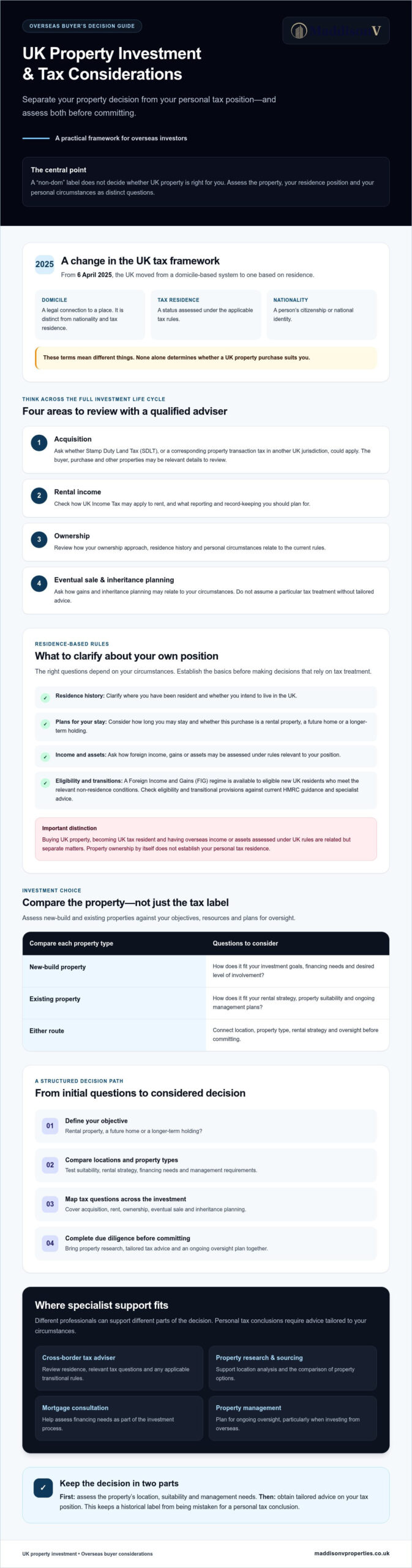
Your tax status should inform a UK property decision, but it shouldn’t make the decision for you. For property investment for non-domiciled residents uk, start by understanding what the term means under today’s rules: since 6 April 2025, the UK has moved from a domicile-based system to one based on residence.
If you’re considering a purchase from overseas, it’s reasonable to ask whether tax and reporting obligations could affect your returns, and how to compare locations and property types remotely. This guide separates tax questions from investment choices, identifies where specialist advice is essential and sets out practical checks to complete before committing.
We’ll cover residence-based rules that may affect foreign income, gains and inheritance planning, alongside the considerations involved in selecting a UK property and ownership approach. You’ll also find a framework for comparing investment options and assessing professional support, including how a property sourcing and management partner can coordinate research, due diligence and ongoing oversight. The aim is to help you make a considered decision based on your circumstances, not assumptions about the “non-dom” label.
Key Takeaways
- Understand why “non-dom” may not answer whether UK property is right for you, and which personal tax questions need specialist advice.
- For property investment for non-domiciled residents uk, map potential tax considerations across purchase, rental income, ownership and eventual sale.
- Compare new-build and existing properties against your investment goals, desired level of involvement, financing needs and management plans.
- Use a structured due diligence process to connect location, property type, rental strategy and ongoing oversight before committing.
- Learn how property sourcing, market analysis, mortgage consultations and property management may support an overseas buyer’s investment process.
What does ‘non-domiciled’ mean for UK property investors in 2026?
Does being described as “non-domiciled” determine whether UK property investment is right for you? No. It’s a label many overseas buyers still search for, but your decision depends on separate questions about the property, your UK tax residence and your personal circumstances. Understanding those distinctions is a more useful starting point for property investment for non-domiciled residents uk than relying on a familiar phrase alone.
For context, watch this overview of UK non-resident Capital Gains Tax:
Is ‘non-domiciled’ still the right term for a 2026 investor?
It remains a common search term, but it shouldn’t be treated as a current tax status that settles your obligations. Domicile is a legal concept concerning a person’s enduring connection to a place. It isn’t the same as nationality or tax residence. You can read more about the legal concept of ‘domicile’, but general explanations cannot determine your individual position.
From 6 April 2025, the UK abolished the remittance basis for non-domiciled individuals and moved to a residence-based system. A Foreign Income and Gains (FIG) regime is available to eligible new UK residents who meet the relevant non-residence conditions. Eligibility, transitional provisions and the tax treatment of particular income or assets need to be checked against current HMRC guidance and specialist advice.
Definition box
Domicile: A legal connection to a place, distinct from nationality and tax residence. Tax residence: A status assessed under applicable tax rules. Nationality: A person’s citizenship or national identity. These terms have different meanings, and none alone determines whether a UK property purchase suits you.
Which personal circumstances should investors clarify first?
Before making decisions that depend on your tax position, establish your residence history, whether you intend to live in the UK and how long you may stay. Clarify your investment objective too: for example, whether you’re considering a rental property, a future home or a longer-term holding. These details help you identify the questions to put to an adviser.
Buying UK property, becoming UK tax resident and having your overseas income or assets assessed under UK rules are related but separate matters. Property ownership by itself doesn’t establish your personal tax residence. Ask a qualified cross-border tax adviser to review your circumstances and any relevant transitional rules before choosing an ownership approach or relying on a particular tax treatment.
Keep the decision in two parts: assess the property’s location, suitability and management needs, then obtain tailored advice on your tax position. This helps you compare investments without mistaking a historical label for a personal tax conclusion.
Which UK property tax questions should overseas investors resolve?
Before comparing properties, map the tax questions across the investment’s full life cycle: acquisition, rental income, ownership and eventual disposal. The phrase property investment for non-domiciled residents uk describes a search, but it doesn’t establish how tax rules apply to a particular investor. Outcomes depend on current rules and personal facts, so treat tax as a due diligence workstream rather than assuming one general answer will fit.
What tax questions arise when buying, letting or selling UK property?
Ask a qualified adviser to review the relevant rules for your circumstances and the property’s location. Your questions may include:
- Acquisition: Could Stamp Duty Land Tax (SDLT), or a corresponding property transaction tax in another UK jurisdiction, apply? Which details about the buyer, purchase and other properties matter?
- Rental income: How might UK Income Tax apply to rent, and what reporting and record-keeping should you plan for?
- Ownership: Could your ownership structure affect tax or reporting considerations, and what should you assess before choosing it?
- Disposal and estate planning: How could Capital Gains Tax (CGT) on a future sale and Inheritance Tax (IHT) considerations relate to your residence history and circumstances?
For a sale, consult HMRC’s Capital Gains Tax rules for non-residents and ask an adviser how they apply to your situation. Keep purchase, ownership, income and expense records together, then confirm which documents and reporting steps are required in your case. This is a planning prompt, not a calculation of your liability.
How can investors check whether UK property tax rules have changed?
Use current HMRC and GOV.UK guidance to verify each rule, its effective date and any transitional provisions before acting. Check that the guidance covers your property’s UK jurisdiction, ownership arrangement and tax residence position. Don’t rely on an old article or a broad “non-dom” label to settle those details.
As of 2026, the government has no current plans to abolish SDLT or Council Tax, although wider property tax reform continues to be debated. Confirm the latest position before publication or a purchase, as proposals and applicable rules can change.
Property investment guidance can help you assess location, property type and management needs, but it isn’t tax advice. A qualified cross-border tax adviser can review your personal facts. For support with property research, sourcing and ongoing management, explore MaddisonV Properties’ investment support.
How should you compare UK property investment routes from overseas?
For property investment for non-domiciled residents uk, the right comparison is not simply new-build versus existing, or London versus another location. Consider how each option fits your objectives, time horizon, financing needs, currency exposure and appetite for ongoing involvement. These factors are connected: a property that suits your rental strategy may still be impractical if you can’t oversee its upkeep from abroad.
New-build versus existing property: what should an overseas buyer weigh?
Compare when you’ll take responsibility for the property, its condition, likely maintenance needs and the oversight you can arrange. With a new-build or off-plan opportunity, review the expected handover context and the information available about the development. An existing property calls for careful assessment of its current condition and any work or ongoing attention it may require. Neither route guarantees stronger returns.
| Factor | New-build or off-plan | Existing property |
|---|---|---|
| Timing | Consider the proposed completion or handover and how it fits your plans. | Assess the acquisition process and when the property may be ready for your intended use. |
| Condition | Review the specifications and available development information carefully. | Evaluate the current condition and identify any maintenance or improvement needs. |
| Oversight | Plan how you’ll monitor progress and prepare for ownership. | Plan for inspections, routine attention and ongoing management. |
| Time horizon | Check that the expected timeline aligns with your investment objectives. | Consider whether the property’s current condition and characteristics suit your intended holding period. |
For either route, compare the location against your tenant or personal-use objectives, not assumptions about performance. London may suit an investor seeking exposure to its property market, while another UK location may better match their priorities. Consider how exchange-rate movements could affect your budget and future cash flows, and assess financing requirements with a qualified mortgage professional. Tax treatment also belongs in the comparison. This comprehensive guide to UK property taxes offers further context, but isn’t a substitute for advice tailored to you.
Personal purchase or company ownership: what needs professional review?
Don’t choose personal or company ownership based on a general claim of tax efficiency. Ask qualified legal and tax advisers to review administration, financing options, succession planning and reporting responsibilities in light of your circumstances. Lenders may assess applications differently depending on the borrower and arrangement, so clarify available routes before committing. MaddisonV Properties’ mortgage consultations can help you explore financing considerations, while property management may support ongoing oversight from overseas.
What due diligence should a non-resident complete before investing?
For property investment for non-domiciled residents uk, careful due diligence connects your investment plan to the realities of owning property from overseas. Location, property type, rental strategy, financing and ongoing management aren’t separate choices: each affects the practical demands of the others. Follow a clear sequence and label assumptions so you can distinguish verified information from estimates.
How can an overseas buyer assess a UK property opportunity remotely?
- Define your objectives. Clarify whether you’re seeking rental income, a longer-term investment or a future home. Set your preferred time horizon and level of involvement.
- Assess locations against those aims. Compare relevant UK markets using the factors that matter to you, such as access, property choice and the management oversight you can arrange. For London, consult current market information and compare specific areas rather than treating the city as one uniform market.
- Request verifiable property information. Ask for available property documents, details of condition and a clear explanation of assumptions behind the proposed rental strategy. Separate confirmed facts from estimates.
- Test the rental and financing picture. Ask what evidence supports projected rent and what costs or periods without rental income have been assumed. Discuss financing with a qualified mortgage professional, and consider how currency movements could affect your budget and cash flows.
- Plan management before purchase. Establish who will handle tenant relations, rent collection and routine maintenance coordination, and what oversight you’ll need to provide from abroad.
- Arrange independent professional review. Engage appropriate legal, tax and property professionals to examine the documents and advice relevant to your circumstances. A sales explanation or estimate is not a substitute for independent review.
What should investors confirm before making an offer?
Before committing, confirm that you understand your financing route, the proposed acquisition timeline works for you and each professional’s role is clear. Have qualified specialists review the property’s condition and relevant documentation. Make sure the management plan suits both the asset and your availability. For a new-build or off-plan opportunity, understand what information is available about the development and proposed handover before relying on projected dates or assumptions.
A remote purchase should still be evidence-led. Keep a record of documents received, questions raised and points that remain unverified. If an estimate matters to your decision, ask what it is based on and have it independently assessed where appropriate.
For coordinated support with London property research, sourcing and due diligence, discuss your investment requirements with MaddisonV Properties.
How can MaddisonV Properties support a considered UK investment?
A well-judged purchase requires more than identifying an appealing property. For overseas investors, research, acquisition decisions and the practicalities of ownership need to fit together. MaddisonV Properties works with private and international clients, with a London focus that includes high-end new-build developments and luxury apartments.
For property investment for non-domiciled residents uk, an advisory partner can help coordinate the property side of your decision while you retain independent tax and legal advisers for personal advice. Property sourcing and investment support can inform your evaluation, but shouldn’t be treated as a tax determination or legal opinion.
What can a property sourcing adviser coordinate?
MaddisonV Properties’ sourcing process includes market analysis, due diligence and negotiation. The discussion can start with your preferred locations, property characteristics and desired level of involvement, then focus research around those priorities. For example, an investor seeking a London apartment with ongoing management support may have different requirements from someone considering an off-plan opportunity and a longer investment horizon.
Clear objectives make a property search more relevant. Share the factors that matter to you, such as property type, intended rental approach and how much oversight you can provide from abroad. Research and due diligence can support an informed acquisition, but can’t guarantee a particular result or investment performance.
What should you prepare for an investment discussion?
A concise brief gives the conversation a useful starting point. Consider preparing:
- Your objectives: What you want the property to achieve and your intended investment horizon.
- Your preferences: A shortlist of locations, property types and any essential features.
- Your involvement level: How much day-to-day oversight you expect to provide, and whether property management may suit your needs.
- Your financing questions: Points you’d like to explore through a mortgage consultation. This can help clarify what to discuss with relevant lenders, without implying that financing is assured.
- Your professional support: Which independent tax and legal advisers will review the implications of your circumstances and proposed purchase.
MaddisonV Properties’ property management can provide ongoing oversight, including rent collection, tenant relations and routine maintenance coordination. Consider it as part of your ownership plan, not as a substitute for deciding whether a particular property aligns with your goals.
If you’re ready to discuss your priorities, Discuss your UK property investment requirements with MaddisonV Properties. A clear brief can shape a focused conversation about sourcing, acquisition support, mortgage consultations and management needs.
Take your next UK property decision with clarity
The “non-dom” label alone doesn’t determine whether a UK property suits your plans. A considered decision starts with understanding your tax position through qualified advice, then weighing property type, location, financing and management against your investment objectives.
For property investment for non-domiciled residents uk, thorough due diligence can bring these connected choices into focus before you commit. MaddisonV Properties can support the property side of that process with sourcing that includes market analysis, due diligence and negotiation. Mortgage consultations and property management are also available to help investors explore financing questions and ongoing oversight. Independent tax and legal advisers remain essential for advice tailored to your circumstances.
Bring your preferred locations, property requirements, investment horizon and questions about oversight to an initial discussion. Discuss your UK property investment requirements with MaddisonV Properties, and take your next step with a clearer brief and a more considered plan.
Frequently Asked Questions
Can a non-domiciled resident buy property in the UK?
Yes, non-UK residents can generally purchase UK property, and the “non-dom” label alone doesn’t determine whether a purchase is possible. Buying property, immigration permission, tax residence and the tax treatment of ownership are separate matters. Before proceeding, ask a UK conveyancer to confirm the transaction requirements for the property and proposed ownership structure. A qualified cross-border tax adviser can assess how your personal circumstances may affect your tax position.
Does non-dom status affect UK property investment in 2026?
The phrase is still widely searched, but it no longer describes the former remittance-basis tax regime, which was abolished from 6 April 2025 and replaced by a residence-based system. For property investment for non-domiciled residents uk, focus on your UK tax residence, residence history and relevant income or assets rather than relying on the label. Some new residents may qualify for the Foreign Income and Gains regime; ask a specialist to assess eligibility and transitional rules.
What taxes should an overseas buyer consider when investing in UK property?
Ask a qualified adviser to review Stamp Duty Land Tax or the applicable property transaction tax, tax on rental income, Capital Gains Tax on a future sale and possible Inheritance Tax considerations. The details may depend on the property’s location, how it’s owned, your residence position and personal circumstances. Keep purchase and rental records organised, and confirm any reporting steps that apply to you with current HMRC guidance or a tax professional.
Can I get a UK mortgage as an overseas property investor?
Possibly, but approval and available terms depend on the lender’s criteria and your individual circumstances. Prepare information about your income, assets, deposit, intended property and ownership structure, then ask lenders or a qualified mortgage professional what they’ll need to assess your application. MaddisonV Properties offers mortgage consultations through a network of lenders, but a consultation doesn’t guarantee a mortgage, a particular rate or approval.
Is buying a new-build or off-plan property better for an overseas investor?
Neither is automatically better. An off-plan purchase may involve a future handover, so review development information, specifications, proposed timings and the assumptions behind any rental estimates. An existing property calls for different checks, including its current condition, maintenance needs and suitability for your rental plan. Compare both against your investment horizon, financing, ability to oversee the purchase and plans for ongoing management before deciding.
Are UK property taxes changing in 2026?
As of 2026, the government has no current plans to abolish Stamp Duty Land Tax or Council Tax, while wider property tax reform remains under discussion. That doesn’t mean every rate, band or related rule is unchanged. Before purchasing or relying on a tax assumption, check current GOV.UK and HMRC guidance for the relevant jurisdiction, effective date and your circumstances, and confirm the implications with a qualified adviser.
How can I manage a UK rental property while living abroad?
Plan how rent collection, tenant communication and routine maintenance will be handled, and agree clearly who is responsible for each task. A property management service can provide practical ongoing oversight. MaddisonV Properties offers management that includes rent collection, tenant relations and routine maintenance coordination. Confirm your tax, record-keeping and reporting responsibilities with a qualified adviser, since appointing a manager doesn’t replace personalised tax guidance.
To discuss property sourcing, mortgage consultations or ongoing management for a UK investment, contact MaddisonV Properties.

Sign Up Now
Want to read more great articles and blogs subscribe to our newsletter