
A limited company can suit UK property investors who plan to retain rental profits for reinvestment. Company-owned residential property can deduct...

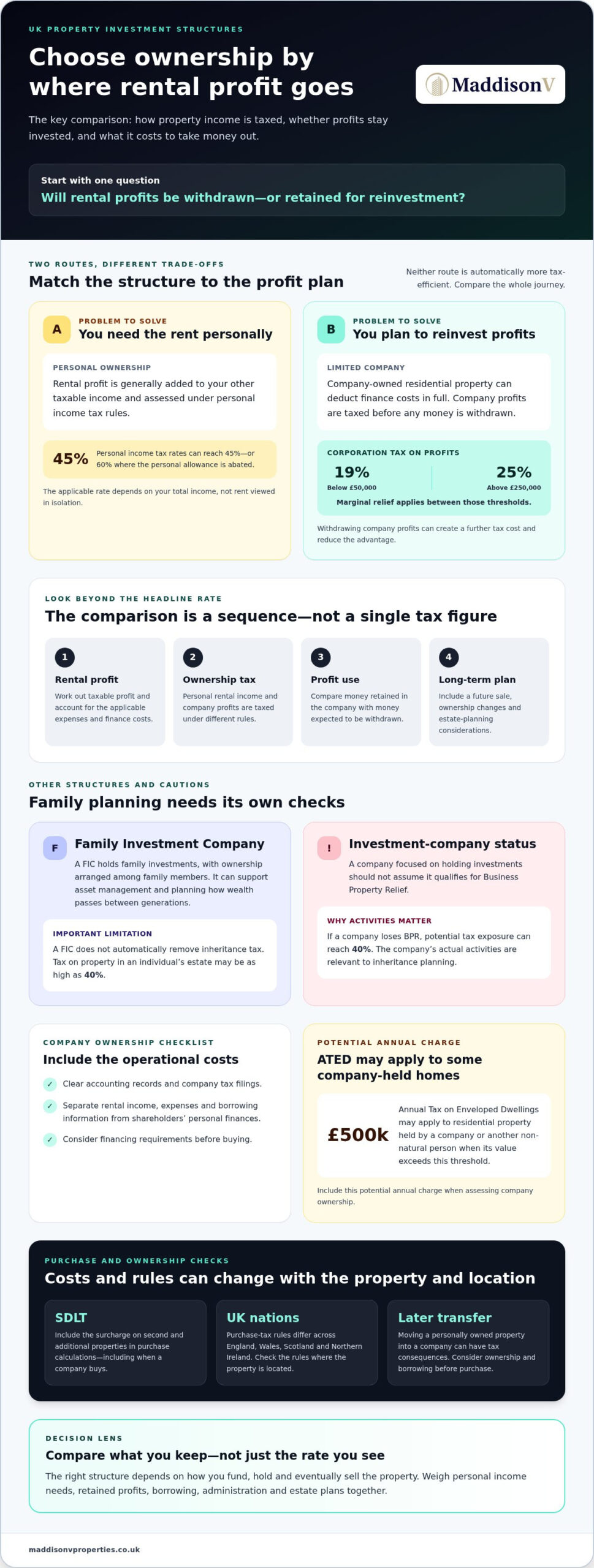
A limited company can suit UK property investors who plan to retain rental profits for reinvestment. Company-owned residential property can deduct finance costs in full, while corporation tax is 19% on profits below £50,000 and 25% above £250,000, with marginal relief between those thresholds. The tax-efficient property investment structures in the UK depend on how you fund, hold and eventually sell the property, since drawing profits out can create a further tax cost.
It’s easy to assume a company structure is automatically more tax-efficient. In practice, the comparison also involves personal tax on rental income, the cost of extracting company profits and Stamp Duty Land Tax, including the surcharge on second and additional properties.
This guide explains how personal and company ownership affect rental income, finance costs, investment decisions and property purchases. You’ll see where each structure may fit, what trade-offs to weigh and why the right comparison goes beyond the headline tax rate.
Key Takeaways
- Compare ownership structures by how rental profits will be used: retained for reinvestment or withdrawn for personal income.
- Assess mortgage finance costs alongside rental income tax; the treatment differs between personal and company ownership.
- Look beyond headline tax rates and factor in profit extraction, future sale and estate-planning considerations.
- Include the second-property Stamp Duty Land Tax surcharge in your purchase calculations, including when a company buys.
- Review the full investment plan before choosing a structure, since changing ownership later can have tax consequences.
What are the benefits of holding investment property in a limited company?
Tax efficient property investment structures UK investors consider include personal ownership, a trading company and a Family Investment Company (FIC). The right choice depends on how you’ll use rental profits, who will own the assets and what inheritance plans matter.
Property tax rules differ across England, Wales, Scotland and Northern Ireland, particularly for purchase taxes. Don’t assume the transaction-tax treatment in one nation applies throughout the UK. Compare the rules for the property’s location.
Family Investment Companies and Inheritance Tax Planning
A FIC is a company used to hold family investments, with ownership arranged among family members. It can provide a structure for managing assets and planning how wealth passes between generations, but it does not automatically remove inheritance tax. UK inheritance tax on property in an individual’s estate may be as high as 40%, so share ownership and estate planning both deserve attention.
Investment-Company Status and Business Property Relief
Investment-company status describes a company whose activity centres on holding investments rather than operating a trading business. That distinction matters for Business Property Relief (BPR), because a property company should not assume its investment activity qualifies. If a company loses BPR, the potential tax exposure can reach 40%, making its actual activities relevant to inheritance planning.
Personal ownership places the property and rental income directly with the individual. A trading company owns property within its business, while an FIC holds assets within a family investment structure. UK companies pay corporation tax at 19% on profits below £50,000 and 25% above £250,000, with marginal relief between those thresholds. Company ownership may suit rental, development or trading activity, particularly when profits remain inside for reinvestment.
Regularly withdrawing company profits can reduce the tax advantage, as extraction may create an additional tax cost. Compare the company’s taxable profit with the amount you expect to receive personally. This distinction matters if you rely on rental income rather than retaining earnings to fund further purchases.
A UK property company also needs clear accounting records and company tax filings. Keep rental income, expenses and borrowing information separate from shareholders’ personal finances, and consider financing requirements before buying. Transferring a personally owned property into a company may have tax consequences, so consider the ownership structure and borrowing before acquisition.
For residential property held by a company or another non-natural person, Annual Tax on Enveloped Dwellings may apply when its value exceeds £500,000. Include this potential annual charge when assessing company ownership. Tax efficient property investment structures UK investors compare should account for both the company’s activities and the property’s use.
A Self-Administered Scheme (SSAS) can sit alongside an FIC as a separate planning vehicle. A SSAS can invest in commercial property and certain permitted loans, but it does not replace the decision about who should own residential investment property. Consider the intended asset and purpose of each structure.
The main drawbacks of company ownership include administration, potential tax on withdrawn profits and uncertainty around inheritance relief. A limited company is not automatically the better option, especially if you need the rental income personally. Compare ownership, profit plans and long-term intentions before choosing.
Personal ownership and rental income tax
Rental profits from personally owned property are taxed as an individual’s income, while limited-company profits are taxed within the company first. This affects the tax calculation and whether profits are available personally or remain invested.
Personal Tax on Rental Profits
For an individual landlord, taxable rental profit is generally added to other taxable income and assessed under income tax rules. Personal income tax rates can reach 45%, or 60% where the personal allowance is abated, so rental income may affect the overall tax position. The relevant rate depends on the person’s total income, not rent viewed in isolation.
According to UK Government, individuals may have a tax-free allowance for the first £1,000 of income from property they rent, unless they use the Rent a Room Scheme. This property allowance is distinct from the Rent a Room Scheme, which concerns letting furnished accommodation in a home. A landlord should account for eligible rent and expenses consistently when working out taxable profit.
Personal ownership can also shape how co-owners report rental income. Jointly owned property income is generally split 50:50 by default, though that allocation may not suit every ownership arrangement. Before filing, establish who is entitled to the rent and keep records that support the reported division. This helps distinguish rental income from other personal income and clarifies each owner’s liability.
Rental Taxation by Ownership Structure
With personal ownership, rental profit is assessed as the owner’s income. With a limited company, the company reports its profit and pays corporation tax. A shareholder may then face a separate tax consequence when withdrawing money, so comparing only the company’s tax rate with an individual’s can give an incomplete picture. The key question is how much profit will be retained and how much withdrawn.
Tax on rental income also depends on the investor’s circumstances and the property’s expenses. For personal landlords, income tax bands apply to taxable profit alongside other income. For a company, profits are recorded in the company’s accounts before any distribution. These differences can affect the cash available for reinvestment, personal spending and future purchases.
Tax administration is changing too. From April 2026, landlords meeting the income threshold must use Making Tax Digital for Income Tax, keep digital records and submit quarterly updates to HMRC. A final end-of-year declaration is also required. Organised rent and expense records make it easier to report figures consistently across the tax year.
From the 2026-27 tax year, a 2% surcharge applies to rental profits from personally held residential property. Separate property income tax rates are scheduled from April 2027: 22%, 42% and 47%. These changes make the timing of income and the ownership structure relevant to forward planning, not merely the tax bill for one year.
Stamp duty affects the purchase rather than the annual taxation of rent, while inheritance tax concerns how assets pass through an estate. Keep these separate from income tax when comparing ownership choices. For landlords focused on smooth rental operations, property management support can help oversee the practical work of a let property.
What is the best business structure for property investors?
Finance-cost relief affects the after-tax return from a residential investment. Compare the relief available to an individual landlord with the treatment for a company, then consider whether the property could qualify for other reliefs.
Finance-Cost Relief for Individual Landlords
Finance-cost relief lets individual landlords receive a tax reduction linked to residential mortgage interest and other eligible finance costs. Under the Section 24 rules, landlords receive relief at the basic rate of 20%, rather than deducting those costs in full when calculating rental profit. This can make the taxable profit differ from the cash left after mortgage payments.
From April 2027, landlords receive finance-cost relief at the property basic rate of 22%. The rate and the landlord’s wider income affect the eventual tax position. Model rent, operating expenses, mortgage interest and tax relief together, rather than treating the mortgage payment as a direct deduction from rental income.
Mortgage Interest Relief by Ownership Type
For an individual landlord, residential finance costs are relieved under the Section 24 framework; for a company, finance costs are allowable in full. UK resident companies continue to receive relief for interest and other finance costs in the usual way, according to UK Government. This difference can affect the taxable profits reported by each ownership type.
Consider a personally owned property with substantial mortgage interest: the landlord’s relief is calculated at the basic rate, while financing costs still form part of the cash-flow calculation. A company can deduct its finance costs when calculating profits. That does not automatically make company ownership better, since plans for retaining or withdrawing profits also matter.
Property Reliefs and ATED
Principal private residence relief (PPR) concerns a home that qualifies as an individual’s main residence, rather than a straightforward buy-to-let asset. Non-UK tax residents may qualify for UK PPR if they spend at least 90 days in the property for each year they are not UK tax resident. That condition matters when a property’s use changes between personal occupation and letting.
Annual Tax on Enveloped Dwellings (ATED) may apply when a company or another non-natural person owns UK residential property worth more than £500,000. A company holding a rental property should include potential ATED exposure when assessing the investment’s net benefit. The charge is distinct from mortgage finance-cost relief, so one should not be assumed to offset the other.
Section 24 changes also matter over time: the former mortgage tax relief of up to 45% was removed for UK landlords. The basic-rate credit is therefore not equivalent to a full deduction from rental income. From April 2027, the stated 22% property basic rate changes the relief calculation, making a forecast across tax years more useful than a single-year snapshot.
Compare each structure using the same assumptions: rent received, eligible expenses, borrowing costs, ownership period and how profits will be used. For an individual, total income affects the tax outcome; for a company, deductible finance costs affect company profits. These distinctions help you assess the financing benefit alongside other tax and ownership considerations.
Choosing a property investment ownership structure
Individuals can hold UK property personally, through a limited company, an LLP or a trust. On sale, residential investment gains are usually subject to Capital Gains Tax at 18% or 24% for individuals, while companies may pay corporation tax at rates up to 25%.
Personal, Company, LLP and Trust Ownership
Each structure places legal ownership, income and future gains differently. Personal ownership keeps the asset in an individual’s estate; a company holds it separately, while an LLP combines partnership ownership with a formal entity. A trust holds property under trustee control for beneficiaries. The appropriate comparison depends on how you’ll use income, your sale plans and inheritance objectives.
Partnership membership interests can have their own transaction-tax consequences: transfers involving partnership, LP or LLP interests may attract Stamp Duty Land Tax at rates normally up to 5%. That means the structure can affect costs when interests change hands, as well as how rental income and gains are reported. Consider entry, ongoing ownership and exit together.
Advice on Ownership Structures
Advice on ownership structures should consider tax, financing, estate plans and the intended use of profits together. It should also assess whether a future transfer could trigger tax before any cash changes hands. For example, moving property between structures can mean Capital Gains Tax is calculated using market value, even if the transfer produces no sale proceeds.
For a practical comparison, set out the expected rental income, expenses, borrowing arrangements and likely ownership period. Then model what happens if profits are retained, distributed or realised through a sale. This makes the trade-offs visible and helps avoid choosing a structure based on just one tax rate or the first purchase.
Joint Spousal Ownership and Capital Losses
Joint ownership means each spouse has an interest in the property, so records should show how ownership and sale proceeds are divided. Jointly owned property income is generally split 50:50 by default, although that split may not suit every arrangement. For capital gains and losses, each owner’s share matters; one spouse’s loss should not simply be treated as the other’s.
Keep acquisition documents, evidence of ownership shares and sale records together. A property transfer or change in ownership proportions may have tax consequences. Reviewing records before a sale helps establish who reports each gain or loss and how the figures relate to their share of the asset.
Trust Ownership and Inheritance Tax
A trust can hold property for beneficiaries, with trustees responsible for managing the asset under the trust arrangement. It may support succession planning, but can bring higher income-tax rates and more complex compliance. UK inheritance tax on property in an individual’s estate may reach 40%, while trusts can face a ten-yearly charge of up to 6% of the trust property’s capital value.
Trusts also have their own Capital Gains Tax treatment, with the rate listed at 28%. A trust must be registered on the UK Trust Register if liable to certain UK taxes, including Capital Gains Tax, Income Tax, Inheritance Tax or Stamp Duty Land Tax. Weigh those obligations against the family’s inheritance aims and the property’s expected income.
The 3% stamp-duty surcharge on second properties
The 3% figure in this heading refers to the surcharge introduced in April 2016 on an individual’s purchase of a second property. The current facts also describe an additional 5% added to existing rates for second and additional property purchases. These are different points in the surcharge’s history, so don’t treat the original 3% as the current additional-property rate for an individual purchase.
Companies have a separate stated rule: they face a 3% surcharge from their first property investment, regardless of shareholders’ property ownership. For a company buying UK residential property, the listed SDLT rate is 15% for UK residents, or up to 17% for non-residents. A company buying property worth over £500,000 may face the 15% rate. These rates describe the company-purchase treatment; assess any applicable surcharge separately rather than simply adding headline figures.
Stamp Duty Land Tax is a purchase tax, so it affects the funds needed at acquisition rather than the annual return from a rental portfolio. For an individual, whether a purchase counts as a second or additional property affects the surcharge. For a company, the stated surcharge applies from its first property investment. Shareholders’ personal property ownership does not remove that company rule.
When comparing a personal purchase with a company purchase, establish the buyer, property location and transaction circumstances first. Then distinguish the underlying SDLT treatment from any surcharge that applies. This is particularly important for non-resident investors, since the listed company comparison reaches up to 17% for non-residents. Avoid relying on a single headline percentage to estimate the whole transaction bill.
Restructuring an existing portfolio can also trigger SDLT. A transfer between ownership structures may create a charge if outstanding debt or other consideration is involved. Treat a transfer into a company as a transaction to assess, even if the same people remain behind the investment. The debt and consideration attached to the transfer affect that assessment.
Partnership interests require separate attention. Transactions involving partnership, LP or LLP membership interests can attract SDLT at rates normally up to 5%. A change in ownership interests may therefore affect the transaction-tax position even when the underlying property remains in the portfolio. Include planned changes to partnership interests in the ownership review.
For an acquisition, compare ownership options before exchanging contracts, and keep the purchase and any planned restructuring distinct in your calculations. This makes the buyer-specific rate and relevant surcharge easier to identify. Investors assessing a property opportunity can explore property sourcing for investment as part of that decision.
MaddisonV Properties: Property Management
MaddisonV Properties supports investors beyond the ownership decision with Property Management for the practical demands of a rental portfolio. This can be useful once your investment structure is in place and you want consistent oversight of the property. Property Sourcing can help you assess suitable opportunities, while Mortgage Consultations can inform financing decisions. Facilities Management and Portfolio Management address operational needs across properties, helping owners take a considered approach to day-to-day oversight.
If you’re weighing ownership, financing and ongoing responsibilities together, these services provide a natural next step from tax planning to property operations. Contact MaddisonV Properties to discuss your property investment requirements, or visit maddisonvproperties.co.uk.
Make your next property decision with clarity
A considered approach to tax-efficient property investment structures in the UK should evolve with your investment plans. A new acquisition, a change in financing, a decision to sell or a shift in family priorities can each affect which ownership structure best supports your goals. Treat the structure as part of an ongoing property strategy, not a decision that ends when a purchase completes.
Before your next move, set out what you want the investment to achieve: long-term growth, income, a future sale or a planned transfer of wealth. Then consider how the property will be managed and how it fits within your wider portfolio. A clear plan can help keep operational decisions aligned with your financial aims.
For support connecting your property plans with the right next step, contact MaddisonV Properties. Take the next decision at a pace that suits you, with a more confident view of the opportunities ahead.
Frequently Asked Questions
What are the best options?
The right option is the structure that fits how you intend to use and control the investment. Before choosing, map who will contribute capital, make decisions and receive future income, and what should happen if an owner exits. A simple ownership chart can expose mismatches early, such as one person funding a purchase while another expects to control future decisions.
What UK tax rates and allowances apply to rental income and property investment in 2026?
For 2026, distinguish rental profit from a gain on disposal: they fall under different tax calculations. Your rental calculation should start with rent received and allowable property expenses, then consider your wider personal income and applicable allowances. For a sale, keep acquisition and improvement records so the gain calculation reflects the relevant costs. The article’s earlier tax comparison sets out the applicable rates and allowance details.
What tax applies when withdrawing profits from a UK property investment company as dividends or salary?
Dividends and salary are separate ways to receive company funds, and each needs to be considered alongside the company’s accounts and your personal income. Before making a withdrawal, record its purpose and route, then compare the effect on your personal cash with the funds retained for property expenses or reinvestment. A forecast can help prevent an unplanned distribution from disrupting the company’s investment budget.
What are the costs and tax implications of transferring personally owned property into a UK limited company?
Build a transfer assessment using the property’s current valuation, original purchase records, improvement documentation, financing details and intended company ownership. These records help establish the transaction figures and identify what to include in the review. Also compare the company’s expected future cash flow with your personal position before proceeding, so the decision reflects ongoing ownership as well as the initial transaction.
How do UK property investment structures affect inheritance tax and estate planning?
Estate planning should address both who benefits from the investment and who controls decisions about it. Record the intended beneficiaries, ownership of company shares or other interests, and arrangements for managing the property if an owner can no longer act. Review those documents when family circumstances or investment aims change. This keeps succession intentions aligned with actual ownership and governance arrangements.

Sign Up Now
Want to read more great articles and blogs subscribe to our newsletter