
The clearest answer to the section 24 mortgage interest relief changes 2026 question is that Section 24 itself hasn’t changed for the 2026/27 tax...

The clearest answer to the section 24 mortgage interest relief changes 2026 question is that Section 24 itself hasn’t changed for the 2026/27 tax year. But that doesn’t mean mortgage costs have no effect on your tax position.
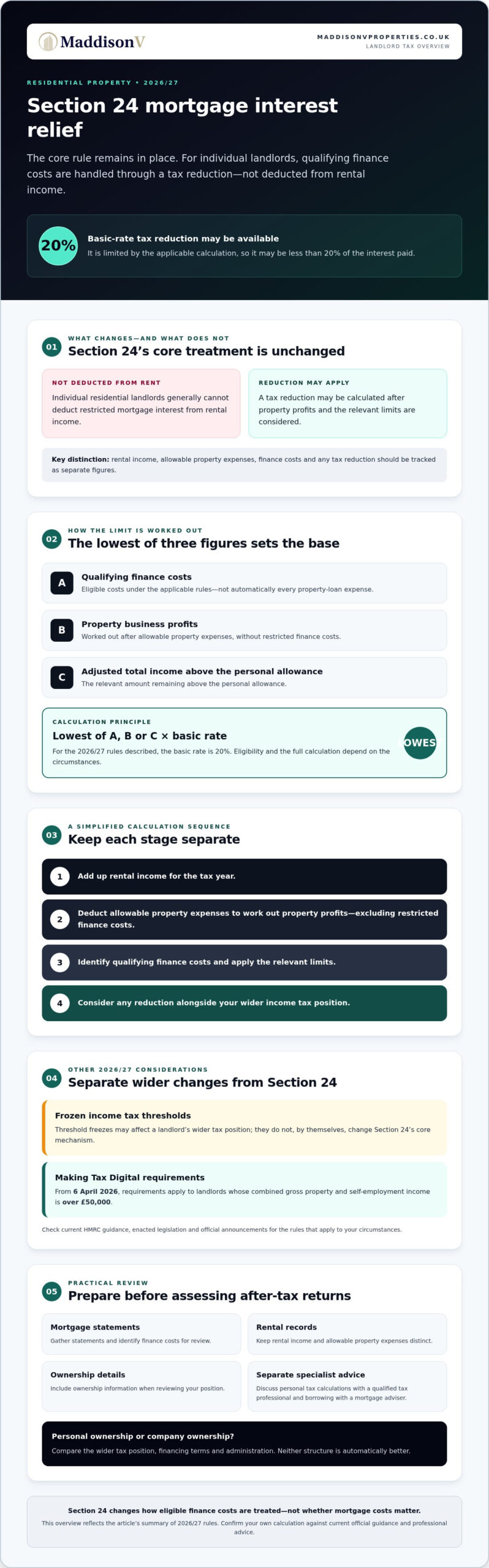
Individual landlords can’t deduct restricted mortgage interest from rental income. Instead, a tax reduction of 20% may be available, based on the lowest of three figures: qualifying finance costs, property business profits, or adjusted total income above the personal allowance. As a result, the reduction may be less than 20% of the interest paid.
This guide explains the calculation and distinguishes Section 24’s established rules from wider 2026/27 considerations. These include frozen income tax thresholds and Making Tax Digital requirements from 6 April 2026 for landlords whose combined gross property and self-employment income is over £50,000. You’ll also find practical questions to take to a qualified tax professional and financing points to discuss with a mortgage adviser, so you can assess your rental property’s after-tax return more clearly.
Key Takeaways
- Separate Section 24’s established rules from other tax and reporting changes that may affect landlords in 2026.
- Track rental income, allowable property expenses, mortgage finance costs and any tax reduction as distinct figures.
- Before comparing personal and company ownership, consider the wider tax position, financing terms and administration. Neither structure is automatically better.
- Gather mortgage statements, rental records and ownership details before reviewing expected after-tax returns or considering a financing change.
- Use a qualified tax professional for personal tax calculations, and discuss borrowing separately with a mortgage adviser.
Section 24 mortgage interest relief in 2026: what the rules mean for landlords
For individuals letting residential property, Section 24 changes how certain finance costs are treated when calculating tax on rental income. Instead of deducting eligible costs, such as qualifying mortgage interest, from property income, a landlord may receive a tax reduction based on those costs.
Featured snippet definition: Section 24 is a UK tax rule that restricts individual residential landlords from deducting eligible finance costs from rental income and provides a tax reduction instead, subject to the applicable calculation and conditions.
The rule was introduced through the Finance Act 2015. In practice, rental income and finance costs need to be considered separately. Mortgage interest is not treated as an ordinary deduction from rent.
For a concise overview of wider landlord tax topics discussed in 2026, watch this video:
What does Section 24 change about mortgage interest relief?
Under a deduction-based approach, eligible finance costs reduce the property income used to calculate taxable profit. Under Section 24, an individual landlord generally calculates property profits without deducting restricted finance costs, then claims a tax reduction instead. For 2026/27, that reduction is calculated at the basic rate and subject to limits. It is based on the lowest of the relevant finance costs, property business profits, and adjusted total income above the personal allowance.
“Finance costs” is a tax term, not a label for every expense connected with a property loan. Which interest and other borrowing costs qualify depends on the circumstances and current HMRC rules. Check the guidance before including a cost in a return, and don’t assume the same reduction applies to every landlord or borrowing arrangement.
Has mortgage interest relief changed for the 2026/27 tax year?
As of September 2026, Section 24’s core treatment remains in effect for 2026/27: HMRC guidance and applicable legislation provide for a basic-rate tax reduction on qualifying finance costs, rather than a deduction from an individual landlord’s residential property income. The core Section 24 rule itself hasn’t changed for this tax year. Check HMRC guidance, enacted legislation and official announcements before filing, since other tax or reporting developments may affect your wider position without changing Section 24.
This answers the central question behind section 24 mortgage interest relief changes 2026: the established mechanism remains, but its effect on your overall tax bill depends on your circumstances. Treat commentary about possible future reforms as unconfirmed unless an official source confirms a change.
How the Section 24 tax calculation works for residential landlords
Keep rental income, allowable property expenses and finance costs in separate categories. Section 24 doesn’t treat qualifying mortgage interest as a deduction from an individual landlord’s rental income. Instead, a tax reduction may be calculated after working out property profits and applying the relevant limits.
A simplified sequence is:
- Add up rental income for the tax year.
- Deduct allowable property expenses to work out property profits, without deducting finance costs restricted under Section 24.
- Identify qualifying finance costs and calculate the potential reduction using the applicable limits.
- Consider that reduction alongside the landlord’s wider income tax position.
For the 2026/27 rules described in official government guidance, the calculation is generally based on the lowest of qualifying finance costs, property business profits, and adjusted total income above the personal allowance. The reduction is calculated at the basic rate. Check the full calculation and eligibility against current HMRC guidance.
Which figures and records should a landlord gather?
Keep clear records for each tax year. Gather rental income statements, invoices and receipts for property expenses, mortgage statements showing interest and other charges, and relevant tax records to help establish your wider income position.
Separate interest from capital repayments. A mortgage payment may include both, but they aren’t interchangeable when reviewing finance costs for Section 24. Check which loan costs qualify under current HMRC rules, then reconcile your figures with your tax return and your adviser’s guidance.
Why can the tax reduction differ from the mortgage interest paid?
The amount paid to a lender isn’t automatically the amount used to calculate a tax reduction. Limits include property profits and the landlord’s adjusted total income above the personal allowance. If one of those figures is lower than the qualifying finance costs, it can restrict the amount used.
Hypothetical illustration, not personal tax advice: Assume a landlord has £24,000 in rent, £4,000 in allowable property expenses and £10,000 in qualifying finance costs. Property profits before finance costs are £20,000. If adjusted total income above the personal allowance is at least £10,000, the lowest relevant figure is £10,000. At the basic rate of 20%, the potential tax reduction is £2,000. This illustrates the calculation only. It doesn’t establish the landlord’s final tax bill or eligibility.
Individual results depend on personal circumstances, current rules and the whole tax position. For the section 24 mortgage interest relief changes 2026 question, use current HMRC guidance rather than assuming the interest paid equals the relief available. A qualified tax professional can assess the return. A mortgage consultation about financing considerations may help you review borrowing as part of your investment plan.
Personal ownership and company ownership: how to compare Section 24 implications
Choosing how to own a rental property involves more than asking whether Section 24 applies. Individuals and companies operate under different tax frameworks. Compare the full picture, including borrowing, administration, ownership plans and how you may eventually sell the property or draw income.
How does Section 24 apply to an individual landlord?
For an individual landlord letting residential property, the 2026/27 framework restricts the deduction of qualifying finance costs from property income. Instead, a basic-rate tax reduction may be available, subject to the applicable limits and the landlord’s circumstances. The result can depend on property profits and personal income, so the same mortgage costs may produce different tax outcomes for different landlords.
Consider how rental income sits alongside your other income and whether the property’s finances remain workable after tax. A guide from AXA UK offers further landlord-focused context on Section 24, but it can’t replace advice tailored to your tax position. Ask a qualified tax professional to check your figures and current eligibility.
Does owning through a company remove the need for tax analysis?
No. Company ownership uses a different framework, not an automatic Section 24 workaround or a guarantee of a better result. A company’s treatment of borrowing costs and profits follows company tax rules, which should be checked for the relevant circumstances and tax year. Also consider how funds are taken out of the company and what you plan to do with the property over time.
Use this compact comparison to frame a professional discussion:
- Tax framework: Ask how individual landlord rules compare with the company’s tax treatment, including the treatment of finance costs and profits.
- Finance: Check which mortgage options and terms are available for each ownership structure. Don’t assume the same borrowing is available on identical terms.
- Administration: Compare record-keeping, reporting and accounting responsibilities for each route.
- Professional advice: Discuss tax calculations with a qualified tax professional, and seek legal and mortgage advice on ownership and borrowing questions.
Incorporating or transferring a property into a company may have wider tax, legal, finance and transaction implications. Ask advisers to assess those consequences before making a change, and include future sale plans in the discussion. For the section 24 mortgage interest relief changes 2026 question, distinguish the established individual-landlord rules from any separate company analysis rather than relying on a blanket claim that one structure is always preferable.
A mortgage consultation can help you consider financing alongside an investment plan. MaddisonV Properties offers mortgage consultations for property investors. Leave personal tax calculations to a suitably qualified tax professional.
A practical 2026 checklist for reviewing mortgage interest and rental returns
A well-organised review can make a refinancing or investment discussion more productive. Start with the rules for the correct tax year, organise your records, then assess financing separately from tax treatment. The section 24 mortgage interest relief changes 2026 question is one part of the review, not a substitute for assessing the property’s full after-tax performance.
What should landlords check before the end of the tax year?
Work through this checklist before making decisions or preparing information for an adviser:
- Confirm the tax year and current rules. Check HMRC guidance and relevant legislation for the year you’re reviewing. Confirm which reporting obligations apply to you rather than relying on commentary or last year’s process.
- Organise rental records. Collect rent statements, invoices, receipts and other records of property income and expenses. Keep finance costs separate from other expenses.
- Review mortgage statements. Identify interest and capital repayments separately, and note changes to borrowing or loan arrangements. Ask a tax professional which recorded costs qualify under current rules.
- Gather previous-year information. Earlier returns and supporting calculations can help your adviser understand changes in income, expenses or ownership. Check that the figures reconcile with the records you’ll use for the current return.
- Confirm your ownership structure. Record who owns the property and whether it’s held personally or through a company. Don’t assume a change in ownership or refinancing will produce a particular tax result.
For 2026/27, HMRC’s Making Tax Digital guidance is also relevant to landlords with combined gross income from property and self-employment over £50,000. The requirement begins on 6 April 2026 and includes digital records and quarterly updates. Check current HMRC guidance to confirm whether it applies to you and what steps you need to take.
Which questions should you take to an adviser?
Keep tax and mortgage conversations distinct, while giving each adviser the information needed to consider the same investment plan.
- Ask a qualified tax professional: How do the current rules apply to my income, property profits, finance costs and ownership structure? Which figures should I report, and what tax treatment applies to my circumstances?
- Ask a qualified mortgage adviser: How do affordability, product terms and my existing borrowing affect refinancing suitability? What should I compare before making a decision?
Use any buy-to-let mortgage guide or UK property tax guide as background, then verify important details against current authoritative sources. A guide can help shape your questions, but it can’t confirm an individual outcome. To discuss financing as part of a property investment plan, arrange a mortgage consultation with MaddisonV Properties.
What Section 24 means for your investment plan, and when to seek advice
Section 24 is one part of a landlord’s investment assessment, not a verdict on whether a property is worth buying or keeping. A sound review brings together verified tax treatment, mortgage terms, rental assumptions, ownership structure and professional fees. Consider how each affects your expected return and the resilience of your plan if costs or income change.
When should a landlord seek specialist tax advice?
Seek advice if your position is unclear because of your income, borrowing, ownership structure or circumstances across more than one country. These factors can interact, and general information can’t determine your individual tax liability.
Before changing how a property is owned or altering its borrowing, ask a qualified tax professional to confirm the current 2026/27 rules and assess the likely consequences for your situation. Bring relevant income and rental records, mortgage information and details of any proposed change. This article offers general guidance, not tailored tax advice.
How can mortgage guidance fit into a property investment review?
A mortgage consultation can help you consider financing options, affordability and suitability alongside an investment plan. It doesn’t determine your tax liability. Take personal calculations and tax planning to a qualified tax professional, and borrowing questions to a qualified mortgage adviser.
Assess the investment as a whole. Test rental assumptions against expected mortgage payments and other ownership costs, and consider how the property fits your longer-term plans. Include professional fees in your review. Compare any proposed financing change with your current arrangements rather than assuming it will improve the tax outcome.
If you’re researching borrowing, a buy-to-let mortgage guide may help you prepare questions about mortgage options and terms. Use it as background, then confirm current details with a qualified mortgage adviser. For the section 24 mortgage interest relief changes 2026, verify the tax position separately with HMRC guidance and a suitably qualified tax professional before making a decision.
MaddisonV Properties offers property sourcing and mortgage consultations to help investors consider property and financing as part of their investment plans. To discuss those considerations, Discuss your UK property investment and mortgage requirements.
Make your next property decision with greater clarity
The key takeaway on section 24 mortgage interest relief changes 2026 is that the established framework remains in place for 2026/27: qualifying finance costs are generally handled through a tax reduction, not deducted from an individual landlord’s rental income. The amount available depends on the applicable limits and your circumstances, so verify current HMRC guidance before filing or changing your arrangements.
For a sound investment review, consider rental assumptions, borrowing, ownership structure and the wider tax position together. Keep mortgage and rental records organised, and take personal tax calculations to a qualified tax professional. A mortgage adviser can separately help you assess financing options and suitability.
MaddisonV Properties offers property sourcing and mortgage consultations, alongside property management. To discuss how property and financing considerations fit your plans, Discuss your UK property investment and mortgage requirements. With informed advice and a clear view of your objectives, you can make your next decision with greater confidence.
Frequently Asked Questions
Has Section 24 mortgage interest relief changed in 2026?
No. As of the 2026/27 tax year, the core Section 24 rules remain in effect. Individual residential landlords generally can’t deduct restricted finance costs from rental income. Instead, a basic-rate tax reduction may apply, subject to limits. This is the central point behind the section 24 mortgage interest relief changes 2026 question. Check current HMRC guidance and enacted legislation before filing, as other tax or reporting changes may still affect your wider position.
How does Section 24 mortgage interest relief work for UK landlords?
For an individual landlord letting residential property, qualifying finance costs are generally excluded when calculating property profits. A tax reduction may then be available, calculated at the basic rate and limited by relevant figures, including finance costs, property profits and adjusted total income above the personal allowance. The result depends on the landlord’s circumstances and current eligibility rules. Keep interest and other borrowing costs distinct from capital repayments, and confirm the calculation with HMRC guidance or a qualified tax professional.
Can landlords still claim mortgage interest as a tax deduction?
Individual residential landlords generally can’t deduct restricted mortgage interest from rental income under Section 24. Instead, a tax reduction may be available for qualifying finance costs, subject to the applicable calculation and limits. The reduction isn’t necessarily equal to the interest paid, and it doesn’t make mortgage interest a rental-income deduction. Check current HMRC guidance to confirm which costs qualify and how to report them in your circumstances.
Does Section 24 apply to a property owned through a limited company?
Section 24’s individual-landlord restriction doesn’t apply to a company in the same way. A company’s rental profits and finance costs are considered under a separate corporation tax framework, so company ownership isn’t a simple, automatic tax solution. The overall result can depend on the company’s circumstances, financing and how profits are used or distributed. Get current tax and legal advice before choosing a structure or transferring a property into a company.
Can unused finance costs be carried forward under Section 24?
Unused qualifying finance costs may be carried forward where current HMRC rules allow, but they don’t automatically create a tax reduction in the year they’re paid. Eligibility and the use of any carried-forward amount depend on the applicable rules and the landlord’s later tax position. Keep clear year-by-year records, and ask a qualified tax professional to confirm the treatment before including an amount in a return.
What happens if mortgage interest is higher than rental profit?
You may have a cash-flow shortfall and still face tax on your property income. Under Section 24, restricted finance costs generally aren’t deducted from rental income when calculating property profits. The tax reduction is subject to limits, so it may not offset all tax arising on that income. Review rent, allowable expenses, finance costs and your wider income together, then ask a qualified tax professional to assess your position.
Should I transfer a rental property to a company because of Section 24?
Not without tailored advice. Company ownership uses a different tax framework, but a transfer can also raise tax, legal, financing and transaction questions. Compare the full position, including borrowing terms, administration, how you plan to use rental profits and your future sale intentions. Before taking action, ask a qualified tax professional to model your circumstances and obtain legal and mortgage advice on the proposed change. There’s no structure that’s right for every landlord.

Sign Up Now
Want to read more great articles and blogs subscribe to our newsletter