
Buying property in the UK from abroad involves more than choosing a home or investment. Overseas buyers need to understand the purchase process, the...

Buying property in the UK from abroad involves more than choosing a home or investment. Overseas buyers need to understand the purchase process, the costs involved and the practical arrangements for completing a transaction while based outside the country.
Careful preparation can help make the process clearer. Buyers should consider how they will identify a suitable property, arrange professional support and manage the steps required to complete a purchase in the UK.
This guide explains key considerations for non-resident property buyers, from preparing to buy through to completion. It also outlines points to consider when assessing a property and planning the purchase, helping you understand the process before deciding how to proceed.
Key Takeaways
- Research the location, property type and likely demand before committing to a UK property investment.
- Compare purchase costs, ongoing expenses and potential rental income when assessing the investment’s affordability.
- Understand the tax implications of buying and owning UK property as a non-resident, including relevant reporting responsibilities.
- Arrange suitable legal and financial advice, and confirm the requirements for completing a purchase from abroad.
- Plan how the property will be managed, maintained and let if you will not be based in the UK.
RTM companies and management providers
Unlike leasehold enfranchisement, the right to manage transfers specified management functions without requiring leaseholders to buy the freehold. Appointing an agent alone does not create this statutory transfer. Requirements vary across the UK, so do not assume England’s thresholds apply elsewhere. Common mistakes include overlooking eligibility, membership and claim-notice requirements.
RTM Company Structure and Membership
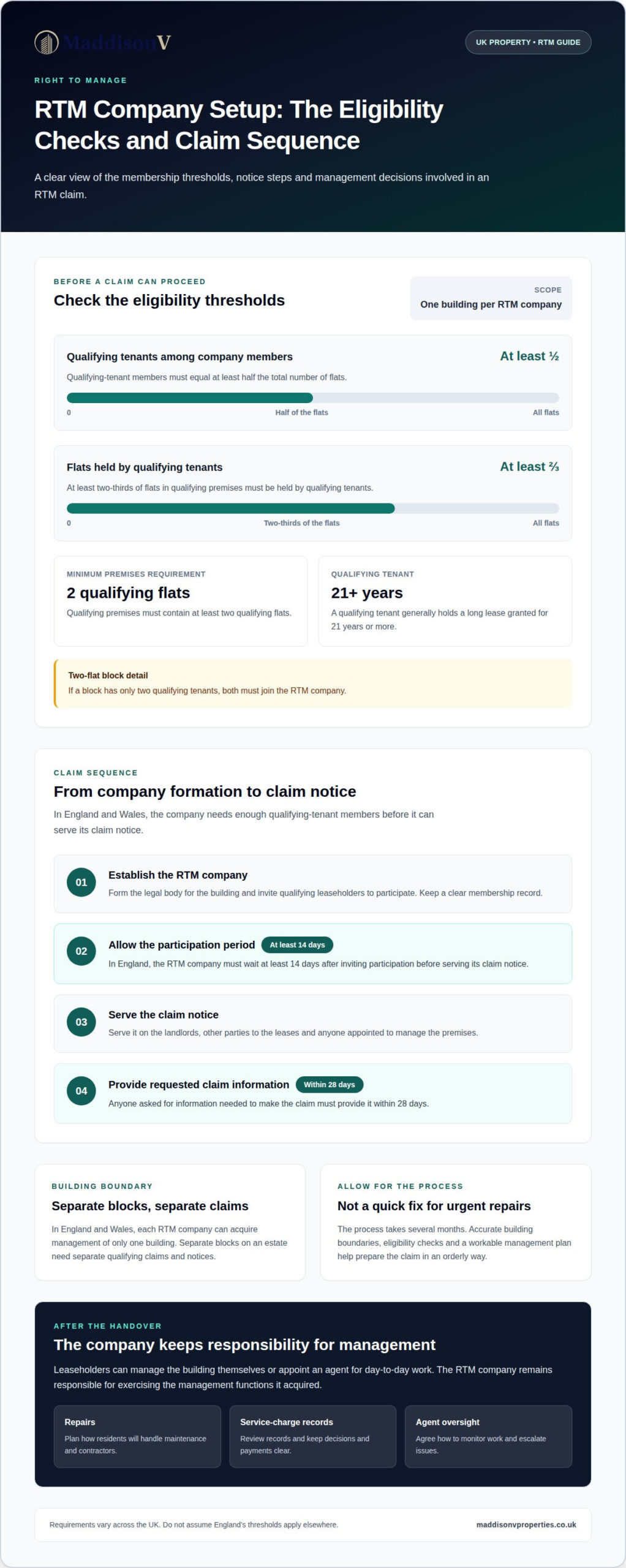
An RTM company is the legal body through which qualifying leaseholders exercise management rights for one building. Its membership structure matters because participation and voting shape how the company is formed and decisions are made. In England, qualifying-tenant members must equal at least half the total number of flats. If a block has only two qualifying tenants, both must join.
At least two-thirds of flats in qualifying premises must be held by qualifying tenants, and qualifying premises must contain at least two such flats. A qualifying tenant generally holds a long lease granted for 21 years or more. The landlord also becomes entitled to membership and full voting rights when the company takes over. Votes initially reflect the units the landlord holds, including flats or non-residential parts; a landlord with no units receives one vote.
Setting Up an RTM Company
Setting up an RTM company involves establishing it, inviting qualifying leaseholders to participate and following the statutory claim process. The sequence matters: the company needs enough qualifying-tenant members before it can serve its claim notice. In England and Wales, each RTM company can acquire management of only one building, so separate blocks on an estate need separate qualifying claims and notices.
According to The National Archives, an RTM company in England must wait at least 14 days after inviting participation before serving its claim notice. The company must serve that notice on the landlords, other parties to the leases and anyone appointed to manage the premises. A person asked for information needed to make the claim must provide it within 28 days.
Directors coordinate company decisions and organise its management arrangements. For example, they can plan how residents will handle repairs, review service-charge records and decide whether to appoint a managing agent. Leaseholders can manage the building themselves or pay an agent. The choice depends on their capacity to oversee contractors, finances and resident communications.
An agent can carry out day-to-day work, but the RTM company remains responsible for exercising the acquired management functions. Before setting up, members should decide how to record decisions, escalate maintenance issues and monitor the agent’s work. Clear arrangements help prevent confusion after the handover.
Eligibility and notices deserve close attention. For example, treating several separate blocks as one claim conflicts with the one-building limit in England and Wales. The process also takes several months, so it is not a quick remedy for urgent repairs. A clear membership record, accurate building boundaries and a workable management plan help the company prepare its claim in an orderly way.
UK property tax for overseas buyers
Buying property in the UK can create tax obligations for overseas buyers. The rules that apply depend on the buyer’s circumstances and the property. Investors should consider the potential tax implications before proceeding and seek advice on their position.
There is no single tax figure that applies to every purchase. Stamp Duty, tax on rental income and Capital Gains Tax may all be relevant at different stages of ownership. The property’s value, how it is used and the buyer’s residency status can affect which rules need to be considered.
Taxes to consider when buying UK property
Stamp Duty may be payable when a property is purchased. Overseas buyers should establish what applies to their transaction and include the potential cost in their budget. The amount is not the same for every property, so buyers should not rely on an assumed figure.
Tax on rental income and Capital Gains Tax may also matter to investors. Members of a buying group may have different circumstances, so each buyer should assess their own position. The rules can depend on factors such as residency and how the property is owned.
Tax responsibilities and planning
Tax responsibilities belong to the relevant property owner, not just the person who first proposes the purchase. Buyers should agree how they will meet expenses and keep clear records of decisions, invoices and payments. This helps owners monitor costs and explain financial commitments.
It is also important to distinguish purchase taxes from the costs of owning and managing a property. Owners should plan for services, repairs, maintenance, improvements and insurance. These are separate from tax, but they affect whether an investment is financially sustainable.
A practical tax review can group considerations into three areas: purchase taxes, tax on rental income and potential Capital Gains Tax. Buyers can then consider how each may apply to their circumstances. This is more useful than relying on an assumed average.
UK tax rules apply to property transactions, but the financial commitment is not identical for every buyer. Individual circumstances and the property’s use shape the tax position. Buyers should record the basis for their decisions and understand potential liabilities before making commitments.
Owners may also use a managing agent to handle building operations while retaining responsibility for their property. For those considering that ongoing arrangement, professional property management can support the practical running of a property.
Counter-notices and tribunal decisions
A counter-notice gives the landlord an opportunity to challenge an RTM claim, while a tribunal can resolve a dispute about entitlement. The notice sequence and decision date affect when management can transfer.
Claim Notices and Procedure
A claim notice formally tells the landlord and relevant parties that the RTM company seeks to acquire management. It matters because the landlord’s response period and any tribunal application follow from this notice. The company serves it on the landlords, other parties to the leases and anyone appointed to manage the premises.
The landlord can send a counter-notice stating whether the company is entitled to claim the right to manage. The landlord must have at least a month to respond. If the counter-notice disputes entitlement, the RTM company can apply to the First-tier Tribunal in England for a determination.
Statutory Timescales
The statutory timetable sets a response window before a dispute can proceed to a tribunal. Serving a claim notice does not itself transfer management; the landlord’s deadline and any later decision shape the handover date.
After a counter-notice, the landlord has at least a month to respond. If the First-tier Tribunal in England decides the RTM company is entitled to claim, the company acquires the right three months after the determination. Members can use these milestones to plan the transition, rather than treating the claim date as the transfer date.
Tribunal Decisions
When the landlord disputes a claim, a tribunal decision determines whether the RTM company is entitled to proceed. A favourable decision establishes entitlement, but the management transfer follows later under the statutory timetable.
In England, the First-tier Tribunal decides the dispute raised in the counter-notice. The company acquires the right three months after a determination in its favour. This is distinct from a leaseholder application for a tribunal-appointed new manager, which requires evidence of bad management.
A Section 22 notice belongs to that separate new-manager route, not the RTM counter-notice process. In England and Wales, leaseholders seeking a tribunal-appointed manager must first give the landlord a Section 22 notice, allowing an opportunity to address the problems. Examples include unreasonable service charges or failure to follow an approved management code.
On an estate with separate blocks, each block must qualify separately, and a separate RTM notice must be served for each. Do not assume one landlord response or tribunal outcome determines every block’s claim. Linking each notice, counter-notice and decision to its specific building helps members track the correct timetable and transfer.
Managing a UK property investment
After buying a UK property, investors need to consider how services, repairs, maintenance, improvements and insurance will be managed. These responsibilities affect the property’s ongoing operation, not just who manages it. For example, someone must organise a response when a shared entrance needs repair, coordinate routine maintenance and oversee the property’s insurance arrangements.
Clear decisions help turn these responsibilities into manageable tasks. Owners can set meeting agendas, record approvals, review contractor updates and make sure unresolved issues reach the right decision-makers. If a resident reports a leak in a communal area, for instance, there should be a process to log it, arrange action and track completion. Clear records help everyone understand what was decided and why.
An owner can manage a residential property directly or appoint a managing agent. Delegating day-to-day tasks does not remove the need to oversee the property. Owners still need to understand what work is underway, how issues are escalated and whether agreed services have been delivered. A written management plan can assign responsibilities for repairs, insurance renewals, resident communications and contractor coordination.
Fire safety should be managed as a distinct workstream. Owners can organise relevant building information, record reported concerns and make sure safety-related tasks are assigned and followed through. For example, if a resident reports a damaged fire door, the report should be logged, passed to the person responsible for action and tracked until resolved. Clear records support orderly oversight.
Owners should distinguish routine maintenance from improvement decisions. A recurring problem with a shared lift may call for repair planning, while a proposed upgrade may require consideration of its scope and funding. Recording the issue, options discussed, decision and next action creates a practical audit trail. It also helps a managing agent understand instructions and report on progress.
Insurance needs ongoing attention alongside repairs and maintenance. Owners can keep renewal dates, policy documents and relevant building details together, then direct questions or claims to the appropriate contact. If water damage affects a shared corridor, for example, the owner or appointed manager needs to coordinate the building’s response and communicate clearly with residents while the matter is handled.
The workload depends on the property and the management model chosen. Self-management gives owners closer oversight but requires time for administration and follow-up. A managing agent can handle operational tasks, while owners retain responsibility for decisions and monitoring. Agreeing who handles each task before taking over management helps avoid gaps in maintenance, insurance and resident communication.
Planning for ongoing London property investment costs
Investing in London property involves more than the purchase price. Ongoing costs can affect the financial picture, so review them before committing to a property. For a flat, this includes understanding service charges and how any unspent funds are handled. Consider these costs as part of your investment planning rather than leaving them until after you buy.
The key distinction is between costs already paid and amounts that remain due. For example, if service charges cover shared maintenance, records should show what has been paid and what remains. Reviewing this information can give investors a clearer picture of the property’s ongoing financial commitments.
A practical review starts by identifying who manages the building and holds the relevant records. Depending on the arrangement, that may be the freeholder or a management company. Request a clear account of the service-charge balance and supporting records. Keeping the latest statement alongside payment and expenditure information helps you understand how the balance arose.
Connect the available information to the building’s immediate needs. For instance, outstanding invoices for shared cleaning or a planned repair may affect the costs ahead. Separating recorded commitments from unspent funds helps investors assess future cash flow without treating the balance as unrestricted money. Check which payments have been made and which remain outstanding.
If funds are not passed on, the parties may need to consider recovery. The amount matters: pursuing unspent funds of less than £2,000 through the courts may not be economic. This is one reason to understand how funds are held and what action may be needed if a balance is disputed.
If a dispute arises, a concise evidence file can help clarify the issue and inform next steps. It can bring together the service-charge account, payment records, correspondence with the manager and the amount said to remain due. For example, matching a statement entry to an invoice can clarify whether it represents a payment already made or an unspent balance.
The clearest takeaway is to assess ongoing costs alongside the property itself. Understand what money remains, who holds it and which building costs it relates to. That information supports more informed decisions about London property investment. For help overseeing building operations, explore property management support.
MaddisonV Properties
MaddisonV Properties can support investors considering London property investment. Property Management and Facilities Management can help organise ongoing building operations, while Portfolio Management can support owners overseeing property interests across multiple investments.
For example, an investor may retain responsibility for decisions while arranging professional support for maintenance and shared facilities. This helps define operational roles and keep management support distinct from ownership responsibilities.
If you are considering how property management support could fit your investment plans, contact MaddisonV Properties to discuss your requirements.
Plan your next UK property investment
Choosing a UK property investment is also a decision about your priorities over time. Consider the balance between hands-on involvement and professional support, then choose an approach suited to your goals and the property. A clear investment plan can help you make considered decisions about buying and managing property in London.
MaddisonV Properties offers Property Management, Property Sourcing and Mortgage Consultations. These services support different property needs, from ongoing oversight to investment planning. Start by clarifying your priorities and the role you want professional support to play.
Contact MaddisonV Properties today to discuss your property plans. A thoughtful next step can bring greater clarity to the decisions ahead and help you move forward with confidence.
Frequently Asked Questions
What is the right to manage?
The right to manage lets qualifying leaseholders take over certain management functions from their landlord without buying the freehold or proving poor management. The leaseholders exercise the right through an RTM company, which can manage the building directly or appoint a managing agent. It changes who handles building management, but it doesn’t transfer ownership of the freehold or remove the leaseholders’ obligations under their leases.
What is the right to manage for leaseholders in the UK?
The right to manage for leaseholders in the UK is a statutory route for eligible flat owners to take responsibility for managing their building through an RTM company. The rules and eligibility conditions discussed here concern England and Wales; they do not necessarily apply across the whole UK. For example, a qualifying claim transfers management functions, not the freehold, so leaseholders remain leaseholders after the change.
Which leaseholders and buildings qualify for the right to manage?
In England, a qualifying tenant generally holds a long lease granted for 21 years or more, and qualifying premises must contain at least two flats held by qualifying tenants. At least two-thirds of the flats must be held by qualifying tenants. The claim concerns a single self-contained building or a structurally detached, self-contained part. A local-authority landlord excludes a building from the right to manage.
What are the RTM eligibility rules for flats, mixed-use buildings, and landlord-owned units?
In England, the right to manage is unavailable if more than 50% of a building is non-residential, under the rule effective from 3 March 2025. Landlord-owned flats don’t count as qualifying-tenant flats unless held by qualifying tenants. The landlord becomes entitled to RTM company membership after acquisition, with votes initially based on units held, including residential or non-residential units. Separate blocks must qualify separately.
How many leaseholders must participate to claim the right to manage?
In England, qualifying-tenant members must make up at least half the total number of flats in the premises. If a block has only two qualifying tenants, both must join the RTM company. This membership threshold is distinct from the rule that at least two-thirds of flats must be held by qualifying tenants. For example, a block may meet the qualifying-tenancy test but still need more members before making a claim.
What is the step-by-step process and timeline for making an RTM claim?
The broad sequence is to form the RTM company, invite participation, serve the claim notice and address any counter-notice. According to The National Archives, an English RTM company must wait at least 14 days after inviting participation before serving its claim notice. The landlord has at least a month to respond. The process takes several months, and a disputed claim may require a tribunal decision before management transfers.
What notices and forms are required to set up a right to manage company?
The central statutory notice is the claim notice, served on the landlords, other parties to the leases and anyone appointed to manage the premises. Before serving it in England, the company must invite leaseholders to participate and observe the required waiting period. The claim notice is different from a Section 22 notice, which belongs to a separate route for seeking a tribunal-appointed manager due to bad management.
How much does it cost to exercise the right to manage, and who pays the costs?
There is no single claim cost for every building. The RTM company can be liable for its own expenses and the landlord’s costs, so members should consider both when assessing the commitment. The work involved can depend on the building and whether entitlement is disputed. Later operating costs, such as repairs and insurance, are separate from claim expenses.

Sign Up Now
Want to read more great articles and blogs subscribe to our newsletter