
The best residential property investment strategies in the UK depend on whether you prioritise rental income, potential capital growth or a more...

The best residential property investment strategies in the UK depend on whether you prioritise rental income, potential capital growth or a more hands-off investment. Buy-to-let, short-term lets, rent-to-rent and off-plan property each involve a different balance of income, involvement and risk. Overseas investors can consider these approaches too.
It’s understandable to look for a manageable strategy from abroad, especially when the property, tenants and day-to-day decisions are in another country. Match the investment model to your goals and the level of oversight you want, rather than assuming one approach suits every investor.
This guide compares how each strategy works, what to consider when assessing rental income and growth, and practical issues for overseas buyers. You’ll also see how off-plan property fits alongside established homes, and how property sourcing, mortgage consultations and ongoing management can support a considered investment plan.
Key Takeaways
- Compare buy-to-let and short-term letting by weighing potential rental income against management demands, seasonality and property costs.
- For overseas investment, consider how tenant arrangements and local requirements affect the level of oversight a property needs.
- Rent-to-rent depends on the landlord’s explicit permission to sublet, so clear consent is central to the arrangement.
- Assess off-plan opportunities by considering the development timeline alongside your investment goals and plans for managing the completed property.
- Explore how property sourcing, mortgage consultations and management can support a more considered investment approach.
1. Buy-to-let rental income and capital growth
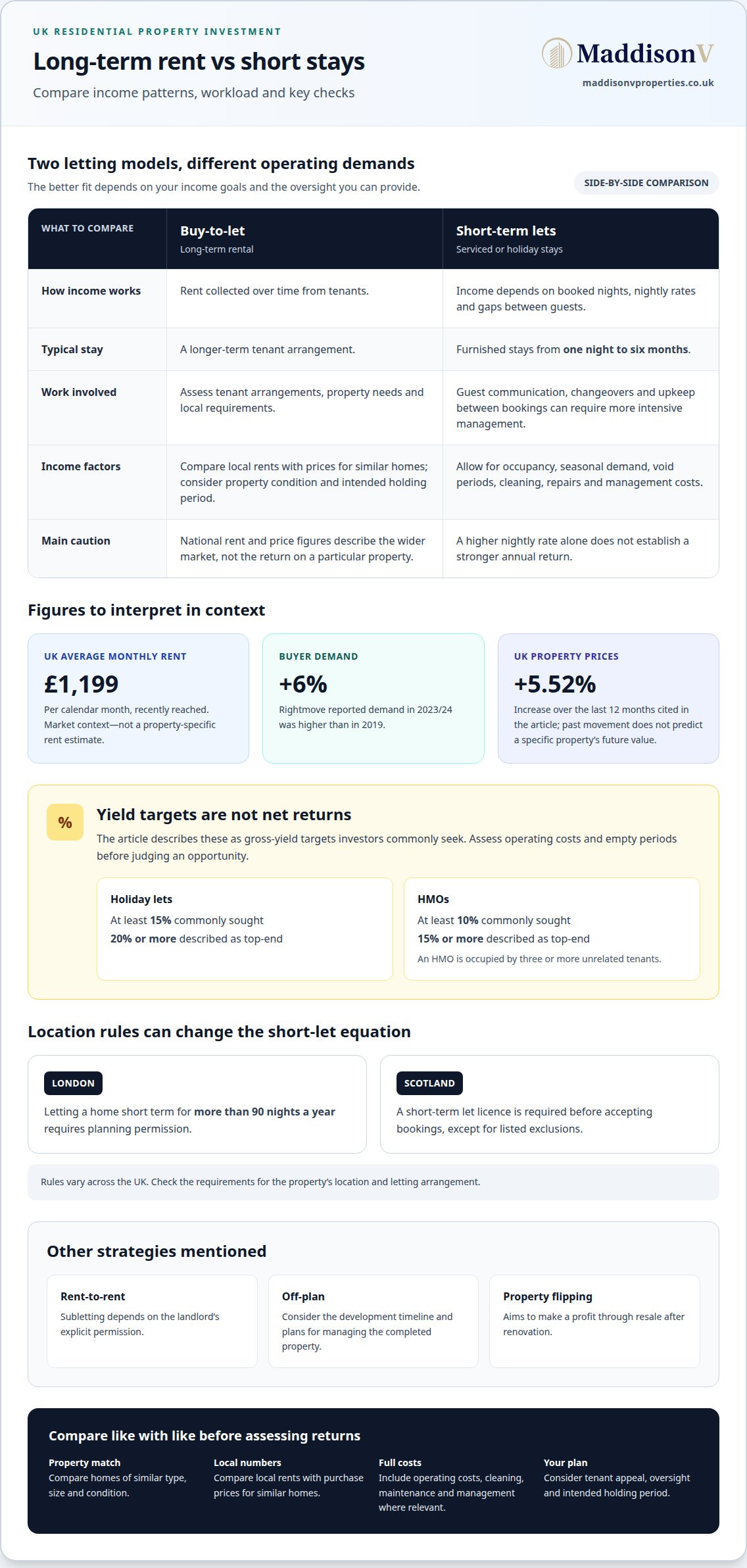
Buy-to-let planning starts with the relationship between rent, the property and your intended holding period. The UK residential market’s average monthly rent had recently reached £1,199 per calendar month. Treat that as market context, not an estimate for a particular home. A property’s achievable rent depends on its location, condition, size and suitability for the tenants it is intended to attract.
For a useful comparison of rental yields by region and city, compare like with like. Match property type, size and condition, then compare local rents with purchase prices for similar homes. Combining a national rent figure with a regional purchase price can distort the apparent return. This approach gives you a clearer basis for comparing locations and deciding which properties merit closer analysis.
National housing figures provide context, but they don’t replace a local assessment. A national figure describes the market as a whole, not a particular investment area or property type. A city-centre flat and a family house may attract different tenants, rents and maintenance needs, even in the same market.
Rental demand and capital growth are related, but they are separate considerations. Rightmove reported buyer demand in 2023/24 was 6% higher than in 2019. For an individual property, assess whether its location and layout suit likely tenants as well as future buyers. A clear tenant profile can help guide decisions about the home’s condition, features and asking rent.
UK property prices had increased by 5.52% over the last 12 months. Past movement offers context for reviewing a purchase, but it doesn’t establish what a particular property will be worth later. Examine the home’s condition, its appeal to prospective occupants and buyers, and the reasons you may sell. A defined investment horizon helps connect rental income with your longer-term plans.
Plan separately for tax on rental income and gains from a sale. Their treatment can vary with ownership and personal circumstances, so include both in your financial planning. Before tenants move in, identify the licensing, safety and tenancy requirements that apply to the property’s location and letting arrangement. These checks help shape your investment plan from the outset.
Bring the figures together before making an offer: comparable local rents, prices for similar properties, the home’s condition and your intended holding period. Record the assumptions behind expected income and growth, and revisit them if the property or local market changes. This gives you a practical basis for comparing opportunities without treating national averages as a promise of property-level performance.
2. Short-term lets, serviced accommodation and holiday lets
Short-term lets provide furnished accommodation for stays ranging from one night to six months. Unlike a long-term rental, income depends on booked nights, nightly rates and gaps between guests. Holiday homes may command higher nightly rates than long-term rentals, but changeovers and more intensive management affect net returns.
Holiday-let investors commonly look for gross yields of at least 15%, with 20% or more considered a top-end yield. Treat these as screening targets, not net income. To assess an opportunity, estimate likely booked periods, then deduct operating costs, cleaning, maintenance and any management expenses. Seasonal demand can leave homes in holiday parks and seaside locations empty for part of the year.
Serviced apartments and boutique hotels may earn income from services as well as accommodation. This differs from a standard holiday let, where the main income comes from guest stays. Compare revenue sources with the operational demands: guest communication, changeovers and property upkeep between bookings. A higher nightly rate alone does not establish a stronger annual return.
Airbnb is one route for marketing a short-term stay, but the platform does not remove the need to understand local rules or manage the property. In London, letting a home short term for more than 90 nights a year requires planning permission. In Scotland, a short-term let licence is required before accepting bookings, except for listed exclusions. Rules and requirements vary across the UK, so the property’s location matters.
Compare projected income with a long-let scenario for the same property, using realistic occupancy assumptions. Include void periods, cleaning, repairs and the time needed to coordinate each changeover. For a holiday home, consider whether demand is concentrated in particular seasons; for serviced accommodation, account for the services included. This helps show whether the extra activity supports the expected return.
Before committing capital, assess how the development, location and intended guest stay align. A city apartment may serve short business or leisure visits, while a coastal home may depend more heavily on holiday periods. For help assessing a property’s fit within a wider rental strategy, explore property sourcing support.
3. What If You’re Investing in UK Property From Overseas?
UK investors can choose long-term buy-to-let, HMOs, serviced accommodation or property flipping. Buy-to-let focuses on rental income over time, HMOs let rooms to multiple tenants, serviced accommodation relies on shorter stays, and flipping aims to make a profit through resale after renovation. Each model brings different income patterns, operating demands and exposure to empty periods.
A house in multiple occupation, or HMO, is a rental property occupied by three or more unrelated tenants. HMO investors commonly seek gross yields of at least 10%, with 15% or more considered a top-end yield. Higher room-by-room income can come with more tenant turnover and coordination than letting one home to a household.
Planning rules add another layer. In England, converting a house into a small HMO for up to six people normally does not require planning permission, unless the council has an Article 4 direction removing that permitted right. HMOs for seven or more people usually require planning permission. These thresholds make occupancy and the local council’s rules essential parts of the purchase assessment.
A two-bedroom house may be a simpler starting point than a multi-room HMO. Let the likely tenant profile, achievable rent and upkeep guide your decision, particularly if you live overseas. Compare the property’s layout and local rental demand with the intended tenancy: a home suited to tenants in one area may not meet their needs elsewhere.
House flipping follows a different return logic. In a UK example, buying for £200,000 and selling for £240,000 leaves £40,000 before purchase costs, building work, finance and selling fees. Renovation overruns, delays or a lower sale price can narrow that margin. Unlike a let property, a flip depends on completing improvements and finding a buyer.
Ongoing risks include periods without rent, repairs, maintenance and the costs of managing tenants or guest stays. HMO arrangements can bring added planning and licensing complexity, while refurbishment may involve extra building work and compliance considerations. For an overseas owner, distance can make decisions and on-site coordination more demanding, so reliable local oversight should be part of the operating plan.
Before buying, decide whether your priority is rental income, resale potential or a manageable level of involvement. Compare purchase and renovation assumptions with likely rent or sale proceeds, including ongoing expenses and empty periods. Then establish how property management will work from abroad and assess local tenant demand. These steps help align the investment model with your objectives before you commit capital.
4. Rent-to-rent
Rent-to-rent lets an investor operate a property without buying its freehold or leasehold interest. The operator agrees terms with the landlord, then lets the home to occupants, often managing the tenancy and day-to-day arrangements. Income depends on the difference between rent received and the costs of operating the arrangement.
Permission comes first. In a UK rent-to-rent arrangement, obtain the landlord’s explicit permission before subletting. The agreement should state whether subletting is allowed, who handles repairs, how rent is paid and who manages tenant communication. Clearly defined responsibilities help both parties understand the arrangement before occupants move into an apartment or house.
Model cash flow before committing. Set out the rent payable to the landlord, expected income from occupants, management costs, maintenance and periods without rent. A student property, for example, may have demand linked to academic calendars, so consider how vacancies affect payments due under the agreement. Don’t rely on full occupancy throughout the year.
Operational work matters. Rent-to-rent can involve marketing rooms or a home, responding to tenant needs, arranging cleaning or maintenance, and coordinating move-ins and move-outs. A listing platform may help attract occupants, but it won’t manage the property’s condition or resolve every issue. Have a practical process for handling repairs and communicating with the landlord.
Build-to-rent is a different model. It generally describes housing developed or held specifically for rental, rather than an investor taking a property from a landlord and subletting it. In a build-to-rent apartment scheme, the owner focuses on operating rental homes as a portfolio. Rent-to-rent, by contrast, centres on a contract between an operator and a property owner.
For investors, the distinction is about control and responsibility. Build-to-rent involves investing in rental housing designed for tenants, while rent-to-rent involves operating a property under agreed terms without purchasing it. Neither description alone determines income or workload. The property layout, local demand, management approach and agreement shape the practical opportunity.
Before proceeding, map the arrangement from the owner’s agreement through to occupant move-out. Confirm the landlord has explicitly permitted subletting, define responsibilities in writing, and test cash flow against realistic occupancy and operating costs. Consider the exit too: if the arrangement ends, clarify how occupants, property condition and outstanding obligations will be handled. This planning matters whether the property is a student house, an apartment or another residential property.
5. Off-plan property investment
Off-plan investment means committing to a property before construction is complete. The purchase decision is based on the development, its planned homes and expected handover, rather than a finished apartment you can inspect. This may suit investors building a portfolio, but rental income starts only when the property is ready and let.
Start by defining the investment’s purpose. Is your priority long-term rental income, potential capital growth or adding a particular location to your portfolio? Your answer guides the development, property type and intended letting strategy. A home suited to long-term tenants may not suit short-stay accommodation.
Assess the location and development as an investment, not simply as a new building. Consider the surrounding housing, transport connections, local employment and likely tenant demand. Compare anticipated rent with the purchase price and ongoing costs to estimate net income. For a flat, include service charges and ground rent, which can affect returns.
West One in Manchester illustrates how timing and projected income enter the assessment. It is estimated to complete in Q4 2027, with a projected net long-let yield of 6.6% for Year 1. That figure is a development projection, not a promise of profit. Investors should understand which assumptions underpin the rental estimate and how costs influence the net return.
Finding the right opportunity also means examining the delivery plan. Review the proposed completion timeline, property specification and how the finished home will serve its intended tenants. Consider how a change to the handover timing would affect furnishing, letting and income plans. A later completion can delay the start of rental income.
For overseas investors, distance adds a practical consideration. Decide how the property will be inspected, prepared for letting and managed after completion. If you plan to acquire several properties, consider how each development fits the portfolio and whether the locations and income assumptions complement one another. A clear management plan connects the pre-completion decision with the property’s long-term purpose.
Before proceeding, compare the projected rental income with the complete ownership costs, review the completion assumptions and set out how the finished property will be managed. This creates a more grounded view of potential return than relying on headline figures alone. Investors assessing a new-build purchase can explore off-plan investment opportunities suited to their portfolio objectives.
MaddisonV Properties: Off-Plan Investment Opportunities
MaddisonV Properties helps investors explore off-plan opportunities that align with their objectives and portfolio plans. If you’re weighing a development purchase, the team can help connect the opportunity with a future rental strategy.
Property sourcing supports the search, while mortgage consultations can inform your financing discussions. After completion, MaddisonV’s Property Management helps with the ongoing responsibilities of a rental home. Together, these services connect opportunity selection with ownership and letting, including for investors based overseas.
Before deciding, clarify the property’s intended purpose, expected completion timeline and management approach after handover. Contact MaddisonV Properties to discuss your off-plan investment plans.
Make your next property decision with clarity
Choosing among residential property investment strategies in the UK is ultimately about fit: the right approach should serve your financial goals, available time and appetite for involvement. Before moving forward, define what success means to you and which practical responsibilities you’re prepared to take on. A clear investment purpose keeps decisions focused, from selecting an opportunity to planning how ownership will work over time.
For overseas investors, a useful next step is to bring your objectives and preferred level of involvement into one conversation. MaddisonV Properties can help you explore a suitable path and understand how the next stage aligns with your plans. A measured decision starts with understanding what you want your investment to achieve.
Contact MaddisonV Properties to discuss your investment plans and take the next step with confidence.
Frequently Asked Questions
What If You’re Investing in UK Property From Overseas?
Begin by choosing an investment model that suits your goals and planning how the property will be overseen from a distance. For example, a long-let needs a plan for tenant communication, maintenance and periods without rent. As an overseas owner, also consider how local decisions will be made and how rental income and expenses will be tracked. Clarifying these arrangements before purchase helps align remote ownership with your investment aims.
So, what’s my strategy?
Choose a strategy by working backwards from your desired outcome. If predictable occupancy and longer-term income matter most, assess conventional letting; if you can manage frequent changeovers, short stays may be a better fit. Investors focused on new construction can consider off-plan opportunities, while rent-to-rent depends on an agreement with a property owner rather than buying the home. Compare involvement, cash-flow timing and exit plans before choosing a route.
What does traditional residential buy-to-let require?
Traditional buy-to-let requires an investment property, a funding plan and a clear approach to letting and upkeep. Before buying, estimate achievable rent and account for mortgage payments, maintenance, insurance and periods without a tenant. Landlords also need to organise tenancy administration and understand applicable tax and property obligations. For instance, service charges on a flat can reduce net income, so include them in your return calculation.
Why is putting down a large deposit important to my strategy?
A larger deposit reduces the amount borrowed, which can lower the mortgage balance and the interest exposure attached to it. The investment framework discussed in this guide recommends a 30–40% deposit for each buy-to-let property. However, committing more cash upfront also leaves less available for repairs, void periods or another purchase. Balance the deposit against a separate reserve for ownership costs and the needs of your wider portfolio.
What are the main residential property investment strategies in the UK?
The main approaches include buy-to-let, short-term letting, HMOs, rent-to-rent, off-plan purchases and property flipping. They differ in how investors secure a property, generate income and pursue an eventual return. Buy-to-let, for example, centres on renting a home to tenants, while flipping relies on resale after improvements. Compare each model’s operating demands and income timing with your available capital and preferred level of involvement.
How much deposit and upfront cost is needed to buy a UK investment property?
The deposit depends on the purchase price and financing plan. Budget separately for transaction taxes, legal work, valuation, financing and immediate repairs or furnishing. Tax treatment and transaction charges vary across the UK: England and Northern Ireland use SDLT, Scotland uses LBTT, and Wales uses LTT.
What are UK buy-to-let mortgage rates, fees, and lending criteria?
Mortgage rates and fees vary by lender product and application, so compare the total borrowing cost rather than the headline rate alone. Lenders assess factors such as the deposit, applicant finances, property details and expected rental income. Upfront expenses can include lender charges and property-related transaction costs. Prepare a realistic rent estimate and ownership budget before discussing financing, so you can consider the figures together.
How are rental income and property gains taxed for UK landlords?
Plan for rental income and gains from a sale separately, as their tax treatment can vary with ownership and personal circumstances. Landlords who own rental property in their own name cannot deduct mortgage interest from rent before tax; instead, they receive a basic-rate tax reduction of 20%.

Sign Up Now
Want to read more great articles and blogs subscribe to our newsletter