What if the first warning sign isn’t a missed repair, but a vague answer about who is responsible for arranging it? The red flags when hiring a...

What if the first warning sign isn’t a missed repair, but a vague answer about who is responsible for arranging it? The red flags when hiring a property manager often appear before an agreement is signed: unclear service scope, inconsistent communication, and fees or reporting that are difficult to understand. These signals matter because effective management involves more than handing over day-to-day tasks. It requires clear responsibilities, responsive operations and useful oversight.
Before committing, expect a clear explanation of what is included, how tenant concerns and maintenance requests are handled, and what information you will receive about the property’s finances. This guide explains how to spot warning signs, assess whether responsibilities and accountability are clear, and decide what kind of management support suits your property and priorities. It covers communication, agreements, fees, maintenance and reporting, with practical points to help you compare a service against your needs.
Key Takeaways
- Spot red flags when hiring a property manager by looking for gaps in communication, service scope, processes or reporting.
- Review the management agreement for clearly defined responsibilities, fees and accountability before proceeding.
- Assess whether maintenance updates, tenant communications and financial reports make open issues and next steps easy to understand.
- Set your essential requirements, from the level of oversight you need to the specific needs of your property.
- Documented property and facilities management, supported by London-focused expertise, can help owners maintain clearer oversight.
Red flags when hiring a property manager: warning signs to notice early
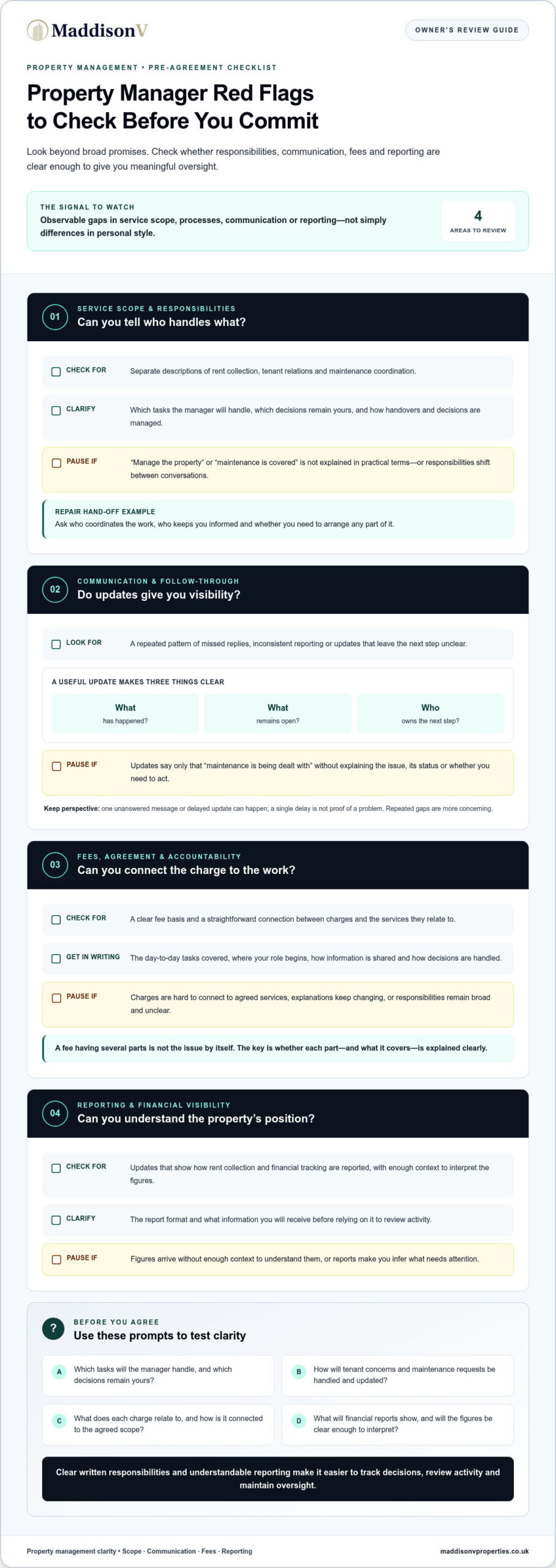
Entrusting a valuable property to someone else means delegating decisions that affect its condition, rental income and tenants’ experience. The red flags when hiring a property manager are observable gaps in the service scope, communication, processes or reporting, not simply differences in personal style.
Vague service boundaries, unclear updates and promises without an explanation of how they will be delivered are reasons to pause and clarify expectations. Property management can involve a range of operational and financial responsibilities, as outlined in this property management overview. Before committing, establish which tasks the manager will handle, which decisions remain yours and how you will receive updates.
For another perspective on warning signs to notice before signing, this video discusses what landlords may want to look out for:
Transparent responsibilities help owners understand the service they are agreeing to, who is accountable and how they can retain meaningful oversight. Use early conversations to establish how the arrangement will work in practice, rather than relying on broad assurances.
Unclear responsibilities and shifting expectations
Ask for a clear description of the management tasks covered. Tenant communication, rent collection and maintenance coordination are distinct responsibilities. A general promise to “manage the property” may not explain how each will be handled. For example, if a tenant reports a repair, will the manager coordinate the work and keep you informed, or will you need to arrange part of it?
Ambiguity can leave the owner and manager each assuming the other is handling an issue. Look for responsibilities described in terms you can understand, including how decisions and handovers are managed. If explanations differ from one conversation to the next, resolve the discrepancy before proceeding. For real estate investors and homeowners looking to benchmark comprehensive service scopes, full-service resources such as tbmpropmanagement.com demonstrate how management duties and owner communications should be structured.
Communication that leaves owners without visibility
An unanswered message or delayed update can happen. On its own, it is not proof of a problem. A repeated pattern of missed replies, inconsistent reporting or updates that do not explain what happens next is more concerning because it makes oversight difficult. Owners need information that helps them understand the property’s operational and financial position.
Check whether an update explains what has happened, what remains open and who is responsible for the next step. For instance, “maintenance is being dealt with” gives little visibility if it does not say what the issue is, where it stands or whether you need to act. One temporary delay may have a straightforward explanation. Repeated gaps that leave you unable to follow tenant concerns, rent activity or outstanding work can undermine confidence in the management relationship.
Property management fees, agreements and accountability: where clarity matters
A management arrangement should explain what you are paying for, which responsibilities are included and how activity will be reported. A fee is difficult to assess if it is not connected to a defined service scope. Before proceeding, understand the fee basis and how it relates to the work described, rather than relying on a headline summary or verbal assurance.
Clarity also helps you identify the red flags when hiring a property manager. If explanations keep changing, charges are hard to connect to agreed services, or responsibilities are described only in broad terms, pause and ask for a clearer account. The goal is to understand the practical arrangement, not to assess each phrase in isolation.
What a clear management scope should make understandable
A written scope should show which day-to-day tasks are managed and where your role begins. Rent collection, tenant relations and maintenance coordination are separate areas of work. A useful description explains each in terms you can follow, including how information is shared and decisions are handled.
Defined boundaries reduce the risk of assumptions on either side. For example, a description that says maintenance is “covered” may not explain whether the manager coordinates repairs, communicates progress or updates you as the owner. Clearer wording gives both parties a shared reference point and makes it easier to identify an unresolved responsibility.
When fee explanations and reporting raise concerns
Look for a straightforward connection between charges and the services they relate to. An explanation that is difficult to follow, changes during discussion or does not clarify which work is covered makes the arrangement harder to assess. The concern is not simply that a fee has several parts, but whether those parts and their relationship to the agreed work are explained clearly.
Financial visibility matters too. You should be able to understand how rent collection and financial tracking appear in management updates. If a report gives figures without enough context to interpret them, clarify the format and information before relying on it. Clear reporting helps you review activity and see what may need attention without having to infer the story behind the numbers.
Written responsibilities and understandable reporting give owners a practical basis for tracking decisions, reviewing activity and holding the management arrangement to account.
| Clear, documented terms | Vague or difficult-to-follow terms |
|---|---|
| Tasks such as rent collection, tenant relations and maintenance coordination are described separately. | Broad wording leaves it uncertain which tasks are included or who handles them. |
| The fee basis is explained in relation to the services agreed. | Charges are presented without a clear link to the described work. |
| Updates make financial activity and management actions understandable. | Reports are inconsistent or difficult to interpret. |
Use the comparison to judge whether the arrangement is understandable in practice. For property management covering defined responsibilities, explore MaddisonV Properties’ property management.
Maintenance, tenants and reporting: operational red flags landlords can assess
Once you understand the management scope, consider how it works day to day. Maintenance handling, tenant communication and financial visibility are separate measures. A manager may give clear financial updates yet leave repair progress unclear, or respond to maintenance requests while providing little information about tenant concerns. Assess each area on its own rather than relying on a general impression of responsiveness.
Useful updates explain what has happened, what remains open and what comes next. When assessing the red flags when hiring a property manager, notice whether information is specific enough to follow without repeatedly chasing for details or guessing who is responsible.
Maintenance handling and emergency response
A maintenance process should make responsibility and progress visible. Potential warning signs include uncertainty about who is coordinating a repair, a request that appears to stall without explanation, or updates that do not distinguish a new issue from one still awaiting action. These gaps do not, by themselves, establish poor conduct, but they make it harder to understand the property’s condition and any decisions needed.
MaddisonV provides a 24/7 emergency maintenance response. For other maintenance matters, assess whether updates identify the issue, its current status and any next step or owner input required. In each case, look for clear communication about what has been reported and what action is being taken.
Tenant relations and owner reporting
Tenant relations are an ongoing part of property management, not simply a response to complaints. A defined process helps concerns get received, communicated and followed through, while giving the owner suitable visibility. Consider whether updates explain the nature of an issue and how it is being handled, rather than offering brief reassurance without useful context.
Financial visibility is a separate measure. Owners should be able to follow rent activity and understand what financial reports show. MaddisonV’s online portals support rent payments, maintenance requests and financial tracking, bringing relevant information into a digital channel. The portals can make it easier to review activity, but technology alone cannot ensure that an issue is resolved or an update is clear. Digital records are most useful when the information is understandable and accompanied by clear communication.
To assess operational oversight, consider whether each update answers these practical questions:
- What has been reported or completed?
- Which maintenance or tenant issues remain open?
- What action is expected next, and who is responsible?
- Does the financial information make activity understandable?
A missing detail once may be an isolated oversight. Repeatedly unclear updates about repairs, tenant matters or financial activity can make informed oversight difficult. Look for communication that connects records with context, so you can understand both the activity and its next step.
A practical self-assessment before entrusting a property to management
A good management fit starts with your property’s needs, not a one-size-fits-all service model. Whether evaluating residential specialists like Regal Gateway Property or local providers, deciding which responsibilities you want to delegate, what information you need to stay informed and where you prefer to remain involved is essential before comparing options. This turns general expectations into criteria you can assess against a provider’s documented processes.
Set priorities for your property and tenants
Consider the property’s type and location, tenant needs and the level of owner involvement that suits you. A landlord who wants to oversee decisions closely may prioritise regular reporting. An owner seeking more day-to-day support may place greater weight on tenant relations or maintenance coordination. Separate essential requirements from conveniences so that a polished presentation does not distract from the capabilities your property needs.
- Identify your essential responsibilities. Note which tasks you want managed, such as rent collection, tenant communication, inspections, reporting or repairs. Mark any areas where you want to retain approval or direct involvement.
- Consider the property itself. Record its type, location and any features that affect ongoing management. A property with particular maintenance needs may call for a different operational emphasis from one where financial visibility is your main concern.
- Set your visibility preferences. Decide what information you need, how often you want updates and what makes a report useful. For example, you may want a clear record of completed actions, outstanding matters and decisions that need your attention.
- Separate essentials from preferred conveniences. Essential capabilities are those needed to manage the property in line with your priorities. Conveniences may make the experience smoother, but should not replace clear accountability or a defined scope.
- Map each priority to a process. For every essential, identify the relevant service area and the information that would help you understand how it works, such as inspection records, maintenance updates or financial reports.
This comparison can help organise your priorities:
| Owner priority | Relevant management capability | What to look for |
|---|---|---|
| Property condition | Inspections, maintenance and repairs | Visible records, open actions and clear follow-through |
| Tenant experience | Tenant relations and communication | A defined way to handle enquiries and concerns |
| Financial oversight | Rent collection, financial management and reporting | Understandable records and useful updates |
Use visible processes to assess management fit
Look for a clear connection between each priority and an operational capability. A maintenance concern should map to a process for requests and repairs. A need for oversight should connect to inspections or reporting. Consider whether the format and frequency of updates suit your preferred level of involvement, and whether you can understand the information without having to reconstruct the property’s status yourself.
For broader context on management responsibilities and service considerations, explore The Sophisticated Investor’s Guide to Property Management in 2026. If your priorities point towards structured oversight of a London property, explore MaddisonV’s property management.
How MaddisonV Properties addresses property management concerns
Clear responsibilities, consistent communication and visible oversight are central to a considered management arrangement. MaddisonV Properties provides property and facilities management services across areas including tenant support, property condition and financial activity. Reviewing these service areas can help owners understand how distinct tasks fit into the day-to-day operation of a property.
A defined service scope for property owners
MaddisonV’s Facilities Management Services include tenant sourcing and screening, leasing and contract management, and rent collection and financial management. The services also cover maintenance and repairs, tenant relations, inspections and reporting, and compliance and risk management. These defined areas help owners identify the support involved, from preparing for a tenancy to monitoring a property over time.
The separate service areas can help clarify who handles particular tasks. Maintenance and repairs sit alongside inspections and reporting, for example, while tenant sourcing and screening are distinct from leasing and contract management. Compliance and risk management are also included in the facilities management services.
For London property owners, MaddisonV’s dedicated facilities-management team has in-depth knowledge of London’s property landscape. The company lists UKAS, IWFM and RICS.
Digital oversight and experienced facilities management
Digital tools can complement a defined management service by giving owners another way to maintain oversight. MaddisonV’s online portals support rent payments, maintenance requests and financial tracking. The value of these tools depends on having information that is clear enough to follow, alongside communication that explains how management responsibilities are being carried out.
MaddisonV’s team brings over 50 years of combined experience. This is experience across the team, not a claim about any individual’s tenure. Alongside its dedicated facilities-management team, this supports an approach focused on informed operations and considered property oversight.
Use the red flags when hiring a property manager as a prompt to compare your concerns with the management scope and processes available. Consider whether responsibilities are clearly allocated, reporting gives you a useful view of activity and the approach reflects your property’s requirements. A suitable fit should leave you with a clearer understanding of how your property is being managed.
To explore how these responsibilities can be brought together for your property, explore MaddisonV’s property management services.
Choose management that gives you confidence to move forward
Entrusting a property to a manager is about more than convenience. It affects how you stay informed, how tenant needs are handled and how confidently you can plan for the property’s future. Use the red flags when hiring a property manager to define what good oversight means for you, then look for a management approach that makes responsibilities and communication easy to understand.
Your priorities may change as your property or investment plans evolve. A sound management relationship should make it easier to discuss those needs and maintain a clear view of the work being managed. A considered assessment helps you move beyond uncertainty and choose support that aligns with your expectations.
Explore MaddisonV’s property management services to see how its property and facilities management services can support your property.
Frequently Asked Questions
Is it a red flag if a property manager is slow to respond?
Not necessarily. A single delayed reply may have a straightforward explanation, but repeated delays can be one of the red flags when hiring a property manager, particularly if you cannot get an update on an open issue. Keep a record of when you raised the matter and what response followed. Assess the pattern and whether important information is eventually communicated clearly, rather than judging the relationship on one missed message.
Can a property manager guarantee that rent will always be paid?
No management process can ensure that a tenant will never miss or delay a payment. A manager may collect rent, track payment activity and communicate with tenants about outstanding amounts, but those tasks are not the same as guaranteeing payment. Treat any promise of guaranteed rent as a separate commitment and understand exactly what it covers, how it is documented and what conditions apply before relying on it.
How much should a property manager charge in the UK?
There is no single figure that suits every property or management arrangement. The amount depends on the agreed service scope and how the fee is calculated. Compare proposals by considering what work is included, how charges are presented and whether any additional services are priced separately. A clear explanation should help you understand the financial commitment without relying on an unexplained headline figure or making assumptions about what it covers.
What happens if a property manager does not handle a maintenance issue?
Start by documenting the issue, when it was reported and any replies or actions recorded. Follow up in writing with a concise description of what remains unresolved and what information you need. Review the management agreement to understand the manager’s stated role and any process for raising concerns. If the situation remains unclear, use the agreement’s escalation or complaint process and keep a copy of relevant correspondence.
Is a property manager responsible for tenant communication?
That depends on the agreed management scope. Tenant communication may be handled as part of management, but owners should understand whether the arrangement covers routine enquiries, maintenance updates, tenancy matters or only some of these. MaddisonV’s management offering includes tenant relations. Clear allocation helps prevent a tenant being passed between owner and manager, and ensures both parties know who is expected to respond or provide an update.
Are UKAS, IWFM and RICS listed as MaddisonV accreditations?
Yes, MaddisonV lists UKAS, IWFM and RICS. They can form part of your overall assessment, but should not replace consideration of how the management arrangement works in practice. Look at whether the service scope matches your property’s needs, how responsibilities are allocated and whether the information provided gives you a clear picture of ongoing management.
Can I change property managers if the arrangement is not working?
It may be possible, but the process depends on the terms of your current arrangement. Review its termination provisions, notice process and any outstanding responsibilities before making a change. Plan for a clear handover of property records, tenant communications, financial information and open maintenance matters, so important details are not lost. If the agreement’s wording is unclear, seek appropriate professional advice before taking action.

Sign Up Now
Want to read more great articles and blogs subscribe to our newsletter