A 6.3% average gross residential rental yield in August 2026 gives Dubai a compelling income profile, but yield alone doesn’t explain the property...

A 6.3% average gross residential rental yield in August 2026 gives Dubai a compelling income profile, but yield alone doesn’t explain the property investment trends in Dubai in 2026. Population growth, infrastructure investment and a substantial pipeline of new homes are shaping the market, while residential transaction volumes and values fell in the first half of 2026 compared with the same period in 2025.
It’s understandable to focus on headline returns, especially when off-plan opportunities offer a different route into the market. Yet location, delivery timing and incoming supply all influence the balance between rental income and potential value growth.
This article explores the forces shaping Dubai’s market, how new transport links and housing supply may affect property values, and how rental yields compare with off-plan investment. Use this framework to weigh the opportunities and trade-offs against your investment goals.
Key Takeaways
- Assess rental income alongside service charges, maintenance, financing and other ownership costs to understand the difference between gross yield and your potential net return from UK property investment.
- Compare established London neighbourhoods with emerging areas by weighing transport access, local amenities and the timing of infrastructure improvements.
- Consider how new home completions could affect rental competition and tenant choice across London neighbourhoods.
- Weigh off-plan investment’s payment structure and future completion against the timing of rental income and the risks of construction delays.
- Before choosing a property, align its location, type and investment timeline with whether your priority is rental income, potential capital growth or a balance of both.
Are rental yields good in Dubai in 2026?
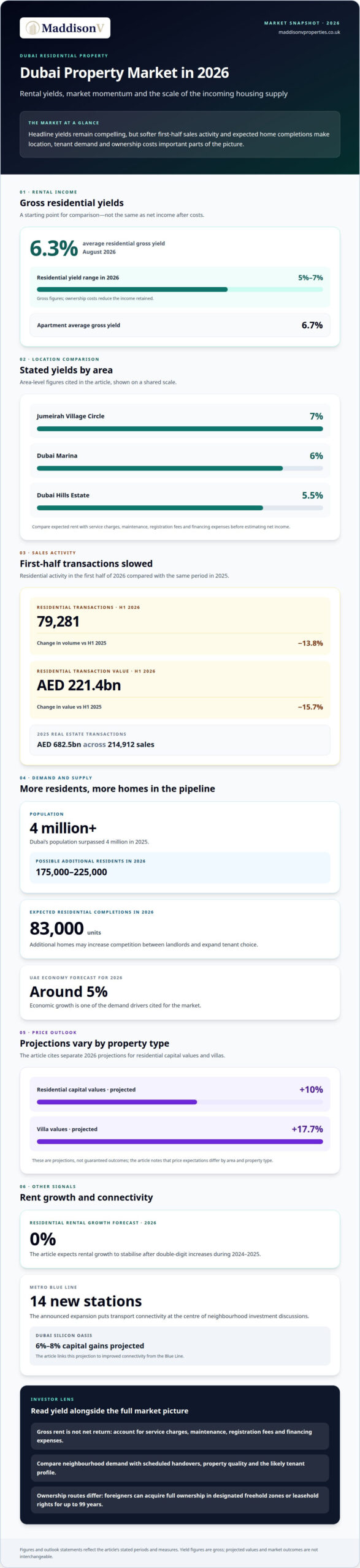
Dubai’s residential market offers gross rental yields of 5% to 7% in 2026. The average gross residential yield was 6.3% in August 2026, while apartments averaged 6.7%. These figures are a useful starting point, but investors should distinguish rental income from net returns after ownership costs. The property investment trends in Dubai in 2026 make that distinction especially relevant as buyers weigh income against future appreciation.
Location shifts the equation. Jumeirah Village Circle had a stated average yield of 7% in 2026, compared with 6% in Dubai Marina and 5.5% in Dubai Hills Estate. Jumeirah Village Circle also offers yields of 7-9%. For a strategic purchase, assess tenant appeal, property condition and the surrounding estate alongside headline yield.
Rental demand spans apartments and family-sized homes, but income potential differs by property type. These examples help frame rental prospects, not guarantee returns.
Recent rent growth also needs context. Dubai rental prices increased by double digits during 2024-2025 after record-breaking increases lasted two years. Residential rental growth is forecast to stabilise at 0% in 2026, so a long-term plan should not assume earlier increases will continue. Capital appreciation and rental income are separate return drivers.
Compare Dubai with Abu Dhabi and other global cities using the same gross-to-net framework, but don’t treat the figures here as a like-for-like ranking. Consider rental income, ownership costs, location and potential capital appreciation in each market rather than relying on yield alone.
For purchase budgeting in 2026, include registration fees, service charges, maintenance and financing expenses. Tax and fee totals depend on the transaction and ownership circumstances, so model each cost separately before estimating net rental income.
Investors can compare a cash purchase with mortgage financing, including borrowing costs in their return calculations. Lender assessments and personal circumstances shape available terms; the loan amount, repayment structure and interest cost all affect net income.
Ownership eligibility matters too. According to the Government of Dubai, foreigners can acquire full ownership in designated Dubai freehold zones or leasehold rights for up to 99 years under Law No. 7 of 2006. This distinction can shape an investor’s ability to hold an asset over the intended investment period.
For investors assessing property investment trends in Dubai in 2026, compare a property’s expected rent with its full running costs and likely tenant profile. A Dubai Marina apartment, a Jumeirah Village Circle unit and a Dubai Hills villa each represent different balances of yield, property type and investment horizon.
What’s Driving Dubai’s Property Market Growth?
Dubai’s growth story now includes a more measured signal: residential sales activity softened in the first half of 2026. The market recorded 79,281 residential transactions worth AED 221.4 billion, down 13.8% in volume and 15.7% in value compared with the first half of 2025. That shift makes location, delivery timing and buyer demand especially important over the next 12-36 months.
Economic activity and population growth remain key demand drivers. The UAE economy is forecast to grow around 5% in 2026, while Dubai’s population surpassed 4 million in 2025. The city could add 175,000-225,000 residents in 2026, supporting demand for homes and services. Yet population growth alone cannot protect every property from market-wide price changes.
Price expectations vary by area and property type. Dubai residential capital values are projected to grow by 10% in 2026, while villa values are projected to appreciate by 17.7%.
Dubai apartment and villa prices reflect distinct locations and demand profiles.
Recent price and rental trends show both opportunity and cooling. Residential prices rose 11.62% annually in 2024; Jumeirah Village Circle apartment prices rose around 17% in 2025. Dubai’s average gross residential rental yield was 6.3% in August 2026. These indicators describe different periods and measures, so they shouldn’t be treated as a single forecast.
Supply creates a central risk. Around 83,000 residential units are expected to be completed in Dubai in 2026, and more homes can increase competition between landlords. Oversupply may weigh more heavily on lower-tier apartments, while project delays, global economic shifts and currency movements can affect prices and investor returns. Sustainable, well-located communities may be better positioned to retain demand.
For the 2026 outlook, compare neighbourhood demand against scheduled handovers and the property’s quality. Dubai’s 2025 real estate transactions reached AED 682.5 billion across 214,912 sales, but first-half 2026 residential activity declined year over year. For informed Dubai property sourcing, balance potential appreciation with rental demand, supply exposure and your investment horizon.
Metro infrastructure and nearby property values
Transport expansion can improve access to employment, retail and leisure destinations, making nearby homes more convenient for residents. Dubai’s Metro Blue Line was announced with 14 new stations, placing connectivity at the centre of several neighbourhood investment discussions. For buyers, proximity matters most when a station connects a residential area with established destinations and everyday services.
Dubai Silicon Oasis illustrates the potential link between transit and capital values. The area is projected to deliver 6-8% capital gains as the Blue Line improves connectivity. Treat that forecast as a scenario, not a substitute for assessing a specific building, its location relative to a station, and competing residential supply.
Planned transport can influence buyer interest before services begin, but timing matters. An announced schedule calls for a longer investment horizon than completed infrastructure, making entry price and holding period central to the decision.
The RTA estimates that property values near planned Gold Line stations could rise by up to 20%. That projection offers a reference point for considering transport-led appreciation, not a guaranteed outcome for every home. Station distance, project delivery, local amenities and supply all affect whether improved access translates into sustained demand.
Emerging districts have additional demand drivers. Dubai South, Expo City and Creek Harbour attract interest through affordability, infrastructure and lifestyle factors. Infrastructure improvements and job opportunities are expected to support occupancy in Creek Harbour and Expo City. For international buyers, these factors help explain how infrastructure-led expansion can support resident demand and investment appeal.
Compare transport forecasts with the neighbourhood’s existing fundamentals. Start with the announced route and station, then consider links to jobs and amenities, construction progress, and nearby homes competing for tenants. This helps distinguish a working transport advantage from a longer-term promise, especially around planned lines.
Infrastructure is part of wider urban development. Dubai’s Metro Blue Line supports the connectivity case for Dubai Silicon Oasis, while the Gold Line introduces a longer-term expansion corridor. Weigh each project’s timeline against your holding period: a property bought for near-term rental demand calls for different priorities from one held for future appreciation.
Forecasts are most useful when translated into property-level questions: how will a station change travel options, which residents benefit, and what competing supply is nearby? In Dubai Silicon Oasis, the 6-8% capital-gain projection is tied to Blue Line connectivity. In Gold Line areas, the RTA’s estimate of up to 20% highlights potential, while the September 2032 opening points to the longer wait.
Developer launches, handovers, and supply-demand balance
Dubai developers launched more than 150,000 residential units in 2025, while handovers reached approximately 42,000 units. That gap matters: launches indicate planned future supply, while completed homes can enter the rental or resale market. Investors should distinguish announced developments from properties ready for occupation when assessing near-term competition.
Handovers rose from around 29,000 units in 2024 to approximately 42,000 in 2025. Dubai also has an estimated pipeline of 131,234 new residential units for 2026. These figures represent different stages of supply, not an assurance that every planned home will be completed on schedule. Delivery timing and location help determine where new competition will be felt.
Demand has a demographic foundation. Dubai added over 200,000 residents in 2025, and the article’s housing estimate uses an average household size of approximately four people. On that basis, 2025 population growth implied demand for roughly 50,000 additional homes. These estimates help frame demand, but household formation and property preferences also affect which developments attract residents.
The key question is whether new homes match demand in the same location and price segment. A large pipeline gives buyers more choice and may strengthen their negotiating position, particularly when developments target similar tenants. Homes in well-located communities may remain competitive when their amenities, access and quality set them apart from nearby supply.
Oversupply risk varies across Dubai. A cluster of similar apartments can intensify rental competition, while a community with employment access and established services may absorb homes more readily. Compare a project’s completion schedule with nearby handovers, tenant demand and comparable available units. This makes the supply picture specific to each area, not a citywide assumption.
How can investors verify a developer and make a more informed purchase? Review the developer’s reputation and record for construction quality and project delivery, then assess project documents, payment milestones and the completion schedule. A qualified property legal professional can review transaction documents and ownership details before you commit funds.
Dubai end-user buyers may have more property choices, greater bargaining power and improved developer payment plans in 2026. That environment can benefit purchasers, but payment flexibility doesn’t remove delivery or resale risk. Compare the full schedule with your ownership horizon and assess whether demand can support the property after completion.
Global economic conditions can influence demand, financing decisions and investor confidence. Compare planned launches with actual handovers, then examine local employment, tenant preferences and competing supply. A completed apartment in a crowded segment, for example, faces a different rental challenge from a well-located home serving a distinct resident profile.
Off-plan property investment
Off-plan property gives investors access to a home before construction is complete. In Dubai, it has become a major part of residential activity: off-plan transactions represented 70.2% of residential transactions in the first half of 2025. That share shows the strategy’s popularity, but it doesn’t establish that every project will deliver the same value or rental performance.
Sales value also demonstrates the segment’s weight. Off-plan sales accounted for 66% of Dubai’s total real estate sales value in 2024, amounting to AED 288 billion. Flexible terms may attract buyers in a cooler price environment. For an investor, the appeal can include staged payments and a new apartment, while the trade-off is waiting for completion before occupation or rental income begins.
Let timing shape your decision. A buyer entering near launch may wait longer for the property to be ready, while a later-stage project may offer a clearer picture of construction progress. In either case, align payment milestones with your cash flow and expected handover. A projected completion date is not the same as a completed, rentable home.
Assess each project on its own merits. Review the developer’s reputation and record for construction quality and project delivery, then consider the site’s location, transport access, nearby amenities and competing residential developments. These factors help show whether the finished property can appeal to residents, rather than relying on launch interest or a polished sales presentation.
Quality and differentiation matter in a market receiving new supply. Dubai developments with green credentials and technology integration are likely to hold better value. Prioritise projects that are well located and sustainable, and consider how their design and amenities suit likely residents. A distinctive apartment may compete differently from multiple similar units launching in the same area.
Off-plan investment changes the return timetable. Rental income generally depends on completion, handover and finding a tenant, so it should not be treated as immediate cash flow. Compare the expected holding period with your income goals. If rental income is the priority, weigh the wait against a completed residential property that can be occupied or rented sooner.
A considered review can follow four steps: assess the developer’s delivery record, study the location, understand payment milestones, and compare expected completion with your investment horizon. Then consider whether the finished home suits tenant demand and competing supply. These checks connect the launch decision to the property’s eventual use and potential performance.
Dubai’s off-plan activity makes the segment impossible to ignore, yet transaction share alone cannot determine a sound purchase. Choose based on project quality, delivery timing and location, not launch momentum alone. To discuss your Dubai off-plan investment strategy, consider how each opportunity fits your return priorities and ownership horizon.
MaddisonV Properties: London Property Investment
MaddisonV Properties helps investors explore London property opportunities with a clear view of property type, location and timing. Turn to the team when weighing a new build against a completed property or aligning a purchase with your investment horizon. Property sourcing can focus your search, while mortgage consultations can support funding decisions. Property management offers ongoing oversight after purchase.
Keep the essentials in view: property condition, purchase costs, expected completion and potential rental appeal. Together, these factors connect the purchase decision with your ownership plans, rather than relying on market momentum alone.
For a considered conversation about your London property investment plans, contact MaddisonV Properties.
Shape your next investment decision
Use the property investment trends in Dubai in 2026 as a starting point, then define what success means for your own portfolio. Is your priority dependable rental income, long-term capital growth, or a balance between the two? A clear objective can help you assess opportunities consistently, rather than being swayed by launch activity or short-term market sentiment.
Before committing, write down your preferred holding period, required income level, and the conditions that would prompt you to sell or hold. Consider how your plans might change if rental demand softened, handover took longer, or resale interest shifted. This simple framework can bring discipline to property selection and make the next steps easier to evaluate.
For tailored guidance on sourcing, financing or managing an investment, contact MaddisonV Properties today. A considered plan can help you move forward with greater clarity and confidence.
Frequently Asked Questions
Dubai real estate trends 2026: What’s cooking?
Dubai’s 2026 story combines continued investment interest with more scrutiny of individual locations and projects. For investors, the practical shift is from asking whether the city is growing to asking which property can attract residents after completion. Compare a project’s handover schedule with nearby rental options, then consider whether transport, employment and amenities support demand for that specific home.
Final thoughts: will Dubai property prices rise or fall in 2026?
There isn’t one reliable answer for every Dubai property: the outlook differs by location, property type and incoming supply. Residential capital values are projected to grow in 2026, while softer first-half transaction activity shows why forecasts shouldn’t be treated as a guarantee. For a purchase decision, consider the expected holding period and whether the property remains attractive if appreciation is slower than anticipated.
What can you expect further?
Project delivery, transport expansion and rental demand are important signals for investment decisions. Revisit them as a purchase progresses: compare the latest construction milestone with the original schedule, assess nearby competing homes, and consider whether planned infrastructure fits your holding period. This helps distinguish a property’s current appeal from value dependent on future changes.
Will Dubai face oversupply by 2026?
Supply pressure is a credible risk, but its effect depends on where homes are delivered and what residents want. A cluster of similar apartments may face greater rental competition than a property serving a distinct tenant profile. Assess the local pipeline alongside employment access, amenities and comparable rental choices. Citywide supply figures alone can’t show whether a particular building or neighbourhood is saturated.
Which Dubai neighborhoods have the strongest property investment potential in 2026?
Potential depends on your investment goal. Jumeirah Village Circle has a strong stated rental-yield profile, while Dubai Silicon Oasis is linked to anticipated Metro Blue Line connectivity. Dubai Hills Estate, Dubai Marina, Creek Harbour, Expo City and Dubai South each have different property or infrastructure considerations. Compare tenant appeal, transport access and competing developments in the specific neighbourhood before selecting an apartment or villa.
What is the outlook for Dubai property demand, supply, and new launches in 2026?
Population growth supports demand, while new launches and scheduled handovers add competition and choice. Outcomes can therefore differ by neighbourhood: residents may favour completed homes with established amenities, while buyers may consider launch-stage projects for their payment structure and future use. Compare the delivery timetable with local housing demand, then assess whether similar homes will reach the market at the same time.
How do Dubai property investment returns compare with Abu Dhabi and other global cities?
The figures provided don’t establish a like-for-like ranking. Compare rental income, ownership costs, location and potential capital appreciation in each market rather than relying on yield alone.
What are Dubai property purchase fees, taxes, and ongoing ownership costs in 2026?
Budget for registration fees, service charges, maintenance and financing expenses. Total taxes and fees depend on the transaction and ownership circumstances, so model each cost separately when estimating net rental income.

Sign Up Now
Want to read more great articles and blogs subscribe to our newsletter