
UK property investment can offer UAE investors a way to explore opportunities in an established market. Before buying, it helps to understand the...

UK property investment can offer UAE investors a way to explore opportunities in an established market. Before buying, it helps to understand the costs, financing, rental income and ongoing responsibilities involved, and to assess each property on its own merits.
It is easy to focus on potential rent, but a complete picture of costs helps show how a property may perform. Clear records can also help you track expenses, plan for maintenance and assess whether a purchase is likely to meet your investment objectives.
This guide explains how to assess rental income after operating costs and mortgage payments, account for vacancies and compare opportunities across locations. It also covers tenant retention, financing decisions and portfolio-level strategies, helping UAE investors make measured choices based on performance after costs, not rent alone. The aim is to clarify what each asset may contribute and where careful management can support cash flow over time.
Key Takeaways
- Keep clear records of property income and expenses to monitor performance, plan ahead and identify which assets need attention.
- Assess each investment by considering operating income, costs and financing to understand its overall financial performance.
- Build realistic vacancy assumptions into income forecasts and use local demand, tenant retention and turnover patterns to assess a market.
- Plan for maintenance and larger capital expenses so investment decisions reflect both their cost and their potential effect on property performance.
- Review the portfolio as a whole, balancing income sources, financing and expense controls rather than judging each property by rent alone.
1. How does accounting impact rental portfolio cash flow and performance?
Accurate accounting turns rent and property costs into a clear performance record. For each asset, track rent due and received, expenses, arrears and planned repairs. This distinguishes collected cash from income merely expected and shows whether a property can generate dependable cash flow after regular costs. Consistent records can reveal weak rent pricing or rising expenses before they distort the wider portfolio’s results.
The 1% rent-to-price rule is a screening heuristic: monthly rent equals at least 1% of the purchase price. Under its example, a $200,000 property would need $2,000 in monthly rent. Treat that as an initial comparison, not a guarantee of profit. It excludes operating costs, financing, vacancies and capital work. Actual performance depends on local rent and the costs required to keep the property occupied and in good condition.
Rent-to-price ratios help compare markets, but they don’t tell the whole story. An example for Indianapolis pairs a $270,000 home with $2,200 monthly rent, a 0.8% ratio. In Los Angeles, a $900,000 home with $3,500 monthly rent has a 0.4% ratio. Indianapolis’s example also lists 7.5% year-over-year rent growth, while Charlotte’s is 9.1%. Compare these measures with expenses and vacancy patterns before judging potential cash flow.
Market analysis makes rent pricing more precise. Compare similar properties by location, condition, layout and included services, then track asking rents alongside achieved rents and time vacant. Stronger rent growth in comparable Indianapolis homes, for example, does not automatically justify a steep increase on one property. Its condition, competing options and tenant experience all affect whether the price is sustainable. Record the evidence behind each pricing decision and review the results after a change.
Weigh rent increases against tenant retention. A higher asking rent may improve income on paper, but turnover can bring lost rent, preparation work and maintenance costs. Compare the expected gain from an increase with the likely cost of a vacancy and reletting. If a reliable tenant renews at slightly less than a new listing might attract, the renewal may preserve steadier monthly income. Track renewal outcomes and vacancy periods to inform future decisions.
Use regular accounting reviews to connect pricing with actual performance. Match rent collected against the agreed rent, classify recurring and one-off costs, and compare each property’s results across reporting periods. Flag late payments, repeated repairs and longer vacancies. These patterns can indicate whether to adjust pricing, schedule work or revisit a property’s operating plan. Comparisons are most useful when every property uses consistent categories and reporting periods.
Tax planning also affects property decisions, but rules differ by country. In the United States, a 1031 exchange has strict timelines: according to the Internal Revenue Service, investors have 45 days to identify a replacement property and 180 days to close on it. These deadlines apply to that exchange process, not to rental accounting generally. Keep transaction records distinct from operating reports, so cash-flow analysis remains clear while a separate tax plan accounts for applicable exchange requirements.
2. Assessing London rental income and cash flow after financing
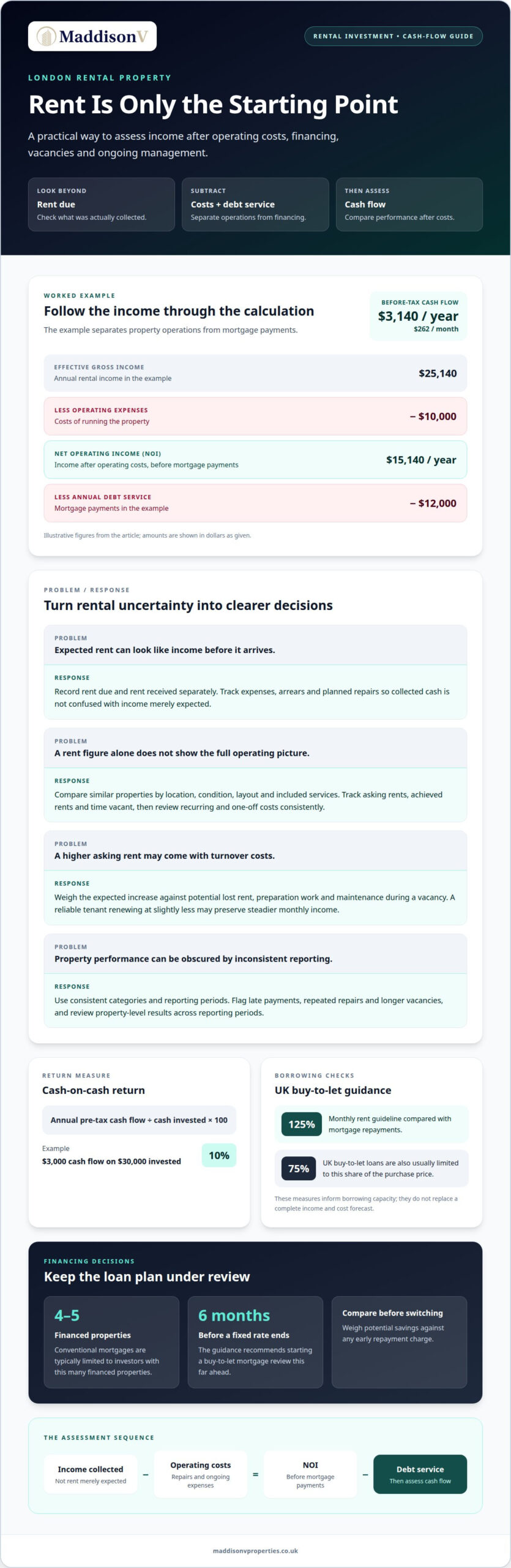
Assess London property investment cash flow by subtracting operating expenses and debt service from effective rental income. To find cash-on-cash return, divide annual pre-tax cash flow by cash invested, then multiply by 100. These calculations help investors assess whether rent supports both property operations and financing.
Net operating income, or NOI, measures income after operating expenses but before mortgage payments. In one example, effective gross income is $25,140 per year and operating expenses are $10,000 per year. The resulting NOI is $15,140 annually. After $12,000 in yearly debt service, before-tax cash flow is $3,140 per year, or $262 per month. This separation shows how a London rental property performs before its financing structure is considered.
Cash-on-cash return compares annual cash flow with the cash invested. For example, $3,000 in cash flow on a $30,000 investment produces a 10% return. Use consistent periods and expense categories when comparing London rental properties. Assess this return alongside the cash each property contributes and the capital it requires when evaluating a rental portfolio.
Financing terms shape the amount left after NOI. The stated UK buy-to-let lending guideline requires monthly rent of at least 125% of mortgage repayments. Under that guideline, £1,000 in monthly repayments calls for at least £1,250 in monthly rent. UK buy-to-let loans are also usually limited to 75% of a property’s purchase price. These measures inform borrowing capacity for a London investment property, but don’t replace a complete forecast of costs and income.
As a London rental portfolio grows, financing options depend on existing borrowing and lender criteria. Conventional mortgages are typically limited to investors with 4-5 financed properties. Review a buy-to-let mortgage as its fixed rate approaches expiry; the guidance recommends starting that review six months before the current fixed rate ends. Compare potential savings against any early repayment charge before switching.
For investors assessing London rental properties, consistent reporting makes financing decisions easier to compare. Standardise property-level income, debt-service and expense reports, then review them quarterly where practical. Keep operating income, interest and financing transactions distinct. Ownership structure can affect tax liabilities, including capital gains tax and inheritance tax, so consider tax planning separately from operating performance. This provides a clearer basis for deciding whether to retain, refinance or reinvest in a London property.
3. Vacancy rates and UK property market selection
A UK rental property earns no rent while it stands empty, so vacancy belongs in every income forecast. Start with the local vacancy rate, then compare it with occupancy, tenant demand and property type. For example, an illustrative London rental property might have an occupancy rate of 97%. A property in another UK location might have a vacancy rate of 3.8%, while a third might have a rate of 10.8%. These figures show how market selection can change the income assumption before purchase.
Build a vacancy allowance into projected rental income rather than treating every month as fully occupied. One approach is to budget for one vacant month per year, equivalent to 1/12 of annual rent, or 8.3%. Another is to assume a 5-10% annual vacancy allowance, adjusted for property type and local demand. A 5% reserve is also described as a standard starting point, but the appropriate allowance depends on local conditions and the asset’s leasing history.
Vacancy costs extend beyond lost rent. Turnover preparation, marketing and the period without a tenant can together cost the equivalent of 1-2 months’ rent. That makes tenant retention part of cash-flow planning, not simply a service consideration. Before accepting a likely turnover, compare the cost of preparing and reletting the property with the income expected from a new tenancy. A lower rent increase may preserve income if it helps retain a reliable tenant.
Vacancy and turnover records can help diagnose operational problems. Track days vacant, enquiries, viewings, applications and reasons tenants leave. If one UK property repeatedly takes longer to let than comparable homes, review its asking rent, presentation and tenant service. A persistent pattern may indicate that pricing does not match local demand or that the property needs attention. Comparing these measures across London and other UK locations can distinguish a market-wide slowdown from an issue specific to one rental.
Effective gross income gives a more realistic starting point than advertised rent. In one example, monthly rent of £2,200 and other monthly income of £50 are reduced by £155 for vacancy. The resulting effective gross income is £2,095 per month. The calculation makes the vacancy deduction visible, so operating forecasts don’t assume that every scheduled payment arrives. Apply the same method across UK properties to compare expected income on consistent terms.
Market selection should weigh vacancy alongside rent and purchase price. A low vacancy rate can support steadier occupancy, but it doesn’t establish profitability by itself. Compare local demand with likely rent, operating costs, property condition and tenant turnover. For example, a UK location’s 3.8% vacancy figure sits below the cited 5% threshold for a healthy rental market. A 10.8% figure for another location suggests a larger vacancy assumption may be prudent when assessing a comparable UK investment.
To reduce avoidable vacancies, align rent with comparable local listings, respond promptly to tenant concerns and plan maintenance between tenancies. Review renewal dates early enough to make a considered decision. For each property, update your vacancy allowance when actual vacancy differs from the forecast. This keeps projected income grounded in evidence and helps identify which UK markets and assets support steadier portfolio cash flow.
4. What is UK property cash flow?
UK property cash flow is rental income remaining after operating expenses, financing and planned capital spending. Long-term and short-term rentals differ in occupancy, turnover, operating demands and local requirements. Compare their net income using the same cost categories, not headline rent alone.
Start by separating routine operating expenses from mortgage payments and capital improvements. The 50% rule estimates that operating costs, excluding the mortgage, equal half of gross rental income. For a UK property renting at $2,000 per month, that estimate suggests $1,000 in monthly operating expenses before financing. It’s a screening tool, not a substitute for property-specific records.
Location shapes expenses. Property taxes, insurance premiums and homeowners association fees can vary between properties and locations, reducing the cash available after rent is collected. Record these costs against the relevant UK property, alongside utilities and routine upkeep, then compare actual expenses with income. A property in London with attractive rent may leave less cash if recurring charges take a larger share.
Preventive maintenance protects both the property and its operating budget. Regular inspections can catch small issues before they become larger repairs, while maintenance records reveal recurring trouble spots. One budgeting rule recommends setting aside about 1% of a rental property’s value per year for maintenance. Proactive maintenance can reduce emergency repair costs by approximately 32% compared with reactive maintenance, making planned attention a practical cash-flow measure for UK landlords.
Capital expenditure planning covers larger, less frequent projects, such as replacing major building components or improving kitchens. Keep these separate from routine repairs in your accounts. For each proposed upgrade, estimate its full cost and the income or operating benefit it may bring. Assess a cosmetic improvement against comparable UK rents and the property’s condition, rather than assuming it will justify a higher asking price.
Build a capital reserve before a major project becomes urgent. One guideline recommends setting aside 5-10% of annual rent for capital expenditure reserves. Adjust the plan to the building’s age, condition and known replacement needs. A newer London apartment and an older UK property may face different future work, so applying one reserve blindly across the portfolio can obscure each asset’s actual exposure.
Base reinvestment on evidence. Compare proposed work with maintenance history, current cash flow and the property’s ability to generate income after completion. If borrowing funds the project, include the resulting interest and repayments in your forecast. After the work, compare occupancy, operating expenses and achieved rent with the previous period. This review shows whether capital spending improved the UK property or simply increased its costs.
Neither long-term nor short-term UK rentals are inherently more profitable after expenses and local requirements. Compare each option’s net income using the same cost categories, accounting for differences in occupancy, turnover, operating demands and local requirements.
5. UK property investment cash flow strategies
A UK property portfolio can look healthy overall while individual rental properties quietly weaken. Compare cash flow by property, then review the combined position. Consistent reporting shows which London or UK assets support shared reserves and which need attention. For each rental, track collected income, operating expenses, financing and planned work using the same categories. This gives you a portfolio-wide view without hiding an underperforming property behind stronger results elsewhere.
Set shared priorities based on these comparisons. A UK property with stable occupancy and manageable costs may need a different reinvestment plan from one facing repeated repairs or turnover. Rank projects by urgency, likely operating benefit and effect on available cash, then assign capital with a clear purpose. This helps investors avoid spreading funds evenly when one building needs essential work and another can operate reliably without immediate upgrades.
Geographic concentration can make UK property operations more efficient. When a portfolio reaches around 15 to 20 or more units in the same geographic area, centralising maintenance may have a significant operational impact. Shared scheduling and a consistent process can simplify routine work across nearby properties. Keep property-level cost records alongside shared costs, however, so the portfolio’s overall efficiency doesn’t obscure the true performance of each UK asset.
Diversifying rental income can also reduce dependence on a single revenue stream. Evaluate any additional income against tenant satisfaction, management complexity and local regulatory requirements. The right approach depends on the property and its permitted use. A simpler income profile may be preferable if another stream brings more administration than value. Assess the net effect across the portfolio, including operating demands, before treating extra revenue as an improvement.
Tenant retention and expense control work best as consistent UK property management practices. Use clear renewal processes, prompt maintenance coordination and comparable service standards across properties. Review recurring costs together, then investigate unusual changes at individual buildings. A repeated expense may warrant a portfolio-wide adjustment; a one-off repair needs a property-specific response. This keeps management focused where intervention matters without applying the same solution to every asset.
Choose performance measures that fit the portfolio’s UK investment priorities. One example describes an investor accepting $50 per month per door across 50 doors. That illustrates how a modest property-level figure can be assessed against the portfolio’s scale, rather than judged in isolation. Track cash flow per property as well as total cash flow, occupancy and reserve needs. Use consistent reporting periods so changes can be compared meaningfully.
Review the operating plan on a regular schedule and record the reason for each change. If a UK property persistently drains cash, assess its rent, expenses, financing and future work before deciding whether to reinvest or change strategy. Property management can support coordinated operations, while portfolio-level analysis keeps decisions tied to overall performance. Explore portfolio management to bring property-level results into a clearer UK property investment strategy.
MaddisonV Properties: London Investment Portfolio Management
MaddisonV Properties helps owners bring London property investment performance and day-to-day oversight into a considered plan. Its Portfolio Management and Property Management services support owners reviewing how rental income, operating costs and property-level performance fit together. For investors considering a new UK acquisition, Property Sourcing and Mortgage Consultations can inform the decision before adding another asset.
Consider this support when managing several London properties makes consistent performance tracking more difficult, or when you are weighing a purchase, financing decision or change in management. A clear view of each property’s role can help shape more deliberate investment decisions. Contact MaddisonV Properties to discuss your portfolio and its management needs.
Turn your analysis into a clear next step
The next decision is not always to add another property. You may need to refine your investment priorities, adjust the time you devote to oversight or define what a successful asset should contribute to your wider plans. Written priorities can make future decisions more consistent, especially when opportunities compete for capital and attention.
Use those priorities to guide your next review. Identify which decisions need action, which can wait and what information could change your view. This keeps optimising a rental portfolio for cash flow connected to your long-term objectives, rather than turning it into a series of disconnected adjustments.
If you’re ready to consider the next step for your London property investment portfolio, speak with MaddisonV Properties. A considered plan can help bring greater clarity to your investment decisions and a more purposeful direction to the properties you hold.
Frequently Asked Questions
How can investors assess rental performance in the UK property market?
Compare rental income with operating costs, financing and vacancy periods to understand a property’s performance. A consistent review of receipts and outgoings can highlight changes that need further investigation. Consider both the income generated and the property’s wider investment objectives, as rental activity is only one part of a decision about holding or redirecting investment.
What should overseas investors know about UK property investment?
Overseas property investment in the UK involves considering income, outgoings and the timing of payments, as well as the property’s market value. An asset may appreciate while producing limited rental income. Keeping these measures distinct helps investors assess whether a property supports their income requirements and wider portfolio priorities.
What is a “good” cash-on-cash return for a UK rental property?
A commonly cited target is a cash-on-cash return between 10% and 12%, with 12% described as ideal. Calculate it by comparing annual pre-tax cash flow with the cash invested, then express the result as a percentage. Treat the figure as a benchmark, not a stand-alone verdict. Financing, vacancy exposure, property condition and investment objectives all affect whether a particular return suits an investor’s plans.
How can investors compare UK properties across a portfolio?
Use consistent records and categories to compare rental income, costs and operating changes across properties. Incomplete records can hide late rent, recurring repairs or rising costs, making a property appear stronger than it is. Reconcile rent records, bank activity and supplier invoices regularly. Good bookkeeping gives investors a more dependable basis for deciding where operating changes or additional capital may be appropriate.
What should a UK property investment strategy include?
A coordinated approach considers income, expenses, tenant retention and investment priorities across multiple properties. It is especially useful when owners hold assets in different locations or under different financing arrangements, since individual decisions can affect the wider portfolio. A practical strategy sets shared performance measures, assigns responsibility for reviewing exceptions and records why decisions are made. This helps active investors focus on properties where a change could matter most.
What expenses should investors include when estimating UK rental property cash flow?
Include recurring operating costs such as maintenance, insurance, property taxes, utilities paid by the owner, management costs and any applicable association charges. Account separately for mortgage payments, vacancy allowances and planned capital work so these items remain visible rather than being lost in a single total. The exact mix depends on the property and ownership arrangement. Reviewing invoices and payment history replaces broad estimates with figures grounded in the asset’s actual operation.
How can investors assess rent in a UK property market?
Base a proposed rent on comparable homes with similar locations, condition, layout and included services. Consider the tenant’s payment history and potential turnover costs alongside current market evidence. If the property needs improvements, assess whether they address a feature tenants value before adjusting the rent. A measured renewal discussion can help owners understand tenant concerns and avoid setting a price that raises vacancy risk without improving net income.
When might refinancing or paying down a UK rental property mortgage improve cash flow?
Refinancing may improve monthly cash flow if revised repayments and borrowing terms reduce ongoing debt costs enough to outweigh switching expenses. Before changing a loan early, compare potential savings with any early repayment charge. Paying down principal can reduce interest costs, although the effect on monthly payments depends on the loan terms. Assess both options against the property’s income, available reserves and your wider plans before committing funds.

Sign Up Now
Want to read more great articles and blogs subscribe to our newsletter