With 83,000 residential units projected for completion in 2026, the Dubai skyline remains a testament to ambition, scale, and relentless growth. For...

With 83,000 residential units projected for completion in 2026, the Dubai skyline remains a testament to ambition, scale, and relentless growth. For the ultra-high-net-worth investor, these figures represent both an unparalleled opportunity and a complex puzzle. You’ve likely observed the market’s transition from speculative volatility toward a more balanced, mature phase. However, as the landscape shifts, the specific risks of buying property in dubai require a level of scrutiny that matches the standards of a Prime Central London acquisition.
This intelligence report offers a definitive breakdown of the structural, economic, and regulatory risks currently shaping the Emirates. We’ll provide you with a clear risk-mitigation framework designed to protect your global portfolio while verifying the latest legal protections for foreign buyers. By examining the 2026-2030 market forecast, we’ll reveal how to distinguish between oversupplied sectors and high-value assets that offer long-term financial security, mental tranquility, and lifestyle prestige. We’ll start by analyzing the current supply-demand dynamics and the specific developer due diligence necessary to ensure your peace of mind throughout the entire lifecycle of your investment.
Key Takeaways
- Analyze how the 2040 Urban Master Plan is transforming the landscape from speculative flipping to a mature, end-user-driven market.
- Secure your capital by understanding the critical legal protections, including Oqood pre-registration and the specific risks of buying property in dubai for non-GCC nationals.
- Determine the true impact of the 2028 luxury oversupply narrative and the AED/USD currency peg on your long-term rental yields.
- Deploy a rigorous 5-step due diligence framework that prioritizes independent developer audits and secondary market resale potential.
- Learn how to bridge the gap between London’s safe-haven security and high-yield global opportunities through PCL-standard sourcing strategies.
The 2026 Dubai Real Estate Landscape: Beyond the Hype
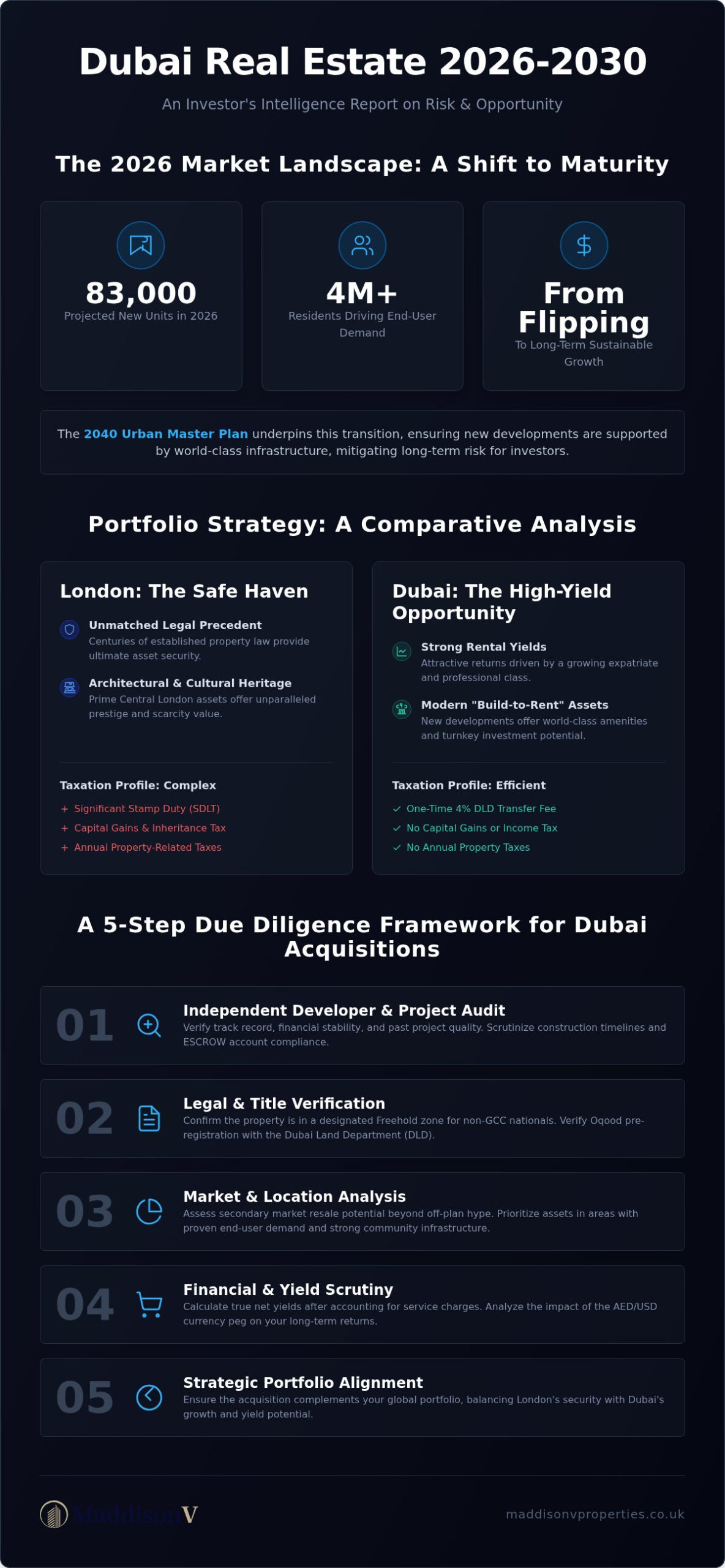
The 2026 landscape is no longer the wild frontier of previous decades. Investors have moved past the frantic “flipping” cycles of 2024 and 2025, opting instead for a market defined by long-term occupancy, structural integrity, and sustainable growth. This transition marks a pivotal stabilisation phase where capital appreciation is driven by genuine demand rather than pure speculation. With Dubai’s population now surpassing 4 million residents, the focus has shifted toward high-quality assets that serve an expanding professional class. Understanding the Dubai Real Estate Market Overview reveals a city-state that has matured into a global hub, yet the inherent risks of buying property in dubai still demand a rigorous, London-standard approach to due diligence.
To better understand the nuances of the current market and how to navigate off-plan opportunities, watch this helpful video:
The 2040 Urban Master Plan serves as a strategic roadmap for this evolution, effectively mitigating long-term infrastructure risks by ensuring that new developments are supported by world-class transport, green spaces, and community facilities. This vision offers a layer of security that contrasts sharply with the tax-heavy environments of the West. While Dubai requires a one-time 4% DLD transfer fee, it remains free from the recurring pressures of annual property taxes or the complex Capital Gains and Stamp Duty regimes found in the UK. For the sophisticated investor, 2026 represents a unique window where regulatory clarity meets significant yield potential.
The Evolution of Market Maturity
Entry points in 2026 have shifted as the market absorbs the projected 83,000 new units. While Prime Central Dubai locations like Downtown and the Palm Jumeirah continue to command a premium, emerging suburban districts such as Dubai Hills are seeing increased interest from those seeking location liquidity and family-centric amenities. Market maturity in 2026 is defined as the transition from a high-volatility, speculative environment to a transparent, regulated landscape where value is anchored in end-user demand and legislative stability. Investors are now more selective, prioritising developer track records and facilities management over flashy marketing promises.
London vs. Dubai: A Risk-Reward Comparison
For the ultra-high-net-worth individual, the choice isn’t necessarily between London or Dubai, but how to balance both jurisdictions to ensure financial security and lifestyle prestige. London remains the ultimate “Safe Haven,” offering centuries of legal precedent, architectural heritage, and proximity to elite institutions like Westminster School. Conversely, Dubai provides a high-yield profile and modern “Build-to-Rent” opportunities that traditional mansion blocks often lack. You can explore this further in our guide on London vs. Dubai: Where Should You Invest? to see how these two markets complement a sophisticated global portfolio through 2030.
Structural and Legal Risks: Protecting Your Capital
Navigating the legal intricacies of a foreign jurisdiction requires more than just capital; it demands a meticulous understanding of local statutes. For non-GCC nationals in 2026, the distinction between freehold and leasehold rights remains the cornerstone of any acquisition strategy. Freehold ownership grants perpetual rights to the land and the structure, whereas leasehold typically offers rights for a duration of up to 99 years. Most investors seeking the stability of a global portfolio prioritise freehold zones to ensure their assets remain liquid and transferable. The Dubai Land Department (DLD) acts as the central registrar and regulator, providing the legal infrastructure that guarantees the validity of title deeds for foreign owners.
While the regulatory environment has matured significantly, external assessments like Fitch Ratings on Dubai Market Risks highlight the importance of monitoring broader economic shifts. Managing the legal risks of buying property in dubai involves more than just signing a contract; it’s about verifying the developer’s financial health through independent audits. To mitigate the risk of developer insolvency, UAE law mandates that all buyer payments for off-plan units be deposited into a project-specific Escrow account. These funds are only released to the developer upon reaching verified construction milestones, ensuring your capital is protected even if the developer faces financial headwinds.
Navigating the Off-Plan Regulatory Framework
Off-plan acquisitions in 2026 require an interim registration known as Oqood. This certificate acts as a legal placeholder, protecting your rights before the building’s completion. When reviewing a Sale and Purchase Agreement (SPA), it’s vital to scrutinise “Force Majeure” clauses, which can occasionally be used to justify delivery delays. The Real Estate Regulatory Agency (RERA) provides a robust platform for dispute resolution, offering a level of oversight that mirrors the professional standards seen in Prime Central London. Our team at MaddisonV Properties applies this same level of PCL-standard due diligence to every developer audit we conduct, ensuring nothing is left to chance.
Residency and the Golden Visa Link
The 10-year Golden Visa remains a significant draw for international buyers, currently requiring a minimum investment of AED 2 million. This threshold has remained stable, yet investors must stay vigilant regarding policy shifts that could impact eligibility through 2030. It’s also essential to consider the impact of the Common Reporting Standard (CRS) on global tax transparency. While Dubai offers a tax-neutral environment, your property holdings are still subject to international reporting requirements. Understanding the specific risks of buying property in dubai related to residency requires a forward-looking perspective on how these regulations intersect with your broader estate planning and global tax obligations. For those looking to complement their residency with a physical business base, you can explore Monthly Membership & Office Space Rental Fees at Sky Hub Business Center in Abu Dhabi’s ADGM.
Economic Volatility and the Oversupply Narrative
The most pervasive concern for any investor entering the Middle East is the spectre of a property bubble. While the 2026 market shows signs of maturity, the oversupply narrative remains a central point of debate among global analysts. Critics often point to the 83,000 units projected for handover this year as a sign of impending saturation. However, the real risks of buying property in dubai lie in the distinction between headline figures and the actual delivery of high-tier, lifestyle-centric assets. Many of these projected completions face delays, meaning the net housing supply often struggles to keep pace with a population that grew by over 200,000 residents in 2025 alone.
The UAE Dirham’s peg to the US Dollar provides a layer of stability for those holding USD, yet it introduces a specific currency risk for investors from the UK, Europe, or Singapore. If the Dollar strengthens, the cost of acquisition and maintenance rises for those with non-pegged capital. Simultaneously, inflationary pressures on raw materials continue to squeeze developer margins. This can lead to project delays or a reduction in the promised finish quality as builders attempt to recoup costs. Investors must also remain vigilant about rental yield compression in saturated districts like Business Bay, where a high concentration of similar apartment stock can lead to intense competition for tenants.
Analyzing Supply-Demand Cycles
Headline supply often masks the true scarcity of prime real estate. While thousands of apartments enter the market, the number of truly “luxury” units in established neighborhoods is far lower. Research into Dubai’s High-Rise Paradox suggests that while high-rises dominate the skyline, the demand for low-density villas remains underserved. We identify “Safe Zones” by looking at areas where demand consistently outstrips new builds:
- Palm Jumeirah: Limited land availability ensures long-term capital protection.
- Emirates Hills: The “mansion block” equivalent of Dubai, where secondary market liquidity is exceptionally high.
- Jumeirah Bay Island: Ultra-exclusive plots that cater to the highest tier of UHNW demand.
The Impact of Global Interest Rates
Mortgage rates in the UAE closely mirror the US Federal Reserve’s decisions. For those looking at strategic financing, 2026 rates have stabilised between 3.89% and 4.99%. However, the luxury segment (AED 10M+) remains largely cash-dominated. This provides a significant buffer against rate-induced volatility. This cash-buyer resilience is a key differentiator from the mortgage-dependent secondary markets in London or New York. We suggest that international investors leverage their cash-buyer status to negotiate more favourable payment plans directly with Tier-1 developers, ensuring maximum flexibility through the 2030 forecast period.
A 5-Step Due Diligence Framework for Dubai Acquisitions
For the global investor, the allure of high returns must be balanced by a clinical approach to risk. Protecting your portfolio against the risks of buying property in dubai involves more than just selecting a premium postcode; it requires a systematic, multi-layered verification process. This framework applies the same rigour found in Prime Central London acquisitions to ensure your Middle Eastern assets deliver long-term security and effortless oversight.
- Step 1: Independent Developer Audit. Scrutinise the financial health and delivery history of the developer. Don’t rely solely on marketing materials; verify their track record for completing projects on schedule and within the promised specifications.
- Step 2: Location Liquidity Analysis. Assess the secondary market resale potential. High-yield districts are attractive, but you must ensure the asset remains liquid enough to exit at your preferred valuation.
- Step 3: Service Charge and Maintenance Fee Projections. Unforeseen costs can erode returns. Obtain certified estimates of annual service charges and sinking fund contributions before committing capital.
- Step 4: Legal SPA Review. Ensure your Sale and Purchase Agreement is reviewed by DIFC-standard counsel to protect against unfavorable “Force Majeure” or delay clauses.
Vetting the Developer Beyond the Brochure
In 2026, transparency is your greatest asset. You can verify a developer’s Escrow status directly through the Dubai REST app, ensuring your funds are legally protected and tied to construction milestones. Beyond financial safety, look at the maintenance standards of their past projects. Developments that mirror the “Mansion Block” style of management, where common areas are meticulously curated and facilities are kept to an elite standard, consistently hold their value better than those with neglected amenities. This attention to detail is a reliable proxy for future capital appreciation.
Calculating the Real Net Yield
While gross yield is often cited in sales pitches, it’s a vanity metric that masks the true performance of an asset. To understand your actual return, you must account for the 4% DLD transfer fee, agency commissions, and recurring annual service charges. For a deeper dive into these operational complexities, read The Sophisticated Investor’s Guide to Property Management in 2026. By focusing on net yield, you can make data-driven comparisons between a modern new-build in Dubai and a heritage asset in Knightsbridge. If you’re looking to secure a high-performing asset with PCL-standard due diligence, explore our bespoke property sourcing services to ensure your next acquisition is handled with absolute precision.
Strategic Sourcing: How MaddisonV Properties Mitigates Global Risk
Bridging the gap between the historic stability of London and the high-yield dynamism of the Middle East requires a partner who understands both worlds. At MaddisonV Properties, we apply the rigorous “Prime Central London” (PCL) standards of due diligence to every acquisition. This ensures that the inherent risks of buying property in dubai are not just identified, but actively managed through our Tier-1 developer partnerships and exclusive access to off-market properties. We don’t just source assets; we curate portfolios that reflect the visual and functional standards our clients expect from a Mayfair or Knightsbridge residence. Our approach is defined by transparency, integrity, and long-term capital protection.
Our methodology is rooted in a deep commitment to service. We recognize that for an international investor, the complexity of foreign legal frameworks can be a significant hurdle. By providing clinical oversight and detailed market intelligence, we alleviate the anxieties associated with off-plan delivery and structural quality. Our commitment to your financial security means we only recommend opportunities that meet our stringent criteria for location liquidity and architectural excellence. This meticulous attention to detail ensures that nothing is left to chance, allowing you to focus on the broader growth of your global portfolio.
Bespoke Advisory for the UHNW Investor
UHNW investors often require more than just a transaction; they need a strategy that aligns with complex family office structures or inheritance tax planning. Our bespoke advisory service identifies properties that offer both financial returns and lifestyle prestige. For families, this often means prioritizing proximity to elite international schools, ensuring that your relocation or investment serves the next generation. You can learn more about our approach to high-value acquisitions in our guide on Property Sourcing Agents London: Prime Acquisitions in 2026. We ensure every sourcing decision is backed by data and a genuine appreciation for high-quality environments.
Passive Ownership Through Professional Management
True luxury is found in mental tranquility. Our comprehensive facilities management and portfolio management services allow you to enjoy the rewards of ownership without the operational burden. We handle the intricacies of maintenance, tenant relations, and regulatory compliance, ensuring your asset remains “Prime” for decades to come. By managing the entire lifecycle of your investment, we transform the potential risks of buying property in dubai into a fluid, professional experience. If you’re ready to expand your global footprint with a partner who values precision and prestige, schedule a private consultation with our Dubai & London specialists to discuss your 2026 investment strategy.
Securing Your Legacy in the 2026 Dubai Market
The transition of the Emirates into a mature, regulated global hub offers a unique window for the sophisticated investor. By applying the same rigorous standards found in Prime Central London, you can transform potential volatility into a stable, high-yielding component of your global portfolio. We’ve explored how identifying quality supply and verifying developer Escrow status are essential steps in protecting your capital. Precision is paramount. While the rewards are significant, the risks of buying property in dubai are best mitigated through a clinical, data-driven strategy that prioritizes long-term value over speculative hype.
MaddisonV Properties serves as your London-headquartered bridge to these opportunities. We specialize in high-yield luxury developments and offer comprehensive management and mortgage advisory to ensure your experience is entirely passive. Our global reach and commitment to PCL-standard due diligence mean your assets are handled with absolute precision. Secure your global capital with MaddisonV’s expert property sourcing today. Your journey toward a resilient and prestigious international portfolio starts with the right intelligence.
Frequently Asked Questions
Is it risky for non-residents to buy property in Dubai in 2026?
Buying as a non-resident is highly secure in designated freehold areas, which grant perpetual ownership rights similar to UK outright ownership. The primary risks of buying property in dubai for overseas investors often stem from a lack of local market intelligence rather than a lack of legal protection. Engaging a sophisticated partner ensures your acquisition aligns with the latest 2026 regulatory updates and avoids the pitfalls of speculative suburban districts.
What happens if a developer delays a project in Dubai?
If a project is delayed, your Sale and Purchase Agreement (SPA) typically outlines specific grace periods and compensation structures. The Real Estate Regulatory Agency (RERA) oversees these disputes to ensure developer accountability. Because your funds are held in a mandatory DLD-regulated Escrow account, your capital is protected from developer insolvency, allowing for a structured resolution or refund if the project fails to meet critical milestones.
How does the Dubai Land Department protect foreign investors?
The Dubai Land Department (DLD) serves as the ultimate guarantor of your ownership by managing the central registry of all real estate transactions. It enforces strict transparency standards, ensuring that every title deed is legally binding and undisputed. By regulating developers and brokers, the DLD creates a secure environment that mirrors the stability of Prime Central London, giving international investors the confidence to build long-term portfolios.
Are there property taxes or hidden costs in Dubai for 2026?
Dubai remains a tax-neutral environment with no annual property or capital gains taxes in 2026. However, you must account for the mandatory 4% DLD transfer fee and a 5% municipality housing fee paid through utility bills. While there are no “hidden” costs, failing to factor in service charges for facilities management can impact your net yield. We recommend a full audit of these operational expenses before any acquisition.
Can I lose my Dubai Golden Visa if I sell my property?
Maintaining your 10-year Golden Visa requires you to hold a real estate investment with a minimum value of AED 2 million. If you sell the property that qualified you for the visa, you must reinvest the proceeds into another qualifying asset to retain your residency status. Our portfolio management services help you transition between assets while ensuring your long-term residency and Golden Visa eligibility remain uninterrupted through 2030.
How does the USD/AED peg affect my real estate investment?
The fixed peg between the UAE Dirham and the US Dollar provides significant stability for investors whose primary capital is in USD. It eliminates exchange rate volatility within the local market, making it an attractive “safe haven” during global economic shifts. For those holding Sterling or Euros, the peg means your investment performance will be influenced by the Dollar’s strength, which should be factored into your risk-mitigation framework.
What is the “Oqood” and why is it vital for off-plan buyers?
Oqood is a mandatory interim registration for off-plan properties that ensures your unit is officially recorded with the Dubai Land Department before completion. It is a vital safeguard that prevents developers from selling the same unit to multiple buyers and provides a clear legal paper trail. This certificate is the first step in protecting your equity and is essential for any off-plan investment opportunity in the 2026 landscape.
Is the Dubai property market currently in a bubble?
Current data suggests the market is entering a sustainable maturation phase rather than a speculative bubble. While price growth has moderated from the record levels of 2025, the influx of over 200,000 new residents annually continues to absorb the projected housing supply. By focusing on high-quality assets in established districts, investors can navigate the risks of buying property in dubai and achieve reliable rental yields that outperform many Western markets.

Sign Up Now
Want to read more great articles and blogs subscribe to our newsletter