What happens when a repair needs attention in your UK property while you’re asleep on the other side of the world? Managing repairs and maintenance...

What happens when a repair needs attention in your UK property while you’re asleep on the other side of the world? Managing repairs and maintenance from abroad can feel uncertain when you can’t inspect the problem yourself or respond in the same time zone as your tenant. A clear process makes the difference: each issue is reported, assessed and resolved with decisions and records in place.
You need prompt repairs, informed oversight and clear communication with tenants, without having to coordinate every task from overseas. This guide explains how to establish a practical approach, from gathering useful details about a reported issue to approving work and keeping maintenance records organised. It also covers how professional property management, including tenant relations and routine maintenance coordination, can reduce your day-to-day involvement while keeping you informed. With a local arrangement and a documented decision process, distance needn’t mean losing sight of your property’s upkeep.
Key Takeaways
- Set up a consistent route from a tenant’s repair report through assessment, approval and completion, with a record closed out at each stage.
- Gather clear details about an issue before deciding what to do, so you can make informed maintenance decisions without being on site.
- Compare self-management, a trusted local contact and professional management by the level of involvement and continuity each requires.
- Before travelling, prepare notes about property systems, known maintenance issues, emergency contacts and preferred communication channels.
- Managing repairs and maintenance from abroad is more straightforward with agreed communication and decision processes, supported by local tenant relations and routine maintenance coordination.
Managing UK Property Repairs from Abroad: What Makes It Challenging?
A repair request can arrive while you’re asleep, in a meeting or unable to reach the property. Even a straightforward decision may take longer from overseas: you need to understand what has happened, decide what should happen next and coordinate someone locally to assess or carry out the work. Managing repairs and maintenance from abroad is easier when you treat it as a defined process rather than a series of urgent messages.
Remote maintenance involves four connected tasks: reporting an issue, assessing it, coordinating the repair and recording what was done. Time differences and physical distance can make routine decisions feel less certain, particularly when you can’t inspect the problem yourself. Distinguish an active issue that may worsen without prompt attention, such as a reported leak, from a non-urgent fault that can be assessed through the usual process. The appropriate response depends on the circumstances, not simply the label attached to a request.
For background on the legal framework, the Landlord and Tenant Act 1985 is a useful reference on landlords’ repair obligations. Specific responsibilities can depend on the tenancy and circumstances, so this overview isn’t a substitute for advice on an individual situation.
This video offers a broader introduction to managing a UK rental property:
Which repair decisions are hardest to handle remotely?
A tenant might report water beneath a sink, an appliance that has stopped working or a concern in a shared hallway. Each situation needs a different assessment. Ask for a clear description, when the issue began, what area is affected and whether it is changing. Photographs or video can clarify visible signs, while follow-up updates help you understand whether the situation has developed. Images may not reveal the underlying cause, so a local assessment may be needed before deciding what work is appropriate.
What does effective overseas oversight look like?
Good oversight starts with a clear point of contact for the tenant, owner and person coordinating maintenance. Agree in advance which decisions can proceed within set approval limits and which require your input. This reduces unnecessary back-and-forth across time zones while preserving your role in significant decisions. Concise updates and a written record for each issue make it easier to see what was reported, what was agreed and whether the work is complete.
A consistent record can also show whether a repair is a one-off or part of a recurring problem. If you prefer not to coordinate every task personally, property management can bring tenant relations and routine maintenance coordination into one arrangement, with agreed updates to keep you informed from overseas.
How to Create a Reliable Remote Repairs Process for UK Property
A repeatable process turns a repair request into a trackable task rather than a chain of messages spread across email and time zones. When managing repairs and maintenance from abroad, the aim is to stay informed and make key decisions without personally arranging every visit or update.
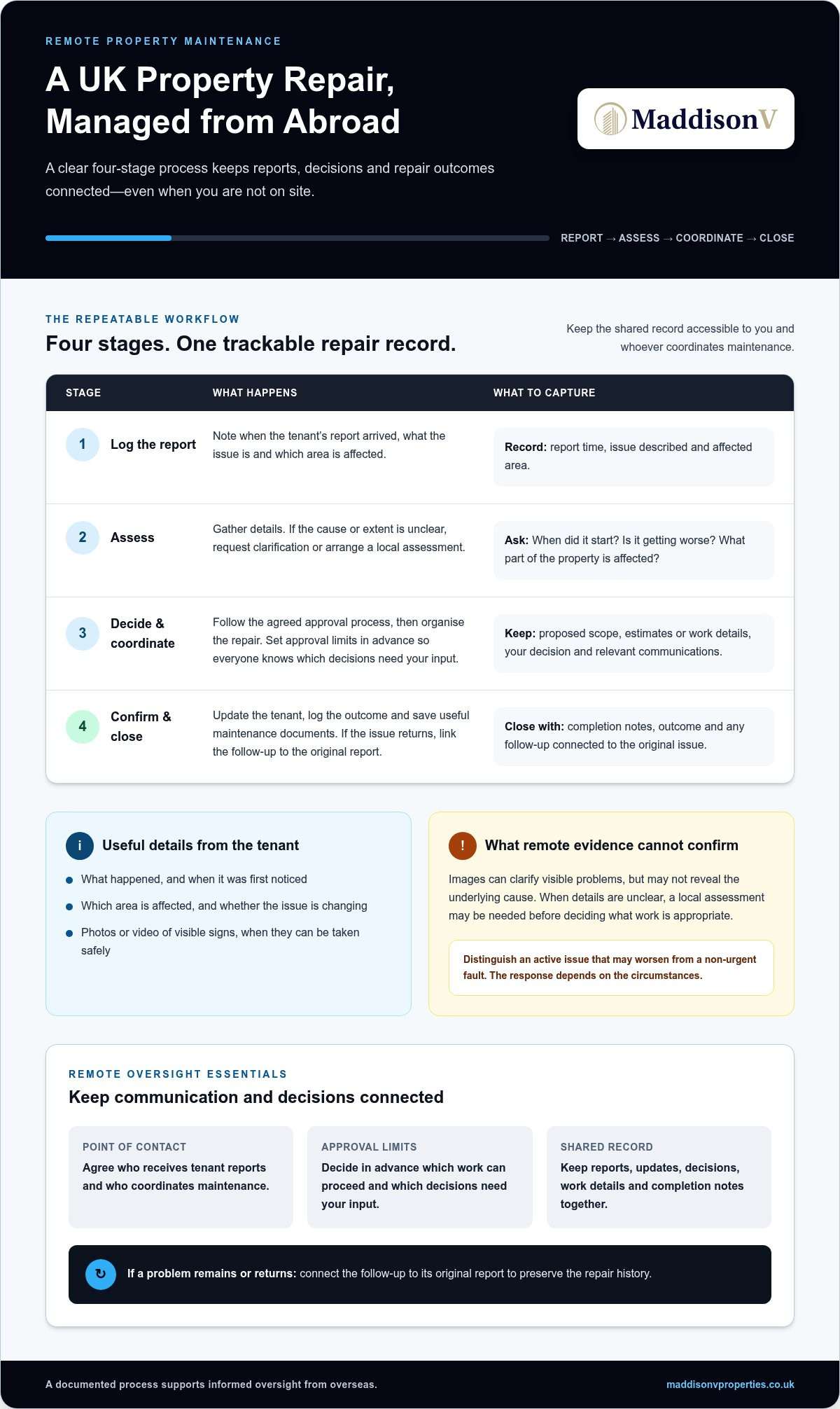
Agree who receives tenant reports, how issues are assessed and how decisions are recorded. A practical sequence is:
- Log the report: Note when it arrived, the issue described and the area affected.
- Assess the information: Gather details or arrange a local assessment if the cause or extent is unclear.
- Decide and coordinate: Follow the agreed approval process, then organise the repair.
- Confirm and close: Update the tenant, record the outcome and save relevant documents.
Keep the shared record accessible to you and the person coordinating maintenance. Store reports, updates, decisions, estimates or scopes of work, and completion notes together. This makes the status easier to follow and can reveal recurring issues. For context on repair responsibilities from a tenant perspective, see Shelter England’s guide to responsibilities for most repairs.
What information should a repair report include?
Ask the tenant to describe what happened, when they first noticed it and whether it is getting worse. Record the part of the property affected and any updates as the situation changes. Photographs or video can clarify visible problems when they can be taken safely, but they may not show the cause. If key details are missing, request clarification or arrange a local assessment before deciding on the next step.
How should approval and follow-up work?
Set approval limits in advance so everyone understands which work can be coordinated without your input and which decisions should come to you. The arrangement can reflect your preferences and the property. When your approval is needed, share a concise summary of the issue and proposed scope, then record your decision and the relevant communications with the tenant.
When work is complete, log the outcome and retain useful maintenance documents. If the problem remains or returns, link the follow-up to the original report rather than creating an isolated record. That continuity helps you see what was reported, what was agreed and what still needs attention.
Property management can bring tenant relations and routine maintenance coordination into one structured arrangement. Explore MaddisonV property management to maintain clear oversight while reducing the need to coordinate each task personally.
Self-Management or Property Management: Which Suits an Overseas Landlord?
The right arrangement depends on how involved you want to be, how much time you can give the property and who can coordinate matters locally. Self-management offers direct control. A trusted local contact can provide practical help, while professional property management can bring tenant relations and routine maintenance coordination into one structured arrangement. None is automatically right for every owner or property.
Whichever approach you choose, define how repair reports will be handled and how decisions will be recorded. Your process should also reflect the property’s circumstances and your responsibilities as a landlord. GOV.UK provides guidance on a landlord’s repair responsibilities; requirements can depend on the relevant tenancy and jurisdiction.
When might an owner coordinate repairs personally?
Self-management may suit an owner who has time to respond to reports, make decisions across time zones and follow up until work is complete. A reliable local contact can help with access or relay observations, but agree clearly what they are expected to do and how they should report back. You remain responsible for organising the process, maintaining communication and keeping a record of decisions and outcomes.
This approach can preserve close owner oversight, but it also means tracking each open issue and ensuring tenants know where to direct updates. If your schedule changes or your local contact becomes unavailable, plan how continuity will be maintained.
What can professional property management coordinate?
Property management can take on tenant relations and routine maintenance coordination, giving overseas owners a local point of coordination while they retain agreed oversight of decisions. Clear communication helps you understand what has been reported, what action is proposed and when an issue has been resolved. The level of your involvement can be shaped around your preferences and the agreed management arrangement.
A trusted local contact may be a useful middle ground, but consider who will receive tenant reports, keep communication consistent and track outstanding work. The best fit is the one that provides the right balance of owner control, local coordination and continuity for your circumstances.
For a broader perspective on how management can support an investment, explore The Sophisticated Investor’s Guide to Property Management in 2026. For overseas owners managing repairs and maintenance from abroad, a considered delegation plan can reduce day-to-day involvement while keeping important decisions visible.
How to Prepare Your Property for Repairs Before You Travel
Preparation before departure can make later repair decisions clearer and less dependent on memory. Assemble essential property information, note known issues and agree how updates will reach you. This gives whoever coordinates maintenance useful context and helps you stay informed from overseas.
Which property records help with remote decisions?
Keep relevant appliance and installation details, previous maintenance records and notes about recurring concerns together in an accessible file. For example, a record that a particular fixture has needed attention before can help distinguish a repeat issue from a new report. Include practical information that helps someone understand the property’s systems and find relevant records.
Tell the people involved in coordinating maintenance where this information is kept and how to access it. A concise property file might include:
- Appliance and installation information, alongside records of previous work.
- Known defects or recurring issues, with dates or context where available.
- Local emergency contacts and the appropriate way to reach them.
- Your preferred communication channel and any agreed approval arrangements.
Keep information current and store it in a way that’s practical for the people who may need it. Legal and contractual responsibilities can depend on the property, tenancy and circumstances, so don’t treat a general checklist as a substitute for understanding the arrangements that apply to your property.
How can owners set clear communication expectations?
Before you leave, agree who will send updates and which channel to use for routine reports, proposed work and completion messages. Set a simple expectation for what each update should contain: a description of the issue, any useful images, the proposed next step and whether your decision is needed. This avoids fragmented conversations and makes progress easier to follow across time zones.
Decide how estimates or scopes of work will be shared and recorded, and how approval decisions will be documented. The person coordinating maintenance should know when to proceed under the agreed arrangement and when to bring a decision to you. Clear expectations support consistent communication with tenants as well as useful oversight for owners.
A London property market guide can provide broader ownership context alongside practical preparation. A well-organised record and agreed communication route are especially valuable when managing repairs and maintenance from abroad.
Prepare for time away with property management and maintenance coordination from MaddisonV Properties, supporting clear tenant communication and local oversight while you’re overseas.
How MaddisonV Properties Supports Overseas Owners with Maintenance
For an overseas owner, the goal isn’t to manage every repair personally. It’s to have a clear local arrangement that keeps tenant communication moving, maintenance coordinated and important decisions visible. MaddisonV Properties provides property management that includes tenant relations and routine maintenance coordination, supporting owners who aren’t based in the UK.
This puts the principles in this guide into practice: tenants have a point of contact, repair matters are coordinated locally and owners can stay involved at the level that suits them. Agreed communication and decision processes clarify what information is shared and when owner input is needed. The aim is considered oversight without requiring you to organise each task from another time zone.
What does a coordinated maintenance arrangement aim to provide?
A coordinated arrangement brings tenant relations and routine maintenance into an organised approach. Reports and updates can be shared with you, while maintenance coordination provides a local link between the issue and its progress. A written record helps you follow what has been raised and how it has been addressed. The right balance of delegation and involvement depends on the property and your preferences.
For owners of residential developments, MaddisonV Properties also provides facilities management focused on operational upkeep. This supports the upkeep of shared residential environments, where communications may concern the development as well as an individual home. The management approach can be tailored to the property and your priorities.
What is a practical next step for an overseas owner?
Start by outlining the property, its location and the maintenance oversight you’re looking for. Explain how you prefer to receive updates, how you want decisions brought to you and how much day-to-day coordination you’d like to delegate. These details provide a practical starting point for an arrangement suited to your needs.
With a shared understanding of tenant communication, maintenance coordination and owner involvement, managing repairs and maintenance from abroad can feel more structured and less demanding. A clear arrangement won’t remove the need for decisions, but it can make their context and progress easier to follow.
If you own a UK property and would like to explore a tailored management arrangement, MaddisonV Properties invites you to discuss your property and maintenance priorities at a pace that suits you.
Give Your UK Property a Clear Maintenance Plan
Distance needn’t leave you uncertain about what’s happening at your property. A consistent process for reporting, approving and recording repairs helps you stay informed, while preparation before travel gives local coordination the context it needs. The right balance of self-management and delegated support depends on your availability, preferences and property.
MaddisonV Properties’ property management includes tenant relations and routine maintenance coordination, helping overseas owners maintain oversight without organising every task themselves. For residential blocks and developments, facilities management supports operational upkeep. Together with clear communication and documented decisions, these arrangements can make managing repairs and maintenance from abroad feel more structured and manageable.
If you’re considering a tailored approach for your UK property, discuss property management with MaddisonV Properties. Start a conversation about your property and maintenance priorities to put a clear local arrangement in place.
Frequently Asked Questions
How can I manage repairs to a UK property while living abroad?
Set up a clear process for receiving reports, assessing issues, approving work and recording outcomes. Choose a local point of contact, agree how tenants should report problems and decide in advance which work needs your approval. Ask for useful details, such as when an issue began and whether it’s worsening. A shared maintenance record helps you track open repairs and follow progress across time zones.
Can a property manager arrange repairs on my behalf?
Yes, a property manager can coordinate routine maintenance and communicate with tenants as part of an agreed management arrangement. Clarify what the manager can coordinate independently and which decisions need your approval. MaddisonV Properties’ property management includes tenant relations and routine maintenance coordination, helping overseas owners stay informed without arranging every task themselves. Agree how updates, proposed work and completion records will be shared.
What information should I request when a tenant reports a repair?
Ask the tenant to describe the issue, say when it began and explain whether it’s getting worse. Request the location within the property, what appears to be affected and any updates since the first report. Photos or video may help clarify visible signs, provided they can be taken safely. If the information doesn’t explain the situation, request further details or arrange a local assessment before deciding what work is appropriate.
How can I approve repair work remotely?
Agree an approval process before a repair arises. For work that needs your decision, request a concise summary of the issue and the proposed scope or estimate. Confirm your approval in writing through the agreed channel, and keep the decision with the repair record. Clear approval limits can help routine coordination continue while ensuring you’re involved in decisions you’ve identified as important.
What happens if a repair is urgent and I am in another time zone?
Plan for this possibility before travelling by agreeing how urgent reports are identified, who receives them and what steps can be taken if you’re temporarily unavailable. Set out the local contact or manager’s authority for coordinating an initial response, and how they should update you. Keep tenant and contact details accessible. The appropriate action depends on the issue and your agreed arrangements, so define the process clearly in advance.
Is it possible to manage UK property maintenance without visiting the property?
Yes, many maintenance decisions can be coordinated remotely when reports, photographs, local assessments and updates provide enough context. Some issues may be difficult to understand from images alone, so arrange for someone local to assess the property when needed. A property manager can coordinate routine maintenance and tenant communication, while a clear record keeps you informed. The level of remote oversight depends on the property and the management arrangement.
How should I keep records of repairs to a rental property?
Keep a central, accessible record for each repair. Include the original report, date received, issue details, tenant updates, relevant photographs, any estimate or proposed scope, your decision and confirmation of completed work. Save useful maintenance documents alongside the record, and link follow-up reports if the issue returns. This creates a clear history, supports consistent communication and helps you identify recurring concerns while managing the property from overseas.

Sign Up Now
Want to read more great articles and blogs subscribe to our newsletter