
Could a single oversight in your documentation be the only thing standing between you and the long-term security of your investment? With the...

Could a single oversight in your documentation be the only thing standing between you and the long-term security of your investment? With the implementation of the Renters’ Rights Act 2025 on May 1, 2026, the era of the Section 21 “no-fault” eviction has officially ended, leaving many property owners feeling exposed to the risks of rent arrears, property damage, and legislative uncertainty. You likely understand that managing difficult tenants uk law now requires more than just patience; it demands a meticulous, evidence-based strategy that respects the new legal landscape while prioritizing your personal peace of mind.
This guide provides a sophisticated, legal-first framework designed to help you navigate these complex changes with quiet confidence and professional poise. We’ll outline a step-by-step resolution process that protects your property’s capital value, restores order to your portfolio, and ensures you remain fully compliant with the latest statutory requirements. From understanding the new three-month arrears threshold to utilizing emergency routes for antisocial behavior, you’ll gain the clarity needed to handle even the most challenging tenancies with professional grace, meticulous detail, and absolute certainty.
Key Takeaways
- Identify the specific legal thresholds for rent arrears and antisocial behavior under the Renters’ Rights Act 2025 to separate personality clashes from actionable contract breaches.
- Learn how to establish a meticulous documentation trail that stands up to the scrutiny of a UK tribunal or court.
- Navigate the new possession process under Section 8 to ensure your investment remains secure without the traditional Section 21 safety net.
- Discover a refined, legal-first framework for managing difficult tenants uk law that prioritizes professional resolution and restores your mental tranquility.
- Explore how moving from a DIY approach to professional property management can eliminate conflict through expert vetting and high-tier standards.
Defining the ‘Difficult Tenant’ Within the 2026 UK Legal Framework
The implementation of the Renters’ Rights Act 2025 has fundamentally recalibrated the relationship between property owners and their residents. In this new era, the concept of a “difficult” tenant is no longer a matter of subjective friction or personality clashes; it is a question of documented legal breaches. To succeed in managing difficult tenants uk law, you must look past interpersonal frustrations and focus on the rigid definitions provided by current legislation. Difficulty is now categorised by specific, evidence-backed failures to adhere to the terms of an Assured Periodic Tenancy.
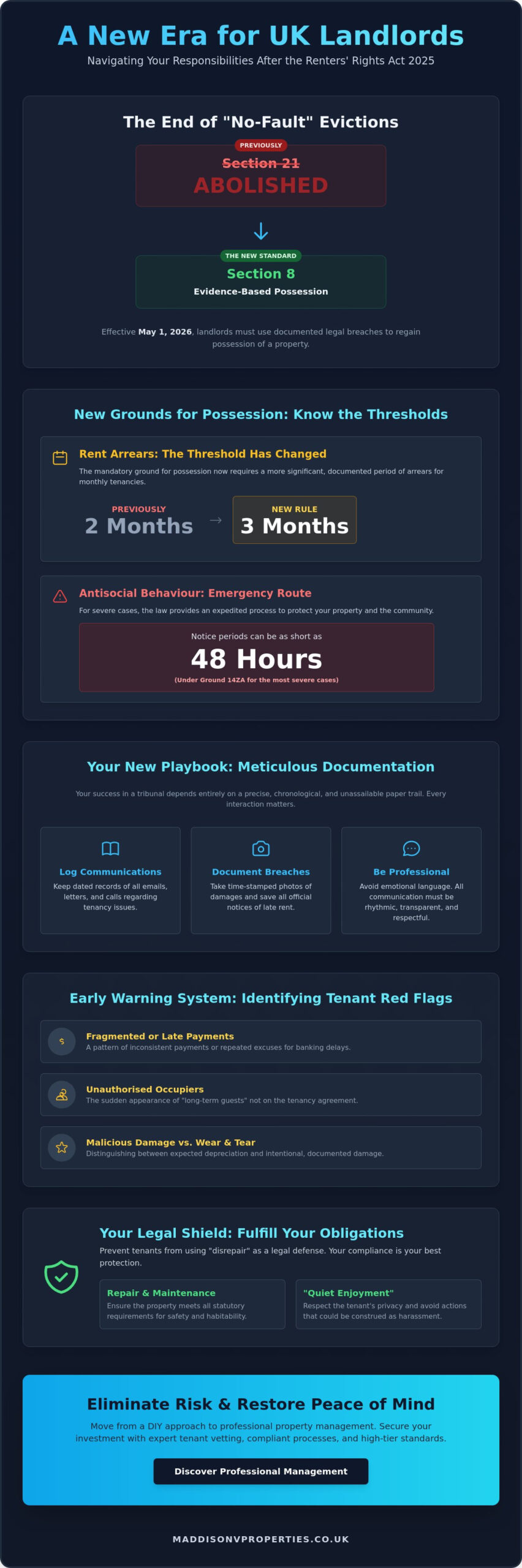
The distinction between a demanding tenant and a defaulting one is codified with surgical precision. Under the revised Section 8 grounds, persistent rent arrears are defined by a mandatory possession threshold of three months’ rent for monthly tenancies. This is a significant shift from the previous two-month standard, requiring a more patient and documentation-heavy approach. Similarly, antisocial behaviour is no longer a vague complaint but a specific legal trigger, with the most severe cases allowing for notice periods as short as 48 hours under Ground 14ZA.
To better understand these legislative shifts and how they impact your portfolio, watch this helpful video:
Understanding the current Housing Act and the foundational UK Landlord and Tenant Act 1985 is the essential starting point for any resolution. These statutes define your core obligations regarding repair and maintenance, which must be fulfilled to prevent tenants from using “disrepair” as a legal shield during possession hearings. By ensuring your property meets high-end functional standards, you eliminate the most common counter-arguments used by problematic occupants.
Common Red Flags in Residential Tenancies
Identifying instability early is vital for protecting your property’s capital value. Look for patterns such as fragmented payments, repeated excuses regarding banking delays, or the sudden presence of “long-term guests” who may be unauthorised occupiers. It’s also important to distinguish between fair wear and tear, which is expected in any high-quality environment, and malicious damage. Malicious damage is intentional, documented, and often serves as an early warning of a tenancy that is no longer sustainable or professional.
The Shift in Landlord Obligations
Your role has evolved from an active overseer to a meticulous, documentation-led observer. A tenant’s right to “quiet enjoyment” is more protected than ever under the 2026 rules. Any attempt to chase rent arrears that feels excessive or intrusive can be reinterpreted as harassment, potentially jeopardising your possession claim. Professional communication must be rhythmic, transparent, and respectful. By maintaining these high-tier standards, you ensure that your approach to managing difficult tenants uk law remains legally unassailable and professionally beyond reproach.
The Professional Standard: Proactive Documentation and Communication
In the post-Section 21 environment, the strength of your possession claim rests entirely on the quality of your records. Documentation is no longer a peripheral task; it is the core of professional oversight. Managing difficult tenants uk law requires a transition from informal arrangements to a precise, chronological, and unassailable paper trail. This systematic approach ensures that every breach is noted, every warning is logged, and every interaction is preserved for potential legal scrutiny.
Modern management relies on the intersection of high-tier standards and sophisticated technology. While the Tenancy Deposit Scheme (TDS) remains the gold standard for documenting property condition at the start of a term, ongoing management requires time-stamped communication. Utilizing professional property management software creates a rhythmic record of conduct. This digital archive provides the stability and order needed to present a clear case to a tribunal, ensuring that your investment remains protected by a wall of verified facts. For owners seeking this level of effortless oversight, professional property management provides the rigorous documentation needed to maintain financial security.
We advocate for a refined “Three-Strike” rule to maintain professional distance. Informal chats are suitable for minor, first-time queries, but recurring issues demand a shift to formal, written warnings. These communications should be clear, declarative, and focused on the value of the tenancy agreement. By moving from casual conversation to structured correspondence, you signal that the management of the property is handled with meticulous care and quiet confidence.
Building a Legally Admissible Evidence Log
A robust evidence log is your most powerful asset in a possession hearing. It should include a chronological record of all breaches, supported by date-stamped photographic evidence and third-party contractor reports. These reports are particularly valuable when countering claims of disrepair, as they provide an independent assessment of the property’s high-end functional standards. It is vital to remain mindful of GDPR considerations; ensure all tenant data and communication logs are stored in a secure, compliant manner that respects privacy while preserving your legal rights.
Mastering the Art of Professional Correspondence
The “Letter Before Action” is a pivotal document that must be drafted with poise and precision. It should outline the specific breach and the required remedy using neutral, rhythmic language that avoids escalating the conflict. While email is fluid and convenient, move to formal physical mail via Recorded Delivery for final notices. This ensures a verifiable audit trail that no tenant can dispute. Adhering to the guidance from Citizens Advice regarding professional dispute resolution will help you maintain your prestige as a landlord while following the exact requirements of the law.
Strategies for Resolving Specific Breaches: Arrears and Antisocial Behaviour
Effective resolution in the modern regulatory environment is no longer about heated debates or informal pressure. It is about applying the law with surgical precision and maintaining a posture of professional distance. When managing difficult tenants uk law, your success depends on categorising breaches into mandatory and discretionary grounds for possession. This clarity allows you to move forward with quiet confidence, knowing that your investment is protected by a robust legal framework rather than subject to the whims of negotiation.
The 2026 court system places a high value on the “Mediation First” approach. Judges now look for definitive proof that a landlord has attempted to resolve disputes through structured dialogue before escalating to a possession claim. This requirement ensures that only the most persistent or severe breaches reach a hearing. By documenting these mediation attempts, you demonstrate the prestige and integrity of your management style, fulfilling the UK government guidance on tenant rights while securing your own legal standing.
Navigating Rent Arrears with Sophistication
The Renters’ Rights Act 2025 has raised the threshold for mandatory possession under Ground 8 to three months of arrears. To manage this effectively, you must establish formal payment plans at the first sign of instability. These plans should be clear, declarative, and legally binding. If these efforts fail, the Ground 8 claim remains your most powerful tool for financial recovery. We also recommend the rigorous use of guarantor agreements for all high-end tenancies. A well-drafted guarantor clause provides an additional layer of financial security, ensuring that your rental yield remains stable even when a primary resident defaults.
Tackling Antisocial Behaviour and Nuisance
In luxury apartment blocks and high-end developments, antisocial behaviour often takes the form of persistent noise, unauthorised sub-letting, or conduct that devalues the wider community. Managing these issues requires a collaborative approach. We work closely with professional facilities management teams to gather witness statements and time-stamped evidence that meets the strict requirements of Ground 14ZA. This emergency route allows for notice periods as short as 48 hours in the most severe cases. Protecting your portfolio reputation is paramount; a swift, professional response to nuisance ensures that your property remains an aspirational environment for high-quality residents. By outsourcing these complex operational details, you enjoy the rewards of property ownership without the emotional stress of direct conflict.
The Legal Process: Eviction and Possession in the Post-Section 21 Era
The total abolition of Section 21 “no-fault” evictions on May 1, 2026, has ushered in a new era of evidence-based possession. For owners accustomed to the relative simplicity of fixed-term endings, managing difficult tenants uk law now requires a deeper engagement with the Section 8 framework. Every possession claim must be anchored in a specific, legally recognized ground, transforming the eviction process into a test of a landlord’s documentation and procedural discipline. This shift ensures that only justified claims proceed, providing a system defined by transparency, accountability, and legal rigor.
The timeline of a modern possession claim has become more structured, typically moving from the service of a notice to a court hearing, and finally to a bailiff’s appointment if the resident remains. Statistics from late 2025 indicate that the median time from a possession claim to a court order is approximately 7.9 weeks. During this period, it’s vital to avoid any actions that could be interpreted as “retaliatory eviction.” If a tenant has recently raised a legitimate complaint about property standards, any subsequent notice must be handled with extreme care to ensure the court views the claim as a genuine response to a breach of contract rather than a punitive measure.
To secure a mandatory possession order under Ground 8, you must prove the “serious arrears” threshold has been met. As of May 2026, this requires the tenant to owe at least three months’ rent both at the time the notice is served and at the time of the court hearing. Providing a clear, rhythmic account of the payment history is the only way to satisfy the court’s requirement for absolute financial certainty.
The Section 8 Notice: A Precision Tool
Success begins with the selection of the correct grounds. While Ground 8 covers mandatory possession for arrears, Grounds 10 and 11 offer discretionary routes for smaller debts or persistent late payments. A common pitfall that leads to case dismissal is a failure to provide a valid “Certificate of Service” (Form N215). This document proves exactly when and how the notice was delivered, acting as a vital safeguard for your legal standing. Without this meticulous attention to detail, even the most justified claim can be delayed by procedural technicalities.
The Court Hearing and Beyond
At a 2026 possession hearing, the judge will look for a comprehensive evidence bundle that mirrors the passive, professional oversight we advocate. This includes the tenancy agreement, the information sheet provided to the tenant by May 31, 2026, and a chronological log of all communication. Once an order is granted, the physical eviction must be handled exclusively by court-appointed bailiffs. You must never attempt “self-help” evictions; such actions are illegal and carry severe penalties. For investors who prefer to remain at a professional distance from these complexities, our professional property management ensures that every legal threshold is met with quiet confidence and meticulous care.
Mitigating Risk: Why Professional Management is the Ultimate Safeguard
The evolution of the UK rental market has made the traditional “DIY” landlord model increasingly precarious. In an environment defined by the Renters’ Rights Act 2025, the most effective strategy for managing difficult tenants uk law is to prevent friction before it ever begins. Professional property management acts as a sophisticated firewall, separating your personal lifestyle from the operational complexities of daily tenancies. This transition from active oversight to passive investment allows you to enjoy the rewards of a high-tier portfolio while we handle the meticulous details of compliance, communication, and conflict resolution.
Expert vetting is your first and most vital line of defense. By employing high-tier standards and fluid processes, we identify aspirational residents who value quality, integrity, and long-term relationships. This proactive approach eliminates the majority of “difficult” scenarios long before a contract is signed. When issues do arise, our integrated legal cover and rent guarantee schemes provide a level of financial security that individual owners rarely achieve alone. It’s a system designed for stability, order, and mental tranquility, ensuring that your capital value is never compromised by tenant instability.
The Value of a Professional Buffer
Removing the emotional element from tenant-landlord disputes is essential for maintaining professional distance. When you outsource these responsibilities, you ensure that every interaction is handled with quiet confidence and legal rigor. We maintain 100% compliance with the shifting landscape of 2026 rental laws, protecting you from the risks of harassment claims or procedural errors that often derail possession claims. This professional buffer doesn’t just resolve conflict; it preserves the aspirational quality of your assets. By managing the visual and functional standards of the property, we ensure it remains a prestigious environment that attracts superior users.
Securing Your Financial Future
The return on investment for professional oversight is measured in more than just saved time. When you compare management fees to the potential costs of legal battles, rent arrears, or extended voids, the value proposition becomes clear. A sophisticated approach to managing difficult tenants uk law is ultimately about risk transfer. Leveraging expert portfolio management allows you to scale your investments across the London market without increasing your personal stress levels. We handle the complex operational details so you can enjoy the rewards of financial security and effortless oversight. You deserve a partnership that prioritizes your peace of mind and long-term growth.
Reclaim your peace of mind and discover our bespoke property management solutions today.
Restoring Professional Order to Your Property Portfolio
The transition to the Renters’ Rights Act 2025 has redefined the standards of successful property ownership. Mastery of managing difficult tenants uk law now requires a shift from reactive negotiation to a proactive, documentation-led strategy that prioritizes legal precision and personal peace of mind. By establishing a rigorous evidence log, utilizing the specific grounds of the Section 8 framework, and embracing a mediation-first approach, you ensure that your investment remains secure, compliant, and prestigious.
True financial security comes from moving beyond the daily frictions of tenancy management. You deserve a partner who offers bespoke management for high-yield London portfolios, expert navigation of 2026 UK rental legislation, and the promise of passive income through effortless oversight. We handle the complex operational details so you can return to the rewards of ownership without the weight of administrative anxiety. It’s time to reclaim your time and elevate your investment experience.
Secure your investment with our professional property management and discover the tranquility that comes with expert partnership. Your portfolio’s future is defined by the quality of its oversight, and we’re here to ensure that every detail is managed with absolute certainty and professional grace.
Frequently Asked Questions
Can I still evict a tenant in the UK without a reason in 2026?
No, you cannot. Section 21 “no-fault” evictions were officially abolished on May 1, 2026, marking a fundamental shift in rental legislation. Every possession claim must now be justified under specific Section 8 grounds, such as rent arrears or antisocial behaviour. This change ensures that managing difficult tenants uk law is now a process defined by evidence, documentation, and specific legal merit rather than simple notice periods.
What is the fastest legal way to deal with a tenant who stops paying rent?
The most effective route is serving a Section 8 notice under Ground 8 once the arrears reach the mandatory three-month threshold. Under current 2026 regulations, you must provide a four-week notice period. We recommend initiating a structured mediation process as soon as a payment is missed, as courts now require proof of attempted resolution before they will grant a possession order for your property.
How much does it cost to legally evict a difficult tenant in the UK?
The total cost depends on the complexity of the case and the level of legal representation you choose to employ. You should account for court filing fees, solicitor costs for drafting notices, and the eventual fee for court-appointed bailiffs. Many property owners find that the financial security provided by professional management, which often includes legal cover, is a more cost-effective way to protect their high-yield portfolios.
Can I change the locks if a tenant is being aggressive or antisocial?
You must never change the locks or attempt to forcibly remove a resident, as these actions constitute illegal eviction and carry severe penalties. For the most serious cases of antisocial behaviour, the law provides an emergency route under Ground 14ZA, allowing for notice periods as short as 48 hours. This professional, legal-first approach ensures a swift resolution while maintaining your status as a compliant and prestigious landlord.
What should I do if a tenant refuses to leave after the notice period expires?
If a resident remains in the property after the notice expires, you must apply to the court for a possession order. Once this order is granted, if the tenant still refuses to vacate, you must instruct court-appointed bailiffs to handle the physical eviction. Maintaining professional distance during this process is vital for your mental tranquility and ensures that the transition is handled with order and legal certainty.
How does the Renters’ Rights Act affect my ability to manage my property?
The Renters’ Rights Act 2025, which came into full force on May 1, 2026, transitioned all tenancies to rolling periodic contracts. It requires a more meticulous approach to managing difficult tenants uk law, emphasizing the need for clear communication and precise record-keeping. While it provides tenants with greater security, it also offers landlords robust, mandatory grounds for possession when residents fail to respect the terms of their agreement.
Is mediation compulsory before taking a tenant to court in the UK?
While mediation is not strictly a statutory requirement for every case, the 2026 court system strongly expects landlords to demonstrate a “Mediation First” approach. Judges may delay or dismiss possession claims if there is no evidence that you attempted to resolve the dispute professionally. Providing proof of these efforts demonstrates your commitment to high-tier standards and ensures your case is viewed favorably by the tribunal.
What happens to the tenancy deposit if there is significant property damage?
You can claim for the cost of repairs through the Tenancy Deposit Scheme (TDS) at the conclusion of the tenancy. To succeed in this claim, you must provide a high-quality inventory and date-stamped photographic evidence that clearly distinguishes between fair wear and tear and malicious damage. This meticulous attention to detail ensures that your property’s capital value is protected and that your financial interests are fully secured.

Sign Up Now
Want to read more great articles and blogs subscribe to our newsletter