
Could a 7.2% gross yield in an emerging district like Barking offer more long-term security for your capital than a legacy address in Mayfair? For...

Could a 7.2% gross yield in an emerging district like Barking offer more long-term security for your capital than a legacy address in Mayfair? For the sophisticated global investor, the 2026 market demands a departure from traditional wisdom. You likely recognize that while London remains a peerless safe haven, the layers of Stamp Duty surcharges and evolving Capital Gains Tax rates require a more surgical approach to acquisition. Finding the ideal london rental yield by postcode is no longer a simple search for the highest number; it’s an exercise in balancing aggressive income, lifestyle prestige, and capital preservation.
This market intelligence report bridges the gap between raw data and actionable strategy. You’ll discover the high-performing postcodes currently redefining the rental landscape, from the resilient yields in IG11 to the refined stability of Prime Central London where yields often sit between 2% and 3%. We provide a clear map of the 2026 investment horizon, detailing the lifestyle drivers that attract elite tenants and the customized solutions, fluid processes, and high-tier standards that protect your peace of mind. By the end of this guide, you’ll have the clarity, confidence, and control to navigate tax complexities and secure off-market opportunities that align with a vision of enduring wealth and effortless oversight.
Key Takeaways
- Identify the specific outer London postcodes, such as IG11 and SE28, where gross yields are projected to exceed 6% through 2026.
- Understand the PCL Paradox to balance modest rental returns in areas like Chelsea with superior long-term capital preservation and asset security.
- Master the nuances of london rental yield by postcode to distinguish between high gross figures and actual net profitability after accounting for non-resident Stamp Duty surcharges.
- Leverage the Education Premium by targeting high-demand zones near elite institutions like Westminster School to ensure consistent occupancy from premium tenant profiles.
- Discover how bespoke property sourcing and professional mortgage consultations can unlock off-market opportunities that optimize your net ROI and portfolio growth.
Navigating London Rental Yields by Postcode: The 2026 Landscape
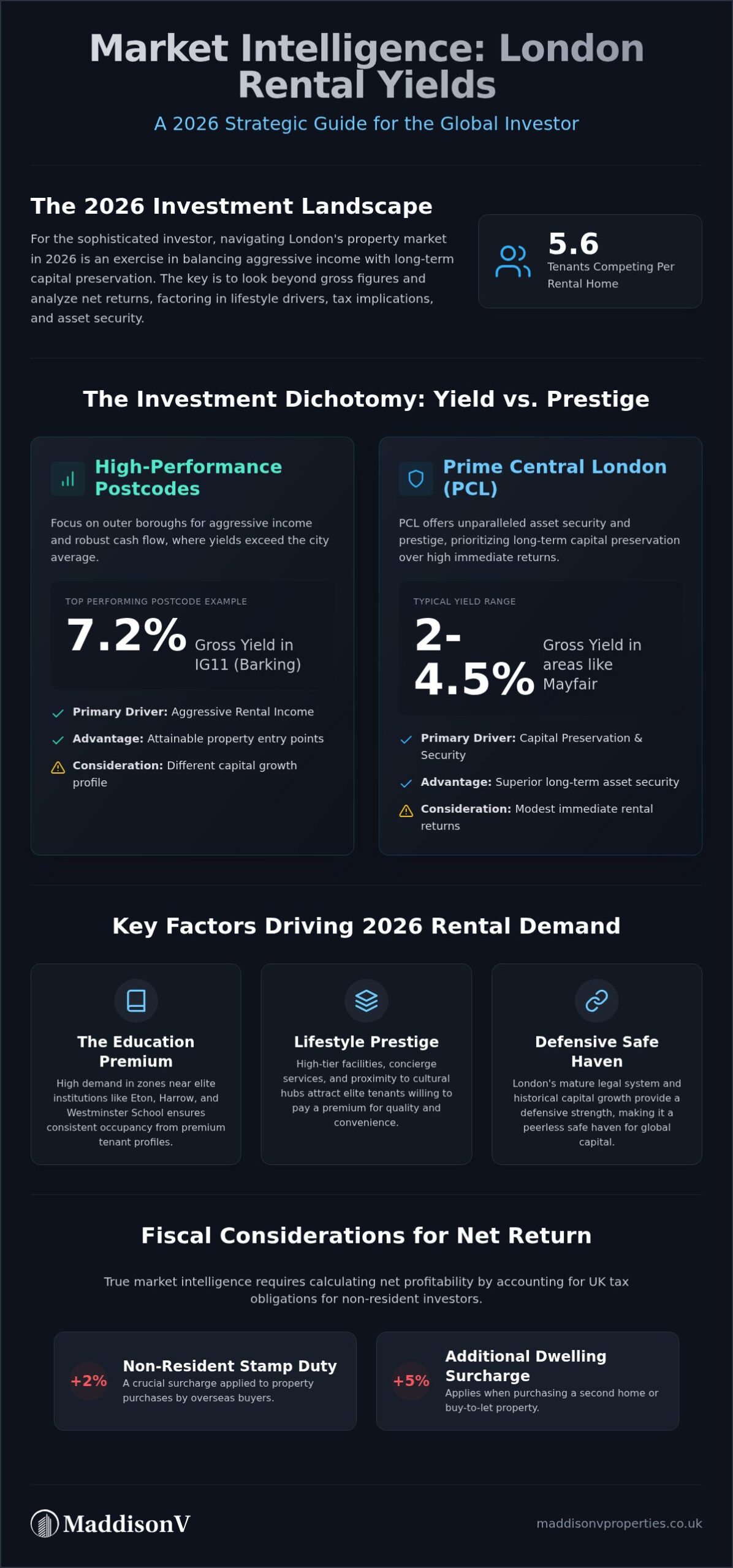
Market intelligence in 2026 isn’t just a collection of spreadsheets; it’s the surgical application of data to secure generational wealth. For the sophisticated investor, understanding the london rental yield by postcode requires looking past surface-level percentages. We define market intelligence as the intersection of localized demand, architectural quality, and fiscal efficiency. With approximately 5.6 tenants competing for every available rental home, the city remains a peerless safe haven. This scarcity creates a floor for valuations, yet the real rewards go to those who can navigate the pivot from speculative buying to disciplined, yield-focused acquisition.
Success in this environment depends on a clear-eyed view of net returns rather than gross projections. While an outer-London postcode might boast a headline yield of 7.2%, your actual ROI must factor in the 2% non-resident Stamp Duty surcharge and the 5% additional dwelling surcharge. High-tier property management and facilities management aren’t just costs; they’re essential investments that preserve the “lifestyle prestige” required to attract premium tenants. Reviewing a comprehensive UK housing market overview reveals that while the regulatory landscape is complex, the underlying demand for high-quality housing remains the market’s most reliable driver.
To better understand how the city’s unique geography influences investment potential, watch this helpful video:
The 2026 Benchmark: What is a “Good” Yield in London?
In Prime Central London (PCL), a yield of 4.5% is currently the gold standard for high-performance assets, though the market average for areas like Marylebone often sits between 2% and 3%. These lower figures are balanced by exceptional capital preservation. Conversely, outer boroughs offer yields of 6% or higher, but these carry different risk profiles regarding long-term price appreciation. The 2026 interest rate environment has stabilized, yet it still demands that investors use bespoke mortgage consultations to ensure debt service doesn’t erode their net monthly cash flow.
London vs. Dubai: A Comparative Yield Analysis
Our clients in the UAE and Singapore often view London through a comparative lens. Dubai’s tax-free rental income offers immediate liquidity, which is highly attractive for cash-flow-heavy strategies. However, London provides the defensive strength of a mature legal system and a historical track record of capital growth that Dubai is still building. A balanced portfolio often utilizes both: the Gulf for high-yield income and the UK for asset security. If you’re weighing these two hubs, our guide on how to Invest in Dubai Property: The Definitive Investor’s Guide for 2026 provides the necessary data for a global comparison.
The High-Performance Postcodes: Where Yields Exceed 6% in 2026
In the 2026 landscape, the 6% yield threshold has become the defining marker for aggressive income performance. While Prime Central London offers security, investors seeking robust cash flow are shifting their focus toward the city’s perimeter. Barking (IG11) currently leads the market with a 7.2% average gross yield, driven by a combination of attainable entry points and a chronic shortage of high-quality rental stock. This data, corroborated by recent JLL residential market analysis, highlights a clear trend: the highest london rental yield by postcode is found where infrastructure meets affordability.
East London: The Regeneration Powerhouse
The Docklands and Stratford continue to serve as the engine room for London’s rental growth. In E14, we’re seeing a significant shift toward professional Build-to-Rent developments that cater to the Canary Wharf workforce. Stratford (E15) maintains a strong 5.8% yield, attracting high-income young professionals who value the proximity to the Olympic Park and Westfield. Our projections through 2030 suggest that the Docklands area will remain a high-liquidity zone, offering a reliable exit strategy for investors. Identifying these “Micro-Prime” pockets before they reach full maturity is a hallmark of our property sourcing service.
South East London: Value and Connectivity
The “Thamesmead Effect” is now a reality for savvy investors. SE28 offers a compelling 5.9% yield, benefiting directly from the Elizabeth Line legacy which has slashed commute times to central hubs. Areas like Woolwich (SE18) and Greenwich (SE10) are showing consistent rental growth as tenants migrate from more expensive central postcodes in search of space and modern amenities. The regeneration premium in 2026 is the specific rental uplift achieved by securing assets in zones where infrastructure milestones have permanently altered tenant commuting patterns. We’re also seeing a “Battersea effect” in neighbouring SW postcodes, where the maturation of the Power Station district has uplifted the entire local rental ecosystem.
North London is also carving out its own niche for the sophisticated investor. Tottenham (N17) has emerged as a yield leader at 5.8%, particularly for warehouse conversions that appeal to the tech and creative sectors. These properties offer a unique aesthetic that justifies a rent premium, often outperforming standard new-builds in the same area. Understanding the nuances of london rental yield by postcode allows for a portfolio that balances the high-yield volatility of emerging zones with the steady appreciation of established hubs. It’s a strategy that requires local intelligence and an eye for architectural quality to ensure long-term tenant retention.
The Prime Central London (PCL) Paradox: Yield vs. Prestige
While outer boroughs like Barking offer headline-grabbing numbers, the sophisticated investor understands that the london rental yield by postcode in Prime Central London (PCL) operates on a different logic. In areas like Chelsea (SW3) and Marylebone (W1), gross yields typically range between 2% and 3%. However, focusing solely on these percentages misses the broader strategic value of a PCL acquisition. These postcodes represent the ultimate “safe haven” for global capital, where the primary objective is capital preservation and long-term asset security rather than immediate cash flow. In a volatile global economy, a Victorian townhouse in Kensington is less a rental property and more a “situs” asset of enduring worth.
The latest Office for National Statistics rental data confirms that London’s rental growth remains robust, yet PCL’s value is anchored in its absolute scarcity. The architectural heritage of Georgian townhouses and prestigious mansion blocks creates a permanent supply cap that modern developments cannot replicate. These properties command loyalty from a global elite who prioritize address and aesthetics over price. High-net-worth tenants don’t just rent a home; they rent a lifestyle. This ensures high retention rates and minimal void periods, which often results in a more stable net ROI than high-yield areas plagued by tenant churn.
The Allure of Knightsbridge and Mayfair
In W1 and SW1X, the ultra-luxury rental market serves a specific tier of global citizens. From diplomats and C-suite executives to international students attending elite institutions, the demand for “turnkey” luxury is relentless. Securing assets here requires a deep understanding of the local market, as the most prestigious units are often held as off-market properties. If you’re looking to navigate these high-barrier markets, our Property Sourcing Agents London: The Investor’s Guide to Prime Acquisitions in 2026 provides the necessary intelligence to secure these elusive opportunities.
Nine Elms and Battersea: The New Prime
The 2026 landscape shows that the previous oversupply in SW8 and SW11 has finally been absorbed. The Northern Line extension and the presence of the US Embassy have matured Nine Elms into a high-demand neighborhood with a distinct identity. While traditional PCL stock offers history, these modern developments provide extensive amenities, such as 24-hour concierge services, private gyms, and cinema rooms. This creates a dynamic where the london rental yield by postcode in these “New Prime” zones often sits slightly higher than legacy PCL, offering a compelling middle ground between modern luxury and financial performance.
Beyond the Postcode: Factors Driving 2026 Rental Demand
While the london rental yield by postcode provides a vital statistical foundation, the true performance of an asset in 2026 is governed by qualitative lifestyle drivers. Sophisticated tenants now prioritize “lifestyle buildings” that offer more than just square footage. Concierge services, private wellness suites, and high-end aesthetics are no longer optional extras; they’re the specific components that ensure zero void periods and premium pricing. In a market where supply remains constrained, the ability to offer a fluid, high-tier living experience allows landlords to command a significant rent premium over standard stock.
The 2026 market also sees the rise of the hybrid letting strategy. By navigating the 90-day rule for short-term lets alongside traditional long-term tenancies, investors can optimize returns during peak seasons while maintaining the security of the Renters’ Rights Act. However, this level of operational complexity requires a meticulous approach to compliance and oversight. For investors diversifying into other European hubs, premium concierge services like Rosify provide the high-tier management necessary to optimize short-term rental performance while ensuring absolute compliance. It’s no longer enough to simply own property; one must curate an environment that meets the aspirational standards of a global workforce.
For international families, particularly those from the UAE and Singapore, proximity to elite educational institutions like Westminster School, Eton, and Harrow is a non-negotiable requirement. This “Education Premium” creates a unique micro-market in postcodes like St John’s Wood (NW8) and Kensington (W8). These areas exhibit long-term tenancy stability and a direct correlation between school rankings and rental price growth. When a family secures a mansion block apartment near a top-tier school, they’re likely to remain for the duration of the child’s education, providing the investor with years of uninterrupted, high-yield income.
Taxation and Legalities for the International Buyer
Navigating the UK’s fiscal environment is essential for the global investor. The Non-Resident Landlord Scheme (NRLS) and the current Stamp Duty surcharges—including the 2% non-resident fee and the 5% additional dwelling surcharge—must be factored into your net ROI calculations from the outset. Professional facilities management is no longer just about maintenance; it’s about safeguarding your legal standing and ensuring your portfolio adheres to the latest safety and energy efficiency standards. Key areas of focus for 2026 include:
- Compliance with the latest Renters’ Rights Act to ensure tenant security and landlord protection.
- Meticulous oversight of the NRLS to ensure rent is paid gross where applicable.
- Strategic management of the 90-day rule to maximize seasonal rental peaks in Prime Central London.
For a detailed breakdown of how we protect your interests and manage these complexities, see The Sophisticated Investor’s Guide to Property Management in 2026. If you’re ready to align your portfolio with these high-growth lifestyle drivers, our team provides expert portfolio management to ensure your assets remain competitive and compliant in the 2026 market.
Optimising Your London Yield: The MaddisonV Properties Sourcing Strategy
Yield is not a static number found on a map; it’s the dynamic result of expert positioning, disciplined execution, and local intelligence. While the london rental yield by postcode provides the raw data for your initial research, the MaddisonV Properties strategy transforms these figures into sustained performance. We understand that for the global investor, the anxiety of ownership is often the greatest barrier to entry. Our approach alleviates this through a fluid, end-to-end service that covers everything from initial property sourcing to comprehensive facilities management.
Identifying value in 2026 requires looking beyond the open market where competition is fiercest. The most lucrative opportunities are frequently found in off-market properties where the regeneration premium hasn’t yet been fully realized by the wider public. MaddisonV Properties conducts rigorous due diligence on every asset, examining everything from EPC ratings to complex leasehold nuances, ensuring your capital remains protected. Our bespoke mortgage consultations further refine your net ROI, ensuring your financing structure is as sophisticated and efficient as the asset itself.
Bespoke Sourcing for the UHNW Investor
Our sourcing process is built on long-term relationships and a deep appreciation for architectural quality. We identify high-yield assets in emerging pockets or established mansion blocks in Marylebone before they reach public listings. This exclusivity is vital for the UHNW investor seeking to avoid the frantic energy of bidding wars while securing assets with superior long-term growth potential. For a broader perspective on the current environment, consult our guide on Real Estate in England: The Definitive Guide to the London Market in 2026. We serve as the essential bridge for investors from the UAE and Singapore, offering a global perspective that weighs the benefits of London new-builds against Dubai off-plan opportunities.
Passive Income through Professional Management
True passive involvement is only possible when your partner handles every clinical detail with creative enthusiasm and meticulous care. MaddisonV Properties maintains a Luxury Standard across our portfolio, ensuring that facilities management is proactive rather than reactive. High-tier standards naturally lead to zero-void periods, as premium tenants prioritize the mental tranquility and aesthetic appeal of a well-managed home. Our management model is designed to handle the complex operational details so you can enjoy the rewards of your investment. The MaddisonV Properties promise is one of financial security, effortless oversight, and enduring quality. Whether you are expanding a single holding or managing a diverse portfolio, we provide the stability and order required to thrive in the 2026 London market.
Securing Your 2026 London Legacy
The 2026 property market rewards the disciplined investor who looks beyond surface data to find the intersection of income and prestige. Whether your strategy prioritizes the aggressive yields of the outer boroughs or the defensive strength of a legacy central address, success depends on a surgical understanding of london rental yield by postcode. We’ve explored how infrastructure milestones, educational proximity, and fiscal surcharges transform raw projections into actual net returns. In a global economy where stability is the ultimate luxury, London remains a peerless safe haven for those who navigate its complexities with precision.
MaddisonV Properties serves as the essential bridge for international UHNW clients, offering a level of oversight that turns property ownership into a truly passive experience. As specialists in Prime Central London acquisitions, we provide exclusive access to off-market developments that never reach the public eye. Our commitment to high-tier visual and functional standards ensures your portfolio remains a source of pride and financial security. We handle the intricate operational details, from tax compliance to facilities management, allowing you to enjoy the rewards of your investment without the anxiety of daily oversight.
Secure your bespoke London property investment consultation with MaddisonV Properties and let’s define your path to enduring wealth in the world’s most resilient capital.
Frequently Asked Questions
What is considered a good rental yield in London in 2026?
A good gross rental yield in London currently averages approximately 5.1%. However, for the sophisticated investor, a “good” return is relative to the london rental yield by postcode data. In Prime Central London (PCL), a yield between 3% and 4.5% is considered strong when balanced against capital preservation. Conversely, in outer boroughs like Barking, investors expect 6% to 7.2% to account for different growth trajectories and tenant profiles.
Which London postcode currently has the highest rental yield?
Barking (IG11) currently holds the title for the highest london rental yield by postcode at 7.2%. This performance is driven by relatively lower entry prices compared to the London average and a surge in demand for affordable, modern housing. Other high-performing areas include East Ham (E6) at ~6% and Thamesmead (SE28) at 5.9%. These districts offer aggressive income potential for those prioritizing cash flow over the prestige of central addresses.
How does the 90-day rule affect rental yields in London?
The 90-day rule restricts landlords from letting out residential properties as short-term rentals for more than 90 nights per calendar year without planning permission. For investors, this rule necessitates a hybrid letting strategy. By utilizing high-end short-term lets during peak tourism or fashion seasons and switching to long-term tenancies for the remainder of the year, owners can optimize their annual yield while remaining fully compliant with Greater London regulations and tax requirements.
Can international investors get a buy-to-let mortgage for London property in 2026?
Yes, international investors from the UAE, USA, and Singapore can access specialist buy-to-let mortgages in the UK. These products often require a higher deposit, typically 25% to 35%, and are subject to rigorous affordability checks based on projected rental income. Our bespoke mortgage consultations help overseas buyers navigate these requirements, ensuring the debt structure enhances rather than erodes the net ROI of your London portfolio while accounting for non-resident tax obligations.
How does proximity to elite schools like Eton affect property yields?
Proximity to elite institutions like Westminster School or Eton creates an “Education Premium” that significantly drives tenant demand. While the gross rental yield in these prestigious school catchments might be lower due to high property values, the asset’s security is unparalleled. Families often commit to long-term tenancies of five to seven years, virtually eliminating void periods. This stability, combined with consistent capital growth, makes these properties essential for UHNW investors seeking reliability.
Is it better to invest in new-build developments or period mansion blocks for yield?
New-build developments often provide higher gross yields due to modern energy efficiencies and resident amenities like 24-hour concierges and private gyms. These features attract premium corporate tenants. However, period mansion blocks in PCL offer a scarcity value that ensures superior capital preservation and long-term appreciation. The choice depends on your strategy: new-builds for immediate cash-flow efficiency or mansion blocks for a defensive, legacy-building approach within your broader property portfolio.
What are the main tax considerations for foreign landlords in the UK?
Foreign landlords must navigate a complex tax landscape, including the 2% Stamp Duty surcharge for non-residents and a 5% surcharge for additional dwellings. Rental income is subject to the Non-Resident Landlord Scheme (NRLS), where tax is typically withheld at 20% unless gross payment status is granted. Additionally, Capital Gains Tax of 18% or 24% applies upon sale, and UK property remains subject to 40% Inheritance Tax above the nil-rate band.
How is the Nine Elms regeneration area performing for investors in 2026?
Nine Elms has entered a maturation phase in 2026, with much of the previous oversupply now absorbed by a professional population. The presence of the US Embassy and the Northern Line extension has cemented its status as a “New Prime” district. Investors are seeing stabilized yields as the neighborhood’s amenities and public spaces reach completion. It remains a top choice for those seeking modern, high-tier aesthetics alongside the security of a major regeneration zone.

Sign Up Now
Want to read more great articles and blogs subscribe to our newsletter