
Buying a UK property from abroad involves more than choosing a location: rental figures also need careful scrutiny. For an investment property,...

Buying a UK property from abroad involves more than choosing a location: rental figures also need careful scrutiny. For an investment property, compare the stated rent with lease agreements, payment records and evidence supporting any forecast. This helps distinguish projected returns from income backed by documentation.
It’s natural to focus on a property’s potential, but sound investment decisions also depend on clear financial evidence. This guide explains how to assess rental income and tenant affordability using income documents, business records, bank statements and rent-to-income calculations. You’ll learn what each method can establish, how to compare them and how to include income checks in your UK property investment due diligence.
Key Takeaways
- Use a consistent rent-to-income benchmark, then calculate whether the applicant’s gross income meets it.
- Compare recent pay stubs with tax forms to distinguish current earnings from income reported for a previous tax year.
- For self-employed applicants, assess business profit rather than gross receipts, and look for supporting financial records.
- Use bank statements to assess deposit patterns and cash flow, while remembering they don’t establish whether income is ongoing.
- Match documents to the applicant’s income type so your affordability assessment is clear, balanced, and consistent.
Rent-to-income ratios
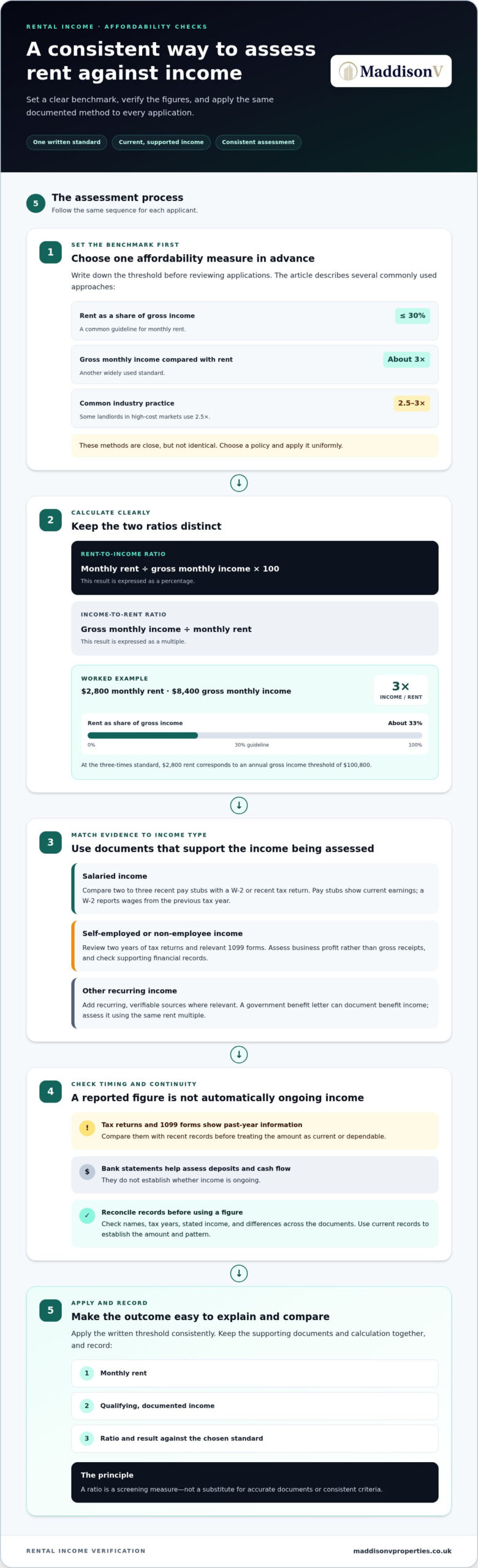
- Choose one affordability benchmark before reviewing a rental application. A common guideline keeps rent at no more than 30% of a tenant’s gross income. Another widely used standard asks for gross monthly income of about three times the rent. These approaches are close, but not identical: rent at 30% of income implies income slightly above three times rent. Set the threshold in writing so each applicant is assessed against the same measure.
- Calculate the rent-to-income ratio by dividing monthly rent by gross monthly income, then multiplying by 100. For example, rent of $2,800 and gross monthly income of $8,400 produce a ratio of about 33%. The income-to-rent ratio reverses the calculation: divide income by rent. In this example, $8,400 divided by $2,800 equals three, so income is three times the monthly rent. Naming the calculation prevents the two ratios from being confused.
- Apply your chosen threshold consistently across income sources. A common industry practice is to look for gross monthly income of 2.5 to 3 times monthly rent; some landlords in high-cost markets use 2.5 times. Don’t switch between thresholds from one rental application to another without a clear, consistently applied reason.
- Compare the calculation with the full picture of documented income. Add recurring, verifiable income sources, then use current records to establish the amount and pattern. A government benefit letter, for example, can document benefit income; assess it against the same rent multiple used for other applicants. If you use the three-times standard for $2,800 monthly rent, the corresponding annual gross income threshold is $100,800. Record the rent, qualifying income, ratio, and result for each applicant.
- Keep the benchmark separate from the decision process. A ratio is a screening measure, not a substitute for accurate documents or consistent criteria. Write down whether your policy uses 30% of gross income, three times rent, or a 2.5-to-3-times range, and apply that policy uniformly. This makes the result easier to explain and gives each tenant a clear, comparable assessment of affordability.
Many landlords and property managers look for verifiable renter income of two to three times the monthly rent. Set your chosen threshold in advance rather than selecting a different point for each applicant. Define which recurring income sources count, what documents establish them and how you’ll calculate the qualifying amount. Then apply the same rent multiple to every application, explaining any policy distinctions before reviewing individual files.
When income is close to your chosen benchmark, check that the records support the amount and that you’re comparing monthly rent with gross income consistently. Keep the supporting documents and calculation together, and record whether the applicant meets your written standard. A clear process prevents estimates, unverified amounts or shifting interpretations of the range from determining the outcome.
Using tax returns and 1099 forms
- Match tax documents to the applicant’s income type. For a salaried employee, compare two to three recent pay stubs with a W-2 or recent tax return. Pay stubs show current earnings, while a W-2 reports wages from the previous tax year. That timing matters if the tenant changed jobs, received a raise, or lost hours after the form was issued.
- Use a tax return as historical evidence, not a complete picture of current earnings. In the United States, Form 1040 reports an individual’s income, including wages and other income such as Social Security benefits or pensions. It can help identify income sources beyond employment, but it reflects a prior tax year. Compare its figures with current records before using them in a rental screening decision.
- For non-employee earnings, review the relevant 1099 forms. Form 1099-NEC can document non-employee compensation, including self-employment or gig income. Forms 1099-MISC and 1099-K may also document non-employee income. A 1099 from the previous tax year doesn’t establish that the same work or payments continue now. Compare the reported amount with recent records that show whether income remains active.
- Ask self-employed applicants for two years of tax returns to assess income history. Review 1099 forms covering the past year or two when non-employee earnings are part of the application. Look for changes across tax years, income categories, and reported totals. A sharp increase in one year may reflect a temporary contract or a one-time project, so avoid treating one unusually strong period as a dependable ongoing amount.
- Separate investment income from wages when reading tax documents. Form 1099-INT reports interest earned during the tax year, while Form 1099-DIV reports dividends and distributions from stocks or mutual funds. Include these sources only when documents establish the amount and the income is relevant to the assessment. Note each source separately, rather than combining unlike earnings into one unexplained total.
- Reconcile the records before calculating qualifying income. Check that the applicant’s name and tax year align across the return, W-2, 1099 forms, and pay stubs. Compare annual totals with the stated income and investigate differences by identifying their period or source. A past-year tax form and current pay stubs can complement each other: one provides historical context, the other shows more recent earnings. Record which documents support the figure used in your decision.
Tax returns show income reported for a previous tax year, so they may not reflect an applicant’s current financial situation. For self-employed applicants, request at least two years of returns.
Profit-and-loss statements and 1099 forms
For self-employed applicants, assess documented business income alongside personal earnings. Distinguish gross receipts from the funds available to cover housing payments.
-
Review Profit-and-Loss Statements and 1099 Forms
Compare the applicant’s profit-and-loss statement with 1099 forms and supporting financial records. A 1099 can document non-employee compensation, but it doesn’t show whether gross business receipts remain after operating costs. Check the reporting period, income categories, and consistency between records. For instance, compare reported contract payments with the corresponding business income rather than treating every receipt as personal earnings.
-
Account for Expenses and Vacancy
Separate gross rental receipts from net income before assessing affordability. Lenders generally start with scheduled rent, then account for eligible expenses and vacant periods to estimate qualifying rental income. Accepted expense categories and vacancy treatment vary by lender, so distinguish gross rent from the net figure used in the calculation. Don’t assume all scheduled rent qualifies after costs and periods without a tenant.
- Calculate business income from profit, not revenue alone. Gross business receipts aren’t equivalent to a self-employed applicant’s personal income because the business may have operating expenses. Review the profit-and-loss statement for the period covered, then compare its net result with a recent tax return or bank statements. If records show payments received but not the costs, the income picture is incomplete for assessing regular rent obligations.
- Check whether the applicant’s 1099 activity appears ongoing. Compare the listed payer, service or contract type, and payment pattern with the applicant’s explanation of current work. A prior-year form documents past compensation, not future work. For irregular earnings, review income history rather than relying on one unusually strong period. Record which payments appear recurring and which depend on a completed project or short-term arrangement.
- Keep business income separate from employment income during screening. If an applicant is also employed, review a current pay stub and employment verification as separate evidence. Don’t add business revenue to wages without establishing the applicant’s share of business profit. Records of typical earnings, documented expenses and income sources help you assess whether available funds can consistently cover housing payments.
- Document how you calculated the qualifying figure. Note the records reviewed, the relevant period, business expenses considered and how vacant rental periods were treated. If a profit-and-loss statement and tax return show different totals, identify the period or category behind the difference before calculating income. Apply the same written method to comparable applications and retain a concise explanation of how business records informed the decision.
Comparing income verification methods
For a mortgage application, a lender can compare rental records, bank deposits and documented expenses to assess rental income. The calculation method matters: scheduled rent alone doesn’t show whether payments arrived or expenses reduced the income available.
For tenant screening, landlords commonly compare pay stubs, tax forms, employer letters and bank statements. Each proof-of-income document shows a different part of an applicant’s finances, so compare records rather than relying on a single item.
- Match the verification method to the income source. Current pay stubs show gross earnings, pay frequency and year-to-date totals for employed applicants. An employment verification or offer letter can provide additional details, while a tax return offers historical context. For self-employment, pair business records with bank statements or tax documents instead of treating deposits as proof of ongoing earnings. This is a practical starting point for how to verify rental income of a property accurately.
- Use bank statements to assess cash flow. Recurring deposits can show the amount and timing of payments, particularly for applicants with variable income. However, statements show money already deposited, not whether the applicant remains employed or continues earning. Compare deposits with other income documents to establish their source and whether the pattern is consistent.
- Compare records covering the same period. A tax return may report a previous tax year, while pay stubs show more recent earnings. Note the difference before calculating income. For example, if a recent pay stub reflects a new job, an older tax form won’t describe that current role. A clear timeline helps distinguish present income from historical figures.
- Keep credit information separate from proof of income. A credit record can inform the broader screening picture, but it doesn’t establish wages, business profit or rent received. Assess income documents for the actual income figure, then apply your written affordability method consistently. This prevents a credit profile from being mistaken for evidence of earnings.
- For rental income used in mortgage calculations, distinguish scheduled rent from rent received. Compare rent records with bank deposits, then account for documented expenses and vacant periods when estimating net income. Lenders’ qualifying methods differ, so use the lender’s calculation rather than assuming every rental payment counts in full. Keep the supporting records and calculation together.
- Record how each document contributed to the decision. Note whether a pay stub, bank statement, tax form or verification letter supports the income amount, and explain any discrepancies. To decide how to verify rental income of a property, document your method and apply it consistently across comparable applications. For variable earnings, combine relevant records to build a balanced view of income stability.
What documents can verify rental income from a property?
- Start with documents that match the applicant’s income type. Landlords commonly review pay stubs, W-2 or 1099 forms, tax returns, employer verification letters, offer letters, and bank statements. Each record answers a different question: what income was reported, what is being earned now, or what money reached an account. Compare related records rather than treating any single document as a complete financial picture.
- For an employed applicant, review two to three recent pay stubs alongside a W-2 or recent tax return. Pay stubs can show current employer, pay frequency, gross pay, and year-to-date earnings. A job offer letter can help establish the employer, position, start date, and stated compensation. Compare these details for consistency, especially if the applicant recently began work or has variable hours.
- Use bank statements to review deposits and cash-flow patterns. When assessing a rental applicant, review two to three months of statements and compare deposits with stated income and pay records. Statements show money received, but don’t establish whether an applicant remains employed or continues earning. For self-employed applicants, recent bank statements can support a tax return by showing current financial activity.
- For freelance or business income, review records showing the source and history of payments. Applicants may provide business financial records, invoices and income-history documents alongside tax forms. Request three to six months of bank statements for self-employed, freelance or gig applicants. Compare business receipts with deposits, and distinguish personal earnings from gross business revenue before assessing affordability.
- Check whether payment-app records support the applicant’s stated side-gig earnings. A summary alone may not show who paid, why the payment was made or whether it reached the applicant’s bank account. Review detailed transaction histories, matching invoices and corresponding bank statements together. For example, a payment-app entry backed by an invoice and matching deposit provides a clearer trail than an unexplained total.
- Assess irregular earnings across a meaningful history rather than relying on one busy month. Averaging income over the last 12 to 24 months can help establish a fair monthly figure for applicants whose earnings fluctuate. Compare the average with current documents to see whether recent activity aligns with the longer record. Keep the calculation and supporting periods clear in your rental file.
- Finish by recording which documents support each income source and the amount used. Note differences between current pay records, tax-year totals, invoices and deposits, then identify which documents explain them. A consistent file lets you revisit the evidence and apply the same assessment method across rental applications.
MaddisonV Properties: Property Management
MaddisonV Properties offers Property Management for owners seeking ongoing oversight after assessing a tenant’s income and affordability. It can be a practical next step when you want rental administration and property responsibilities managed as part of a considered investment approach.
Clear income checks inform tenant selection, while consistent oversight supports a more organised ownership experience. If you’re considering the next steps for a rental property, Property Management can complement property sourcing or portfolio management as your needs develop.
For owners focused on investment decisions rather than day-to-day property responsibilities, MaddisonV Properties also offers Mortgage Consultations and Facilities Management. The right support depends on what you need to address, from property oversight to broader investment planning.
To discuss your property needs, contact MaddisonV Properties or visit maddisonvproperties.co.uk.
Make your next rental decision with clarity
A sound affordability process is about more than approving an application. It creates a clear record of how you assessed income, which evidence informed the decision and how the property fits your wider plans. Keep your criteria consistent, retain the documents supporting your assessment and revisit your approach when your rental strategy changes.
Knowing how to verify rental income of a property can help you make more confident decisions. The next step is connecting that due diligence to the practical demands of ownership. Consider the level of oversight you want, how your investment goals may evolve and which responsibilities you’d prefer to manage more passively.
MaddisonV Properties can discuss the property support that aligns with your plans. Contact MaddisonV Properties to explore a considered next step for your rental investment.
Frequently Asked Questions
How can you verify rental income on a tax return or Schedule E?
Compare rental income and expenses shown on Schedule E with the property’s supporting records. Match the property address and tax year, then reconcile reported rent against lease agreements, payment records and bank deposits. Check that reported expenses relate to the rental and that the resulting figures align with the relevant tax-return totals. This helps distinguish declared rental activity from payments actually received.
How do you verify rental income for a property listed for sale?
Compare the seller’s stated rental income with current lease agreements, a rent ledger and bank deposits. Check which units are occupied, the rent specified in each lease and whether payments match the ledger. Review expenses and vacant periods separately, since advertised income may reflect scheduled rent rather than cash received. Request records covering the same period so you can reconcile the figures consistently.
What rental income verification rules vary by state or local jurisdiction?
Rules can differ by state and city: Colorado bars landlords from requiring annual income above 200% of annual rent, and Portland caps income requirements at 2 or 2.5 times rent depending on the unit. California prohibits using the full rent for an income standard when a government subsidy means the tenant pays only part; local rules may also add protections beyond federal law.
What are the risks of fake leases or falsified rental income documents?
Fake leases or falsified income documents can make rental income appear more reliable than it is, undermining affordability checks and contributing to unpaid rent or bad debt. Among rental providers who experienced fraud, 84.3% reported applicants falsifying or fabricating income documentation.

Sign Up Now
Want to read more great articles and blogs subscribe to our newsletter