
Finding tenants for executive apartments in London starts with reaching the right audience: relocating professionals, employers and mobility teams....

Finding tenants for executive apartments in London starts with reaching the right audience: relocating professionals, employers and mobility teams. Combine a well-prepared, furnished apartment with focused marketing, careful tenant screening, organised viewings and clear tenancy terms.
It’s understandable to want a tenant who suits both the apartment and the way you want it managed. This guide explains how to reach corporate and individual tenants, make an apartment appealing to executive renters, assess applicants and manage viewings and agreements with confidence. You’ll also learn how to connect with employers and relocation professionals, so your search is organised and tailored to people moving to London for work.
Key Takeaways
- Shape the apartment’s presentation and advertised rent around the professionals and employers most likely to need it.
- Use a consistent screening process for identity, references and Right to Rent checks before the tenancy begins.
- Prepare viewings and agreements with the actual arrangement in mind, including whether the tenant is an individual or a company.
- Reach beyond general listings by building relationships with relocation agents, employers and global mobility teams.
- Understand which corporate and individual tenant groups may suit your apartment, then tailor your outreach to their needs.
How Do You Find The Perfect Tenants In London?
A disciplined approach to finding tenants for executive apartments in London starts with matching the property to the people who need it. Prepare the apartment, set a clear advertised rent, and accurately present its location, condition and practical features.
-
Prepare Properties for Corporate Tenants
Furnish the apartment for an employee arriving without household essentials. Corporate tenants often look for well-maintained furnishings, reliable broadband and a dedicated workspace for hybrid working. Check that appliances and essential facilities work, and make the layout easy to understand. Professional cleaning, responsive maintenance and straightforward invoicing can also help employers assess whether the apartment is practical for a relocation.
-
Set Rent and Advertise Listings
Set the advertised rent with the apartment’s location, condition, size and furnishings in mind. Under the Renters’ Rights Act, rental advertisements must state a fixed rent, and landlords cannot accept bids above that amount. Describe the property accurately on portals such as Rightmove, Zoopla and Nestpick.
- Target the listing to its likely audience. Highlight features that matter to relocating professionals, such as furnished interiors, a workspace, broadband and convenient connections to business districts. Paddington and King’s Cross may appeal to corporate tenants seeking access to technology hubs; proximity to London City Airport may also suit employees who travel for work. Clear photographs and a precise description help mobility teams judge whether the apartment suits an assignment.
- Match location to budget and daily needs. A City address may suit tenants who prioritise proximity to work, while Battersea and Paddington can offer access to central areas at rents lower than those in the City. Describe the location practically, including nearby transport and journeys to likely workplaces. No area is universally affordable or ideal: the employer’s budget, commute and employee’s priorities determine the best fit.
- Make property management expectations visible. Explain how maintenance requests, cleaning and invoicing will be handled so employers understand the arrangement before a viewing. Corporate tenants often value clear reporting and professional upkeep as well as the apartment itself. Don’t promise guaranteed rent or occupancy unless the agreement genuinely provides it. Instead, state the services and terms you can deliver.
Tenant identity, references and Right to Rent checks
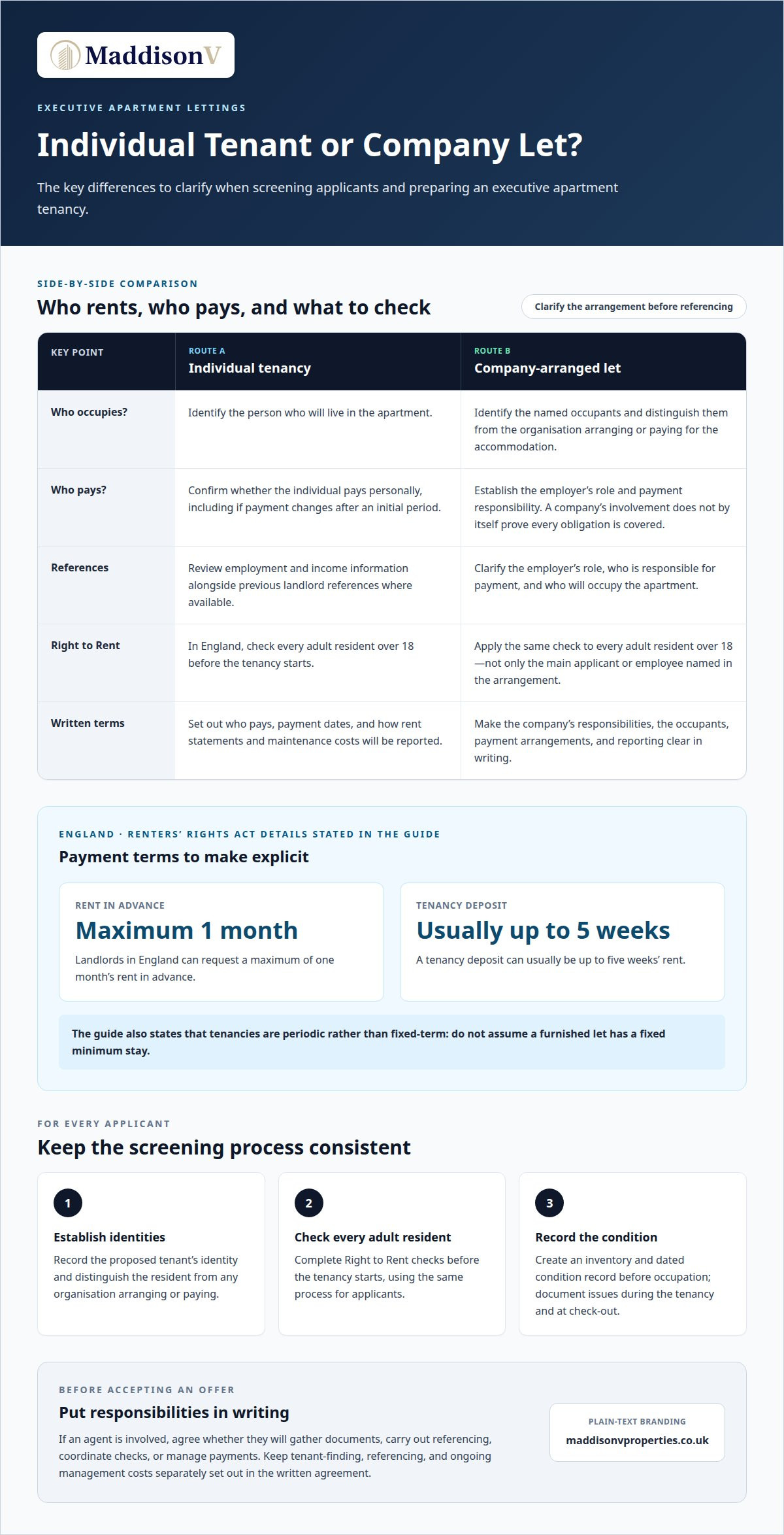
Apply the same documented screening process to every applicant, whether an employee rents personally or an employer arranges accommodation. In England, landlords must check that tenants and other adult residents over 18 have the right to rent before the tenancy starts, according to the Home Office.
London relocation agents and corporate housing providers do not have one universal fee or commission rate. Charges depend on the agreed services and fee structure. Set out tenant-finding, referencing and ongoing management costs separately in the written agreement.
Corporate lets may reduce turnover and the frequency of re-letting, but a gap between occupants can still create a void period. Damage, unpaid rent and unclear responsibilities are other risks. Document the property’s condition, agree clear payment arrangements and maintain regular oversight to help manage them.
- Establish who is applying. Record the proposed tenant’s full identity and distinguish the resident from the organisation arranging or paying for the accommodation. A company may pay directly, or an employee may pay after an initial period, so clarify the arrangement before references begin.
- Complete Right to Rent checks consistently. Check every adult resident individually before the tenancy starts, not only the employee named as the main applicant. Apply the same process across applicants and avoid assumptions based on someone’s name, appearance or nationality.
- Assess references and income against the arrangement. For an individual tenancy, review employment and income information alongside previous landlord references where available. For a company let, establish the employer’s role, payment responsibility and the named occupants; don’t treat the employer’s involvement as proof that every obligation is covered.
- Use a letting agent with defined responsibilities. Agree in writing whether agents will gather documents, carry out referencing, coordinate checks or manage payments. A third party offering guaranteed rent may lease the property and sublet it, reducing landlord control and adding compliance obligations. Understand that structure before accepting it.
- Set out payments and reporting clearly. Under the Renters’ Rights Act, landlords in England can request a maximum of one month’s rent in advance, and a tenancy deposit can usually be up to five weeks’ rent. State payment dates, who pays, and how rent statements and maintenance costs will be reported.
- Keep a clear record of property condition. Create an inventory and dated condition record before occupation, then document issues during the tenancy and at check-out. For a managed rental, professional property management can provide a structured point of coordination for payments, records and property oversight.
Viewings, offers and tenancy agreements
For furnished executive rentals in London, the agreement should reflect who occupies the apartment, who pays and how the arrangement works. Under the Renters’ Rights Act, tenancies are periodic rather than fixed-term, so don’t assume that a furnished let has a fixed minimum stay. Set out the proposed terms clearly before accepting an offer.
- Prepare each viewing around the applicant’s needs. Present the apartment as it will be occupied, with furniture, appliances and storage easy to assess. A relocating employee may prioritise a usable workspace, while an employer may focus on location, condition and move-in arrangements. Keep the viewing focused on those practical details, and answer questions about the property accurately.
- Confirm who is making the offer. Record whether the applicant is an individual, a company or an employee supported by an employer. A corporate tenancy agreement may be made in the company’s name, rather than the names of the employees living there. Clarify the proposed residents and payment arrangement before treating an offer as complete.
- Review the offer’s full terms. Consider the rent offered, proposed start date, occupants, furnishings and any requests for changes. Diplomatic or governmental offices may act as a guarantor rather than paying rent directly, so distinguish a guarantee from the party responsible for rent. Don’t rely on a verbal promise to settle a material point later.
- Tailor the agreement to the actual arrangement. Identify the landlord, contracting tenant, permitted residents, rent, payment method and responsibilities for the furnished contents. Include agreed arrangements for cleaning, maintenance access and reporting problems. Corporate leases can differ from standard assured shorthold tenancy agreements, but corporate involvement alone doesn’t remove the need to follow housing law.
- Clarify the tenancy structure before signing. Corporate lets typically use residential tenancy arrangements governed by housing law, even when a company arranges or pays for accommodation. The Renters’ Rights Act provides for periodic tenancies, not fixed terms. State how rent is paid and how either party gives notice, using terms consistent with the applicable arrangement.
- Keep the final record complete. Provide the signed agreement and a record of the apartment’s furnishings and condition to the relevant parties. For example, document the inventory, agreed maintenance responsibilities and named occupants together. A clear record helps the employer, resident and landlord understand their respective obligations throughout the tenancy.
- Resolve changes in writing. If an employee’s assignment or accommodation needs change, record any agreed adjustment to occupants, payments or property responsibilities. Flexible terms can help address changing housing needs, but changes should be documented rather than left to informal messages. This keeps the landlord and corporate tenant aligned as the tenancy continues.
Which London relocation agencies and corporate housing platforms find tenants for executive apartments?
Reach corporate tenants through two complementary routes: relocation professionals and online property platforms. Relocation agents may have established relationships with multinational employers and global mobility teams, while portals offer another way for professional and corporate applicants to discover London homes.
- Build relationships with relocation agents. Introduce the apartment with a concise property profile, including its location, furnishings, workspace and availability. Relocation agents can support home searches, accommodation, school searches, visa and immigration coordination, shipping, removals and settling-in services. These broader responsibilities make them a relevant contact when an employer needs housing for a relocating employee.
- Connect with employer mobility teams. Global mobility teams coordinate employee moves and may contact relocation agents when accommodation is needed. Share clear details about the property and its practical fit, such as access to the City of London, Paddington or King’s Cross. A specific profile helps the team assess whether the apartment suits an employee’s workplace and assignment.
- List the property on relevant platforms. Rightmove, Zoopla and Nestpick are online platforms used to reach professional and corporate tenants. Give each listing an accurate description, current photographs and clear information about furnishings and facilities. Consistency across platforms makes it easier for an employer, agent or prospective resident to understand what the apartment offers.
- Make the listing useful to intermediaries. Include the details relocation professionals need to assess a match, such as the number of bedrooms, layout, furnishing, workspace and location. Explain whether the property is suited to an individual employee or a household. Avoid vague phrases such as “ideal for everyone”; precise information helps agents present suitable options to their clients.
- Adapt outreach to the assignment. Corporate tenants can include multinational companies relocating overseas staff, UK firms housing contractors, and employers arranging fixed-term placements. A technology employee near King’s Cross may value workspace and broadband, while a commuter to the City may prioritise transport connections. Tailor the property profile to these needs without promising terms the tenancy cannot support.
- Keep channel communication coordinated. Use one current set of property details for portal listings, agent introductions and employer enquiries. Update availability and agreed terms promptly, so different contacts don’t circulate conflicting information. When an agent refers an applicant, record the employer, proposed resident and intended use. This creates a clear path from initial interest to viewing and application.
- Review which routes generate relevant enquiries. Track whether interest comes through Rightmove, Zoopla, Nestpick or a relocation professional. Note which property details applicants ask about, such as furnished accommodation, location or move-in arrangements. Use those patterns to refine the listing and focus outreach on channels reaching suitable corporate tenants.
What types of tenants rent executive apartments in London, and how can landlords reach them?
Executive apartments may suit employees relocating internationally, contractors on assignments and professionals moving within the UK. Match the property’s location, furnishings and proposed terms to the tenant’s needs, then focus your outreach on employers and intermediaries likely to be looking for that fit.
- Target multinational employers relocating overseas staff. These companies may arrange accommodation for employees moving to London. Present the apartment as a ready-to-occupy home, with a clear description of its layout, furnishings and transport connections. Explain how the location relates to relevant business districts, such as the City of London, so mobility teams can assess commute and convenience.
- Reach UK firms housing contractors or assigned employees. Fixed-term work placements can create demand for accommodation suited to an employee’s assignment. Share a concise property profile with employers and relocation contacts, highlighting practical features and the arrangement’s terms. Some corporate tenants seek tenancies lasting up to three years, so state the proposed tenancy structure clearly rather than assuming every assignment has the same duration.
- Shape the offer around London’s major industries. Employers in technology, finance, legal services and energy may need homes for staff arriving for work. A professional working near the City may value a convenient commute, while someone based near Paddington or King’s Cross may prioritise access to those business hubs. Connect the apartment’s actual location to likely workplaces, without overstating travel convenience.
- Recognise that the company may not be the resident or payer. A corporate tenant is often understood as a company paying rent for an employee, but payment arrangements can differ. Rent may transfer to the individual after an initial period, or an employee may rent with employer support or reimbursement. Establish who will occupy the apartment, who pays, and who handles tenancy responsibilities before progressing an application.
- Include professionals relocating independently. Not every executive renter arrives through a company-paid arrangement. Some employees receive housing support or reimbursement while renting in their own names. Describe the apartment’s suitability for an individual or household, and explain the practical features that make moving straightforward. This keeps the listing relevant to both employer-led searches and direct enquiries.
- Use channels that match the intended tenant. Share tailored property information with employers, global mobility teams and relocation agents, then keep the terms consistent across each introduction. For corporate enquiries, make the proposed occupancy and payment structure easy to understand. For individual professionals, foreground location, furnishings and everyday usability.
For support aligning a London property with its intended rental audience, explore tailored property management.
MaddisonV Properties
MaddisonV Properties can help bring your London property plans and management needs into one considered strategy. If you’re assessing an apartment for executive tenants, Property Sourcing can support your search for an investment, while Property Management and Facilities Management address the property’s ongoing care. Portfolio Management can help you take a broader view of your holdings.
Turn to MaddisonV Properties for guidance that connects property decisions with practical management needs. The right support depends on your priorities, the apartment and your investment plans. Contact MaddisonV Properties to discuss your requirements and next steps.
Make your next letting decision with confidence
Turn your rental strategy into a clear plan for the property. Consider the audience you want to reach, the experience the apartment should offer and how involved you want to be in its ongoing management. These decisions shape how you present the home and which enquiries deserve your attention.
Finding tenants for executive apartments in London is about more than filling a vacancy. It means aligning the apartment, its presentation and its management with the needs of a suitable resident. Keeping those priorities in view helps you move forward with a clearer, more deliberate plan for your property.
Discuss your London property plans with MaddisonV Properties and explore a practical next step for your investment.
Frequently Asked Questions
Do you handle viewings, or is that the landlord’s responsibility?
The landlord handles viewings unless a written agreement assigns them to a letting or management agent. Before advertising, decide who will arrange appointments, provide access and follow up with applicants. An overseas owner can appoint a representative to coordinate access and share viewing feedback. Record attendees’ interest and questions, such as requests about furnishings or the move-in date, to inform your next steps.
Should You Use a Letting Agent to Find Tenants?
A letting agent can help market the apartment, organise viewings or handle applicant administration. The right arrangement depends on how involved you want to be and whether you also need ongoing property management. Before instructing an agent, agree the tasks and reporting you expect in writing. Clarify, for example, who communicates with applicants and who updates you after an offer or viewing.
What happens if no tenants want to rent my apartment?
Review the listing before changing your rental strategy. Check whether the photographs show the apartment clearly, the description answers practical questions and the advertised rent reflects the property’s location and condition. Ask relocation contacts what requirements applicants have raised, then adjust the presentation or targeting where appropriate. If enquiries remain limited, consider whether the furnishings, location or proposed terms suit the corporate audience you’re pursuing.
Where do landlords advertise executive apartments for rent in London?
Online property platforms can help landlords reach people seeking professional or corporate accommodation. Pair a portal listing with direct introductions to relocation agents and employer mobility teams. Keep the property details consistent across channels, and clearly describe its location, layout and furnishings. For example, explain how the location relates to the City of London or a tenant’s likely workplace.
How should a London executive apartment be furnished and presented to attract corporate tenants?
Present a finished, functional home rather than an empty shell. Show the room layout clearly, provide comfortable furniture suited to everyday living and make storage easy to assess during a viewing. A dedicated desk area can help a tenant working remotely, while uncluttered surfaces make it easier to picture the apartment as a home. Keep photographs, listing details and the actual viewing consistent.
What legal requirements must London landlords meet before letting an executive apartment?
In England, landlords must check Right to Rent for every adult resident aged over 18 before the tenancy starts, according to the Home Office. The property also needs an EPC rated E or better, a valid gas safety certificate, and an electrical condition report no more than five years old. Provide working smoke alarms on each floor and carbon monoxide detectors in rooms with fuel-burning appliances. Licensing may apply to some HMOs.
Should London landlords use a letting agent, relocation company, or short-term rental platform?
Choose the channel that matches the tenancy you want. A letting agent can support marketing and tenancy administration; relocation companies connect employers and relocating employees with accommodation; property platforms provide listing visibility. For a corporate residential tenancy, a relocation contact or agent may reach applicants whose employers are arranging a move. Tailor the agreement and property presentation to the intended use rather than treating every platform as the same route.

Sign Up Now
Want to read more great articles and blogs subscribe to our newsletter