
Buying off-plan property in Dubai as a foreigner is possible in designated freehold areas, and the right choice depends on more than the advertised...

Buying off-plan property in Dubai as a foreigner is possible in designated freehold areas, and the right choice depends on more than the advertised purchase price. Some off-plan homes offer flexible payment plans and lower entry prices than completed properties, while qualifying Dubai property investments above AED 2 million may make buyers eligible for a 10-year UAE Golden Visa, according to the Federal Authority for Identity, Citizenship, Customs & Port Security.
The appeal is clear: buying before completion can suit investors seeking a planned route into Dubai’s property market, but it also means weighing payment schedules, financing, delivery timing and future rental potential. This guide explains how the market works for foreign buyers and which costs to consider, then compares off-plan and ready properties to help you judge which better fits your goals. You’ll also learn how rental yields, ownership costs and mortgage options shape the decision, with practical steps for assessing a property before committing.
Key Takeaways
- Compare payment schedules and financing eligibility before choosing an off-plan home, since the funding structure affects how much capital you need and when.
- Understand the difference between freehold and leasehold rights so the ownership terms align with your plans for the property.
- Review the sales agreement and payment protections carefully, including how the purchase is registered and how instalments are handled.
- Assess rental potential alongside ongoing costs, rather than relying on headline yield figures alone.
- Weigh the appeal of a lower entry point and staged payments against the immediate use and rental potential of a ready property.
How can I finance the purchase of an off-plan property as a foreign investor?
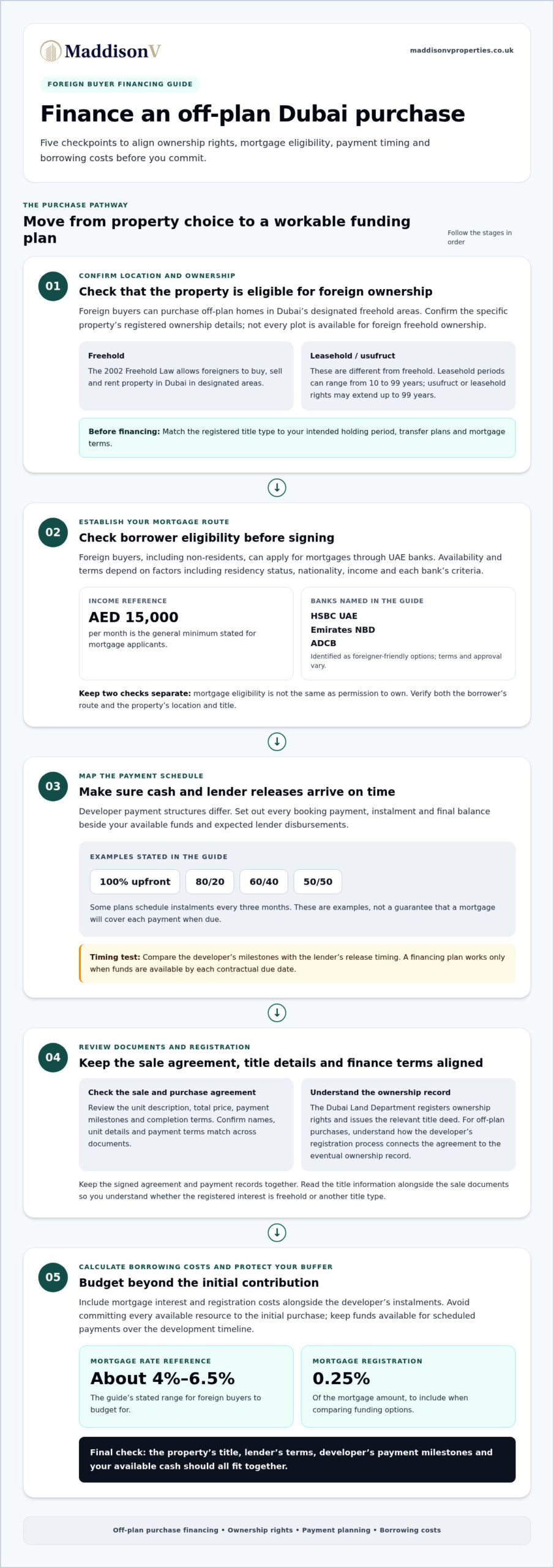
- Choose an eligible location and clarify your objective. Foreign buyers can purchase off-plan homes in Dubai’s designated freehold areas. Compare locations by intended use, access to transport and likely tenant demand, then match the choice to your holding plans. A property purchase can also relate to residency: qualifying Dubai property investments above AED 2 million may make buyers eligible for a 10-year UAE Golden Visa, according to the Federal Authority for Identity, Citizenship, Customs & Port Security. Treat residency and investment as connected decisions, not interchangeable outcomes.
- Establish your mortgage route before committing. Foreign buyers, including non-residents, can apply for mortgages through UAE banks. Availability and terms vary by residency status, nationality, income and each bank’s criteria. For off-plan purchases, mortgage availability and terms can vary by lender and buyer eligibility. Mortgage applicants generally need to earn at least AED 15,000 per month. Compare the expected loan with the developer’s payment schedule, since the lender’s release timing must fit the purchase milestones.
- Model the full payment schedule. Some developers require buyers to pay 100% upfront, while others offer instalment plans. Examples include 80/20, 60/40 and 50/50 structures, with some plans scheduling payments every three months. Don’t assume a mortgage will cover each instalment when it falls due. Set out the booking payment, scheduled instalments and final balance beside your available funds. A financing plan works only when the timing of cash, lender disbursements and contractual payments aligns.
- Review the purchase documents before signing. Read the sales and purchase agreement closely, focusing on the unit description, total price, payment milestones and completion terms. Keep the signed agreement and payment records together as key transaction documents. The Dubai Land Department registers ownership rights and issues the relevant title deed. For an off-plan purchase, understand how the developer’s registration process connects the agreement to the eventual ownership record. Check that names, unit details and payment terms match across the documents.
- Calculate borrowing costs and preserve a cash buffer. Foreign buyers should budget for mortgage rates of about 4% to 6.5%. Dubai mortgage registration costs 0.25% of the mortgage amount, so include it alongside the purchase instalments when comparing funding options. For example, a larger loan can reduce the initial cash contribution but increases the amount subject to mortgage costs and interest. Keep funds available for scheduled payments instead of committing every available resource to the initial purchase. This makes the financing plan more resilient to the long timeline of an off-plan development.
Do banks lend to foreigners for homes in the UAE in 2026?
- Separate mortgage eligibility from ownership eligibility. Foreigners, including non-residents, can apply for home financing through UAE banks. Lenders assess factors such as residency status, nationality, income and their own criteria. HSBC UAE, Emirates NBD and ADCB are among the banks identified as foreigner-friendly options. Mortgage approval and permission to own are separate matters: first establish whether the property’s location and title type allow foreign ownership.
- Limit your search to designated freehold areas. Foreign nationals can purchase property in designated freehold areas across Dubai, including off-plan homes. The 2002 Freehold Law allows foreigners to buy, sell and rent property in Dubai without special regulations or permissions. That does not make every plot in the emirate available for foreign freehold ownership. Compare the specific property’s location with its registered ownership details before treating it as a freehold purchase.
- Check what the land registration covers. Article 3 of Dubai Regulation No. 3 of 2006 identifies land plots designated as freehold properties. The Dubai Land Department registers ownership rights and issues the relevant title deed. Read the title information alongside the sale documents to understand whether the registered interest covers the property as freehold or another title type. The distinction matters because a unit’s location alone doesn’t establish the rights attached to its land.
- Compare freehold, leasehold and usufruct rights. Foreigners and expatriate residents may hold usufruct or leasehold rights over Dubai property for up to 99 years. Leasehold periods can range from 10 to 99 years, depending on the agreement. These interests differ from freehold ownership, so don’t use the terms interchangeably. Review the duration and scope of the registered right, then consider how each affects your intended holding period, transfer plans and financing.
- Match the title type to your financing plan. Banks assess both the property and the borrower when considering a mortgage, so the legal interest matters alongside income and residency status. Ask for the property’s exact title type before signing, then compare it with the ownership details recorded by the Dubai Land Department. A freehold title and a long-term leasehold interest, for example, do not represent identical rights. Keep the sale agreement, title information and financing terms aligned throughout the purchase.
What’s the property market like in Dubai?
Use Dubai Land Department and RERA records to verify the developer and off-plan project registration before paying. RERA oversees project timelines and investor rights in Dubai.
Key risks include construction delays, changing market conditions and payment pressure before handover. Reduce exposure by reviewing the sales and purchase agreement, escrow details and payment schedule before committing.
- Compare the project with your investment plan. Dubai’s market includes different price points and property types, so assess each development on its own merits. These historical examples illustrate variation, not current quotations. Compare the location, unit type, amenities and expected completion timing rather than relying on a district name alone.
- Verify the project and developer before booking. Search Dubai Land Department and RERA records for the project and developer, then compare the recorded details with the sales materials. Check that the project name, unit information and payment instructions align across the documents. Review the stated completion schedule, construction milestones and buyer obligations. This can help you spot inconsistencies before a reservation becomes a larger financial commitment.
- Read the sales and purchase agreement alongside escrow details. The agreement should set out the unit, property value, payment milestones and completion terms. Identify the project escrow account and compare its payment instructions with those in the agreement. Keep signed documents and receipts together. Promotional wording is not a substitute for contractual terms: use the agreement as your practical reference for payment timing and the obligations attached to your purchase.
- Build registration charges into your budget. Dubai charges a 4% Dubai Land Department fee on an off-plan property’s purchase price. Calculate these items against the agreed property value, then keep them separate from instalments, furnishing and future ownership expenses.
- Track the purchase through transfer and handover. Follow the agreement’s payment milestones and retain proof of each instalment. Before handover, compare the completed unit with the agreed specifications and document any outstanding items. Ownership transfers in Dubai are completed at a Dubai Land Department Trustee Office. For a resale, buyers typically sign a Memorandum of Understanding, Form F, after agreeing on price and terms, and obtain a developer No Objection Certificate before transfer. Keep off-plan completion documents ready for registration.
Rental yields and investment considerations
- Compare yields by property type and location. Dubai’s average rental yield was 6.34% in August 2026. Apartment yields averaged 6.66%, compared with 5.06% for townhouses and 4.45% for villas. These figures offer a starting point, not a forecast for an individual unit. Compare like with like: location, property type, purchase value and expected rent all affect the result. An investor considering an apartment should assess its likely rental income against comparable homes nearby.
- Model income against the full ownership costs. A headline yield doesn’t show what remains after expenses. Add applicable building charges and maintenance needs to your rental estimate, then compare the result with purchase and financing costs. For example, a villa’s average yield differs from an apartment’s, so use the relevant property type when estimating expected income.
- Plan for the handover-to-rental period. An off-plan home produces no rent before it’s completed and ready for occupancy. Map the developer’s handover schedule against any planned mortgage payments, furnishing work and tenant search. Decide whether you intend to rent the home immediately, occupy it or leave it vacant. This choice affects cash flow: a rental plan needs funds for preparation and any gap between handover and the first tenancy.
- Understand the tax position for personal ownership. Dubai does not currently impose annual property taxes on individual property owners. An individual foreigner who personally owns and rents out UAE residential property usually pays 0% UAE personal income tax on that rental income. These points concern UAE taxation, not the investor’s obligations elsewhere. If you’re comparing after-tax income across countries, include the rules that apply where you are tax-resident and how ownership is structured.
- Test the return against the holding period. Off-plan properties in Dubai have an average annual ROI of 6% to 10%, depending on location. Treat this as a location-dependent benchmark, not a promised outcome for a specific purchase. Compare it with the August 2026 rental-yield averages, while keeping the measures distinct: rental yield focuses on rent relative to property value, whereas ROI can reflect broader investment performance. Set a holding period and review expected rent, ongoing costs and registration expenses together.
Buying off-plan versus ready property
- Set your priority before comparing properties. Decide whether you value a lower entry point, staged payments or immediate use. Dubai off-plan homes may offer lower entry prices and flexible payment plans compared with completed properties. A ready apartment, by contrast, can be viewed in its finished state before purchase. Write down your intended use, preferred property type and investment horizon, then compare each option against those criteria rather than its marketing headline.
- Assess what you can inspect before committing. With a ready home, you can view the actual apartment or villa and assess its condition, layout and setting. An off-plan buyer relies on plans, specifications and the developer’s contractual commitments until construction finishes. Compare the proposed unit with the project’s written descriptions, noting the details that matter most, such as room arrangements, shared facilities and finish standards. This keeps your decision focused on deliverables, not visual impressions alone.
- Compare payment timing with your available capital. An off-plan purchase may spread payments across development milestones, while some developers require full payment upfront. A ready property follows a different purchase and transfer timetable. Set out when funds are needed under each option, including any borrowing and registration expenses. Staged instalments may suit an investor with funds available over time, while a buyer seeking immediate occupancy may prefer the clearer completion point of a ready home.
- Separate projected returns from evidence. Off-plan marketing may present future rental or appreciation potential, but the home has no personal rental history before completion. With a ready property, you can assess its current condition and, where applicable, existing tenancy details. Compare expected rent with property value, service charges and financing costs. Use the same assumptions for each property type, whether you’re comparing apartments or villas, and don’t treat projected appreciation as assured profit.
- Choose according to your tolerance for timing and uncertainty. Off-plan suits buyers able to wait for construction and manage a longer path to occupation or renting. Ready homes suit buyers who prioritise immediate access and a property they can assess in person. If you’re also considering London as an international investor, explore London property sourcing to compare opportunities against your investment criteria. The clearest choice is the one whose timing, condition and payment structure fit your plan.
MaddisonV Properties: Property Management
MaddisonV Properties helps investors take a considered approach to property ownership and ongoing oversight. For buyers comparing Dubai with London, Property Management and Portfolio Management can support planning for the care and coordination of London holdings. Property Sourcing can help investors assess suitable opportunities, while Mortgage Consultations can clarify financing considerations for a purchase.
Turn to these services when evaluating how a property fits your wider portfolio or when ownership brings ongoing management responsibilities. A clear plan for property selection, financing and oversight can help keep investment decisions aligned with your objectives.
Contact MaddisonV Properties to discuss your property investment plans.
Shape your next investment decision with clarity
If you’re considering buying off plan property in dubai as a foreigner, start by defining how the purchase fits your wider investment strategy. Consider your goals, preferred level of oversight and whether Dubai or London should be the focus of your next move. A clear plan helps align each decision with how you intend to hold and manage your assets.
If buying off plan property in dubai as a foreigner is part of a broader portfolio plan, MaddisonV Properties can support the London property side through Property Sourcing, Mortgage Consultations and Property Management. Consider how these services fit your objectives, then take the next step at a pace that suits your plans.
Explore how MaddisonV Properties can support your property plans, and move forward with confidence.
Frequently Asked Questions
What kind of taxes and fees will I need to pay?
Budget for registration and transaction costs, not just the property price. Booking fees are stated at 5% to 10% of the price, while brokerage commission is typically 2% to 3%. Individual owners currently face no annual property tax.
As of 2026, what other key foreign-ownership rules or limits should I know in the UAE?
Foreign ownership rights depend on the emirate, location and registered title type. In Dubai, foreign nationals may own property in designated freehold areas, while leasehold and usufruct interests carry different rights and durations. A registered title matters more than marketing language: compare the purchase agreement with the title details and Dubai Land Department records. Ownership rules differ elsewhere in the UAE, so don’t assume Dubai’s framework applies across every emirate.
Can I get a mortgage as a foreigner in the UAE, and on what terms?
Yes, foreign buyers can apply to UAE banks, with approval and terms shaped by residency, nationality, income and lender criteria. Mortgage availability and terms for off-plan purchases can vary by lender and buyer eligibility. Mortgage rates are about 4% to 6.5%, and registration costs 0.25% of the mortgage amount. Lenders generally assess income and repayment capacity, so compare the proposed loan with your payment schedule before signing.
Can I own land in my own name in the UAE right now?
In Dubai, foreign nationals can hold freehold ownership in designated areas, including eligible land plots. This doesn’t mean every plot is available to foreign buyers, and other title types may offer different rights. Before committing, identify whether the transaction covers land, a unit or a time-limited interest. Compare the agreement with the recorded title details, because the title determines the ownership interest registered with the Dubai Land Department.
Do I need a specific visa to buy property in the UAE right now?
A foreigner usually doesn’t need a specific UAE visa to buy residential property, and purchasing while on a tourist visa is generally possible in approved areas. Buying a home and obtaining permission to reside are separate processes. Before travelling to complete a transaction, establish which identification and documents the purchase process requires, and distinguish those transaction requirements from immigration status. Property ownership alone doesn’t grant permission to live in the UAE.
Does buying property help me get residency and citizenship in the UAE in 2026?
Qualifying property ownership may support a residency application, but it doesn’t automatically grant residency or citizenship. A qualifying Dubai property investment above AED 2 million may make a buyer eligible for a 10-year UAE Golden Visa, according to the Federal Authority for Identity, Citizenship, Customs & Port Security. Residency depends on meeting the relevant requirements and providing official property evidence. Buying property does not automatically lead to UAE citizenship.
How can I manage my off-plan property investment if I live abroad?
Plan for handover and ongoing oversight before construction finishes. Keep digital copies of the sale agreement, payment receipts, handover records and building communications together in a secure file. Arrange a local point of contact for inspections, maintenance coordination and tenant matters, then agree how updates and decisions will reach you. If you plan to rent the unit, prepare a letting plan around completion, furnishing and tenant onboarding rather than assuming rent starts at handover.
Can foreigners buy off-plan property in Dubai, and which areas are freehold?
Yes. Foreign buyers may purchase off-plan property in Dubai’s designated freehold areas. Freehold eligibility applies to specific areas and plots, not automatically to the entire emirate. Ask for the exact title type and match the project location and unit details with Dubai Land Department records before committing. This helps distinguish a freehold purchase from a leasehold or usufruct interest, which carries different rights and terms.

Sign Up Now
Want to read more great articles and blogs subscribe to our newsletter