What if the very asset designed to build your wealth is silently eroding your capital through the friction of daily operations? You likely understand...

What if the very asset designed to build your wealth is silently eroding your capital through the friction of daily operations? You likely understand that owning a premium property portfolio should feel like a triumph, yet the reality often involves escalating repair costs, which rose by 10.1% in 2023 according to BCIS data. Between the complexities of the Fire Safety Act 2021 and the relentless demand for contractor management, the dream of a passive income can quickly vanish. We agree that your time is too valuable to be spent chasing plumbers or deciphering ever-changing legislative updates. Implementing a sophisticated strategy for facilities management residential is no longer a luxury; it’s a fundamental necessity for the modern, discerning landlord.
In this guide, you’ll discover how a professional approach transforms your residential investments from high-maintenance liabilities into seamless, high-yield assets. We’ll show you how to achieve total compliance peace of mind, meticulous building upkeep, and enhanced long-term asset value through a bespoke service that matches the prestige of your property. We’re exploring the specific frameworks, technological integrations, and preventative maintenance schedules that will define successful asset preservation in 2026.
Key Takeaways
- Distinguish between the “shell and core” of your property and daily tenancy management to establish a foundation for long-term structural integrity.
- Master the synergy between technical hard services and lifestyle-driven soft services to elevate your property’s status to a premium residential destination.
- Uncover how strategic facilities management residential transforms maintenance from a recurring cost into a value-driven asset that protects your investment yield.
- Gain clarity on the 2026 UK Fire Safety and Building Safety Acts to ensure your luxury developments remain compliant, secure, and future-proof.
- Explore a bespoke and meticulous approach to operational management that replaces the complexities of property ownership with absolute peace of mind.
Facilities Management vs. Property Management: Defining the Residential Split
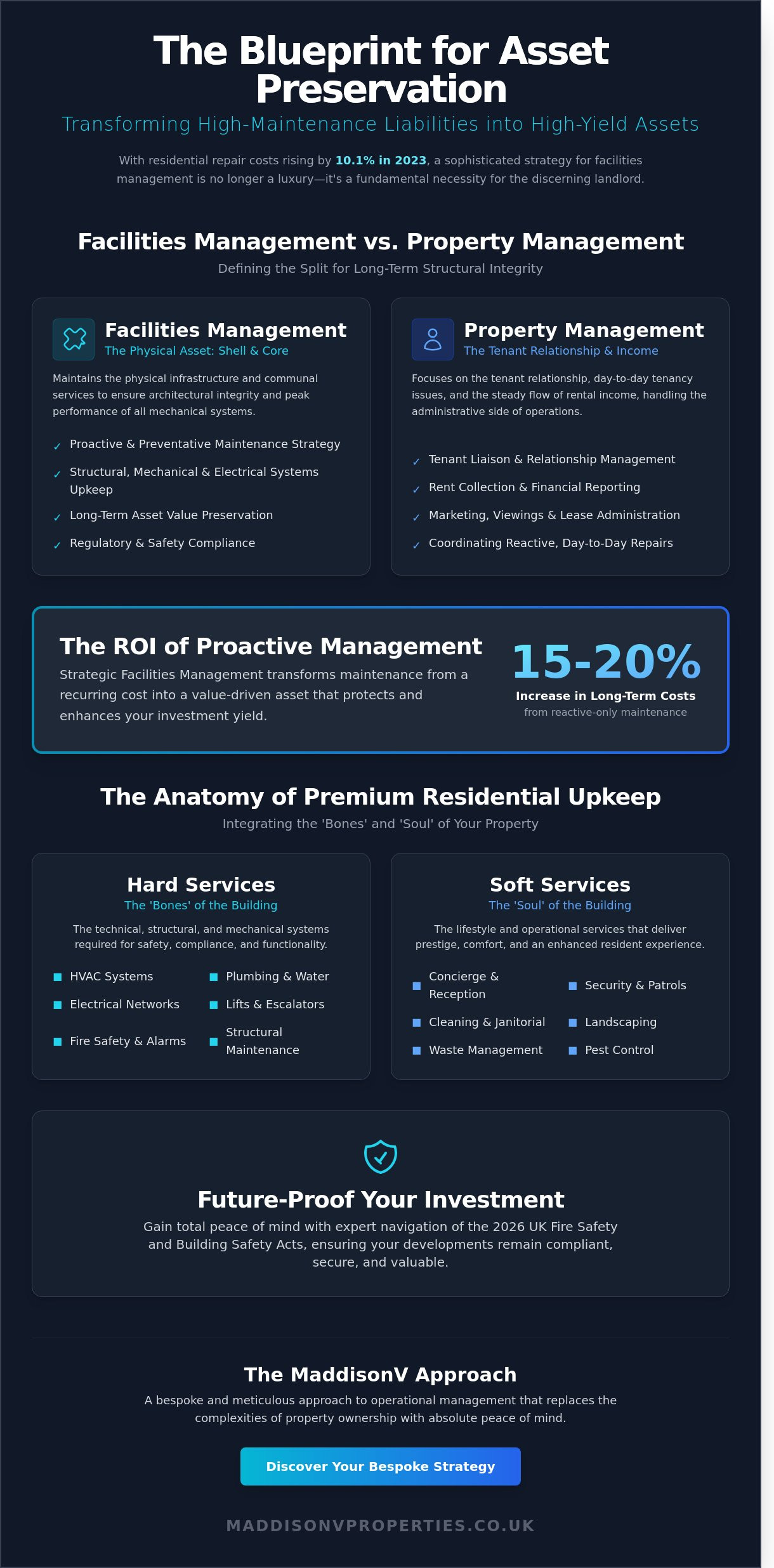
Distinguishing between the commercial efficiency of a building and its day-to-day tenancy is the first step toward true asset preservation. While property management focuses on the tenant relationship and the steady flow of rental income, facilities management residential is the specialized discipline that maintains the physical shell and core of the structure. Residential facilities management is the operational upkeep of a building’s physical infrastructure and communal services. This technical focus ensures that the architectural integrity and mechanical systems remain in peak condition, providing a foundation for long-term value. For London’s luxury developments in 2026, this distinction is no longer academic; it’s a prerequisite for maintaining the prestige that high-net-worth occupants expect. By integrating people, place, and process, a sophisticated strategy transforms a static building into a living environment that enhances the quality of life for every resident.
To better understand the nuances of these roles, watch this detailed breakdown of a manager’s daily impact:
The Core Responsibilities of the Residential Facility Manager
A residential facility manager acts as the steward of the building’s physical assets, ensuring that the environment supports both investor objectives and resident comfort. Their scope is meticulous, covering everything from the 20-year lifecycle of complex HVAC systems to the daily preservation of bespoke marble finishes in a luxury lobby. They coordinate a seamless interface with the property management team, ensuring that technical maintenance never disrupts the resident experience. This proactive oversight prevents the gradual decay that often plagues unmanaged assets, securing the building’s future through precision and foresight. In high-end London blocks, this role ensures that the premium aesthetic promised at sale is the same reality experienced years later.
Why Investors Often Confuse the Two
Confusion often arises because both roles touch upon maintenance, yet they operate at different depths. While a property manager might handle the administrative side of a repair, a specialist in facility management analyzes the systemic pressure of the entire plumbing or electrical network to prevent failures before they occur. Relying solely on reactive maintenance leads to a 15% to 20% increase in long-term repair costs, which directly erodes profit margins. A unified approach is essential for successful real estate portfolio management; it moves the strategy away from the frantic energy of emergency repairs toward a calm, strategic oversight. This professional distance allows investors to enjoy a hands-off experience while their facilities management residential partner handles the gritty technical details of the building’s infrastructure.
Hard vs. Soft Services: The Anatomy of Premium Residential Upkeep
Luxury living isn’t merely about marble finishes or panoramic views; it’s about the invisible orchestration of technical systems and lifestyle services. Within the sphere of facilities management residential, we distinguish between the “bones” of a building and its “soul.” Hard services provide the structural and mechanical certainty required for safety, while soft services deliver the prestige and comfort that high-net-worth residents demand. By 2026, the hallmark of a premium development is the seamless integration of these two pillars into a single, effortless experience.
In global hubs like Chelsea or Dubai, the standard for upkeep has shifted from reactive to anticipatory. Investors now recognize that a bespoke service level is the primary driver of tenant retention and capital appreciation. A 2024 industry report indicated that properties with integrated FM strategies saw a 12% increase in long-term valuation compared to those using fragmented, ad-hoc providers. This holistic approach ensures that every touchpoint, from the temperature of the lobby to the speed of the lift, reflects a commitment to excellence.
Hard Services: The Technical Backbone
Hard services are the non-negotiable physical requirements of a building that cannot be ignored without risking structural integrity or legal compliance. This includes the meticulous maintenance of HVAC systems, lifts, plumbing, and complex electrical distribution networks. In 2026, the focus has moved toward data-driven Planned Preventative Maintenance (PPM). By utilizing IoT sensors, managers can identify a failing bearing in a ventilation fan before it disrupts a resident’s sleep. This proactive stance typically reduces emergency repair costs by 18% annually, ensuring the building’s fabric remains pristine and functional.
Soft Services: Enhancing the Living Experience
If hard services provide stability, soft services provide the luxury. These are the elements residents interact with daily, including professional landscaping, meticulous cleaning of communal corridors, and 24/7 concierge presence. Security remains a paramount concern; modern facilities management residential now incorporates AI-enhanced CCTV monitoring and encrypted access control systems to provide peace of mind without feeling intrusive. Waste management and pest control are also tailored for high-density blocks, utilizing discreet, scheduled removals that maintain the aesthetic standards of a five-star hotel.
Sustainability is the defining trend of 2026 developments. Premium FM now prioritizes eco-conscious cleaning agents, greywater recycling systems, and carbon-neutral waste processing. These choices don’t just protect the environment; they align the property with the values of a new generation of environmentally conscious tenants. To ensure your portfolio meets these sophisticated standards, it’s vital to partner with a specialist who understands the intersection of technical precision and lifestyle curation.
The ROI of FM: How Facilities Management Protects Your Yield
Sophisticated investors no longer view facilities management residential as a line item for loss. Instead, it’s a vehicle for value creation. Meticulous upkeep ensures your property remains competitive in a 2026 market that values reliability as much as aesthetics. When you align your building standards with specific maximise rental income london strategies, you transition from a passive landlord to a strategic asset manager. A well-maintained communal lobby or a flawlessly functioning lift system isn’t just a convenience; it’s a statement of quality that prevents the “void periods” often triggered by dilapidated shared spaces. Properties that present a seamless, premium environment consistently command 15% higher valuations during capital appreciation assessments compared to neglected counterparts.
Effective management provides:
- Stability: Reduced turnover through reliable infrastructure.
- Order: A clear audit trail for compliance and insurance.
- Prestige: An aspirational atmosphere that attracts high-caliber occupants.
Preventative Maintenance vs. Reactive Repair Costs
A 5-year Planned Preventative Maintenance (PPM) schedule acts as a financial shield. It extends the functional life of central heating plants by an average of 4 years, delaying the heavy capital expenditure of a full replacement. While reactive repairs are often priced at premium emergency rates, a scheduled approach allows for competitive bidding and meticulous parts procurement. Specifically, a 10-year proactive roof maintenance plan typically costs 40% less than the combined expense of emergency structural repairs and interior water damage restoration required after a single major leak. This steady, rhythmic approach to maintenance ensures your cash flow remains predictable and protected.
FM as a Tool for Tenant Retention
High-quality facilities are the primary driver for effective tenant retention strategies. The “broken window theory” applies heavily to residential blocks; a flickering light or a scuffed hallway suggests a lack of care, which eventually attracts tenants who treat the property with similar indifference. By maintaining meticulous standards, you curate a sense of prestige. This atmosphere justifies premium rental rates and fosters a community of residents who feel a sense of pride in their home. It’s a bespoke approach to facilities management residential that secures your yield through long-term stability and excellence. When the environment is hassle-free, residents are far less likely to seek alternatives, ensuring your income remains uninterrupted.
2026 Regulatory Compliance and Safety Standards
Compliance in 2026 represents more than a legal obligation; it is a sophisticated safeguard for your investment’s longevity and reputation. The evolution of facilities management residential has moved toward a model of absolute transparency and digital accountability. With the UK Building Safety Act 2022 reaching full maturity this year, property owners must provide a continuous record of safety data. Maddison V Properties treats these mandates as an opportunity to enhance asset value, ensuring every residential block meets the rigorous expectations of modern insurers and high-net-worth residents.
Risk mitigation now requires a meticulous approach to sustainability reporting. By 2026, UK “Green Building” standards demand that portfolios demonstrate progress toward EPC B ratings, while Dubai’s Green Building Regulations have integrated mandatory energy audits for all residential high-rises. Our team manages these complex requirements through a seamless, hands-off process, allowing landlords to enjoy the rewards of ownership without the administrative burden of health and safety (H&S) audits.
Fire Safety and Life Safety Systems
The 2026 fire safety protocol revolves around the “Golden Thread” of information. This digital record must track every alarm test, sprinkler service, and smoke ventilation check in real time. We implement mandatory testing cycles that exceed baseline legal requirements to ensure total peace of mind. For high-rise developments, our strategy includes quarterly resident safety briefings and bespoke evacuation planning tailored to the specific architectural layout of the building. This proactive stance reduces insurance premiums by an average of 12% for compliant buildings.
Dubai vs. London: Differing Compliance Frameworks
Managing an international portfolio requires a deep understanding of localized legalities. In Dubai, compliance is governed by RERA and the Mollak system, which mandates that Owners Associations (OA) maintain transparent service charge accounts and rigorous maintenance schedules. Conversely, the London market focuses on the “Accountable Person” role under the Building Safety Act, alongside strict EICR (Electrical Installation Condition Report) and Legionella testing cycles. Maddison V Properties bridges this gap, providing a premium, cross-border service that synchronizes these differing frameworks into a single, cohesive management strategy.
Experience the security of a meticulous, premium management partner. Discover how we provide bespoke facilities management residential solutions that protect your global assets.
The MaddisonV Approach: Bespoke Facilities Management for Private Clients
Generic firms often treat luxury assets like standard utility blocks, failing to recognize the nuances of high-end residential portfolios. This lack of attention leads to asset depreciation, frustrated tenants, and unexpected costs. At MaddisonV, we’ve refined a boutique touch that prioritizes the longevity of your investment. Our “Meticulous & Reassuring” philosophy guides every operational decision, ensuring that your facilities management residential strategy is as prestigious as the property itself. We believe that true luxury is found in the details that most observers never see.
We provide a single, sophisticated point of contact for sourcing, mortgages, and facilities management. This integrated approach removes the friction of dealing with multiple agencies; it’s about stability, order, and ease. To support this, we utilize real-time digital reporting tools. These platforms offer landlords transparent, instant access to maintenance logs and compliance certificates, ensuring nothing is left to chance. Our clients enjoy a premium partner experience that is both ambitious and grounded, delivering the quiet confidence that their assets are being preserved by experts.
Tailored Solutions for Chelsea, Marylebone, and Beyond
Managing a heritage building in Chelsea presents vastly different challenges than maintaining a modern, off-plan development in Marylebone. Historic structures require delicate, specialized care to preserve period features. New builds demand technical expertise in smart systems and complex warranties. We bridge this gap through a network of vetted, premium contractors who understand luxury standards. In 2024, our data-led approach improved a Marylebone residential block’s operational efficiency by 15% within just 12 months. This result was achieved through precise HVAC optimization and a rigorous preventative maintenance schedule that prevented costly emergency repairs before they could occur.
Transitioning to a Hands-Off Investment Model
Our contracts are built to alleviate the “midnight call” anxiety that plagues many landlords. We take on the complex, gritty details of building health so you don’t have to. By integrating facilities management into our wider property management ecosystem, we create a seamless, hassle-free environment for both owners and residents. It’s a partnership defined by reliability, prestige, and peace of mind. We handle the pressure while you enjoy the rewards of a high-performing asset. Our team ensures your property remains a source of pride rather than a source of stress.
Securing Your Legacy Through Strategic Asset Preservation
The landscape of property ownership is shifting toward a model where meticulous care and regulatory precision are non-negotiable. As we approach 2026, the distinction between basic property oversight and high-level facilities management residential becomes the defining factor in protecting your yield. True asset preservation requires a balance of hard and soft services that go beyond the surface. It demands a commitment to the technical integrity of the building and the seamless lifestyle of the resident. You don’t have to navigate these complexities alone.
MaddisonV brings this level of sophisticated expertise to London’s most prestigious postcodes, including SW3, W1, and NW1. Our team integrates comprehensive 2026 compliance auditing into every strategy; this ensures your investment meets every evolving safety standard. With a proven track record in managing luxury off-plan and new build operations, we handle the complex details so you can enjoy the rewards of a truly hands-off partnership. Our approach is meticulous, seamless, and premium, ensuring your assets are managed with the quiet confidence they deserve. It’s time to elevate your property’s potential with a partner who values excellence as much as you do.
Experience the peace of mind of bespoke residential facilities management with MaddisonV
Your property deserves a future that is as secure as it is prestigious.
Frequently Asked Questions
What is the primary difference between facilities management and property management?
Facilities management focuses on the physical health and operational efficiency of the building’s infrastructure, while property management handles the administrative and tenant-facing aspects. Facilities management ensures your assets remain meticulous and functional through technical expertise. Property management manages the lease, collects the rent, and facilitates the legal relationship between the landlord and the resident.
Is facilities management mandatory for residential blocks in the UK?
No, facilities management residential isn’t a singular legal requirement, but the Building Safety Act 2022 mandates strict safety management for high-rise structures. Buildings over 18 metres or seven storeys must have a Principal Accountable Person to oversee safety risks. Neglecting these specific duties can lead to unlimited fines or criminal prosecution under current UK safety legislation.
How much does residential facilities management typically cost?
Costs depend entirely on the building’s complexity, though data from the BCIS suggests maintenance expenses usually account for 2% to 5% of a property’s total operating budget. A bespoke plan ensures every pound spent preserves the long-term integrity of the structure. This proactive investment prevents the 15% surge in emergency repair costs typically seen in unmanaged properties.
Can facilities management help reduce my building’s insurance premiums?
Yes, a comprehensive management strategy can lower insurance premiums by up to 15% by providing insurers with documented proof of risk mitigation. Underwriters offer better rates to buildings with meticulous maintenance records and active fire safety protocols. By demonstrating a seamless approach to asset care, you present a significantly lower risk profile during your annual policy renewal.
What are “Hard Services” in a residential context?
Hard services are the physical, permanent elements of a building that are required by law to ensure occupant safety and comfort. This includes the maintenance of HVAC systems, electrical wiring, plumbing, and lift mechanics. These meticulous technical services ensure the building remains operational and fully compliant with the rigorous 2026 engineering and safety standards.
How does facilities management improve tenant retention?
Facilities management residential improves tenant retention by providing a seamless, high-quality living environment that justifies premium rental prices. Industry surveys show that 70% of tenants identify poor maintenance as their primary reason for moving. A proactive approach to repairs creates a sense of reliability and prestige that encourages residents to renew their leases for longer periods.
Do I need facilities management for a single luxury apartment?
A single luxury apartment benefits from bespoke facilities management to protect high-end finishes and complex smart home technologies. While you don’t need a full on-site team, a tailored maintenance schedule prevents the 10% annual depreciation often found in poorly maintained interiors. It’s a premium solution for owners who demand peace of mind and long-term asset preservation.
What are the new fire safety regulations for 2026?
The 2026 fire safety updates mandate the installation of second staircases in all new residential buildings exceeding 18 metres in height. These regulations also require a digital “Golden Thread” of information for all safety equipment as monitored by the Building Safety Regulator. Maintaining these meticulous records ensures your property remains compliant and attractive to sophisticated investors in a changing market.

Sign Up Now
Want to read more great articles and blogs subscribe to our newsletter