
The exchange of contracts to completion timeline is usually 7 to 28 days, but there’s no fixed gap: the date depends on what the buyer and seller...

The exchange of contracts to completion timeline is usually 7 to 28 days, but there’s no fixed gap: the date depends on what the buyer and seller agree. Exchange makes the sale legally binding; completion is when the purchase money reaches the seller’s conveyancer and the buyer receives the keys.
It’s natural to focus on the moving date, but the time between these milestones matters for more than packing. Under the Standard Conditions, the property is at the buyer’s risk from the contract date unless the contract says otherwise, so insurance arrangements deserve attention before exchange.
This guide explains how exchange differs from completion, what can affect the timing, and which practical steps fall between the two dates. You’ll also learn how risk and insurance work during the gap, helping you plan the move with greater clarity.
Key Takeaways
- Exchange makes the sale legally binding, while completion transfers the purchase money and brings the handover of the property.
- The gap between these milestones is commonly 7 to 28 days, but the parties agree the date around readiness, finances and moving plans.
- Understand how the deposit paid at exchange affects your commitments if the transaction does not complete as agreed.
- Plan insurance with care: under the Standard Conditions, the property is at the buyer’s risk from the contract date unless the contract provides otherwise.
- Learn why mortgage-fund arrangements, property chains and the chosen completion date can all shape the move.
What Does Exchange of Contracts Mean?
The inspection and due diligence period comes before exchange. The buyer’s survey, property searches, title review, seller’s forms and mortgage offer can all affect how long it takes. There is no fixed duration: delays in receiving documents or resolving questions can postpone exchange and, in turn, completion.
Exchange is when the buyer and seller become legally bound by the sale contract. Their conveyancers confirm that everyone has signed, agree the contract terms and formally exchange contracts. The contract records the agreed price and completion date, along with the obligations each party must meet.
Before this step, either party may change their mind, although doing so can cause losses on payments to third parties and disrupt moving plans. Once contracts are exchanged, withdrawing is not a simple change of plans. A buyer who fails to complete could risk losing a 10 per cent deposit under the stated standard terms.
The deposit paid at exchange: Under the Standard Conditions for an English property purchase, the buyer’s standard exchange deposit is 10 per cent of the purchase price, unless the parties agree otherwise. In practice, buyers typically pay 5-10% when contracts are exchanged. The amount can therefore differ from the standard figure when the buyer and seller agree alternative contract terms.
The exchange deposit is separate from the full purchase price and the buyer’s overall funding plan. A mortgage offer sets out the lender’s proposed borrowing, while the exchange deposit is the payment required at this contractual stage. For buyers navigating property financing and down payment options, resources such as dhuggamortgages.ca show how mortgage planning aligns with initial deposit commitments. The conveyancer can explain how the agreed deposit relates to the balance due on completion and the funds available.
- Agree the amount. The buyer and seller settle the deposit figure as part of the contract arrangements.
- Arrange payment. The buyer sends the agreed funds to their conveyancer in time for exchange.
- Exchange contracts. Once both sides are ready, their conveyancers formally exchange the signed contracts.
A reduced deposit does not necessarily remove the buyer’s financial exposure. Under condition 6.8.3 of the Standard Conditions, a buyer who agreed a reduced deposit may have to pay the balance up to 10 per cent if the seller serves a notice to complete. The contract wording and agreed amount therefore matter beyond exchange day.
For the exchange of contracts to completion timeline, being ready before exchange matters: unresolved seller forms, outstanding legal questions or mortgage arrangements can delay the point when the contract becomes binding. Exchange should follow the necessary checks and agreement on the contract terms, not replace them.
What is the difference between “exchange” and “completion”?
Exchange and completion are separate legal and practical stages in an English property purchase. At exchange, the buyer and seller become bound by the contract and its agreed terms. Completion comes later, when the purchase money reaches the seller’s conveyancer’s bank account. The conveyancer confirms receipt, and the buyer can collect the keys.
Think of exchange as the commitment and completion as the handover. After exchange, both parties must follow the contract, including its completion date. Before then, the buyer arranges the remaining funds, the seller prepares to vacate, and everyone coordinates moving arrangements. The gap gives both sides time to organise these tasks without changing their legal commitment.
At completion, the buyer transfers the outstanding purchase price, including any mortgage funds arranged for the transaction. Once the seller’s conveyancer receives the money, the seller relinquishes ownership and access. The buyer receives the keys, while their conveyancer or solicitor later registers the ownership transfer at the Land Registry. Registration follows completion; it does not replace the handover.
- At exchange: the contract becomes binding, and the completion date is fixed in the contract.
- Before completion: the buyer arranges the remaining purchase funds, and the seller prepares to leave.
- At completion: the seller’s conveyancer receives the purchase money, then the keys are released.
Exchange and completion can happen on the same day. This is known as simultaneous exchange and completion. A cash sale in the UK can complete on exchange day or within 48 hours, because no mortgage drawdown needs arranging. The conveyancer still needs the contract, funds and other required arrangements ready before the exchange takes place.
Same-day timing leaves little room to resolve a last-minute funding or paperwork issue. A buyer relying on a mortgage needs the funds coordinated with the lender and conveyancer. The seller must also be ready to vacate and hand over the property. If either side is unprepared, a later completion date gives more room to manage the move and transfer funds.
For a buyer using a mortgage, a mortgage consultation can help clarify how borrowing fits into the purchase and funding schedule. Explore mortgage consultations as part of planning the financial side of a property purchase.
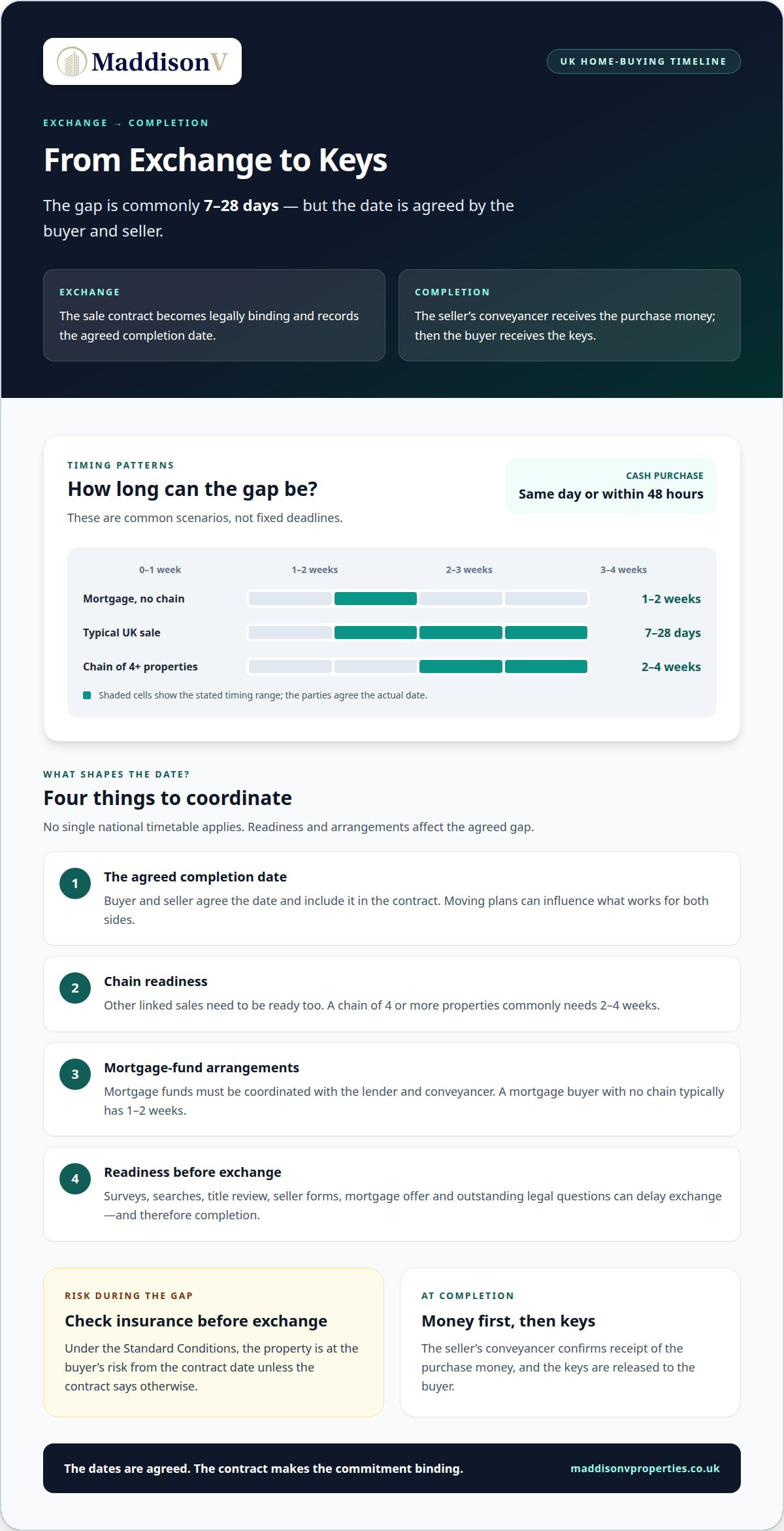
Typical gap between exchange and completion
In UK residential sales, exchange and completion usually sit 7 to 28 days apart, although the parties agree the dates. The questions about US state rules and US closing timescales concern a different system; this section explains the UK process.
Factors Affecting Closing Timelines
In England, the exchange-to-completion period depends on the agreed date, chain readiness and mortgage-fund arrangements, rather than a single national timetable. A mortgage buyer with no chain typically has 1 to 2 weeks; a chain of 4 or more properties commonly needs 2 to 4 weeks. The property type alone does not establish the period.
For a short chain of 2 to 3 properties, the typical gap is 2 weeks. If a seller needs an onward property, the gap may extend to 4 to 8 weeks. These examples show why a purchase involving several linked transfers can take longer: everyone in the chain needs to coordinate a completion date. Delays at one point can affect the other transactions.
The UK government’s buying guide describes the usual gap as around two to four weeks. This is a broad planning window, not a fixed legal deadline for every purchase. A week or two is also common in residential transactions. The agreed date, lender arrangements and each buyer’s and seller’s readiness determine what is workable.
Steps from Contract Signing to Closing
The typical UK sequence is to exchange contracts, use the agreed period to prepare, then complete on the contract date. This matters because the purchase becomes legally binding at exchange, while money and property transfer at completion. The buyer’s solicitor coordinates the transaction and the required funds.
- Exchange contracts. The buyer and seller become committed to the agreed terms and completion date.
- Prepare for completion. The parties arrange funds, moving plans and other practical details during the agreed gap.
- Complete the purchase. The seller’s conveyancer receives the money, and the buyer receives the keys.
For cash purchases, exchange and completion can occur on the same day; a UK cash sale can also complete within 48 hours of exchange. Mortgage purchases need time for the lender’s funds to be arranged. Most mortgage lenders need about seven days’ notice to release funds, so the buyer’s solicitor factors that lead time into the proposed date.
A gap longer than 4 weeks is rare in UK residential sales and usually arises when the seller needs more time for an onward purchase. Conversely, a short gap may suit a ready chain with aligned finances and moving arrangements. The exchange-to-completion period is therefore set by agreement, with the chain and funding schedule carrying particular weight.
Setting the completion date
The parties agree the completion date and record it in the contract before exchange. There is no fixed interval for every sale. The date needs to work for the buyer, seller and any linked transactions, with funds and moving arrangements aligned. Choosing a workable date gives everyone a clear point for completing the sale.
Where the Standard Conditions apply unchanged and the contract gives no completion date, completion is due twenty working days after the contract date. The parties can agree another interval between exchange and completion. The rules described set no maximum interval, so the date can reflect a buyer’s moving plans or a seller’s onward purchase.
Readiness is central to agreeing a date. All parties need to be ready, finances must be in place, everyone must have signed, and buyers and sellers in the chain must agree on the same date. If a chain includes several purchases, one party’s preferred date may not suit the others. The completion date is settled when these elements align.
- Confirm readiness: all parties have signed, and the required finances are in place.
- Align the chain: buyers and sellers agree on a shared completion date.
- Record the date: the agreed date appears in the contract exchanged by the parties.
The interval provides practical time between becoming contractually committed and completing the move. Buyers and sellers can pack, arrange removals, plan utility changes and finish legal or financial checks. For example, a buyer moving from one property while selling another needs dates that coordinate both transactions, rather than planning each completion in isolation.
If either party cannot complete on the agreed date, the other may serve a notice to complete under the Standard Conditions. The party served then has ten working days to complete, excluding the day the notice is given. Late completion can also trigger contract interest, typically 4% above the specified bank’s base rate under the Law Society’s Standard Conditions of Sale (6th Edition).
That notice period is no substitute for choosing a workable date. If mortgage funds, a chain or moving arrangements are not ready, completion may not happen on the agreed day. The exchange-to-completion period should reflect the sale’s actual requirements, with the date kept consistent across the chain.
In England and Wales, completion planning also means distinguishing an agreed date from a provisional moving plan. The contract date governs the parties’ obligations; removal bookings and utility arrangements support the practical move. Keeping those plans tied to the signed contract helps reduce avoidable disruption if a linked transaction affects the schedule.
The parties agree the timing; no universal interval applies. It depends on readiness, finances, moving plans and coordination across any chain. Under the unchanged Standard Conditions, if no date is specified, completion is due twenty working days after the contract date, although the parties can agree another interval.
Insurance and risk between exchange and completion
Under the Standard Conditions, the property is at the buyer’s risk from the contract date unless the contract says otherwise. This can place responsibility for an unexpected event before completion, making insurance timing a practical part of buying.
Insurance and Risk During the Gap
The risk period begins on the contract date, not when the buyer collects the keys. The contract may say otherwise, so its terms matter. Buyers should establish when their cover needs to begin and ensure it reflects the contract before exchange. This avoids assuming that the seller’s arrangements protect the buyer throughout the gap.
Consider a property damaged in an incident after exchange but before completion. Under the Standard Conditions, the buyer may already carry the risk, even though the seller remains in occupation. This difference between contractual risk and physical possession makes the gap significant. The buyer’s conveyancer can clarify how the contract treats risk and what insurance arrangements need to be in place.
Completion transfers the property to the buyer when the purchase money reaches the seller’s conveyancer. The buyer’s conveyancer or solicitor later registers the ownership at the Land Registry. Registration follows completion, while the contract’s allocation of risk can already apply from its contract date. These are distinct stages, not interchangeable milestones.
Reducing the Risk of Closing Delays
Completion can be delayed if funds, contract requirements or chain arrangements are not ready for the agreed date. Reduce this risk by aligning the mortgage drawdown, conveyancer’s transfer and moving plans in advance. Early coordination helps the buyer and seller identify a timing issue while there is still room to address it.
Mortgage funding needs advance coordination: most UK mortgage lenders need about seven days’ notice to release funds. A seller’s onward purchase or unfinished preparations can also disrupt a linked chain. Buyers and sellers can reduce avoidable delays by choosing a date that allows for lender notice, confirming completion funds with their conveyancers, and coordinating the move across the chain.
Before exchange, the buyer should understand the contract’s risk date and arrange insurance accordingly. The seller should be ready for the agreed handover, while the buyer’s conveyancer coordinates funds and completion requirements. A clear sequence reduces the chance that a late transfer or unready party interrupts completion. If completion is missed, the Standard Conditions allow a notice to complete, with ten working days to comply, excluding the day the notice is given.
For property owners planning beyond completion, explore property management options for ongoing oversight after the purchase.
MaddisonV Properties
MaddisonV Properties can help connect your purchase decisions with the practical needs of owning property. If you’re assessing a London investment, Property Sourcing can support your search, while Mortgage Consultations can help clarify financing considerations. Once you own a property, Property Management and Facilities Management can support its ongoing oversight. These services complement the legal and financial steps involved in agreeing exchange and completion dates, without replacing advice from your conveyancer.
Whether you’re planning a first purchase or considering how a property fits into a wider portfolio, the next step depends on your goals and the support you need. Contact MaddisonV Properties to discuss your property plans.
Plan beyond the handover
Completion is a milestone, not the end of your property decisions. Consider what you want the property to achieve after purchase: a home that supports a move, an investment aligned with wider financial goals, or an asset that fits into a growing portfolio. Defining its purpose early can make later decisions about oversight and upkeep more considered. For acquisitions involving extensive renovations or custom builds, consulting with Hodge Construction Management & Consulting can help owners navigate complex project oversight from the start.
Use your next planning conversation to connect the purchase with your longer-term priorities. Understanding the exchange of contracts to completion timeline gives you a framework for placing key decisions in context, while keeping the property’s intended role at the centre. This can help you approach ownership with a clearer sense of what matters after the transaction is complete.
If you’re ready to discuss how your property plans could take shape, speak with MaddisonV Properties. A thoughtful next step can help turn a carefully planned purchase into a confident beginning.
Frequently Asked Questions
What Time Does Exchange Happen?
Exchange takes place once the conveyancers confirm they can formally commit both parties to the contract. There is no set clock time for this process; practical timing depends on signed contracts, deposit arrangements and communication between conveyancers. If you’re coordinating removals or other appointments, treat exchange as a milestone to confirm with your conveyancer rather than assuming it will happen at a particular hour.
What is Completion?
Completion is the point when the seller’s conveyancer receives the purchase money and the property handover can proceed. UK residential completions commonly take place between 11am and 2pm. For a buyer, this means planning the key collection and move around confirmation that the funds have arrived, not simply around the time a bank transfer is initiated. The seller’s arrangements to vacate also need to align with the handover.
Can I pull out after exchange?
Pulling out after exchange can breach the binding contract and carry serious financial consequences. Under the standard terms described for an English purchase, a buyer who fails to complete could risk losing a 10 per cent deposit. If circumstances change, speak promptly with your conveyancer about the contract and available options. Simply deciding not to proceed doesn’t cancel the obligations both parties accepted at exchange.
Can the buyer pay more to bring completion forward?
Offering the seller more money does not, by itself, change the completion date in the contract. Bringing the date forward depends on agreement between the parties and practical readiness across the transaction, including the buyer’s funds and any linked sale or purchase. Discuss the proposed change with your conveyancer, who can coordinate with the seller’s side and clarify what needs to happen before an earlier handover.
Can the gap be extended?
The parties can agree to extend the period, but neither buyer nor seller should assume they can change the contractual date alone. Conveyancers need to coordinate the agreed change, especially if either transaction is part of a property chain. If a party cannot complete on the existing date, raising the issue early gives everyone a chance to discuss a revised arrangement before that date arrives.
Can the gap be shortened after exchange?
The parties may agree to bring completion forward, but an individual buyer cannot make that change unilaterally. The conveyancers need to coordinate the new date, and the buyer must have the purchase funds ready. A chain adds another consideration: linked buyers and sellers need to align their completion arrangements. Discuss the proposal promptly with your conveyancer so the necessary parties can consider the timing.
How Long Does It All Take?
The full purchase takes longer than the period after exchange. The UK government’s How to buy a home guide estimates approximately 12 weeks from an offer being accepted subject to contract through to moving in; it was last updated in September 2019. After exchange, the gap commonly falls between 7 and 28 days. Chains, funding arrangements and agreed moving dates shape the actual schedule.

Sign Up Now
Want to read more great articles and blogs subscribe to our newsletter