
Dubai’s off-plan property funds are held project by project, not pooled in a developer’s general account. Escrow accounts for Dubai property...

Dubai’s off-plan property funds are held project by project, not pooled in a developer’s general account. Escrow accounts for Dubai property development receive buyer payments under the agreed payment plan, with funds released for construction as milestones are completed. Dubai’s Law No. 8 of 2007 established the framework for these accounts, and approved banks and escrow trustees manage them.
It’s natural to focus on how an escrow account safeguards payments, but the institution overseeing it matters just as much. This guide explains how escrow accounts for Dubai property development work, how construction progress affects fund releases, which project expenses escrow funds may cover, and who can manage the accounts. You’ll also see how the system applies to off-plan purchases, from paying into the project account to the checks involved in releasing funds. Understanding these distinctions can clarify a development’s financial structure before you assess an investment.
Key Takeaways
- Each Dubai off-plan development uses a dedicated escrow account, keeping project funds separate from a developer’s other projects.
- Funds are released as construction progresses, with completed stages supported by certification from a qualified engineer.
- Escrow funds can cover eligible expenses for the relevant development, but they can’t be transferred to another project.
- Before paying for an off-plan property, make sure your payments go to the project’s designated escrow account under the agreed payment plan.
- Escrow accounts are managed by banks or financial institutions licensed by the UAE Central Bank and approved by RERA.
What is an Escrow Account?
An escrow account holds funds until the conditions of an arrangement are met. In Dubai real estate, it separates money for an off-plan development from the developer’s general funds. Dubai Land Department introduced Law No. 8 of 2007 to establish escrow accounts for off-plan projects. The account is specific to one development, so a developer with several projects must maintain a separate account for each one.
This separation ties buyers’ payments to the development named in the purchase agreement. Buyers pay into that project’s designated account according to the agreed payment plan. The account agreement and project details identify which development the funds support. The escrow structure keeps each development’s finances separate and prevents funds from one project being moved to another.
Opening an account and activating its disbursement mechanism are separate steps. A developer planning to sell units off-plan applies to the Department to open an account and submits project and business documents. To activate disbursements, the developer submits an official application through the Oqood portal. The trustee reviews the application and documents before the escrow account department approves or rejects it.
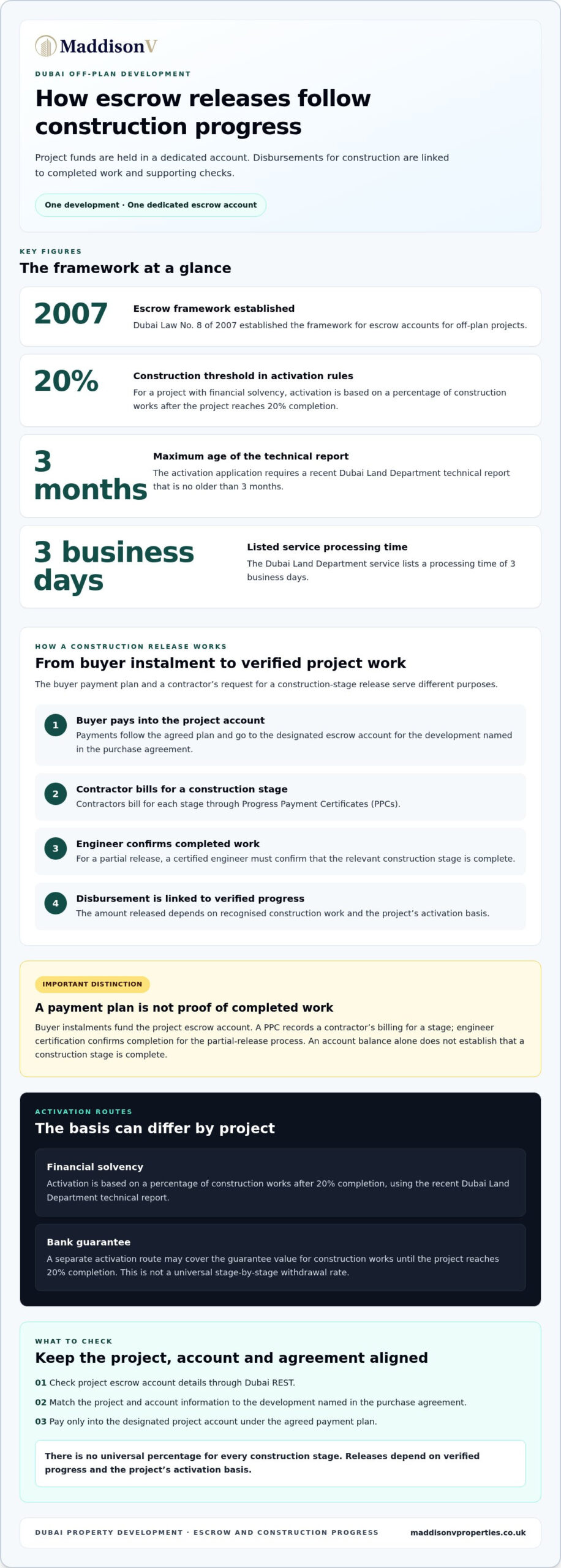
The activation application requires the project’s payment plan and a recent Dubai Land Department technical report. The report must be no older than 3 months. For a project with financial solvency, activation is based on a percentage of construction works after 20% completion, using that report. If the developer contributes funds, activation is limited to the amounts transferred from its special account into the escrow account. The Dubai Land Department service lists a processing time of 3 business days.
Buyers can check project escrow account details through Dubai REST. Match the project and account information to the development named in the purchase agreement, then pay only into the designated account. This links the payment to the correct project rather than relying solely on the developer’s payment instructions. The agreement should also refer to the escrow arrangement so the payment terms and account details align.
Real estate developers must be registered and licensed by the competent entities before conducting development business in Dubai. Specified real estate development offences can carry serious penalties. The penalty provision refers to Bylaw No. (85) of 2006 concerning the Real Estate Brokers Register. It does not mean every registration issue carries the same outcome.
Construction milestone-based fund releases
Dubai escrow disbursements follow construction milestones, with each release linked to completed project work. There is no universal percentage for every stage: the amount depends on verified construction progress and the project’s activation basis.
Releases Linked to Construction Progress
A construction milestone is a defined stage of work that supports a request for funds from the project’s escrow account. For buyers, this means payments are not simply available to the developer as unrestricted operating cash. Each disbursement for a construction stage must correspond to progress on the development named in the account.
Contractors bill for each construction stage through Progress Payment Certificates, known as PPCs. For a partial release, a certified engineer must confirm that the relevant stage is complete. This links the payment request to physical work on the project, rather than a general schedule or unrelated expense.
That distinction matters when assessing an off-plan purchase. A payment plan sets out when a buyer pays, while a PPC supports the contractor’s claim for completed work. These are related parts of the project’s financial structure, but serve different purposes: buyer instalments fund the account, and certified progress supports disbursement. An account balance alone does not establish that a construction stage is complete.
Financial Solvency and Stage Disbursements
Financial solvency is one basis for activating the disbursement mechanism, with activation tied to a percentage of construction works after the project reaches 20% completion. A recent Dubai Land Department technical report also informs this assessment. For the reader, this means activation and later stage releases depend on project progress, not simply the existence of an escrow account.
The permitted withdrawal amount follows the construction work recognised for the project. There is no single percentage for every construction stage, so don’t assume a fixed figure applies across developments. A certified engineer’s confirmation of completed work provides the basis for partial releases, while the activation basis determines how the disbursement mechanism applies.
Projects with a bank guarantee have a separate activation route: escrow activation may cover the guarantee value for construction works until the project reaches 20% completion. This is not a general stage-by-stage withdrawal rate. It describes the guarantee’s role in activation up to that construction threshold.
Keep three elements distinct when reviewing how funds move: the project’s activation basis, the completed construction stage, and the engineer’s confirmation supporting a partial release. A PPC records a contractor’s billing for a stage; the engineer’s certification confirms completion for the release process. Together, these checks link escrow disbursements to documented construction progress without implying that every project uses the same percentage schedule.
Permitted uses of escrow funds
Dubai project escrow funds are restricted to expenses connected with the development named on the account. They cannot be treated as the developer’s general cash reserve or redirected to another project. This project-specific boundary matters when a developer has several developments: money deposited for one cannot be moved to cover costs on another.
Eligible project expenses may include land, construction, consultancy, and approved sales and marketing costs. These categories must be considered alongside the restriction that escrow funds are used exclusively for construction of the relevant development. Escrow funds are generally intended for development-related costs, rather than unrelated expenses. A broad project budget alone does not make every listed cost payable from escrow.
The practical distinction is whether an expense relates to permitted development work or falls outside that purpose. Construction and project consultancy relate directly to delivering the development. General business overheads, costs for another site, and unrelated marketing do not become eligible simply because the same developer incurs them. Project documents and the escrow agreement help identify the development and the purpose of its funds.
Ownership, control, and buyer protection
Once funds are deposited, the depositor legally owns them, while control transfers to the escrow agent. This separates ownership from authority over withdrawals. Dubai project escrow funds also cannot be attached by the developer’s creditors or transferred to a different project. For an off-plan buyer, these safeguards keep the payment tied to its stated development rather than the developer’s wider finances.
If an emergency prevents a development from being completed, the escrow agent must consult the Department. The agent must then take measures to complete the project or refund depositors. This process links the response to project completion or repayment, rather than allowing the funds to be treated as unrestricted developer assets. The escrow arrangement therefore matters during construction and if delivery becomes impossible.
Retention after completion
Completion doesn’t release the entire escrow balance immediately. After the developer obtains the completion certificate, the escrow agent must retain 5% of the account’s total value. That retained amount is released to the developer one year from the registration of units in purchasers’ names.
For buyers, the timing is tied to two distinct milestones: the completion certificate and registration of units in purchasers’ names. The retention period runs from registration, not simply from the date construction finishes. Reviewing the project documents alongside the purchase agreement helps clarify how those milestones relate to the development and its escrow arrangement.
How escrow accounts work for off-plan properties
Dubai developers selling off-plan units must use escrow accounts, while each UAE emirate sets its own operating conditions. The rules for escrow accounts for Dubai property development therefore should not be assumed to apply in Abu Dhabi or elsewhere.
Rules for Off-Plan Escrow Accounts
Dubai’s framework connects off-plan sales with a designated project escrow account. Law No. 8 of 2007 established escrow accounts for off-plan projects, and Law No. 13 of 2017 requires accounts when off-plan properties are sold. These requirements apply to developers selling off-plan units in Dubai, rather than automatically applying to every property transaction.
Each emirate’s real estate regulatory authority sets its escrow account operating conditions. This matters when comparing a Dubai off-plan property with one in Abu Dhabi or another emirate: the Dubai process is not a UAE-wide template. Dubai developers apply to the Department with project and business documents to open an account through an approved bank and escrow trustee authorised by the Dubai Land Department.
Opening the account and activating disbursements are separate stages. The developer submits an official activation application through the Oqood portal. The trustee reviews the application and documents before the escrow account department approves or rejects it. This process establishes the disbursement mechanism for the specific project.
Buyer Payments and Due Diligence
Buyers pay into the development’s designated escrow account according to the agreed payment plan. For buyers, escrow accounts for Dubai property development tie payments to the named project, so check that the account details and purchase agreement identify the same development. Dubai REST can be used to check project escrow account details, and the agreement should refer to the escrow arrangement.
The Dubai Land Department’s escrow account activation service is free and has a processing time of 3 business days. That service charge is distinct from any separate account or banking costs. The available minimum funding basis depends on the activation route: developer contributions count only when transferred from the developer’s special account, while a mortgaging bank’s activation is limited to its deposited amount. A bank guarantee may support activation for construction works until the project reaches 20% completion.
There is no stated minimum balance that applies across every development and funding route. The application must include a project payment plan, and activation also depends on the applicable funding basis and project requirements. Buyers can compare the project’s account details with the purchase agreement to ensure payments go to the designated account, not elsewhere.
Approved institutions that can manage escrow accounts
A Dubai real estate escrow account is managed by an eligible institution, not simply any bank or financial business. The institution must meet two separate conditions: it must be licensed by the Central Bank of the UAE to receive third-party deposits and approved by RERA. Both conditions matter because licensing and real estate regulatory approval serve distinct roles in determining whether an institution can manage these project funds.
Two approvals, distinct responsibilities
The Central Bank of the UAE licence relates to receiving deposits belonging to third parties. RERA approval is the additional real estate regulatory requirement for managing a Dubai development escrow account. A bank’s general presence in the UAE does not mean it meets both conditions for this role. The standard concerns the institution’s authority to hold third-party funds and its approval within Dubai’s property framework.
Developers open real estate escrow accounts with approved banks and escrow trustees authorised by the Dubai Land Department. The developer, bank or trustee, and buyers each have a distinct role. The developer is responsible for the project and its application; the authorised institution manages the account; and buyers deposit payments for the development under its payment plan. This division separates project delivery from custody of the funds.
What the account manager controls
Control of deposited funds transfers to the escrow agent, while the depositor legally owns them. Dubai Islamic Bank states that developers have no operating or withdrawal rights over real estate escrow accounts. This distinction explains why a developer cannot treat an escrow balance like an ordinary business account. Account management follows the escrow arrangement, not unrestricted instructions from one party.
Escrow accounts for property development are subject to applicable regulatory requirements. In Dubai, the Dubai Land Department and RERA regulate these accounts. For a buyer, the practical takeaway is to distinguish the institution managing the account from the developer selling the property. A developer’s registration and project paperwork do not replace the manager’s licensing and approval requirements.
For example, a bank that can receive deposits but lacks RERA approval does not meet the stated two-part test. Likewise, RERA approval alone does not replace the Central Bank licence for third-party deposits. The bank or financial institution managing the account must satisfy both requirements. This is the key point when assessing who has authority over an off-plan project’s escrow funds.
Investors assessing an off-plan purchase can also consider how the property fits their wider portfolio. For guidance on identifying suitable opportunities, explore property sourcing support.
MaddisonV Properties: Property Management
MaddisonV Properties supports property owners with Property Management, helping oversee the ongoing responsibilities that follow an investment decision. Escrow governs how off-plan project funds are held and released; it does not manage a completed property or its day-to-day needs.
If you’re assessing a London investment, Property Sourcing can help you identify opportunities that fit your objectives. For owners who already hold property, Property Management and Facilities Management address different aspects of ongoing oversight. The right support depends on whether you’re choosing an investment, coordinating property operations, or managing a portfolio.
For guidance on property sourcing or management, visit maddisonvproperties.co.uk.
Plan your next property decision with clarity
Understanding escrow accounts for Dubai property development is one part of a considered investment decision. The next step is to connect the development’s financial structure with your wider objectives, including the type of property you want, how you plan to finance it, and the oversight you’ll need after purchase.
MaddisonV Properties supports different stages of that process through Property Sourcing, Mortgage Consultations, and Property Management. Whether you’re exploring an opportunity or planning how to manage an investment, a focused conversation can help clarify which support fits your priorities.
Contact MaddisonV Properties to discuss your project, and take your next property decision forward with confidence.
Frequently Asked Questions
What are the Dubai laws governing escrow accounts for property developers?
Dubai’s framework includes Law No. 8 of 2007, Law No. 13 of 2017, RERA, the Escrow Law, and subsequently issued regulations. Law No. 8 established escrow accounts for off-plan projects, while Law No. 13 requires accounts when off-plan properties are sold. Together, these rules govern project-specific accounts and their use. For a buyer, the key is to assess the account linked to the particular development and sale.
Which banks are approved to hold Dubai property development escrow accounts?
A bank or financial institution must be licensed by the Central Bank of the UAE to receive third-party deposits and approved by RERA. Dubai developers open accounts with approved banks and escrow trustees authorised by the Dubai Land Department. Rather than relying on a bank’s name alone, consider whether the institution meets both conditions and whether the account details match the development named in your purchase documents.
How are buyer payments deposited into and released from a Dubai project escrow account?
Buyers deposit payments into the project’s designated account according to the agreed payment plan. Contractors submit Progress Payment Certificates for construction stages, and a certified engineer confirms completed work for partial releases. For example, an instalment in a purchase plan does not itself certify construction progress. The payment schedule and the evidence supporting a construction disbursement serve different purposes in the project’s financial process.
How can buyers verify a Dubai project’s escrow account and registration with the Dubai Land Department?
Use Dubai REST to check the project’s escrow account details, then compare the project identity with your purchase agreement. The agreement should refer to the escrow arrangement, and payments should go to the account designated for that development. Separately, Dubai real estate developers must be registered and licensed by competent entities before conducting development business. These checks help link the seller, project, account, and payment records.
What happens to escrow funds if a Dubai property development is delayed, canceled, or the developer becomes insolvent?
Dubai escrow regulations provide for buyers’ funds to be recovered under RERA rules in cases involving serious delays, cancellation, or developer bankruptcy. If an emergency prevents project completion, the escrow agent must consult the Department and take measures to complete the development or refund depositors. The response depends on the project’s circumstances and the applicable RERA process, rather than guaranteeing an automatic refund for any delay.
How do Dubai escrow rules compare with Abu Dhabi and other UAE emirates?
Dubai escrow accounts are regulated by the Dubai Land Department and RERA; escrow operating conditions in other UAE emirates are set by their respective real estate regulatory authorities.
What percentage of project funds can a Dubai developer withdraw at each construction stage?
There is no universal percentage for each construction stage. Releases are tied to verified construction progress, with a certified engineer confirming completed work.

Sign Up Now
Want to read more great articles and blogs subscribe to our newsletter