
Viewing energy performance as an administrative hurdle is the fastest way to erode prime property value. When evaluating the EPC rating requirements...

Viewing energy performance as an administrative hurdle is the fastest way to erode prime property value. When evaluating the EPC rating requirements for landlords 2026, the legal standard remains Band E under existing Minimum Energy Efficiency Standards, backed by penalties reaching £5,000 for unlettable units. You are likely all too familiar with the frustration caused by shifting policy deadlines and the evolving Warm Homes Plan, both of which leave discerning owners wondering where present compliance ends and sensible capital allocation begins.
Safeguarding your returns requires absolute clarity rather than guesswork. With the government confirming a mandatory shift to EPC Band C by October 2030, non-compliance fines will rise steeply to £30,000 per property alongside a confirmed £10,000 cost cap. This guide clarifies your legal baseline for 2026 while mapping upcoming statutory obligations, offering a structured framework to protect your equity, avoid unnecessary void periods, and maintain seamless, hands-off compliance across your entire portfolio.
Key Takeaways
- Understand the precise EPC rating requirements for landlords 2026, clarifying the binding Band E baseline while preparing for the 2030 statutory shift to Band C.
- Discover how recent RdSAP 10 assessment standards alter carbon calculations, rewarding electrical heating efficiency and fabric-first improvements.
- Learn how statutory expenditure caps and the PRS Exemptions Register protect your yields from disproportionate retrofit expenses.
- Explore a structured capital expenditure roadmap designed to systematically upgrade period properties while preserving architectural integrity.
- See how integrated portfolio management and strategic acquisitions insulate your prime residential investments from regulatory risk and prolonged void periods.
The 2026 Legal Baseline: Current MEES Regulations vs Proposed 2030 Targets
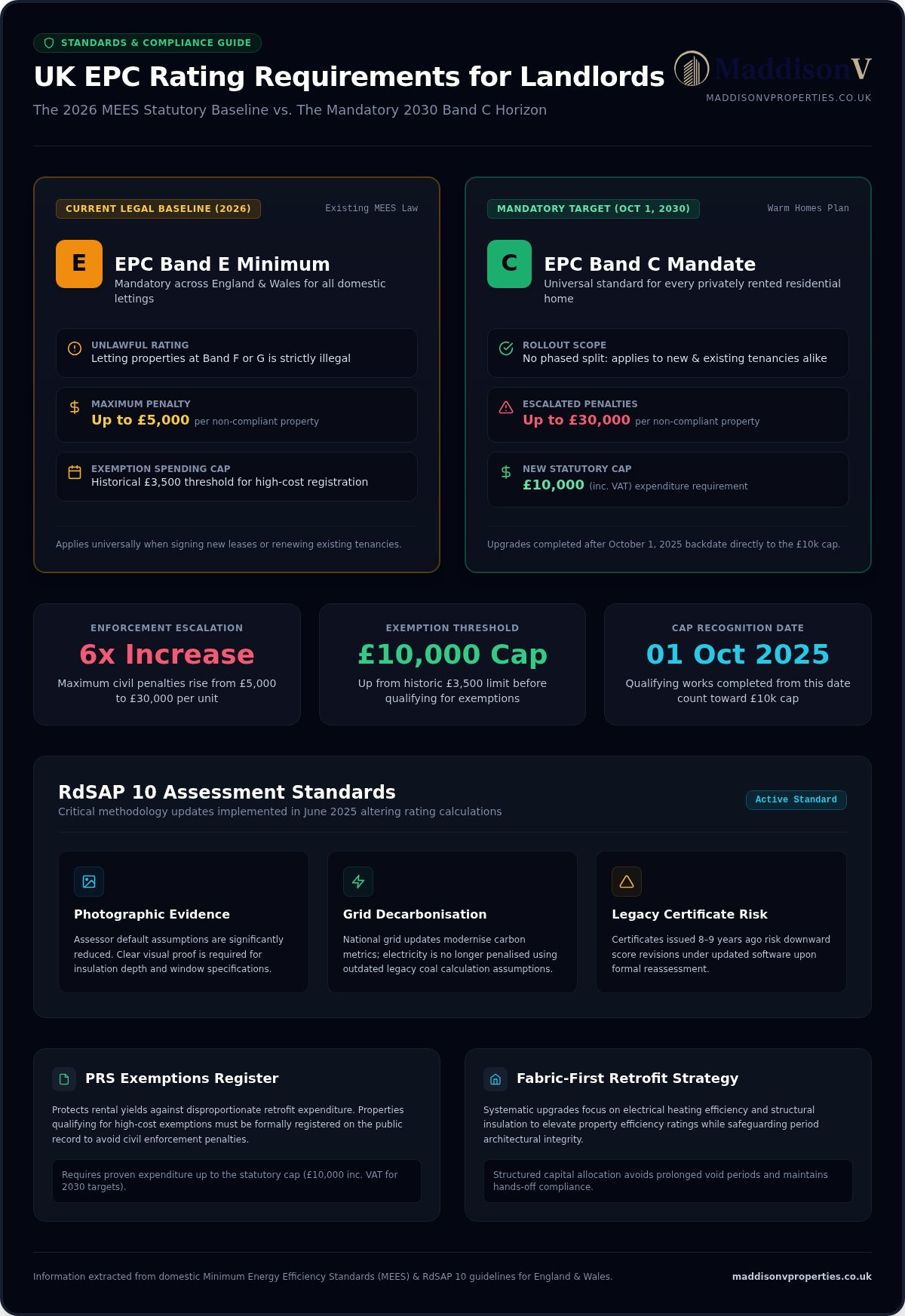
Under current Minimum Energy Efficiency Standards (MEES), the legal baseline requires every domestic private rented property across England and Wales to hold an EPC rating of Band E or higher. Despite significant public discourse surrounding energy transition, the statutory EPC rating requirements for landlords 2026 do not mandate an immediate leap to Band C. Today, letting or continuing to let a residential asset assessed at Band F or G remains unlawful, exposing non-compliant landlords to civil penalties reaching £5,000 per property unless an active exemption sits on the public register.
A comprehensive understanding of the Energy Performance Certificate (United Kingdom) framework allows property owners to distinguish between binding legislation and forward-looking policy. This distinction preserves capital while ensuring tenancies remain continuous, fully lawful, and protected from local authority enforcement.
To better understand how these shifting standards influence portfolio operations, watch this concise breakdown:
Current Statutory Requirements Under Existing MEES Law
The operational standard for 2026 applies universally across the private rented sector. Whether signing a tenancy with a new occupant or maintaining a multi-year agreement, your property must hold a valid Band E rating. Marketing an underperforming home without an officially registered exemption creates immediate legal friction, leaving the asset vulnerable to local council enforcement notices, rent repayment complications, and unwelcome tenant disputes.
The Warm Homes Plan and the Route to EPC Band C
While Band E anchors the present, policy changes under the government’s Warm Homes Plan establish a strict horizon. By October 1, 2030, all privately rented homes must achieve EPC Band C. Ministers have removed the phased rollout between new and existing tenancies, meaning the 2030 deadline applies universally across every rental home.
Preparing for this transition demands disciplined financial forecasting. Key structural changes include:
- Stricter Enforcement Penalties: Maximum local authority fines will escalate from £5,000 to £30,000 per non-compliant property after October 2030.
- Updated Financial Caps: Landlords will be required to invest up to £10,000 inclusive of VAT per property before qualifying for high-cost exemptions, replacing the historical £3,500 threshold.
- Backdated Capital Recognition: Qualifying energy efficiency upgrades completed after October 1, 2025, count directly towards this £10,000 expenditure requirement.
Understanding these thresholds ensures your long-term capital expenditure directly elevates market appeal rather than reacting to sudden statutory deadlines.
Evaluating Property Portfolios Under RdSAP 10 Energy Assessments
Understanding statutory standards means little if you misjudge how assessments measure real efficiency. Introduced in June 2025, the RdSAP 10 methodology fundamentally alters how assessors evaluate domestic dwellings across England and Wales. When considering the EPC rating requirements for landlords 2026, resting on the laurels of a certificate issued eight or nine years ago creates hidden exposure. Reassessment under updated software often shifts scores downward, surprising landlords who assumed their historical paperwork remained bulletproof against official standards like the Current MEES Regulations for Landlords.
Understanding the Mechanics of RdSAP 10
RdSAP 10 removes much of the guesswork from energy modelling. Earlier versions relied heavily on broad regional defaults whenever an assessor could not visually confirm insulation depths or window specifications. Today, assessors must capture comprehensive photographic evidence, reducing default assumptions that artificially lifted legacy ratings.
At the same time, national grid decarbonisation reshapes fuel cost calculations. Electricity is no longer penalised using outdated coal metrics; instead, modern calculations treat direct electric heating, heat pumps, and solar microgeneration far more generously. Looking ahead to late 2027, the government plans to introduce the Home Energy Model (HEM) to evaluate smart readiness and fabric performance across separate metrics. A home comfortably sitting at Band C under older algorithms might slip under stricter RdSAP 10 criteria.
Period Architecture vs Modern Luxury Developments
The divergence between historical assets and prime new developments has never been wider. Prime central London enclaves, such as Chelsea, Kensington, and Marylebone, are defined by exquisite Georgian townhouses and Victorian mansion blocks. Yet these heritage properties carry distinct operational challenges:
- Uninsulated Solid Walls: 220mm solid brickwork lacks cavity space, demanding internal dry-lining that reduces floor space or external cladding that alters protected streetscapes.
- Conservation and Listed Status: Article 4 directions and Grade II listings frequently bar vacuum double glazing or external heat pump condensers.
- Communal Heating Complexities: Redesigning heating layouts in classic red-brick mansion blocks requires complicated freeholder consents and shared plant infrastructure.
By contrast, prime new builds are constructed from inception to satisfy strict building regulations, routinely achieving high-efficiency ratings with minimal landlord intervention. For international and domestic investors balancing portfolio yields, reviewing prime real estate in england london highlights the growing premium commanded by turn-key, future-proof assets. To protect capital yields across both period conversions and luxury stock, partnering with specialists in bespoke portfolio management ensures every holding meets changing statutory thresholds effortlessly.
Financial Thresholds, Exemption Registers, and Mortgage Implications
Maintaining regulatory alignment is fundamentally about balance sheet protection. Under current MEES rules, landlords who cannot economically elevate a substandard asset to Band E are protected by a £3,500 cost cap (inclusive of VAT). When evaluating the EPC rating requirements for landlords 2026, registering a formal exemption shields you from statutory penalties while keeping your property fully lettable. However, an exemption is never automatic; it requires verifiable evidence submitted directly to the PRS Exemptions Register.
Qualifying for Statutory PRS Exemptions
Research from the National Residential Landlords Association revealed that 28% of landlords were unaware that statutory EPC exemptions existed. As of March 2026, just over 10,000 domestic and non-domestic exemptions were registered. For prime residential portfolios, three primary grounds provide statutory relief:
- High-Cost Threshold: Applicable when the cheapest recommended package of efficiency measures exceeds the statutory spending limit, verified by three independent installer quotations.
- Third-Party Consent Barriers: Crucial for leasehold apartments and conservation dwellings when freeholders, planning departments, or sitting tenants refuse permission for necessary retrofits.
- Devaluation Protections: Granted when an independent RICS surveyor certifies that specific thermal installations would reduce the overall market value of the property by more than 5%.
Registered exemptions remain legally binding for five years. They do not transfer to a purchaser upon sale, meaning prospective buyers must reassess compliance independently upon acquisition.
Lending Criteria and Institutional Green Mortgages
Beyond statutory adherence, energy ratings now dictate borrowing efficiency. Institutional buy-to-let lenders evaluate low-rated collateral with heightened scrutiny. Assets holding Band D or E ratings increasingly face tighter interest coverage ratios, lower loan-to-value limits, and punitive arrangement fees from risk-conscious underwriting committees.
Conversely, residential units achieving EPC Band C or higher unlock preferential borrowing terms through competitive green mortgage products. Major domestic lenders actively discount interest margins by 20 to 50 basis points for verified energy-efficient stock. Institutional debt funds view energy-resilient assets as liquid, stable, and lower-risk, whereas low-efficiency stock suffers a measurable valuation discount. Complying with evolving EPC rating requirements for landlords 2026 therefore acts as direct yield defence, lowering your long-term cost of debt and ensuring your assets remain attractive to institutional buyers.
Strategic Retrofit Roadmap: Upgrading Rental Property to Band C
Achieving top-tier energy metrics without eroding net yield requires disciplined execution rather than reactive spending. With government projections estimating the average upgrade to Band C between £5,400 and £7,000, haphazard improvements quickly squander capital. Aligning your assets with the EPC rating requirements for landlords 2026 demands a phased, fabric-first approach. Intrusive works belong squarely within planned tenancy transitions, ensuring high-value occupants experience uninterrupted comfort while your investment steadily gains structural value.
Internal wall insulation paired with breathable aerogel linings represents the single most effective thermal intervention for historic solid-wall residences.
Phase 1: Fabric-First Thermal Upgrades
Heat retention forms the indispensable foundation of any upgrade project before modifying mechanical equipment. Prioritising the external building envelope prevents newly installed heating systems from compensating for structural heat loss. Focus initial capital on non-invasive structural enhancements:
- Loft and Pitch Insulation: Mineral wool or rigid wood-fibre boards laid to a minimum depth of 270mm dramatically reduce roofline heat loss.
- Acoustic and Slimline Glazing: Vacuum-insulated architectural double glazing or discreet internal secondary glazing maintains external sash window aesthetics in conservation areas.
- Architectural Draught Proofing: Precision brush seals around historical casements, skirtings, and decorative cornicing eliminate uncontrolled ventilation.
Phase 2: Modernisation of Heating, Lighting, and Controls
Once the envelope retains ambient heat, attention shifts to mechanical efficiency. Modern condensing units or compact air-source systems lower primary energy demands substantially. Pair heat generators with smart thermostatic radiator valves (TRVs) to allow room-by-room zoning. Full architectural LED conversions throughout residential living spaces and communal stairwells finish this stage, securing vital fractional points under current RdSAP 10 calculations.
Phase 3: Renewable Integration and Microgeneration
Where roof ownership and orientation permit, rooftop solar photovoltaic arrays paired with modular battery storage deliver exceptional energy performance. These active systems capture and retain peak generation, protecting residents from volatile electricity tariffs while securing compliant RdSAP metrics. Any qualifying capital deployed now positions your balance sheet well ahead of future statutory changes, avoiding emergency contractor premiums as broader industry deadlines approach.
Commissioning an accredited assessor upon completion provides an updated certificate verifying Band C status, locking in compliance well before October 2029 transitional cut-offs. For an effortless, turn-key approach to structural renovations and contractor supervision, engage our integrated facilities management specialists to oversee your entire retrofit program without operational friction.
Safeguarding Asset Value: Professional Management and Smart Acquisitions
Treating energy standards as a passive compliance exercise creates balance sheet exposure. Instead, forward-thinking investors view ongoing regulatory shifts as an opportunity to sharpen asset quality, streamline tenant retention, and insulate their holdings from costly administrative oversights. When managing the EPC rating requirements for landlords 2026, outsourcing operational complexities transforms statutory compliance into a durable competitive advantage.
Effortless Compliance Through Dedicated Management
Navigating changing tenancy legislation, contractor coordination, and local authority reporting demands continuous vigilance. High-net-worth property owners often lack the time or inclination to oversee technical assessments or arbitrate disputes over energy certificates. Experienced asset directors eliminate this friction by proactively scheduling assessor visits, commissioning accredited trades, and keeping documentation meticulously filed.
By scheduling non-disruptive fabric interventions strictly during natural tenancy turnovers, operational teams eliminate expensive void periods. Partnering with seasoned professionals in bespoke property management provides the ultimate safeguard against compliance missteps, delivering consistent rental yield alongside complete mental tranquility.
Aligning Acquisition Strategies with Modern Environmental Standards
Capital preservation increasingly relies on smart portfolio rebalancing. Rather than continually absorbing the structural retrofit liabilities of uninsulated period stock, astute investors are systematically shifting their capital profiles. Modern portfolio design pairs heritage holdings with modern developments inherently protected from costly environmental upgrades.
To execute this strategy successfully, many clients engage elite property sourcing agents London to pinpoint prime residences that already deliver superior efficiency metrics. Simultaneously, directing capital into premium off-plan property investment unlocks turnkey assets constructed to contemporary Band B or Band A building codes. These newly completed properties eliminate retrofit capital expenditure entirely, ensuring compliance with future standards well beyond the current EPC rating requirements for landlords 2026. Through thoughtful sourcing and seamless operational management, property owners can protect their capital, enhance overall liquidity, and enjoy totally effortless property ownership.
Future-Proofing Your Prime Portfolio Beyond 2026
Navigating the EPC rating requirements for landlords 2026 is no longer about isolated checklist compliance; it’s a strategic imperative that dictates lending terms, tenant retention, and capital liquidity. While the statutory baseline holds firm at Band E today, the definitive pathway toward mandatory Band C by 2030 rewards investors who act with measured foresight. Implementing structured, fabric-first retrofits and rebalancing holdings toward energy-efficient stock preserves equity while eliminating unexpected regulatory exposure.
True asset protection demands meticulous execution and uncompromising operational standards. Drawing on boutique Mayfair and Chelsea advisory expertise, our team provides comprehensive portfolio oversight across prime sourcing, luxury lettings, and proactive facilities management. We ensure your properties remain fully compliant, highly marketable, and completely insulated from unnecessary void periods. Entrust your prime portfolio to MaddisonV Properties for effortless compliance and management, and secure your long-term rental yields with complete peace of mind.
Frequently Asked Questions
What is the legal minimum EPC rating for landlords in England and Wales in 2026?
The legal minimum rating remains EPC Band E across England and Wales. Under the binding EPC rating requirements for landlords 2026, granting a new tenancy or continuing an existing lease on a Band F or G asset is unlawful without a registered exemption. While future revisions will target higher thresholds, Band E remains the current statutory standard under existing MEES legislation.
Will the EPC Band C requirement become legally mandatory for rental properties by 2030?
Yes, the UK government has confirmed that private rented homes in England and Wales must reach EPC Band C by October 1, 2030. Ministers scrapped previous plans for a phased rollout between new and continuing tenancies. Consequently, all tenancies must meet Band C or secure a valid exemption by that single deadline to remain fully compliant and avoid substantial penalties.
What are the financial penalties if a landlord lets a property below EPC Band E in 2026?
Local authorities can levy civil financial penalties of up to £5,000 per breach for renting out a substandard domestic property. In addition to direct monetary fines, councils can publish enforcement details on the public register, causing reputational damage. Breaching these standards can also complicate possession proceedings and result in rent repayment orders if tenants challenge the legality of their occupation.
Can a landlord let a listed building or conservation area property with an EPC rating below E?
Only if the property holds a registered exemption or is officially exempt from requiring an EPC altogether. Historic or listed homes aren’t automatically exempt. If compliance works would unacceptably alter the building’s character, or if local conservation officers deny planning consent, the landlord must officially register an exemption on the PRS Exemptions Register before lawfully letting the residence to tenants.
How much money does a landlord have to spend before qualifying for a high-cost EPC exemption?
Under current 2026 MEES rules, the statutory spending cap is £3,500 inclusive of VAT. If all recommended energy efficiency upgrades exceed this figure, you can register a five-year high-cost exemption. Looking ahead to the 2030 Band C rollout, the government has confirmed this cap will rise to £10,000, with qualifying expenditure made since October 2025 counting towards the total.
Does the new RdSAP 10 assessment method lower my existing property energy rating?
It can reduce your score if your property previously relied on default assumptions rather than verified thermal performance. Introduced in June 2025, RdSAP 10 mandates strict photographic evidence and refines carbon metrics. While it favours heat pumps and electrical heating due to grid decarbonisation, uninsulated solid walls and older boilers assessed under the new methodology may receive lower efficiency points.
Can buy-to-let mortgage providers reject a financing application based on an EPC rating?
Yes, mortgage lenders regularly decline applications or impose restrictive covenants on properties that fail to satisfy current EPC rating requirements for landlords 2026. Institutional underwriters now view sub-standard energy performance as collateral risk. Submitting an application for an unexempt Band F or G home often leads to immediate rejection, while low-rated D and E assets face stricter stress tests.

Sign Up Now
Want to read more great articles and blogs subscribe to our newsletter