
A new tenant in England must receive the latest electrical report before moving in. If it identifies required remedial work or further investigation,...

A new tenant in England must receive the latest electrical report before moving in. If it identifies required remedial work or further investigation, the landlord must arrange it within 28 days, or sooner if the report sets a shorter deadline. For a new property, an electrical safety certificate for a rental property may be an Electrical Installation Certificate issued at construction, which is typically valid for five years; otherwise, an EICR is needed.
It’s understandable to want a clear answer before setting a move-in date, especially when an inspection report flags work that needs attention. The key is to distinguish the report’s overall result from the action required for each finding. This guide explains what an EICR checks, how its codes affect remedial work, and what landlords must provide to tenants and local authorities. It also explains how electrical paperwork differs for new-build homes, helping you plan an orderly, safe and properly documented handover.
Key Takeaways
- Understand how often rental property wiring needs inspection and what can shorten the interval.
- Learn what EICR codes C1, C2, C3 and FI mean for safety findings and remedial work.
- See how report findings affect move-in decisions and the deadlines for completing required action.
- Know when tenants and local authorities must receive the report and evidence that work is complete.
- Distinguish an Electrical Installation Certificate for a new home from an EICR used to assess an existing installation.
What Electrical Safety Checks Are Involved?
In England, an inspection assesses the condition of a rented home’s electrical installation and records the findings in an EICR. The inspection interval and report deadlines help landlords plan checks before a tenancy begins and while tenants occupy the property.
For rental properties in the United States, electrical certificate requirements depend on state and local rules. The England-specific guidance below does not replace the requirements that apply to a US property’s location.
This England-focused guide does not set out a single nationwide US rental certificate requirement. Federal, state and local rules may all be relevant, so the property’s jurisdiction determines which inspection or documentation duties apply.
In England, the landlord is responsible for arranging the required inspection and any necessary remedial work. Tenants can report electrical concerns, but the landlord must ensure the installation is inspected and required action is completed.
Arrange an inspection with a qualified, competent person, have the electrical installation examined and tested, then receive and retain the EICR. If the report requires work or further investigation, the landlord must arrange it within the stated deadline.
Inspection Frequency and Timing
An inspection checks whether a rental property’s electrical installation meets the applicable safety requirements at the time of testing. According to UK Government, legislation.gov.uk, landlords in England must have rental-property electrical installations inspected and tested by a qualified person at intervals of no more than 5 years, or sooner if the latest report requires it.
Timing also matters at the start of a tenancy: England’s rules applied to new tenancies from July 2020 and to all existing tenancies from 1 April 2021. Landlords must give a new tenant the most recent EICR before the tenant occupies the premises. This makes the report part of a properly prepared tenancy, rather than paperwork to arrange after move-in.
UK Rental Inspections and EICRs
An Electrical Installation Condition Report, or EICR, records the inspection and testing of a rented property’s electrical installation. It documents observations and whether the installation is satisfactory, giving landlords and tenants a clear account of its inspected condition.
The report’s validity generally runs for 5 years in England, unless the inspector specifies a shorter period. A shorter recommended interval means the next inspection should be planned earlier. Landlords should keep the report and use its findings to determine whether remedial work or further investigation is needed.
Qualification matters because the inspector must be qualified and competent to carry out the EICR. The research identifies City & Guilds 2391 inspection-and-testing, or an equivalent qualification, as a relevant credential. A suitably qualified inspector tests the installation and documents findings; the report then guides the landlord’s next actions.
An EICR completed before a new tenancy can show whether the installation is satisfactory and provide the report the tenant needs before moving in. During an existing tenancy, the landlord uses the inspection schedule and any shorter interval stated in the latest report to plan the next check. This keeps inspection dates and tenancy records aligned.
Can a tenant move in if remedial work is needed?
An EICR finding can affect a move-in decision: some codes make the report unsatisfactory and require follow-up. The code, recorded risk and report deadline help determine the landlord’s next steps.
EICR Defect Classifications
EICR classifications describe the seriousness of an observation and whether action is needed. They matter because the codes determine the report’s outcome, not simply the fact that an inspection took place.
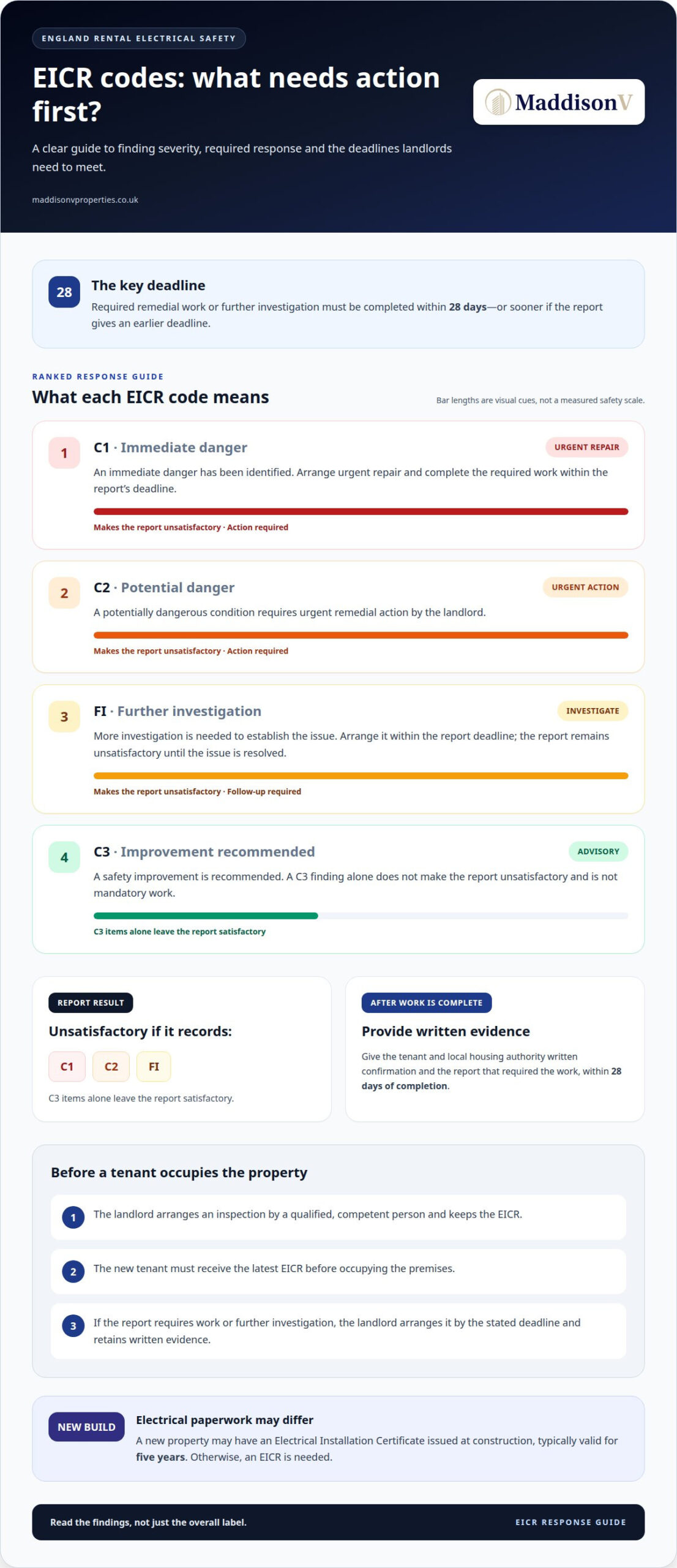
C1 means immediate danger requiring urgent repair. C2 identifies potential danger requiring urgent remedial action. C3 recommends a safety improvement, but a C3 finding alone isn’t mandatory work. FI means further investigation is required, and the report remains unsatisfactory until the issue is resolved.
Result Codes and Repair Actions
A report is unsatisfactory if it records C1, C2 or FI findings; C3 items alone leave it satisfactory. The result helps the landlord identify whether the report calls for urgent repair, remedial work or further investigation.
For example, a C2 observation signals a potentially dangerous condition requiring urgent remedial action. An FI code means the inspector needs further investigation to establish the issue. The landlord must arrange the required work or investigation and retain written evidence of the outcome.
For a prospective tenant, an unsatisfactory report does not mean the installation has passed. The landlord must meet the relevant safety duties and provide the latest report before occupation. An electrical safety certificate for rental property should be read alongside its findings, not treated as a simple pass label.
Repair Deadlines for EICR Faults
In England, landlords must complete required remedial work or further investigation within 28 days, or sooner if the report specifies a shorter period. Repairs or checks for C1, C2 or FI findings must be completed within 4 weeks or sooner.
The report’s own deadline matters: if it sets an earlier date, that shorter timeframe applies. After work is complete, written confirmation and the report that required the work must be provided to the tenant and local housing authority within 28 days of completion.
An EICR assesses and records the condition of a property’s electrical installation. Its observations, codes and overall result guide the next steps; the report does not prove that every issue has been repaired. Tenants already living in the home have the right to stay while electrical safety work takes place.
The cost of an EICR depends on the property’s size, condition, complexity and work involved; the price is provided after a quote request. Inspection and testing are separate from remedial work, which may need to be arranged independently. Landlords should distinguish the report from any repairs required to address its findings.
Before agreeing a move-in date, read the report’s result and any required follow-up carefully. An electrical safety certificate for rental property is useful only when you consider its findings, necessary actions and completion records together.
Electrical Installation Condition Reports (EICRs)
An EICR records the inspection and testing of a property’s electrical installation. Its findings describe the installation’s condition, any concerns identified and whether further action is needed.
What an EICR Covers
An Electrical Installation Condition Report documents the condition of electrical installations when they are inspected and tested. It gives landlords a written record to support safety decisions and show tenants what the inspection found.
The report describes observations using condition codes, then records an overall outcome. This distinction matters: a completed inspection doesn’t automatically mean the installation is satisfactory. For example, an EICR with a C3 observation alone is satisfactory, while a C1, C2 or FI finding makes it unsatisfactory.
Keep the report with the property’s tenancy records. If a later inspection identifies a concern, the earlier report helps document the installation’s history and clarify which findings need attention. It also gives tenants a specific document to refer to, rather than relying on a general statement that the electrics were checked.
Condition Codes and Report Outcomes
Condition codes classify observations according to the action indicated by the report. C1 identifies immediate danger, C2 potential danger, C3 a recommended improvement, and FI a need for further investigation.
The final status depends on the codes recorded, not on how many observations appear. C1, C2 or FI results mean the report is unsatisfactory; C3 items alone leave it satisfactory. An FI finding still needs attention because the inspection hasn’t established whether a potentially serious concern exists. The landlord should use the code and written observation to determine the required follow-up.
Report Delivery Timing
Report deadlines depend on who needs the EICR and why. A new tenant must receive the most recent report before occupying the premises, so have it ready for the tenancy handover.
For an existing tenant, the landlord must provide a copy within 28 days of the inspection and test. If a prospective tenant makes a written request, they must receive the latest EICR within 28 days. A local housing authority that makes a written request must receive it within 7 days. Keep a record of when each copy is sent.
Report Renewal Periods
In England, a report is generally valid for 5 years unless the inspector specifies a shorter period. The next inspection date should therefore follow the report’s stated recommendation, rather than relying only on a standard renewal cycle.
If an EICR calls for an earlier check, that shorter interval determines when the installation should be inspected again. Landlords can use the report date and recommended inspection date to maintain a clear schedule and avoid mistaking an older report for current evidence of the installation’s condition.
Certificate delivery and local authority deadlines
In England, landlords must manage report delivery, follow-up work and inspection dates as separate duties. Keeping a clear record of each step links the test results with tenant communications and any requests from housing authorities.
A new tenant must receive the most recent EICR before occupying the property. Existing tenants must receive a copy within 28 days of the inspection and test. If a prospective tenant makes a written request, the landlord must provide the latest report within 28 days. These are distinct deadlines, so keeping a copy ready for the tenancy handover matters.
Local authorities have their own request deadline. A landlord must provide the EICR within 7 days of receiving the authority’s written request. Keep a dated record of when the request arrived and when the report was sent. That simple record helps demonstrate whether the authority’s deadline was met.
Required remedial work or further investigation must be completed within 28 days, or sooner if the report specifies a shorter period. Once the work is complete, the landlord must provide tenants and the local housing authority with written confirmation and the report requiring the work within 28 days of completion. This creates a documented link between the finding and its resolution.
The possible financial penalty has changed. Breaches of electrical safety duties can have financial consequences for landlords. Timely delivery and completion records help show how the landlord addressed each obligation; sending the report alone doesn’t complete required repairs.
Inspection timing also affects the paperwork cycle. Landlords must arrange inspections at intervals of no more than 5 years, or sooner if the latest report requires it. The report’s recommended date may therefore set an earlier testing point. A landlord should retain the current report and its follow-up records together, so an authority request can be answered with the relevant evidence.
An EICR concerns the property’s electrical installation. It is separate from an inspection of portable appliances: private landlords in England are not required under these rules to check portable electrical appliances. Social landlords who provide electrical equipment have a separate testing duty. Keep records clear about installation findings, required repairs and equipment testing where applicable.
For example, if an EICR identifies an issue requiring further investigation, the landlord must track both the investigation deadline and the later reporting duty. If the housing authority requests the report during that period, its 7-day response deadline still applies. Organised records make these concurrent obligations easier to manage.
Electrical certificates for new properties
A newly built rental home may already have electrical paperwork from construction, but the document matters. In England, a new property needs an EICR unless it has an Electrical Installation Certificate issued at construction, typically valid for five years.
The distinction is practical: an Electrical Installation Certificate records the installation when work is completed, while an EICR assesses its condition later. For a landlord preparing a new build for the private rented sector, the construction certificate can serve as relevant evidence during its stated period. If no certificate was issued, or its validity has ended, an EICR is needed.
Keep the original certificate with the property’s handover and tenancy records. It should relate to the specific electrical installation, rather than simply describe the property as new. A well-organised file helps establish which document supports the safety record and when another inspection is due.
England’s rented properties must meet the minimum electrical safety standards in the current edition of the BS 7671 Wiring Regulations. That requirement concerns the safety of the electrical installation, not the age or appearance of the home. New wiring doesn’t remove the need for appropriate evidence: the construction certificate or subsequent EICR documents the relevant assessment.
For example, a landlord receives a new apartment with an Electrical Installation Certificate issued at construction. They can retain it as the installation record, then plan an EICR when the certificate’s five-year validity ends, unless an earlier inspection is required. If the handover file contains no such certificate, an EICR is needed instead.
Before tenants move in, identify which document applies, retain a copy and provide the most recent EICR where required. A new build is not automatically exempt just because its wiring is recent. The exception depends on having the construction certificate, not simply on the property being newly built.
Registered electrical work and inspection records serve different purposes. A construction certificate evidences the installation at completion; an EICR reports the condition found during inspection and testing. Neither document proves that later repairs have been completed unless the relevant work is documented.
When reviewing a new property’s paperwork, match the certificate to the home, note its issue date and record the next inspection date. If the certificate is missing or the five-year period has passed, arrange an EICR before relying on the old handover file. This distinction helps landlords meet electrical safety standards in England’s private rented sector.
For landlords coordinating a new-home handover and ongoing tenancy records, property management support can help keep property responsibilities organised.
MaddisonV Properties: Property Management
MaddisonV Properties provides Property Management for owners who want a more organised approach to rental responsibilities. Electrical reports, follow-up work and tenant communications are among the wider demands of owning a rental property. Property Management can help owners oversee these responsibilities alongside the practical needs of an ongoing tenancy.
Property Management may be a natural next step if you’re preparing a property for tenants, coordinating its ongoing management or balancing several investment priorities. If you’re still assessing your next purchase, Property Sourcing can support your search for a suitable property. The right support depends on what you need to manage, from a single rental home to a wider investment portfolio.
To discuss Property Management for your rental property, contact MaddisonV Properties or visit maddisonvproperties.co.uk.
Make electrical readiness part of your wider property plan
An electrical safety certificate for a rental property is most useful as part of an organised approach to ownership. Keep safety records alongside tenancy documents, maintenance notes and property plans, so decisions remain clear as the home’s use changes. This creates a considered foundation for managing responsibilities over time, rather than treating each requirement as a separate task.
For landlords, that wider perspective can also shape decisions about the property itself: whether to retain it, source another investment or review how the portfolio is managed. A connected plan can bring day-to-day oversight and longer-term property goals into focus while keeping the tenant experience in view.
If you’re considering the next step for your rental property or investment plans, speak with MaddisonV Properties. A thoughtful plan can make property ownership feel more composed, purposeful and rewarding.
Frequently Asked Questions
How Long is an EICR Valid For?
An EICR is generally valid for five years in England, unless the inspector specifies an earlier inspection. If the report recommends a shorter interval, follow it. For example, use an earlier review date in the report to plan the next inspection rather than relying on the usual cycle. Keep the report’s issue date and recommended next inspection date together in the property’s records.
What do the C1, C2, C3 and FI codes mean?
C1 identifies immediate danger, C2 indicates potential danger, C3 recommends a safety improvement, and FI means further investigation is required. The overall report is unsatisfactory if it records C1, C2 or FI; C3 findings alone leave it satisfactory. For example, an FI code calls for investigation before the landlord can resolve the uncertainty. Read each code alongside the inspector’s observation, since that explains the specific issue.
Do New Properties Need a Certificate?
A new property in England needs an EICR unless it has an Electrical Installation Certificate issued at construction. That certificate is typically valid for five years. The new-build handover file should identify the certificate and the installation it covers. If the certificate is missing or its validity period has passed, the landlord needs an EICR. Recent construction alone does not replace the required electrical documentation.
Do the rules change under the Renters’ Rights Act?
The electrical safety duties continue to matter alongside tenancy changes under the Renters’ Rights Act 2025. From 1 May 2026, a new assured periodic tenancy must have a written statement of its terms before it is entered into, including information about electrical safety obligations. Leaving that information out can lead to a fine of up to £7,000. Landlords should keep the tenancy statement and electrical records consistent.
Do these regulations apply to fixed and portable electrical appliances as well as the electrical installation?
The private rented sector regulations in England concern the fixed electrical installation, such as wiring and sockets. They do not set a defined inspection requirement for landlord-provided fixed or portable appliances, and private landlords are not required under these rules to check portable appliances. Social landlords who provide electrical equipment have a testing duty. Keep appliance testing records separate from an EICR, which reports on the electrical installation.
Do these rules cover lodgers, holiday lets and commercial property?
In England, landlords do not have to carry out these electrical safety checks when the occupier is a lodger. The rules discussed here apply to most private residential tenancies, subject to exemptions, and exclude long leases of seven years or more. Holiday lets and commercial premises are not the private residential tenancies addressed by these rules, so do not assume this specific regime determines their requirements.
How do I find a qualified and competent electrician to carry out the inspection and testing?
Look for an electrician with a relevant inspection-and-testing qualification and competence to assess the installation and produce an EICR. City & Guilds 2391 inspection-and-testing, or an equivalent qualification, is identified as relevant. The report should identify the inspected property, describe observations and record the outcome. For example, check that the document clearly distinguishes C1, C2, C3 and FI findings, rather than giving only a general statement.
How often must rental property electrical systems be inspected?
In England, inspections are required at intervals of no more than five years, or sooner if the latest report requires it. The next due date can therefore differ between properties, even when inspections began at the same time. Use each report’s recommendation to schedule inspections individually. For a portfolio, record each property’s inspection date and next due date to avoid confusing one home’s schedule with another’s.

Sign Up Now
Want to read more great articles and blogs subscribe to our newsletter