
A building with a lower annual fee can still cost more to own over time. Service charges in dubai properties affect rental income and net returns,...

A building with a lower annual fee can still cost more to own over time. Service charges in dubai properties affect rental income and net returns, but the headline figure alone doesn’t show whether a charge represents fair value. What matters is what the charge covers, the condition of the shared spaces and the upkeep the budget supports.
Before committing, get clear on what’s included, what is billed separately and how the charge compares with similar properties. Treat service charges as part of the property’s operating costs, not as an isolated number.
This guide explains what Dubai property service charges commonly cover, how to review a building’s budget and charge statement, and how recurring costs affect an investment comparison. It also sets out a practical way to compare buildings with different facilities and costs, so you can assess the full ownership picture before deciding.
Key Takeaways
- Assess service charges in dubai properties against the documented facilities, maintenance scope and building budget they support, not the amount alone.
- Compare similar properties by separating shared operating costs, facilities and maintenance needs.
- Model rental income, vacancy assumptions, service charges and other costs as distinct inputs.
- Review the latest available budget, unit charge statement and documented inclusions before committing.
- Consider charges alongside building condition, location, property type, rental assumptions and your intended holding period.
What are Dubai service charges and what do they cover?
A property service charge is a recurring contribution towards operating and maintaining shared areas in a building or community. It covers common spaces and services used collectively, rather than costs that relate only to an individual owner’s home.
The scope varies by property, facilities and approved budget. When assessing service charges in dubai properties, compare the amount with the documented services. Don’t assume that the same label means the same inclusions in every building.
This short video offers additional context on Dubai property service charges:
Which shared services may appear in a Dubai service-charge budget?
Depending on the property and its budget, shared costs may include cleaning and maintenance of common areas, security, landscaping, waste services, and upkeep of shared systems and facilities. Pools, gyms and lifts also have operating and maintenance needs, but their presence doesn’t prove that every related expense is covered by the service charge.
Check the budget and property documents for the actual scope. Look for named services, shared spaces and any provision for future major repairs. The Dubai Land Department (DLD) provides background on Dubai’s land administration. For the charge on a specific property, its current documents set out the stated inclusions.
A higher charge doesn’t automatically mean better upkeep or value. It may reflect more facilities, a broader maintenance scope or other building-specific needs. Consider what the charge funds and whether the documented services match the building’s condition and your expectations.
How are service charges different from other property costs?
A service charge contributes to shared building or community operations; a utility bill covers consumption or provision of an individual service to the property. Keep the two separate in your ownership-cost estimate. A charge for common-area operations doesn’t replace separately billed utilities or expenses specific to the owner’s unit.
Insurance and owner-specific maintenance may also sit outside the shared budget, depending on the property arrangements and documents. Check what is charged collectively, what is billed separately and which obligations remain individual. Listing costs separately helps you avoid counting an included item twice or overlooking an additional expense.
How Dubai property service charges are budgeted and allocated
A service-charge budget sets out planned costs for operating and maintaining a particular building or community. It provides the basis for the charge billed to owners, so it is specific to the property rather than a standard allowance that applies across Dubai.
In Dubai, the Real Estate Regulatory Agency (RERA), part of the Dubai Land Department, oversees service-charge budgets. The Mollak system is used to submit budgets for review and approval. When assessing a property, use the budget to understand the building’s planned costs, then check the unit’s current records to see how its charge is allocated.
What can influence the budget from one building to another?
Facilities are only one factor. A building with a pool, gym or landscaped grounds may have different operating needs from one with fewer shared amenities. The size and condition of lobbies, corridors, lifts and other common areas also affect the work required to maintain them.
Look beyond visible features. Two developments with similar amenities may have different shared-area sizes, maintenance contracts or building-system requirements. These differences can affect their budgets even when the properties look comparable. Consider both the facilities residents use and the less visible work needed to keep shared spaces functioning.
What should investors understand about allocation?
Don’t assume a neighbouring unit has the same charge as the property you’re assessing. Review the unit’s current charge statement and supporting budget, then compare the figures with the property documents. Published Dubai service-charge information identifies approved rates; the unit’s stated area and billing period help explain the amount shown.
For a clear comparison, identify:
- The unit area recorded for the charge calculation and the area basis used in the documents.
- The applicable approved rate and the period covered by the statement.
- The resulting unit charge, including any separately itemised amounts.
- The budget year and whether the statement reflects the current approved budget.
The general calculation described in the supplied guidance is the approved rate multiplied by the chargeable area recorded for the property. Use it as a starting point, not a substitute for checking the unit’s documents and current RERA guidance. If the amount doesn’t reconcile, identify whether the difference relates to the area, rate or billing period before using it in your forecast.
This document-led review helps clarify a building’s operating profile. Investors comparing service charges in dubai properties can include property sourcing and due diligence in their wider assessment. Property investment guidance can help put the budget in context.
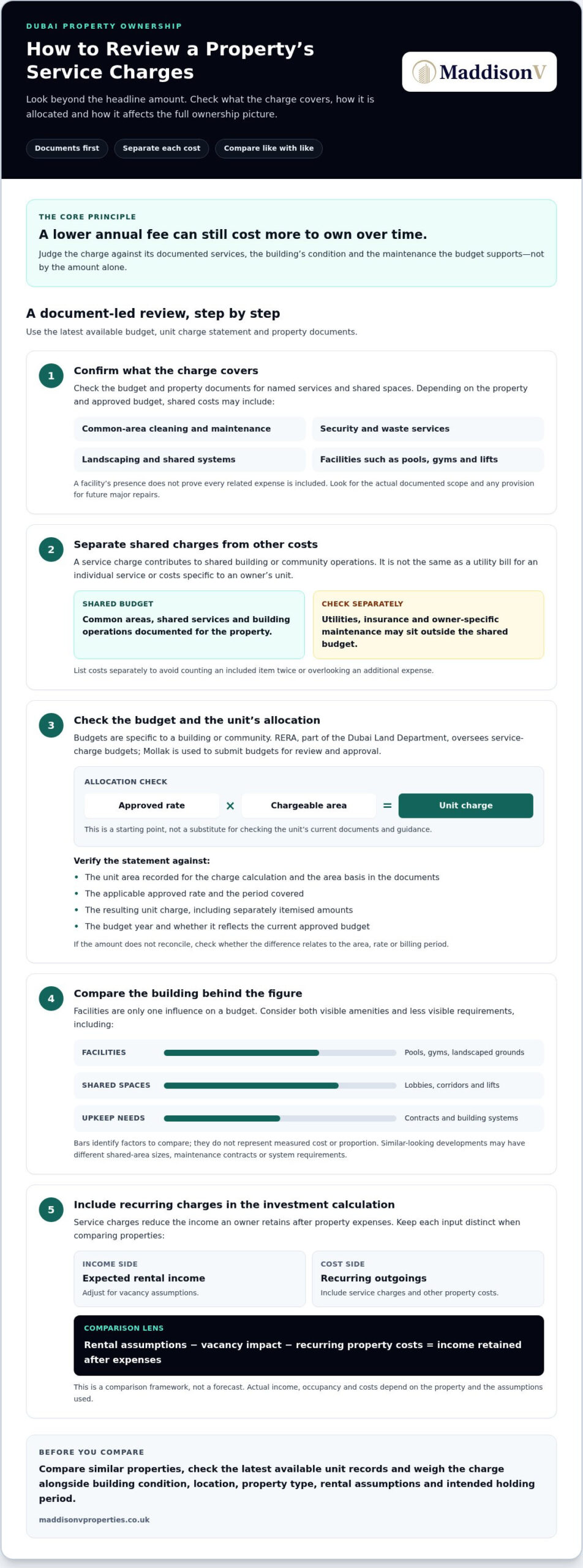
How service charges affect a Dubai property’s investment performance
Service charges reduce the income an owner retains after property expenses, so include them in the investment calculation from the outset. A useful comparison starts with expected rental income, adjusts for vacancy, then subtracts recurring property outgoings. This is a framework, not a forecast: actual income, occupancy and costs depend on the property and the assumptions used.
Keep each input separate. Combining rent, vacancy and charges into one estimated return makes it harder to see what drives the result or adjust an assumption. For service charges in dubai properties, a transparent calculation makes it easier to compare operating costs and see how changes in rent or occupancy could affect net income.
Compare properties using like-for-like assumptions
Compare properties over the same period and, where possible, within similar property types. Apply the same method to rent and vacancy assumptions, and check whether the service-charge figures cover comparable items. Record each figure’s source and date to avoid treating an old statement as a current cost. If documents use different periods or scopes, note that before comparing the totals.
A simple comparison ledger can keep the calculation clear:
- Gross rental income: the annual rent assumption before vacancy or costs.
- Vacancy adjustment: the assumed income reduction for periods without a tenant.
- Service charges: the documented charge for the same period, with its source and date.
- Other outgoings: separately identified recurring costs included in the model.
- Indicative net income: income after the vacancy adjustment and listed outgoings.
For a hypothetical comparison, label two properties A and B and enter figures from each property’s documents. Don’t use an assumed Dubai-wide average or treat an unverified estimate as a quoted charge. The comparison is most useful when every assumption is visible and applied consistently.
Why a low service charge is not the only investment signal
A lower charge may reduce an estimated outgoing, but it doesn’t establish the property’s quality, condition or future performance. Read the maintenance scope alongside the amount. Consider whether the budget and records describe care that matches the building’s facilities and observed condition, rather than treating a low figure as proof of efficiency.
Deferred maintenance can affect the use of shared areas and future planning if repairs become necessary. That doesn’t mean a higher charge guarantees better upkeep or a lower one signals neglect. Assess the cost, stated responsibilities and building condition together, and make any uncertainty clear in your model.
A charge-adjusted comparison is one part of due diligence, not a promise of returns. Reviewing rental assumptions, documented costs and the wider operating profile gives you a more grounded basis for comparing opportunities.
What to review before buying a property with Dubai service charges
Review service charges as part of the full ownership picture before comparing properties or committing to a purchase. A consistent document check helps distinguish recurring costs from one-off adjustments and shows whether your investment assumptions use the latest available information.
Use this sequence to organise the review:
- Obtain the latest available building budget. Record its date or budget period and the building or community it covers.
- Read the unit’s charge statement. Match the unit identifier, stated area, charge basis and billing period to the property.
- Review stated inclusions and exclusions. List the shared services and facilities named in the documents. Don’t assume another building has the same arrangement.
- Check transaction materials for adjustments or outstanding amounts. Include these only when explicitly disclosed, and keep them separate from recurring charges in your cost model.
- Reconcile the information before comparing or committing. Note differences in dates, periods or unit details so figures aren’t treated as directly comparable when they aren’t.
Documents and figures to examine
Read the budget and charge statement together. Confirm that both refer to the relevant building, the statement relates to the correct unit and the billing period is clear. Compare the charge basis with the unit details in the available property documents. Record the document date and any stated inclusions, exclusions, adjustments or outstanding amounts. If a detail isn’t documented, leave it unassumed in your analysis.
Questions that reveal the building’s operating picture
Look beyond the total. Identify which shared services the charge funds, what facilities the documents describe and whether maintenance plans or budget changes are disclosed. Then consider whether the stated scope fits the building’s condition and your intended ownership or operating approach. This puts the charge in context instead of treating it as a standalone figure.
Portal names, terminology and document requirements can change. For a 2026 purchase, check current Dubai Land Department, RERA and Mollak guidance against official information before relying on a particular portal process or document list. Note the source and date, especially when your decision depends on approved budget or current charge information.
Disciplined due diligence brings these details together. MaddisonV Properties provides property sourcing, market analysis and investor due diligence to support a considered review of an opportunity. Explore property sourcing and investment guidance.
A dated record of documents and assumptions makes it easier to compare service charges in dubai properties and keep your decision grounded in disclosed costs, building condition and operating requirements.
Make Dubai service charges part of a considered investment decision
A service charge is one part of owning a property, not a verdict on whether it is the right investment. Weigh the building’s condition and documented services alongside recurring costs, location, property type and rental assumptions. Your holding period matters too: an investor focused on rental income may assess outgoings differently from someone prioritising long-term ownership or a particular level of involvement.
This broader view puts service charges in dubai properties into context. Assess a charge against the services described in the documents, the condition of shared spaces and your objectives. No single figure can establish a building’s quality or predict its future performance.
Build a complete ownership-cost picture
Keep documented service charges separate from utilities, financing and other owner-specific costs. They may have different billing arrangements and shouldn’t be merged into one unclear estimate. Use consistent categories and time periods when comparing properties, and record the source and date of each figure. If a budget or property document changes, update your estimate rather than carrying forward an outdated assumption.
A clear cost picture shows which inputs are supported by current documents and which are assumptions. Keep rental income and vacancy assumptions visible too, so you can assess recurring outgoings in relation to expected income. This supports a measured comparison without suggesting that any particular charge guarantees a result.
Connect the charge review to your investment objectives
Consider how ongoing costs relate to your income expectations, holding period and management priorities. One investor may value a property’s shared facilities, while another may prefer a different property type or a simpler operating profile. The decision is personal, but it should rely on clear documents and consistent assumptions rather than the headline charge alone.
For international investors, property sourcing and due diligence can bring these factors together. MaddisonV Properties provides property sourcing, market analysis and due diligence, alongside property and facilities management for the ownership stage. This support helps investors assess an opportunity’s wider operating profile without promising a particular return or outcome.
Before deciding, bring together the building’s condition, stated services, current cost documents, rental assumptions and your intended holding period. If information is missing or assumptions need refinement, reflect that uncertainty in your assessment. A considered review gives you a stronger basis for choosing a property that fits your priorities.
Explore Dubai property investment opportunities with a clear view of the costs, ownership requirements and objectives that matter to you.
Make your next property decision with clarity
A considered investment decision should make clear what you know, what you’re assuming and what could change. Treat service charges in dubai properties as part of an ongoing ownership plan: update your cost assumptions when new building documents become available, and keep them aligned with your rental strategy and holding period.
This approach helps you compare opportunities by their full ownership profile instead of letting one prominent figure dominate the decision. It also provides a practical basis for planning how the property will be overseen after purchase, with attention to its financial objectives and the experience of people who use it.
MaddisonV Properties combines investment insight with property and facilities management to support decisions from selection through ownership. Explore MaddisonV’s property investment and management support to discuss your next step.
Frequently Asked Questions
What are service charges in Dubai properties?
They’re recurring owner contributions towards shared property operations. For portfolio planning, record each property’s charge separately rather than combining costs in one figure. Note the budget period beside each amount, so charges from different periods aren’t compared as though they were equivalent. Update the relevant property’s forecast when its documents change.
What do Dubai property service charges usually include?
Specific items depend on the building’s documents. Distinguish a named service from a commitment about its frequency or quality: a budget entry for cleaning, for example, doesn’t by itself describe the schedule or standard. Don’t assume a service is included based only on a listing description or a facility seen during a viewing.
How are service charges calculated for apartments in Dubai?
The apartment’s statement should show the charge basis and the period covered. Check whether a quoted amount represents a full budget period or a particular billing period. If the property changes hands partway through that period, keep the full-period charge separate from any transaction-specific adjustment stated in the sale documents.
Can service charges affect rental returns on a Dubai property?
Yes. They affect the income an owner retains after property outgoings. Label whether a return figure represents gross rental yield or an estimate after operating costs, as these measures answer different questions. Keep financing and other excluded assumptions visible too, so an estimate adjusted for service charges isn’t mistaken for a complete personal return calculation or a forecast.
Are service charges the same as utility bills in Dubai?
No. A utility cost may relate to shared areas or to the individual home, depending on the arrangements described in the documents. Give each cost its own line in your budget and note where it appears. This helps prevent the same expense from being counted twice.
How can I check service charges before buying a Dubai property?
Keep a dated record of the figures used in your purchase analysis, including the document or official information source for each. This helps you distinguish a budget change from a different billing period or unit detail if you revisit the decision. It also keeps assumptions consistent across property comparisons and makes later updates easier to trace.
Are higher service charges always a bad sign for investors?
No. Consider whether the facilities suit the property’s intended occupier and your investment strategy. A buyer focused on tenant appeal may value shared amenities differently from an investor prioritising lower recurring costs. Assess the package against your ownership plan rather than assuming every facility adds equal value to every investment.

Sign Up Now
Want to read more great articles and blogs subscribe to our newsletter