
With London residential property prices seeing an annual decline of 1.7% in early 2026, the era of relying solely on the capital for growth has...

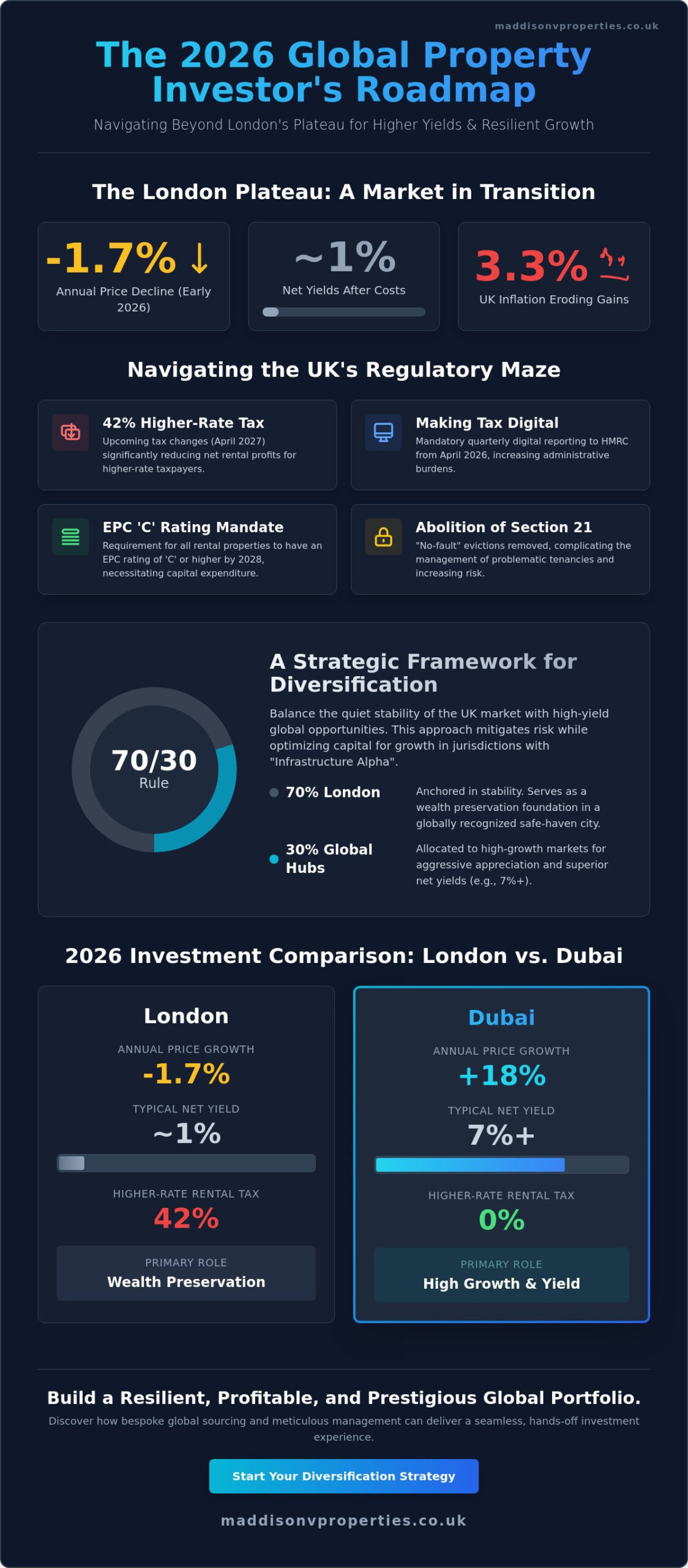
With London residential property prices seeing an annual decline of 1.7% in early 2026, the era of relying solely on the capital for growth has reached a definitive plateau. For the sophisticated investor, diversifying a real estate portfolio beyond London is no longer just a defensive maneuver; it’s a strategic necessity to outpace the 3.3% inflation rate currently eroding domestic gains. You’ve likely noticed that the UK regulatory environment is becoming increasingly meticulous and demanding, from the April 2026 Making Tax Digital requirements to the upcoming 42% higher-rate tax on rental profits. It’s natural to feel that the prestige of a Prime Central London address is being overshadowed by a growing list of administrative burdens and net yields that often struggle to cross the 1% mark after costs.
Expanding your investment horizon requires more than just capital; it demands a steady hand and a meticulous eye. While the rewards of diversifying a real estate portfolio beyond london are compelling, the path is often obscured by a lack of local market transparency. In many high-growth jurisdictions, the most lucrative opportunities remain “off-market,” accessible only to those with established, elite networks. To explore how these off-market opportunities are managed in the New York commercial sector, read more. Without a professional filter, investors risk being led toward sub-prime developments that look impressive in digital brochures but lack the structural or financial integrity required for long-term security. Success in global markets isn’t about taking more risks; it’s about identifying and neutralizing them through superior intelligence.
This article provides a clear, professional roadmap to balancing the quiet stability of the UK market with the vibrant, high-yield opportunities found in global luxury hubs. You’ll discover how to secure 7%+ net yields, benefit from tax-efficient structures, and maintain a truly bespoke, hands-off investment experience. We’ll examine the specific data points, from the Bank of England’s 3.75% base rate to Dubai’s 18% year-on-year price growth, to help you build a portfolio that is resilient, profitable, and prestigious.
Key Takeaways
- Understand how the 2026 UK tax landscape is shifting the focus from aggressive capital growth to strategic wealth preservation in Prime Central London.
- Learn how to apply the 70/30 Rule for diversifying a real estate portfolio beyond london, leveraging “Infrastructure Alpha” to identify markets where government spending drives value.
- Compare the 2026 investment profiles of London and Dubai to understand why these two “Safe Haven” cities create a powerful, complementary portfolio balance.
- Master the essentials of international due diligence, from developer reputation to escrow account laws, to mitigate risks and ensure project transparency.
- Discover how a bespoke approach to global sourcing and management ensures a seamless, meticulous, and hands-off investment experience.
The London Plateau: Why Geographic Diversification is Essential in 2026
London has long been the crown jewel of property investment, but data from early 2026 suggests a fundamental shift in its role. While Prime Central London remains a prestigious and secure location, the annual price decline of 1.7% indicates that the market has transitioned from a high-growth phase into a period of wealth preservation. Relying solely on the capital creates a single point of failure within your investment strategy, especially as domestic inflation sits at 3.3%. By applying the principles of Modern Portfolio Theory, sophisticated investors can reduce volatility by spreading capital across uncorrelated markets. This strategic rebalancing ensures that your wealth isn’t tied to the legislative whims of a single jurisdiction.
To better understand the mechanics of risk management in property, watch this helpful video:
Regulatory Pressures in the UK Market
The administrative burden on UK landlords has intensified significantly. With the Renters’ Rights Act and stringent new EPC requirements, the cost of compliance is eroding margins that were already under pressure. For many, real estate in england london has become a high-security, low-yield asset class. The upcoming April 2027 tax changes, which introduce a 42% rate for higher-rate taxpayers on property income, make diversifying a real estate portfolio beyond london a matter of financial survival. These meticulous, complex, and evolving regulations demand a more agile approach to capital allocation. Consider the following pressures currently facing the domestic market:
- The mandatory requirement for EPC C ratings by 2028, necessitating immediate capital expenditure.
- The abolition of Section 21 “no-fault” evictions, which complicates the management of problematic tenancies.
- The April 2026 implementation of Making Tax Digital, requiring quarterly digital reporting to HMRC.
The Opportunity Cost of Staying Local
Sticking to the familiar streets of Marylebone or Chelsea often comes at a steep price. While these areas offer gross yields of 3-4%, emerging luxury hubs are delivering 7-9% with significantly lower tax friction. Opportunity cost represents the potential financial gain lost when capital remains tied to stagnant or low-growth assets instead of being deployed into higher-performing alternatives. Sophisticated investors are increasingly rebalancing their portfolios toward growth-first jurisdictions that offer a seamless, premium, and tax-efficient experience. This shift allows you to maintain your London heritage while capturing the aggressive appreciation found in global markets. In a world where diversifying a real estate portfolio beyond london is easier than ever, staying local is a choice that limits your long-term wealth potential.
A Strategic Framework for Portfolio Diversification
Establishing a resilient property strategy in 2026 requires a shift from local intuition to a structured global framework. We suggest the 70/30 Rule as a cornerstone for modern investors. Under this model, 70% of your capital remains anchored in the stable, historical safety of London to serve as a wealth preservation foundation. The remaining 30% is allocated to high-growth international jurisdictions where aggressive appreciation and superior yields are the primary objectives. By diversifying a real estate portfolio beyond london, you balance the city’s long-term security with the dynamic growth of emerging luxury hubs. This approach doesn’t just spread risk; it optimizes your capital for “Infrastructure Alpha,” targeting cities where massive government spending is a direct catalyst for property value increases.
In jurisdictions like Dubai, pro-investor policies have created a remarkably attractive environment. As of April 2026, the removal of the AED 750,000 minimum property value for the 2-year investor visa has lowered the barrier for sole owners, making residency more accessible than ever. These regions often provide the meticulous benefit of tax-free rental income. This allows your returns to compound at a much faster rate compared to the UK, where higher-rate taxpayers face significant pressure from the upcoming 42% property income tax. Selecting markets with these incentives ensures your portfolio remains both profitable and agile in a shifting global economy.
Direct vs. Indirect Investment: Which Fits Your Profile?
Choosing the right investment vehicle is as critical as the location itself. While Real Estate Investment Trusts offer liquidity, they lack the personal control and prestige of physical ownership. Direct off-plan property investment allows you to secure premium assets in global financial centers at a lower entry point, capturing value as the project moves toward completion. This bespoke approach provides a tangible, luxury asset that you can manage with precision. Owning physical bricks and mortar offers a level of security that paper assets simply cannot replicate, especially when you utilize our meticulous property sourcing to identify the most promising developments.
Currency Hedging Through Property
International real estate serves as a sophisticated defense against the volatility of Sterling. With UK inflation recorded at 3.3% in March 2026, holding assets in dollar-pegged currencies, such as the UAE Dirham, protects your global purchasing power. This geographic spread transforms your income profile from a single-currency stream into a diversified revenue model. Collecting rental income in multiple currencies provides a natural financial buffer that shields your lifestyle and future investments from localized economic downturns. It’s a seamless way to ensure your wealth remains robust, regardless of fluctuations in the domestic market.
London vs. Dubai: The 2026 Investment Comparison
London and Dubai are often perceived as two sides of the same coin for the international elite. While London offers the historical prestige of a global financial capital, Dubai provides the high-octane growth and visionary scale of a modern metropolis. Diversifying a real estate portfolio beyond london into the Dubai market allows you to hedge against UK-specific legislative risks while benefiting from a pro-growth environment. Both cities maintain a “Safe Haven” status during geopolitical uncertainty, yet their fiscal profiles have diverged sharply. In 2026, the contrast is stark; London’s market saw a 1.7% price decline in January, while Dubai recorded a market-wide price increase of 18% per square foot.
Luxury off-plan developments in Dubai have become a primary focus for those accustomed to the high standards of Prime Central London. These projects offer a level of modernity, amenity, and architectural ambition that is difficult to replicate in London’s heritage-protected landscape. From private beach access to state-of-the-art wellness centers, the “hands-off” management experience in Dubai is designed to be seamless, professional, and entirely meticulous. This allows you to enjoy the rewards of a global portfolio without the gritty details of day-to-day oversight.
Yield and Capital Appreciation Metrics
In London, a gross yield of 3-4% in areas like Marylebone often dwindles to less than 1% net after accounting for the upcoming 42% higher-rate income tax and maintenance costs. Conversely, when you invest in dubai property, you’re entering a market where gross yields average 6-8%. Because there’s no tax on rental income or capital gains, these figures translate directly into superior net returns. For investors seeking the prestige of Chelsea or Mayfair, districts like Downtown Dubai and Palm Jumeirah offer a mirrored experience of luxury and exclusivity, backed by much stronger capital appreciation forecasts for the remainder of 2026.
Entry Costs and Barriers to Entry
The financial friction of entering the UK market has increased, with the surcharge for additional residential properties now sitting at 5 percentage points above standard rates. In contrast, Dubai’s 4% Land Department (DLD) fee remains a straightforward, one-time cost. Transaction speeds are notably different; Dubai’s digital-first approach ensures a seamless acquisition process that can often be completed in days rather than months. Financing options have also matured, with bespoke mortgage consultations now making it simpler for international buyers to leverage their positions in both markets. This ease of entry, combined with the removal of minimum investment thresholds for the 2-year visa in April 2026, reinforces Dubai’s position as the ideal partner for a diversified portfolio.
Navigating the Risks of International Diversification
Expanding your investment horizon requires more than just capital; it demands a steady hand and a meticulous eye. While the rewards of diversifying a real estate portfolio beyond london are compelling, the path is often obscured by a lack of local market transparency. In many high-growth jurisdictions, the most lucrative opportunities remain “off-market,” accessible only to those with established, elite networks. Without a professional filter, investors risk being led toward sub-prime developments that look impressive in digital brochures but lack the structural or financial integrity required for long-term security. Success in global markets isn’t about taking more risks; it’s about identifying and neutralizing them through superior intelligence.
The “management gap” is perhaps the most significant hurdle for the UK-based investor. Owning a premium asset thousands of miles away can quickly transition from an aspirational achievement to an administrative burden if the right infrastructure isn’t in place. Professional sourcing agents do more than just find property; they act as a vital shield, filtering out projects with unstable construction timelines or questionable developer liquidity. This ensures that your transition into international markets is as seamless and prestigious as your existing London holdings.
Meticulous Due Diligence for Global Assets
The Gold Standard for international property due diligence in 2026 involves a three-tier verification process that audits the developer’s historical liquidity, the project’s escrow compliance, and the legal finality of the title deed. In off-plan markets, understanding the local legal framework is essential for peace of mind. For instance, in Dubai, the Oqood system provides a centralized registry for off-plan properties, ensuring your rights are protected long before the building reaches completion. Verifying a developer’s track record is a non-negotiable step; you aren’t just buying a floor plan, you’re buying their ability to deliver a premium product on a specific date.
The Role of Professional Portfolio Management
Effective property management is the linchpin of successful geographic diversification. It’s the difference between being a burdened landlord and a sophisticated portfolio owner. By utilizing outsourced facilities management, you ensure a high-quality experience for international tenants while maintaining the aesthetic standards of your investment. This “hands-off” approach allows you to enjoy the yields of a global portfolio without the gritty details of maintenance or tenant relations. If you’re ready to elevate your strategy, our team can help you secure exclusive global opportunities through our bespoke sourcing and management services.
The MaddisonV Approach: Bespoke Global Sourcing and Management
At Maddison V Properties, our heritage is firmly rooted in the high-stakes world of Prime Central London. We understand the aesthetic standards and financial precision required to manage a portfolio in Chelsea or Kensington. Now, we’re applying that same meticulous rigor to global markets. Diversifying a real estate portfolio beyond london shouldn’t mean compromising on the quality of service or the caliber of your assets. We bridge the gap between clinical property management and a genuine passion for high-quality interiors, ensuring that your international holdings reflect the same prestige as your London home. Our approach is designed for the investor who values their time as much as their returns.
Our sourcing process is exhaustive and personalized. We don’t just look for properties; we identify off-plan investment opportunities that offer “Infrastructure Alpha” and long-term capital protection. Whether it’s a penthouse in a rising global financial center or a boutique development in a tax-efficient jurisdiction, every asset is vetted against our strict criteria for luxury and liquidity. We handle the complex, gritty details of sourcing and facilities management so you can enjoy the rewards of a truly global footprint. It’s a premium partnership built on integrity, ambition, and a shared vision for excellence.
Expert Advisory Beyond the Transaction
Our advisory services extend far beyond the initial purchase. We operate on a success-based fee model, which ensures our interests are perfectly aligned with your capital growth and yield objectives. By leveraging our elite network, we provide our clients with access to off-market luxury units before they reach the general public. This exclusive access is paired with bespoke mortgage and financing consultations, helping multi-jurisdictional investors navigate the complexities of international lending. We believe that professional sourcing is about more than just finding a unit; it’s about securing a strategic advantage in a competitive market.
Building Your 2026 Global Portfolio
The transition into a 2026 global portfolio is about agility and foresight. With the UK income tax on rental profits set to rise to 42% for higher-rate taxpayers in April 2027, the window to rebalance your London-heavy assets is narrowing. We provide the peace of mind that comes with having a single, sophisticated partner for all your property needs, regardless of the time zone. Our team is ready to help you assess your current holdings and identify the most seamless path toward geographic diversification. If you’re ready to elevate your investment strategy, contact MaddisonV Properties today for a bespoke portfolio review and discover the potential of a borderless real estate strategy.
Expanding Your Legacy: The Path to Global Resilience
The 2026 property market demands more than just traditional loyalty to the capital; it requires a calculated, global vision. By rebalancing your holdings to include high-growth jurisdictions like Dubai, you effectively neutralize the 3.3% domestic inflation and the upcoming 42% tax on UK rental profits. Diversifying a real estate portfolio beyond london ensures your wealth remains agile and protected against localized regulatory shifts. It’s about moving from a defensive posture to one of aggressive, tax-efficient growth that prioritizes long-term stability.
As specialists in both the London and Dubai luxury markets, Maddison V Properties offers a meticulous, success-based sourcing model that identifies off-plan opportunities before they reach the general public. Our full-service portfolio management provides the seamless, hands-off experience you expect from a premium partner. We handle the complexities of multi-jurisdictional ownership so you can focus on the rewards of a truly borderless strategy. Our team is dedicated to preserving the aesthetic and financial standards you’ve worked hard to establish.
Secure your global property future with a bespoke consultation from MaddisonV Properties and begin building a legacy that transcends borders. Your capital deserves the prestige and protection of a global perspective.
Frequently Asked Questions
Is it better to invest in London or Dubai in 2026?
Both markets serve distinct purposes within a sophisticated strategy. London remains the premier choice for long term wealth preservation despite the 1.7% price dip seen in early 2026. Dubai offers aggressive capital growth and superior net yields, which averaged 6% to 8% in January 2026. A balanced approach uses London for stability and Dubai for tax free income and high octane appreciation.
How much of my real estate portfolio should be diversified outside of London?
We typically recommend the 70/30 Rule for established investors. Allocating 70% of your capital to the London core provides a secure foundation, while 30% is dedicated to diversifying a real estate portfolio beyond london into high growth markets. This ratio allows you to capture international “Infrastructure Alpha” without overexposing yourself to the volatility of emerging jurisdictions.
What are the tax implications of owning property in both the UK and UAE?
The UK and UAE maintain a Double Taxation Treaty that provides a clear framework for international owners. While the UAE offers 0% tax on rental income and capital gains, UK residents are generally taxed on their worldwide income. It’s vital to prepare for the April 2027 UK tax hikes, where higher rate taxpayers will face a 42% levy on property profits.
Can I get a mortgage for an international property as a UK resident?
Yes, specialized international lenders provide bespoke financing for UK residents looking abroad. While the Bank of England held the base rate at 3.75% in April 2026, international LTV ratios often differ. Non resident buyers in Dubai typically secure up to 50% financing. Our mortgage consultations help you navigate these varied lending criteria to find the most efficient structure.
What is the safest way to buy off-plan property abroad?
The safest method involves using government regulated escrow accounts and developers with a 100% delivery record. In Dubai, the Oqood system and Land Department regulations provide a meticulous level of protection for your capital. Professional sourcing is essential here, as it filters out sub prime opportunities and ensures your investment is backed by a reputable, liquid developer.
How do I manage a rental property located in a different country?
Professional facilities and portfolio management is the only way to ensure a truly hands off experience. Local experts handle the meticulous details of tenant vetting, maintenance, and legal compliance on your behalf. This approach eliminates the management gap, allowing you to enjoy premium yields and peace of mind without the burden of day to day oversight.
Does diversifying beyond London actually reduce my overall risk?
Yes, diversifying a real estate portfolio beyond london significantly reduces single jurisdiction risk. By spreading assets across uncorrelated markets, you hedge against Sterling volatility and UK specific policy shifts. With domestic inflation at 3.3% in March 2026, holding international assets in dollar pegged currencies provides a natural financial buffer that protects your global purchasing power.

Sign Up Now
Want to read more great articles and blogs subscribe to our newsletter