For owners seeking facilities management Clapham residents can rely on, the priority is keeping shared spaces presentable, secure and well...

For owners seeking facilities management Clapham residents can rely on, the priority is keeping shared spaces presentable, secure and well maintained. Coordinating upkeep and managing operational details takes time, particularly when several people share responsibility for a building.
Residential facilities management brings these responsibilities into a considered approach to building operations. It covers areas such as maintenance, security and communal area management, helping owners coordinate the work that supports a well-run property. Understanding what belongs in the scope makes it easier to decide where oversight can help.
This guide explains the responsibilities involved in managing residential blocks and luxury developments, how to assess a building’s needs, and what to consider in a facilities management arrangement. MaddisonV Properties provides facilities management through fixed-term contracts, with the scope shaped around the project’s operational requirements.
Key Takeaways
- Map shared spaces, recurring upkeep, responsibilities and communication priorities to clarify your building’s management needs.
- Understand how facilities management Clapham buildings need can bring operational requirements into a clear scope.
- See how maintenance, security and communal area management support the day-to-day operation of a residential building.
- Consider how ownership structure and building use affect the scope for a residential block or luxury development.
- Learn how MaddisonV Properties manages operational detail through fixed-term facilities management arrangements.
Why Facilities Management Matters for Residential Properties in Clapham
Owning or overseeing a residential building involves more than looking after individual homes. Maintenance needs to be coordinated, shared areas kept in order and building security included in day-to-day operations. When responsibilities are unclear, routine tasks can take up owners’ time or be missed altogether.
Residential facilities management coordinates a building’s operational upkeep and shared environment, including maintenance, security and communal areas. It focuses on how the building functions for the people who use it. This differs from property investment advice, which concerns decisions about acquiring, holding or selling an asset. For a wider overview, see What is Facility Management?
What residential facilities management means in practice
In a residential block, facilities management brings recurring operational needs into a defined scope. This can include coordinating building maintenance, managing security arrangements and overseeing communal areas such as entrances and corridors. The right priorities depend on the property’s layout, how residents use its shared spaces and the upkeep those areas require. Setting out the scope helps owners see what is being managed and how responsibilities fit together.
Why shared spaces matter in Clapham buildings
Residents and visitors experience shared areas as part of their everyday comings and goings. An orderly entrance, hallway or corridor can make arriving and moving through a building feel more pleasant. The needs of each Clapham property depend on its layout and use, so management should reflect the building rather than assumptions about the neighbourhood.
Shared spaces also connect individual homes to the wider building. A maintenance issue in a corridor, for example, can affect everyone who uses it. Coordinating upkeep across common areas helps owners address operational needs across the property instead of treating each concern in isolation.
For owners considering facilities management Clapham residential properties can benefit from, begin by looking at how the building operates day to day. MaddisonV Properties provides facilities management for residential blocks and luxury developments, covering operational upkeep, building maintenance, security and communal area management within a scope shaped around the project.
What Facilities Management Covers in a Clapham Residential Building
A clear facilities management scope turns broad responsibility for a building into practical areas of oversight. For residential properties in Clapham, this can include operational upkeep, building maintenance, security and communal areas. These areas are connected, but each plays a different role in how the building functions and feels to residents.
Building maintenance and operational upkeep
Building maintenance supports the function and condition of the property, while operational upkeep brings recurring needs into an organised scope. A residential block, for example, may need attention to shared fixtures as well as the general state of its common spaces. Coordinated oversight helps owners consider those needs as part of the building’s operation, rather than as disconnected tasks. Priorities will vary between a straightforward block and a luxury development, which may have different layouts, uses and expectations.
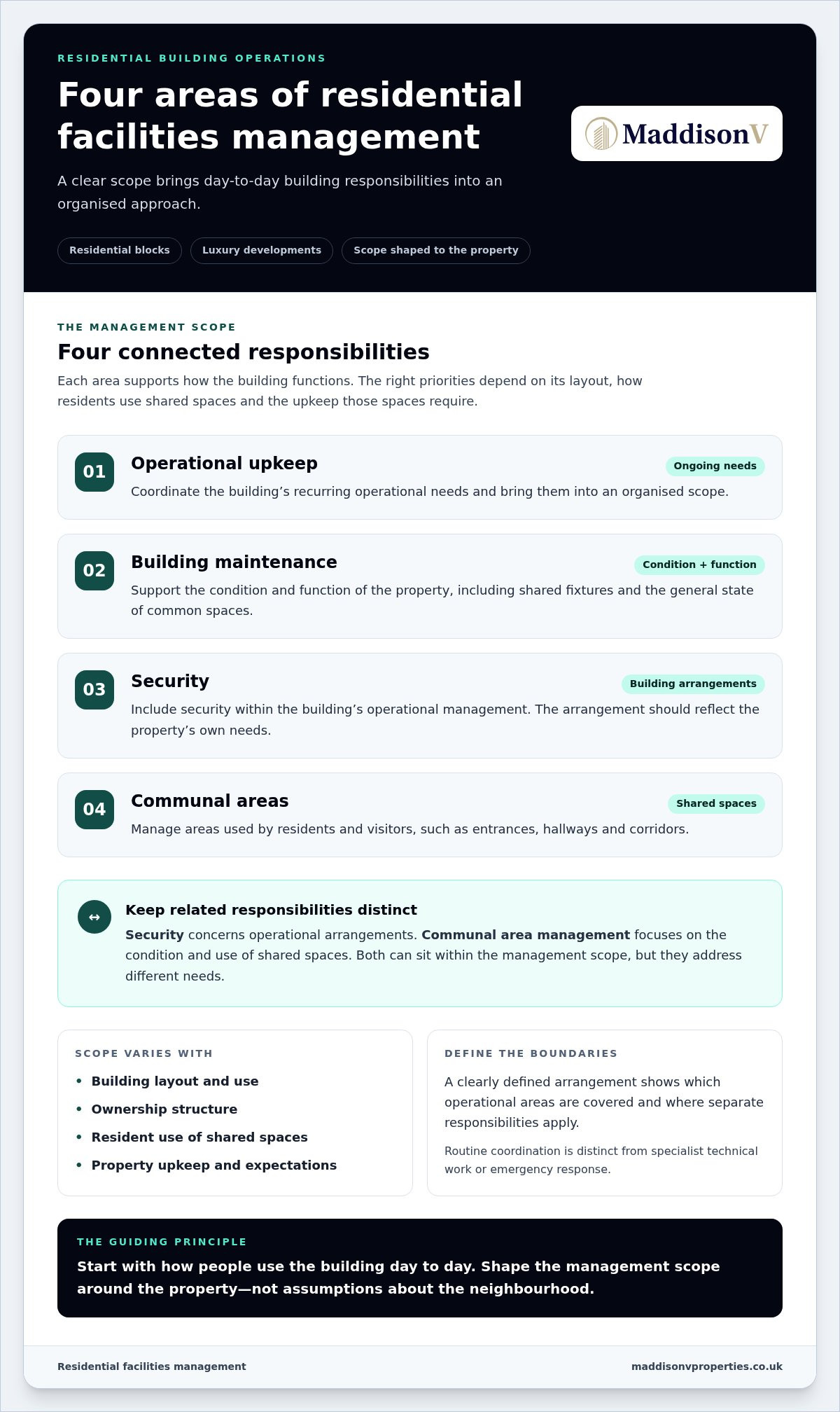
In practice, facilities management may cover these four areas:
- Operational upkeep: coordinating the building’s ongoing operational needs.
- Building maintenance: supporting the condition and function of the property.
- Security: including security within the building’s operational management.
- Communal areas: managing shared spaces used by residents and visitors.
Security and communal area management
Security and shared-space management are related, but distinct. Security concerns the building’s operational arrangements; communal area management focuses on the condition and use of shared spaces. Entrances, corridors and other common areas shape residents’ everyday experience, from getting home to welcoming visitors. An orderly, well-maintained environment supports a more considered experience without assuming a particular system or staffing arrangement.
The appropriate scope depends on the property and its operational needs. Routine coordination is also distinct from specialist technical work or emergency response. A clearly defined arrangement helps owners understand which operational areas are covered and where separate responsibilities apply.
For a wider perspective on how property and community association management brings operational responsibilities together, the U.S. Bureau of Labor Statistics describes the Role of Property Managers in Residential Facilities. The reference offers general context; the management scope for a Clapham building should reflect that property’s own needs.
MaddisonV Properties provides facilities management for residential blocks and luxury developments, bringing operational upkeep, building maintenance, security and communal area management into a considered arrangement. Explore MaddisonV’s residential facilities management to see how building operations can be organised within a tailored scope.
How Clapham Property Owners Can Assess Their Building’s Management Needs
A useful management plan starts with the building as people use it, not with a generic checklist. Facilities management Clapham buildings need can vary with their layout, ownership structure and daily use. A short assessment helps turn scattered concerns into practical priorities for planning the management scope.
Map the building’s shared spaces and recurring needs
List the spaces residents and visitors share, such as entrances, corridors and other communal areas. Then separate recurring upkeep from one-off concerns. This distinction gives owners a clearer picture of the ongoing operational requirements without letting an isolated issue define the entire management scope.
Use these four steps to organise your assessment:
- 1. Identify shared spaces. Record the communal areas in the building and consider how residents and visitors use each one. A space-by-space view can reveal where upkeep and management attention matter most.
- 2. List recurring needs. Note routine operational and maintenance requirements separately from one-off concerns. This helps distinguish ongoing coordination from issues that need individual attention.
- 3. Clarify responsibilities. Set out who currently oversees each operational area and how responsibility is divided across the ownership or management structure. In a building with several owners or shared decision-making, clear roles help prevent gaps and duplicated effort.
- 4. Define communication priorities. Decide what information owners need, who should receive it and which matters need to be raised. Clear expectations make oversight more practical for everyone involved.
Clarify responsibilities and communication expectations
Ownership structure affects how operational decisions are coordinated. A single owner may have a direct view of the property, while a block with multiple stakeholders needs a shared understanding of roles and communication. Building use matters too: a development with shared facilities may have different needs from a simpler block. Shape the management scope around these realities rather than assuming one arrangement suits every property.
Communication belongs in the operating framework, not as an afterthought. Decide which updates help owners maintain oversight, how responsibilities are understood and what information supports timely decisions. The aim is to establish a clear route for operational matters, not to prescribe a particular reporting tool or meeting schedule.
Before discussing an arrangement, bring together the space list, recurring needs, responsibility map and communication priorities. This gives the conversation a practical foundation and helps identify what belongs in the scope, what needs separate consideration and where clearer roles would make the building easier to manage.
What to Expect from a Facilities Management Arrangement in Clapham
A well-considered arrangement begins with the building’s operational needs and sets out how they fit within the management scope. For facilities management Clapham owners should look beyond a general service label: maintenance, security and communal areas need to be considered in relation to the specific property. A residential block and a luxury development may have different shared environments and priorities, so their arrangements need not be identical.
Match management scope to the building
Consider how the property is used and what its shared spaces require. A block with straightforward common areas may have a different operational profile from a development with more extensive communal areas. Relating maintenance, security and shared-space management to the building’s actual needs helps owners understand what the arrangement is intended to cover.
Before agreeing an arrangement, compare the building’s needs with the management areas being considered. Are ongoing maintenance responsibilities clear? Is security included in the intended operational scope? Are communal areas covered in a way that reflects how residents use them? These questions focus the discussion on the property’s requirements.
Responsibilities should also fit the ownership structure. Where several parties have an interest in the building, a clear scope helps explain how operational oversight relates to their roles. Facilities management is distinct from wider landlord and tenancy responsibilities. MaddisonV’s property management guide provides context on those broader considerations.
Understand fees and ongoing oversight
MaddisonV Properties provides facilities management through fixed-term contracts, with the project’s operational requirements informing the scope. When reviewing an arrangement, consider the responsibilities it covers and how those responsibilities relate to the building’s needs. A clear description of the remit helps owners understand the ongoing oversight involved.
Clarity at the outset gives owners and stakeholders a shared reference for the areas being managed. It keeps the arrangement connected to the building rather than relying on a one-size-fits-all template, and makes the operational responsibilities easier to understand.
If you’re considering a tailored arrangement for a residential block or luxury development, discuss your building’s management needs with MaddisonV Properties.
MaddisonV Properties Facilities Management for Clapham Developments
Managing a residential building involves more than responding to individual upkeep concerns. Owners need a clear view of how the property operates as a whole, including the shared environment residents use every day. MaddisonV Properties provides facilities management for residential blocks and luxury developments, bringing building operations into a tailored scope.
A tailored approach to residential building operations
Every property has its own operational profile. The layout, shared spaces and priorities of a residential block may differ from those of a luxury development, so an arrangement should reflect the building rather than follow a generic checklist. MaddisonV’s facilities management covers operational upkeep, building maintenance, security and communal area management, with the scope shaped around the project’s requirements.
This approach brings practical building needs into one considered scope. Maintenance relates to the property’s condition and function; security forms part of its operational management; and communal area management focuses on shared spaces. Together, these areas support the organised operation of the building and help owners understand which details are being managed.
A tailored scope can move routine coordination away from disconnected tasks and towards a more coherent view of building operations. The priorities should reflect how the property is used and how residents share its spaces. This helps keep management attention relevant to the building and its residents.
Facilities management also sits within the wider context of property ownership and investment. Owners exploring how building operations relate to the broader market can find useful context in MaddisonV’s London property market guide. This article focuses on the practical management of the residential environment itself.
Take the next step with MaddisonV Properties
A useful first step for owners and residential stakeholders is to bring the building’s management priorities into focus. Consider which operational areas need oversight, how communal spaces serve residents and what a well-managed environment should support. A clear discussion connects those priorities with a tailored facilities management scope.
MaddisonV Properties offers facilities management for residential building operations, shaped around the development’s needs and shared environment. To discuss facilities management for a Clapham property, Discuss facilities management with MaddisonV Properties.
Give Your Building a Clearer Operational Direction
Well-considered facilities management Clapham owners can build around starts with a practical question: what would make the building easier to oversee while supporting the experience residents value? Use the answer to turn day-to-day concerns into priorities and shape an arrangement around the property.
Next, consider how those priorities fit together over time. Clear responsibility for operational details supports continuity, limits ad hoc decisions and keeps attention on the shared environment. MaddisonV Properties manages facilities for residential blocks and luxury developments, with a scope that includes maintenance, security and communal area management.
A considered conversation can clarify what the building needs and how those needs should be managed. Start with the property’s priorities and discuss a practical approach with MaddisonV Properties.
Discuss facilities management for your Clapham property and take the next step towards more confident building oversight.
Frequently Asked Questions
What does facilities management include for a residential building?
It covers agreed responsibilities for the building’s shared operation, such as maintenance, security and communal areas. Owners can use the management scope to distinguish work coordinated for the building from responsibilities that remain with individual owners or stakeholders. Making that division clear helps prevent confusion about who is handling an operational matter.
Is facilities management the same as property management?
No. The terms refer to different, though sometimes related, areas of oversight. Facilities management concerns the operation of the building as a shared environment, while property management is more closely connected with individual properties and their tenancies. Where both apply, separating the responsibilities helps owners distinguish building-wide matters from those relating to a particular home or tenancy.
Can facilities management support a luxury residential development?
Yes. The management approach can reflect the development’s design, shared environment and operational priorities. Owners of a high-end property can consider how the common areas support the overall resident experience and whether the management scope suits the development’s character. The aim is a considered fit, not simply a longer list of tasks.
How do I assess facilities management needs for a Clapham property?
For facilities management Clapham planning, list the building’s operational concerns and separate recurring needs from isolated issues. Then prioritise them by their effect on the property’s function and shared spaces. This gives owners a practical basis for discussing the management scope and focusing on day-to-day operations.
How are facilities management fees structured?
MaddisonV Properties provides facilities management through fixed-term contracts. When reviewing an arrangement, consider the agreed management remit and the period it covers. Compare charges with other services only when the responsibilities and basis of the charges are comparable. A clear description of the scope makes the fee structure easier to understand.
Who benefits from professional facilities management?
Facilities management can help anyone responsible for coordinating a residential building’s shared operations. It can be particularly useful for owners with limited time for day-to-day oversight or stakeholders who need a clearer division of responsibilities. Its value depends on the building’s needs and the amount of coordination involved.
Can facilities management improve the experience of residents?
It can support a smoother experience by managing the building’s shared operation as a whole. When the management approach reflects how people use the property, shared-space concerns are less likely to be treated as unrelated tasks. No arrangement can guarantee individual satisfaction, but thoughtful management can contribute to a more orderly and cared-for environment.

Sign Up Now
Want to read more great articles and blogs subscribe to our newsletter