Selling an investment property can trigger a tax bill even when the property has never been your home. From 6 April 2026, individuals pay Capital...

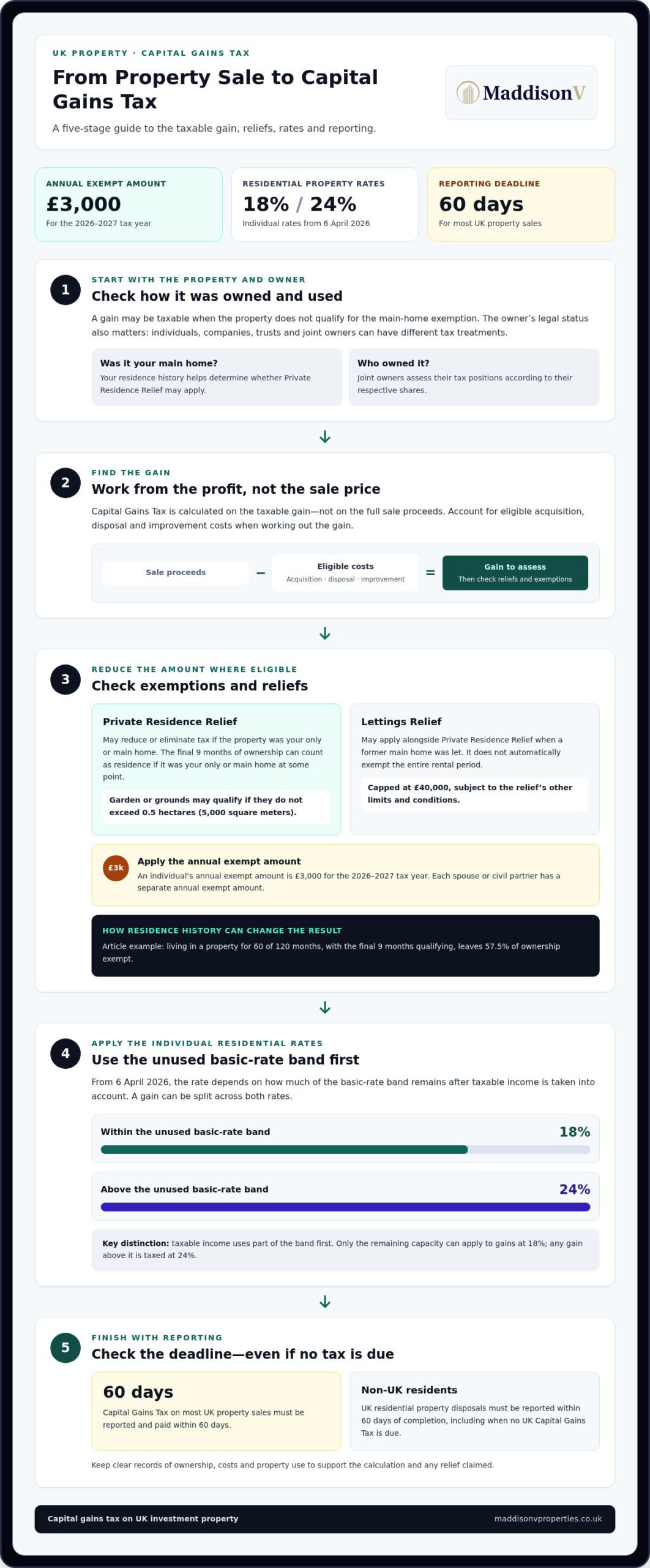
Selling an investment property can trigger a tax bill even when the property has never been your home. From 6 April 2026, individuals pay Capital Gains Tax at 18% on gains within their unused basic-rate band and 24% on gains above it. The capital gains tax on UK investment property is calculated on the taxable gain, not the full sale proceeds, and the annual exempt amount is £3,000 for the 2026 to 2027 tax year.
The final amount depends on how you acquired and used the property, allowable costs, any reliefs you qualify for and your taxable income. Non-UK residents also need to report UK residential property disposals, even when no UK Capital Gains Tax is due, within 60 days of completion, according to HM Revenue & Customs.
This guide explains when a property gain is taxable, how Private Residence Relief and the annual exempt amount may reduce it, and how the calculation works for non-residents. You’ll learn which costs may be deductible, how tax rates apply and what reporting obligations may follow a sale, helping you assess the figures and decisions involved in capital gains tax on UK investment property.
Key Takeaways
- Separate the property’s taxable gain from its sale proceeds by accounting for eligible acquisition, disposal and improvement costs.
- Assess whether Private Residence Relief applies by looking at how and when the property was used as your home.
- Check how your income tax band affects the rate applied to taxable residential property gains.
- Non-UK residents must report UK residential property disposals, including cases where no tax is due.
- Keep clear records of ownership, costs and property use to support your calculation and any relief claimed.
Private Residence Relief
Private Residence Relief can reduce or eliminate Capital Gains Tax when a property has been your only or main home. The outcome depends on how long you lived there and how the property was used during your ownership.
Relief for Main Homes
Private Residence Relief applies to gains on a property that was your only or main residence. A qualifying home sale may be exempt from Capital Gains Tax, unlike a property held solely as an investment.
The final 9 months of ownership can count as residence if the property was your only or main home at some point. The garden or grounds can qualify when they do not exceed 0.5 hectares, or 5,000 square meters.
Relief can be apportioned when you lived in the home for only part of the ownership period. For example, living in a property for 60 of 120 months, with the final 9 months qualifying, leaves 57.5% of ownership exempt.
Some qualifying absences may count as deemed occupation. The rules described allow up to three years away for any reason, or up to four years while working elsewhere in the UK, if occupation conditions are met. A construction delay may qualify when it does not exceed 24 months in total.
If you have more than two residences, you may make a Private Residence Relief election within two years. Your choice can affect which home is treated as your main residence for relief purposes.
Relief and Lettings Relief
Lettings Relief may apply alongside Private Residence Relief if you let a former main home. It can reduce a taxable gain, but does not automatically exempt the entire period it was rented.
HM Revenue & Customs states that UK lettings relief is capped at £40,000, subject to the other limits described for the relief. The cap is not a standalone allowance for every rented property, so the property’s occupancy history and the relief conditions remain important.
Business assets may also qualify for tax relief, depending on their use and eligibility. Business Asset Disposal Relief can reduce the Capital Gains Tax rate to 10% on the first £1 million of lifetime gains. Qualifying gains eligible for this relief are taxed at 18% from 6 April 2026.
These reliefs have different tests: your residence history matters for Private Residence Relief, while business use matters for business asset relief. Establishing whether the property was your home, let accommodation or a business asset helps identify which relief may apply when you dispose of it.
What is the capital gains tax on UK property?
Capital Gains Tax may apply to a taxable profit when you dispose of a property that does not qualify for the main-home exemption. For individuals, the rate depends on the property type and how much of the basic-rate tax band remains after taxable income is taken into account.
From 6 April 2026, individuals pay 18% on gains within their unused basic-rate band and 24% above it. Landlords, companies, trusts and joint owners can have different tax treatments, so the ownership structure matters as much as the property’s use.
Rates for Basic-Rate Taxpayers
For an individual whose gain fits within the unused basic-rate band, the Capital Gains Tax rate is 18% from 6 April 2026. This matters because the basic-rate label alone doesn’t determine the rate on the whole gain.
Taxable income uses part of the band first; only the remaining capacity can be applied to gains at 18%. Any gain extending beyond that remaining band is taxed at the higher rate. A landlord should therefore consider income and gains together, rather than estimate tax from rental income or sale proceeds alone.
For residential property, the applicable individual rates are 18% and 24%. Commercial property and land gains also use 18% and 24% from 30 October 2024, according to the rates stated for those disposals.
Rates for Higher- and Additional-Rate Taxpayers
Individuals whose gains fall above the unused basic-rate band pay 24% Capital Gains Tax from 6 April 2026. This applies to the portion above the band, making the division between taxable income and gain important.
A person can have some gains taxed at 18% and the balance at 24% if the gain crosses the remaining band. The calculation concerns the taxable gain, not the full sale price, so allowable costs and reliefs affect the amount exposed to these rates.
Residential property rates changed from 18% and 28% to 18% and 24% for disposals on or after 6 April 2024. The 24% rate applies above the available basic-rate band under the individual rules.
Taxation Across Owner Types
The owner’s legal status determines which tax framework applies to a property gain. An individual landlord’s residential property gain is assessed against their income and unused basic-rate band, so rental profits alone do not determine the eventual rate.
Joint owners calculate their tax positions according to their respective shares in the property. Each spouse or civil partner has a separate annual exempt amount, which can affect the taxable gain allocated to them.
Companies don’t use an individual landlord’s basic-rate and higher-rate bands for their property gains. Trusts and personal representatives also have distinct rates: they pay 24% Capital Gains Tax from 6 April 2026. The ownership route should therefore be identified before estimating a disposal’s tax.
For most UK property sales, reporting and payment deadlines also matter alongside the rate. HM Revenue & Customs requires Capital Gains Tax on most sales of UK property to be reported and paid within 60 days.
Annual exempt amount
The annual exempt amount is the portion of an individual’s capital gains that can be exempt from Capital Gains Tax in a tax year. HM Revenue & Customs states that the UK annual exempt amount for capital gains tax is £3,000 per person for the 2025/26 tax year. For an investment property owner, this allowance can reduce the gain exposed to tax, but it doesn’t make every disposal tax-free.
Think of the annual exempt amount as a yearly threshold applied to gains, not a discount on the property’s selling price. The starting point is the gain, not the total sale proceeds.
The annual exempt amount is personal, so ownership shares can affect how the allowance applies. If spouses or civil partners jointly own a UK property, their separate annual exempt amounts can total £6,000 for the 2025/26 tax year. Each person’s share of the gain is considered against their own allowance, rather than treating the couple as one taxpayer with a single shared exemption.
Timing matters too. The exemption applies to a tax year, so if you dispose of more than one asset in that year, consider the combined gains when estimating how much may be taxable. For example, selling an investment property and another chargeable asset does not mean the full exemption applies separately to each disposal. The annual allowance is not a per-property amount.
The amount has changed over time. The annual exempt amount can change over time, so check the amount that applies to the relevant tax year. A historical exemption of £12,300 may appear in older calculations, but it should not be substituted for the amount relevant to the disposal’s tax year.
Trustees have a different figure: the UK annual exempt amount for trustees was £1,500 for the 2024/25 tax year. That distinction matters when property is held through a trust, because the individual allowance should not be assumed to apply. The owner’s legal capacity, the tax year and the gains being assessed all shape the calculation.
For a property sale, keep the exemption separate from other reliefs and allowable costs in your working. First establish the gain attributable to the disposal; then identify the annual allowance relevant to the owner and tax year. A clear calculation prevents the £3,000 annual exemption from being mistaken for a fixed tax credit or a guaranteed reduction of that amount from the final bill.
Non-UK-resident property disposals and calculation methods
A non-UK resident may owe UK Capital Gains Tax when disposing of UK property. The calculation depends on the taxable gain, available reliefs and relevant acquisition value.
HM Revenue & Customs says Capital Gains Tax on most sales of UK property must be reported and paid within 60 days. UK residential property disposals must also be reported by non-UK residents, including when no UK Capital Gains Tax is due, within 60 days of completion, according to HM Revenue & Customs.
Late filing may trigger an immediate £100 penalty, daily penalties after 3 months, and increased penalties after 6 months. Interest on tax paid late is separate from filing penalties and depends on how long payment remains outstanding.
Calculating Taxable Property Gains
A taxable property gain is broadly the disposal proceeds minus the property’s acquisition cost and eligible deductions. This distinction matters because Capital Gains Tax applies to the gain, not the full sale proceeds.
For a non-UK resident, the calculation concerns UK property, whether residential or commercial. A non-resident disposing of UK residential property may rebase its value to the market value on 5 April 2015. That can make the post-rebasing increase, rather than the full ownership-period increase, central to the calculation.
Start with the disposal value, then subtract the relevant acquisition value and qualifying costs. Apply any available relief and the owner’s annual exempt amount to work out the taxable figure. A residential property sale may still need to be reported even if no UK tax is due.
Deductible Property Costs and Improvements
Eligible costs can reduce the gain used to calculate UK property Capital Gains Tax. Documented purchase, sale and improvement expenses may therefore change the taxable amount.
Direct acquisition and disposal costs may include legal fees and estate agent fees. Keep records linking each cost to the purchase or sale. These costs are different from ongoing ownership expenses, which do not automatically qualify as deductions.
Qualifying capital expenditure that enhances a property’s value, such as building an extension, may also be deductible. General maintenance typically is not. The key distinction is whether the work improves the asset or simply keeps it in its existing condition.
An extension, for example, may add lasting value, while routine repairs maintain the property. In either case, invoices and a clear description of the work help establish the nature of the expense. Keep purchase documents, disposal costs and improvement records together to support your gain calculation.
Residence status and ownership history can affect the calculation. Non-UK residents should distinguish UK property gains from income and retain the acquisition, valuation and disposal records used to establish the taxable amount. The disposal date also determines the reporting deadline, so keep the completion details with the sale documents.
Capital Gains Tax on non-home property
A property that is not your home can result in a Capital Gains Tax liability when you sell or otherwise dispose of it at a profit. For landlords, second-home owners and investors, the key point is that tax applies to the gain. The final calculation depends on ownership, qualifying costs and available reliefs.
From 6 April 2026, individuals pay 18% on gains within their unused basic-rate band and 24% above it. These rates apply to residential property gains; income uses some or all of the basic-rate band before gains are assessed. The additional-rate taxpayer therefore doesn’t automatically pay the higher rate on every pound of a gain if unused band remains.
Non-residential property has its own rate history. UK non-residential property disposals moved from rates of 10% and 20% to 18% and 24% from 30 October 2024. The owner’s tax position and the disposal date matter, so commercial buildings and land should not be assumed to follow an older calculation used for a previous tax year.
Residence status also affects which assets are within scope. UK-resident individuals are typically subject to UK Capital Gains Tax on worldwide asset disposals, while non-UK residents are subject to UK Capital Gains Tax on UK property, whether residential or commercial. This difference matters if you own properties in several countries and are considering a transfer or sale.
A transfer is not always treated as a straightforward sale at the amount paid. For a disposal to a connected party, proceeds are generally based on the property’s market value at completion. Gifts to a spouse or civil partner usually do not require Capital Gains Tax, while gifts to UK-registered charities are exempt. A gift to a relative outside those categories may need a different analysis.
Losses can also affect your overall tax position. UK capital losses can be carried forward indefinitely to offset gains in future tax years, but must be reported to HM Revenue & Customs within four years from the end of the tax year in which they arise. The annual exempt amount can reduce chargeable gains, but applies to your gains for the tax year, not separately to each asset.
Business property may qualify for relief when it meets the relevant conditions. Qualifying gains eligible for Business Asset Disposal Relief are taxed at 18% from 6 April 2026. That treatment is distinct from ordinary investment property gains, so the asset’s role in a business matters. Before committing to a purchase, investors can explore property sourcing as part of assessing suitable opportunities against their investment objectives.
MaddisonV Properties: Property Management
MaddisonV Properties supports owners seeking professional oversight of a UK investment property as they plan its longer-term role in their portfolio. Property Management helps coordinate the practical responsibilities of ownership, so investors can focus on asset performance, future plans and the records relevant to a potential disposal.
If you are assessing your next purchase, Property Sourcing can help identify opportunities aligned with your investment objectives. Mortgage Consultations can support your consideration of financing, while Facilities Management addresses a property’s operational needs. These services can be relevant at different stages, from acquisition through ongoing ownership.
To discuss property management or investment support, contact MaddisonV Properties through maddisonvproperties.co.uk.
Plan Your Next Property Decision With Clarity
Consider a property’s tax position as part of its wider investment plan, not only when a sale is approaching. Whether you are weighing a purchase, deciding whether to retain an asset or preparing for a future disposal, consider the expected ownership period alongside your investment objective. This can help you assess each opportunity’s longer-term role.
If you are assessing capital gains tax on UK investment property, keep acquisition records and track changes in how the property is used. These steps can support better-informed decisions and provide an organised starting point when reviewing the asset’s role in your wider portfolio.
MaddisonV Properties can help with property investment decisions through its property services. Contact MaddisonV Properties to discuss your property plans and take a considered next step with confidence.
Frequently Asked Questions
What is CGT?
CGT stands for Capital Gains Tax, which may apply when you dispose of a chargeable asset for a gain. It is separate from tax on income, such as rent. Some investments are exempt: gains on investments and savings held in ISAs are not subject to CGT, and gains from selling UK government bonds, known as gilts, are also exempt. Identify the asset type before assessing a gain.
What is a disposal?
A disposal is a transaction or event that ends or changes your ownership of an asset for tax purposes. A sale is one example; a gift or transfer may also count. Death is treated differently: UK CGT is not payable on an individual’s death, and inherited assets are valued at their market value on the date of death. That valuation may provide a reference point for subsequent ownership.
How is capital gains tax calculated on UK investment property?
For capital gains tax on UK investment property, the amount due depends on the taxable gain and how it falls against the owner’s unused basic-rate band. For example, in the 2026 to 2027 tax year, someone with £20,000 taxable income and £12,600 taxable gains would pay £1,728 if the combined amount remains within the basic-rate band. This illustrates why income and gains need to be considered together.
What are the UK capital gains tax rates on residential property for individuals?
The individual residential property rates from 6 April 2026 are 18% within the unused basic-rate band and 24% above it. A mixed-rate example shows how the split works: with taxable income of £20,000 and taxable gains of £52,600, £17,700 of gains fall at 18%, while £31,900 fall at 24%. The rate applied to each portion depends on the remaining band.
What is the UK capital gains tax annual exempt amount for 2026?
For individuals, the annual exempt amount is £3,000 for the 2026 to 2027 tax year. A separate provision applies to trustees of trusts where the beneficiary is vulnerable: their Capital Gains Tax annual exempt amount is also £3,000 for the 2026/2027 tax year. That trustee rule is specific to the stated beneficiary circumstances and shouldn’t be assumed to apply to every trust.
How does the UK principal private residence relief apply if a property was once a main home?
Living in a property does not automatically exempt every period of ownership from CGT. The qualifying time it was your only or main residence is considered alongside your wider ownership history. Certain absences may count as occupation when the required conditions are met, including an absence while working elsewhere in the UK. Keep records of occupation and work-related moves to help establish the relevant periods.
What are the UK capital gains tax rules for non-UK residents selling UK property?
Non-UK residents may be liable to UK CGT on disposals of UK property. A temporary period abroad can also affect the wider tax position: rules may apply if someone was UK-resident for part of at least four out of seven years before leaving and returns before five complete tax years have elapsed. Residence history and the return date can therefore matter alongside the property’s location.
When must UK property capital gains tax be reported and paid after a sale?
HM Revenue & Customs requires most UK property sales to be reported and any CGT due paid within 60 days. A UK-resident individual doesn’t have to meet that property-reporting deadline when no CGT is payable on the disposal. Keep the completion date and sale documents accessible, since the completion date determines the filing window when the requirement applies.

Sign Up Now
Want to read more great articles and blogs subscribe to our newsletter