
The best way to invest £100k in UK property may not be to spend it all on one purchase. If you’re weighing how to invest £100k in UK property, a...

The best way to invest £100k in UK property may not be to spend it all on one purchase. If you’re weighing how to invest £100k in UK property, a buy-to-let deposit could give you access to a higher-value asset, while retaining cash can leave room for costs and future decisions. UK buy-to-let mortgage deposits are typically between 20% and 40%, so the amount you commit depends on the property, the lending terms and your wider plans.
It’s natural to want a clear balance between rental income, potential growth and manageable risk. The right strategy starts with your timeframe and income goals, then tests whether a completed rental property or an off-plan investment better suits them. Neither route removes the need to assess the location, costs and property fundamentals carefully.
This guide explains how to weigh deposit requirements, savings and investment goals before choosing a property. It also covers due diligence on locations, tenants and developers, including the particular considerations of off-plan opportunities, so you can make a measured decision about putting your capital to work.
Key Takeaways
- Compare buy-to-let deposit requirements with your borrowing eligibility before deciding how much of your capital to commit.
- Keep your investment budget aligned with your income needs, time horizon and appetite for risk, rather than tying up every available pound.
- Assess locations, tenant demand and letting strategies together to judge whether a property can support your rental goals.
- Approach off-plan opportunities with careful scrutiny of the developer, project assumptions and potential resale value.
- Consider how property sourcing, mortgage consultations and ongoing management could support your investment plans.
Buy-to-let mortgage deposits and eligibility
Start by testing mortgage eligibility and deposit assumptions before choosing a purchase. A £100,000 budget can serve as a deposit, cover costs, or remain partly in reserve.
-
Assess borrowing options and lender relationships
Compare borrowing criteria across lenders before settling on a property or ownership structure. Buy-to-let mortgage deposits are typically between 20% and 40%, while applicants may need a yearly salary of £25,000 or over. A non-UK resident may pursue a UK property purchase, but mortgage access depends on lender eligibility, income evidence and the application. Include these requirements in your financing plan.
-
Calculate deposits and property leverage
Set a deposit limit, then calculate how much capital remains for purchase costs and a cash buffer. A 25% deposit is a common planning assumption, but the actual requirement varies with the lender and property. Leverage can increase purchasing capacity, but it also creates mortgage commitments that continue if rental income falls.
-
Choose buy-to-let mortgage finance
Test whether expected rent supports the mortgage under the lender’s assessment, rather than relying only on the advertised rent. One rental-cover example tests interest at 6% and requires rent to reach 125% of that tested interest. Compare repayment terms, interest costs and rental assumptions before proceeding. A suitable property must work against both the lender’s criteria and your planned income needs.
-
Consider portfolio mortgage structures
Map existing borrowing and future purchases before adding another mortgage to a portfolio. The UK Prudential Regulation Authority defines a portfolio landlord as a borrower with four or more mortgaged buy-to-let properties. Lenders may review the wider portfolio, not just the latest property, so track each loan, rent and rate-change date. This overview can reveal concentration and refinancing pressures.
Personal ownership and limited-company ownership differ in how mortgage interest and rental profits are treated. For individual landlords, mortgage interest relief is restricted under Section 24; for a limited company, mortgage interest is fully deductible. UK companies with profits over £250,000 pay Corporation Tax at the 25% main rate, according to UK Government.
Non-UK residents can pursue UK property investment, but residence can affect mortgage eligibility and the evidence lenders require. Before making an offer, establish which lenders will consider your circumstances and whether your deposit, income records and proposed ownership structure meet their criteria. Budget separately for the deposit and purchase costs, rather than assuming the full £100,000 can go towards the property price.
Diversifying an investment budget and retaining savings
Set a target allocation before committing your capital. A property can anchor a portfolio, while other assets and retained savings can help manage concentration and maintain liquidity.
-
Spread the budget across investments
Divide your plan between property, pensions, ISAs and accessible savings according to each asset’s purpose. Property may provide rental income and potential long-term growth, while cash can cover unexpected needs without selling an investment. Pensions and ISAs have their own rules and tax treatment, so compare access, risk and interest in light of your circumstances. Avoid investing money you may need at short notice.
-
Compare direct property with funds and REITs
Choose between owning a property directly and gaining exposure through funds or real estate investment trusts (REITs). Direct ownership gives you a specific asset and control over letting decisions, but ties capital to that property and its location. Funds and REITs pool exposure across property assets, broadening diversification without requiring you to purchase a whole building.
For rental property investors, Stamp Duty may apply on purchase, income tax on rental profit, and Capital Gains Tax when a property is sold. The amount depends on the property, ownership and investor’s circumstances, so include each potential tax in your return calculations.
-
Diversify across regions and properties
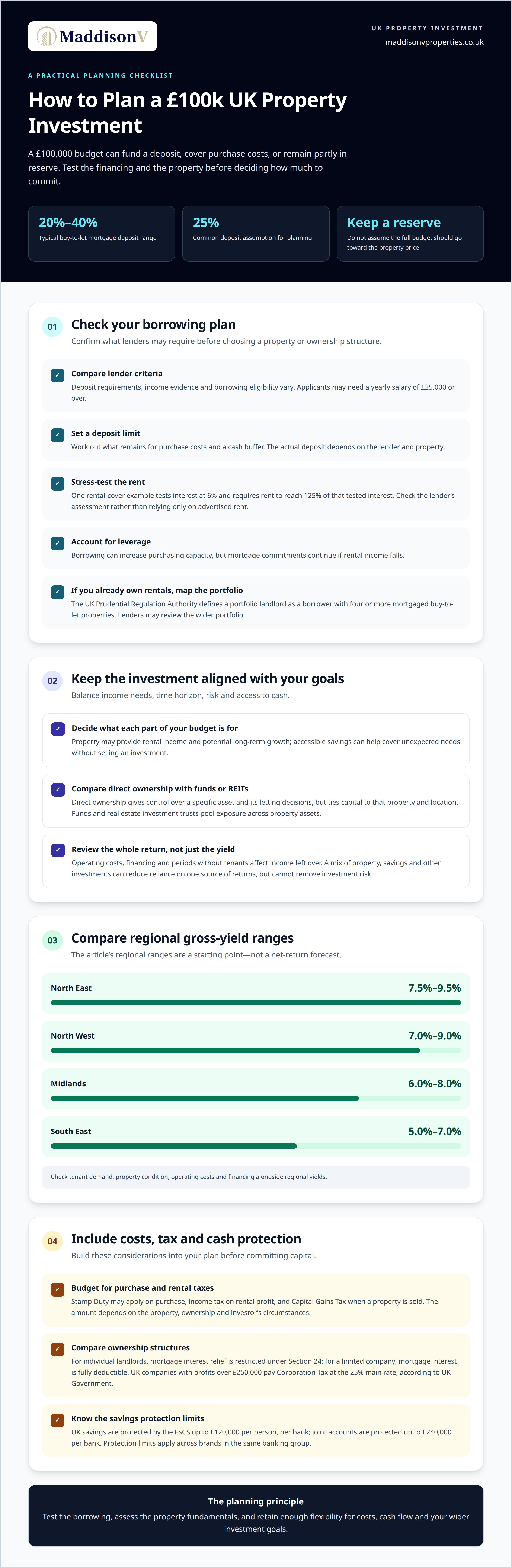
Compare regional yields alongside tenant demand, property condition and the role each asset would play. Typical gross yields are 7.5%-9.5% in the North East, 7.0%-9.0% in the North West, 6.0%-8.0% in the Midlands, and 5.0%-7.0% in the South East. These ranges are a starting point, not a net-return forecast: operating costs, financing and periods without tenants affect the income left over.
Spread exposure across locations or property types when that suits your budget. A portfolio relying on one local rental market may be more exposed to changes in demand there. Property sourcing can help identify options that fit a considered portfolio strategy.
-
Consider investment risk and diversification
Keep a defined reserve rather than placing every pound into property. UK savings are protected by the FSCS up to £120,000 per person, per bank; joint accounts are protected up to £240,000 per bank. Check whether separate banking brands share the same banking group, since protection limits apply across that group.
Review how interest rates, rental gaps and repairs could affect cash flow. A mix of property, savings and other investments can reduce reliance on one source of returns, though diversification cannot remove investment risk. Revisit your allocation if your income needs or time horizon changes.
Assessing investment timeframe, income needs, and risk tolerance
Before allocating £100,000, decide when you may need the capital and what income it must produce. These choices shape the property, financing and reserve strategy.
- Set a clear investment timeframe before viewing properties. If you may need the money within a couple of years, keeping it in cash can help avoid selling a property at an inconvenient time. With a longer horizon, consider whether rental income and potential property growth fit your plans. Write down when and why you might need to withdraw money, such as to fund a home purchase or supplement retirement income.
- Calculate the income you need, then distinguish rental income from possible future gains. A landlord relying on rent for regular expenses needs a different cash-flow plan from an investor who reinvests rental proceeds. Allow for periods without tenants, repairs and mortgage payments when estimating usable income. For example, if rent pauses during repairs, accessible savings can help meet ongoing commitments without forcing a sale.
- Test how much fluctuation you can accept before committing to one asset. Property is less readily sold than listed stocks, and a sale may take time while costs continue. Stocks can also fall in value, but offer a different kind of exposure and are usually more readily traded. Compare each asset’s role in your wider finances rather than treating either as a guaranteed source of income.
- Write down the risks that could change your decision, then set a review point. For a rental property, consider tenant turnover, maintenance, borrowing costs and local demand. A fall in rent or an unexpected repair, for example, could reduce income available for other goals. Decide in advance which changes would prompt you to retain, refinance or sell the asset. An independent assessment can help clarify assumptions, especially when property makes up a large share of your wealth.
Use these steps to align the investment with your circumstances, not just a projected yield. A plan for income, access to capital and acceptable risk makes it easier to judge whether a specific UK property fits your goals.
Due diligence on developers, locations, tenants and letting strategies
Before purchase, identify the rules that apply to the property’s UK nation, local authority and intended letting arrangement. Assess licensing, property safety and tenancy requirements in England, Scotland, Wales or Northern Ireland before setting your rental strategy.
- Review the developer’s record and the specific property before committing capital. Examine completed projects, construction progress, proposed handover arrangements and the documents describing the property. Compare sales assumptions with evidence for the location rather than relying on projected demand alone. For an off-plan purchase, understand what happens if completion dates or specifications change. A careful review helps distinguish the development’s stated prospects from the risks attached to delivery.
- Assess the location through tenant demand, transport, nearby services and the condition of competing rental homes. A headline yield cannot show whether a property will attract suitable tenants or require substantial maintenance. Zoopla data showed Liverpool house prices had grown by over 20% over the last five years, while Birmingham prices had grown by around 19.96% over the same period. These past figures are context, not a forecast of future capital growth or rental performance.
- Model the rental strategy around likely tenants and the property’s layout. A single-let home, shared accommodation and student rental each require different management, maintenance and occupancy assumptions. Estimate rent using comparable properties, then account for possible voids, repairs and ongoing costs before comparing income with mortgage payments. Check whether the expected rent remains workable if a tenant leaves or the property needs attention between tenancies. This gives a more grounded view of cash flow than assuming full occupancy.
- Set a due-diligence checklist covering legal, safety and financial considerations before making an offer. In England, Scotland, Wales and Northern Ireland, establish the relevant local licensing route and property safety obligations, then understand the tenancy framework for the proposed let. Requirements depend on jurisdiction, local authority and property use, so record the applicable checks before marketing the home. Also plan how to handle the tenant’s deposit under the relevant rules, and consider sourcing appropriate landlord cover through independent brokers like justquoteme.co.uk to protect your investment.
- Stress-test the purchase against your available equity and remaining cash. Include the deposit, acquisition costs, initial repairs and a reserve for maintenance or vacant periods. If all available capital goes into completion, for example, an unexpected repair may require additional funds while rent is interrupted. Review the full calculation alongside your intended letting approach, so projected income supports a realistic operating plan.
Off-plan property investments
Off-plan means buying a property before construction is complete. If you’re considering how to invest £100k in UK property, assess the project’s delivery, resale assumptions and time before rental income begins. This route may suit investors planning ahead, provided the investment case accounts for the development’s specific risks.
- Set a maximum purchase budget using a cautious resale estimate, not the developer’s headline valuation. Treat that calculation as a reference point, not a guaranteed sale price. Compare the proposed purchase figure with your limit, then account separately for purchase costs and any work needed before letting.
- Review the developer and development documents before committing funds. Compare the stated specification, completion terms and payment schedule with your investment plan. Identify what the contract says about delays, changes to the development and handover arrangements. An off-plan development may come with a 10-year build warranty, but read its terms carefully. A warranty should not be treated as protection against every investment risk.
- Stress-test projected yields against the expected completion and letting timeline. Rent may not begin until the property is handed over, completed and ready for tenants. Estimate income using comparable homes in the same location, then account for ongoing costs and possible periods without a tenant. Avoid relying on projected yields alone: lower rent or delayed completion can change the property’s cash-flow profile.
- Reduce optimistic assumptions before deciding whether the project suits your investment budget. A developer-profit allowance of 25% to 30% can help estimate a purchase budget from projected resale value. Where appropriate, reduce expected project profit to 15%-20% in your calculation. Test whether the investment still works if the resale value falls or costs rise, rather than relying on a single best-case scenario.
- Compare off-plan ownership with other investments, including shares and completed rental property. Off-plan gives exposure to a specific estate or development, while shares represent a different asset and completed homes may generate rent sooner. Consider how long your capital will be committed and whether you can cover costs before completion. A practical plan for how to invest £100k in UK property weighs those trade-offs against your income goals. Explore off-plan investment opportunities as part of a carefully assessed property strategy.
MaddisonV Properties: Off-Plan Investment Opportunities
MaddisonV Properties helps investors assess off-plan opportunities against their budget, income goals and investment timeframe. Its property sourcing supports the search for a suitable purchase, while mortgage consultations help investors consider financing alongside the deposit and remaining costs.
Before committing, weigh the development’s assumptions, delivery details and potential rental strategy. If you already own property, MaddisonV Properties’ Property Management can support the ongoing responsibilities of a rental investment after completion. The right combination depends on your plans, whether you’re considering a first purchase or adding to a portfolio.
For a considered discussion of your UK property investment plans, contact MaddisonV Properties.
Turn your investment priorities into a clear next step
If you’re deciding how to invest £100k in UK property, make your next move a focused one. Set out what you want the investment to achieve, how involved you want to be, and which compromises you’re prepared to accept. That brief can help keep the search aligned with your priorities, rather than letting an appealing development or projected return drive the decision.
From there, identify the type of property and investment structure that best fits your plans. A considered discussion can help shape your next steps, whether you’re exploring a first purchase or refining an existing strategy. Turn your aims into practical criteria before progressing, and keep decisions anchored to the outcomes that matter to you.
Contact MaddisonV Properties to discuss your UK property investment plans. A thoughtful first step can bring greater clarity to the opportunities ahead.
Frequently Asked Questions
What’s the Best Way to Invest £100k?
There isn’t one best route for every investor. Start by deciding whether you prioritise rental income, potential growth, liquidity or a balance of these aims. A buy-to-let purchase may suit someone seeking rental income and comfortable with property ownership responsibilities. Someone who values easier access to invested capital may prefer to keep more money in savings or consider other asset types.
Why Invest in Property?
Property can provide rental income and exposure to a physical asset, with potential for value growth over time. It also brings responsibilities, including maintenance, tenant turnover and periods without rent. Property is less readily converted into cash than savings, so consider how long you can commit the funds. Compare expected rental income with ownership costs before treating it as an income source.
How do I invest my money?
Begin by listing your financial goals, the timeframe for each and the amount of capital you can leave invested. Then compare suitable options, such as rental property, savings, pensions, ISAs and other investments. For a property purchase, assess financing, location, tenant demand and ongoing costs before making an offer. Keep money for near-term needs accessible rather than tying it all up in one asset.
Should I see a financial advisor?
An independent financial adviser can help assess how property fits your broader finances, tax position and future plans. This is particularly useful if you’re weighing rental property against pensions, ISAs or other investments. Prepare a clear outline of your goals, existing commitments and cash-access needs. Mortgage consultations address property finance, while broader investment recommendations call for advice that considers your overall financial circumstances.
What UK property investment strategies are available with £100,000?
Options include buying a single-let property, investing in a house in multiple occupation, considering purpose-built student accommodation, or using £100,000 towards a deposit with a mortgage. Off-plan property is another route, though rental income generally follows completion and preparation for letting. Gross yield ranges in the research are 4.0%-7.0% for standard single-lets, 9.0%-15.0% for HMOs and 7.0%-9.0% or higher for purpose-built student accommodation.
How much deposit and additional costs are needed to buy a UK rental property?
Buy-to-let mortgage deposits are typically 20% to 40% of the purchase price, with the precise amount shaped by lender criteria and the property. Reserve capital separately for purchase costs, repairs and periods without rental income. A deposit is not the full cash requirement. For a clear budget, calculate the mortgage deposit first, then account for transaction costs and the funds needed to operate the property.
Where in the UK can £100,000 buy a property with strong rental yields?
£100,000 may be enough to buy one well-chosen rental house in Leeds or Sheffield, covering purchase costs and leaving a buffer. Compare individual properties rather than choosing a city by yield alone: tenant demand, condition and ongoing costs affect the income retained. Some strategies, such as a shared rental, may show higher gross yields but require different management and occupancy assumptions.
What are average UK buy-to-let rental yields and property prices by region?
Typical gross yields vary by region: the North East is 7.5%-9.5%, the North West 7.0%-9.0%, the Midlands 6.0%-8.0% and the South East 5.0%-7.0%. These are gross figures, before costs. Prices and achievable rents vary between locations and property types within each region.

Sign Up Now
Want to read more great articles and blogs subscribe to our newsletter