
A mortgage application is judged on more than income alone. Knowing what documents are needed for a UK mortgage application means preparing proof of...

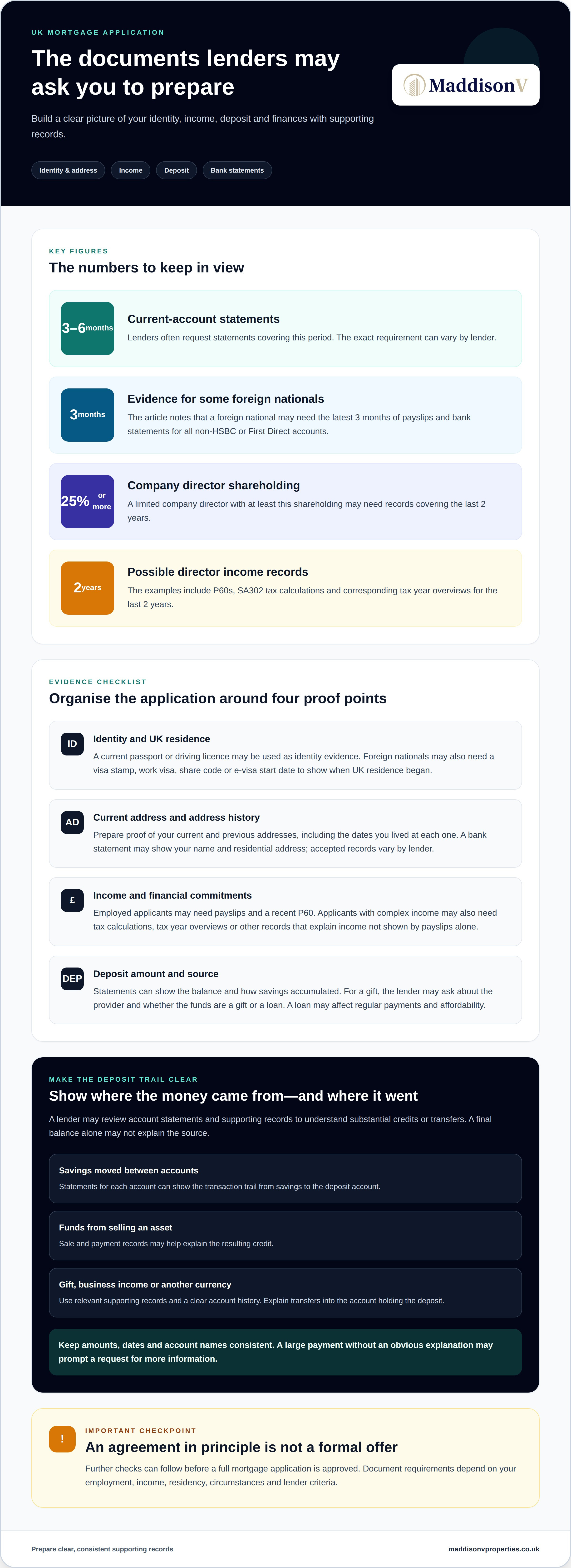
A mortgage application is judged on more than income alone. Knowing what documents are needed for a UK mortgage application means preparing proof of identity and address, evidence of your deposit and income, and bank statements. Lenders often request current-account statements covering three to six months, alongside payslips or self-employed income records.
It’s understandable to want a clear list before you begin. The documents required can vary according to your employment, income and circumstances, but organising the core evidence helps you present a complete picture of your finances.
This guide explains which records lenders may request, how requirements differ for employed and self-employed applicants, and what formal checks can follow an agreement in principle. It also covers applications from foreign nationals, so you can approach the process with greater clarity.
Key Takeaways
- Prepare identity and address records alongside evidence of your income, deposit and financial commitments.
- Keep documents that show where your deposit came from, as well as the amount available for the purchase.
- Self-employed applicants may need tax calculations, tax year overviews and accounts to support their income.
- Bank statement requirements can vary; lenders often request current-account statements covering three to six months.
- An agreement in principle is not a formal mortgage offer. Expect further checks before a full application is approved.
What documents do I need to apply for a mortgage?
If you’re asking what documents are needed for a UK mortgage application, prepare evidence of your identity, address, income and deposit. The specific records depend on your residency, employment and the lender’s criteria.
Identity Evidence
Identity evidence confirms your name and identity for a mortgage application. A current passport or driving licence may serve as proof. The lender uses these details to match your application with supporting records and review your credit information. Keep your name consistent across documents. If it has changed, explain the difference and provide supporting evidence when requested.
For foreign nationals, records showing UK residence may also be relevant. A valid passport with a visa stamp or work visa showing the UK entry date, or a share code or e-visa start date, can evidence when UK residence began.
Address Evidence and History
Address evidence connects your identity to your current home, while address history lists where you have lived. Lenders may request proof of your current and previous addresses, including the dates you lived at each one. Provide the period requested and lay out the information clearly.
A bank statement may show your name and residential address, although accepted documents vary by lender. If you’ve moved recently, make sure your application and records reflect the change. A clear address history helps the lender review your credit information and understand your circumstances.
Additional Documents for Complex Finances
Additional documents support an application when residency or income needs further evidence. A foreign national applying for a UK mortgage may need the latest 3 months of payslips and the latest 3 months of bank statements for all non-HSBC or First Direct accounts. The relevant residence evidence can help establish the start date of UK residence.
Applicants with complex income may also need tax calculations, tax year overviews or P60s. For example, a limited company director with 25% or more shareholding may need the last 2 years’ P60s, SA302 tax calculations and corresponding tax year overviews. These documents help explain income that payslips alone may not show.
Document Submission Steps
A mortgage adviser can guide you through preparing documents and submitting them with an application. They can review your circumstances, identify relevant evidence and help organise records to support the information you provide. This can be useful when your income, residency or address details involve several documents.
An adviser can also help you understand a lender’s request for further information and coordinate a response. For example, if a lender asks for clarification about an address or income record, the adviser can explain which evidence relates to the request. A consultation can clarify what documents are needed for a UK mortgage application in your circumstances and help you prepare a coherent file.
Deposit evidence
Deposit evidence shows the funds available for your purchase and how they were accumulated. Lenders may ask for records linking the deposit amount to its source, such as savings or a family gift.
Savings and Gifted Deposits
Savings evidence documents money you have built up and intend to use towards the deposit. Account statements can show the balance and the transactions that contributed to it. For example, regular transfers from an income account to a savings account create a visible trail. The aim is to make the origin and availability of the funds clear.
A gifted deposit comes from someone else rather than your own savings. The lender may request information about the person providing it and documents explaining the gift. The precise evidence depends on the circumstances, including whether the funds are a gift or a loan. A loan may affect your regular payments and affordability assessment, so its terms matter.
Evidence of Deposit Source
Evidence of the deposit source traces the funds from their origin to the account holding them. A lender may review account statements and supporting records to understand substantial credits or transfers. For example, savings transferred between accounts may need a clear transaction trail across both accounts, rather than a statement showing only the final balance.
Other sources may require different supporting documents. If funds come from selling an asset, relevant sale and payment records may help explain the credit. If business income contributed to your savings, income evidence such as a tax year overview may provide context alongside the account history. These are possible supporting records, not a fixed checklist for every application.
Keep amounts, dates and account names consistent across the records you provide. If a transfer passes through several accounts, statements for each can show its route. A large payment without an obvious explanation may prompt a request for more information. A short, factual explanation can link the transaction to its supporting record, such as a completed sale or family gift.
Funds held in another currency may also need a clear account history and an explanation of any transfer into the deposit account. The lender needs to understand what is available for the purchase, not just see an isolated balance. Organised evidence can make the assessment more straightforward, while unexplained transfers may lead to follow-up requests and delays.
For tailored help understanding deposit evidence alongside your wider mortgage application, explore mortgage consultations.
Self-employed income evidence
Income evidence shows how much you earn and how regularly you receive it. Records differ for employed applicants, freelancers and business owners, because each income pattern needs different supporting documents.
Employed applicants may need payslips and a recent P60, which records annual employment income. UK mortgage lenders often ask for the last three months of payslips. For a residential mortgage, an employee paid weekly may need the latest 4 payslips for basic income, including permanent allowances, or the latest 6 payslips for shift allowance.
Pay frequency can change the payslip evidence. An employee paid fortnightly may need the latest 2 payslips for basic income, including permanent allowances. An employee paid annually may need the latest 2 equivalent payslips or award letters showing variable income. For shift allowance, an employee paid four-weekly may need the latest 3 payslips. A foreign national may need the latest 3 months of payslips.
Yes, lenders may ask for evidence of additional income included in their assessment. For variable employment income, award letters or payslips may support the figures. Buy-to-let applicants may need pension records or tax documents, depending on their circumstances.
Self-employed income evidence is paperwork used to demonstrate earnings from a business or freelance work. Lenders may ask for two to three years of accounts prepared by a professional accountant, alongside an SA302 tax calculation and bank statements. These records allow income figures to be considered alongside business accounts and tax information.
For a sole trader, general partnership or limited liability partnership with fewer than 200 partners, evidence may include tax year overviews and tax calculations. These can be evidenced by an HMRC printout, an SA302, or an accountant’s computation submitted to HMRC. A limited company director with 25% or more shareholding may need the last 2 years’ P60s, SA302 tax calculations and corresponding tax year overviews.
Shorter trading histories have different evidence requirements. A self-employed applicant trading for less than 2 years may need at least 1 year’s finalised financial accounts, or 1 year’s tax calculations and tax year overviews, dated within the past 18 months. This gives the lender a documented view of the available income, even when a longer trading record isn’t available.
Document requests depend on income type and pay frequency, so an adviser can help identify which records fit your circumstances. For example, a freelancer’s accounts and tax calculations differ from an employee’s payslips, while pension or rental income may need its own supporting records.
How many months bank statements might I need for a mortgage application?
A bank statement records account balances and transactions over a defined period. UK mortgage lenders often ask for current-account statements covering three to six months, showing incoming funds as well as regular spending.
For a foreign national applying for a UK mortgage, the latest 3 months of bank statements may be required for all non-HSBC or First Direct accounts. That means statements should cover each relevant account, not only the account used for salary payments. Accounts held abroad may also help explain income transfers or funds moving between accounts.
Statements let lenders review regular outgoings, including credit repayments and bills. A monthly loan payment, credit card repayment or household bill may appear alongside income and other transactions. These payments give context for affordability, while recurring commitments across accounts help present a fuller picture of your finances.
For a clear record, provide statements covering the complete period requested, with the account holder’s name and transaction history visible. For example, if your salary reaches one account before being transferred to savings, statements for both accounts can show how the funds moved. A balance alone may not explain a transfer or large credit; the transaction trail adds useful context.
Deposit evidence links the funds intended for the purchase to their source. Statements may show savings building over time, a transfer from another account or receipt of a gift. If the deposit passes through multiple accounts, linked statements can help trace its route. Supporting records may explain a payment that the statement itself cannot clarify.
Some interest-only applications also involve statements for other UK-based investments. For these applications, the value of investments such as unit trusts, OEICs, investment bonds, shares or gilts is assessed at 50% of the value on the latest account statement. The statement therefore provides evidence of the asset value used in that assessment.
Before submitting, arrange statements by account and date, then check that the requested period is complete. Keep related records together, such as statements showing a transfer and the document explaining its source. This makes it easier to follow income, regular payments and deposit funds across the accounts involved, rather than relying on an isolated balance or partial transaction history.
Formal mortgage application checks
Formal mortgage application checks are the lender’s detailed review of your documents and circumstances before it decides on a full application. A mortgage in principle is an initial decision, not a formal mortgage offer. The lender still needs to carry out further checks before approving the full application.
A mortgage in principle may arrive instantly or within 24 hours, but it doesn’t confirm that a full application will be accepted. At the formal stage, lenders review the information provided and may request further evidence to resolve gaps or clarify details. For example, a difference between declared income and supporting records can prompt a follow-up request.
Your documents should support a consistent account of your income, regular commitments and available funds. Lenders may ask for details of outgoings, including credit repayments and bills. These commitments affect affordability and help the lender assess whether the proposed mortgage repayments fit your circumstances.
For a residential application, some evidence depends on pay frequency and income type. An employee paid four-weekly may need the latest 3 payslips to evidence shift allowance. If an allowance varies, the lender can use the requested records to understand how it appears across pay periods, rather than relying on a single payment.
Buy-to-let applications have distinct evidence requirements. An employed applicant with no existing buy-to-let mortgages or rental income may need one month’s payslips dated within the last 35 days. If the applicant already has a buy-to-let mortgage or rental income, the lender may request the latest year’s tax calculation and corresponding tax year overview.
Pension income can also require supporting documents in a buy-to-let application. An applicant with no existing buy-to-let mortgages or rental income may need the latest annual pension statement, a pension payslip or the latest P60 as evidence. These records help explain the income source and amount being considered.
Responding clearly to a lender’s document request helps keep the formal review moving. If the lender asks about a particular payment, provide relevant evidence and explain how it relates to the application. For example, a payslip showing shift allowance should support the income figure declared, while tax records should correspond to the income being assessed.
Mortgage consultations can help bring application details and supporting evidence into alignment before submission. Arrange mortgage consultations for guidance on preparing for lender checks and responding to document requests.
MaddisonV Properties: Mortgage Consultations
MaddisonV Properties offers Mortgage Consultations for applicants preparing a UK mortgage application. If your income, residency or deposit involves several records, a consultation can help clarify which documents are relevant to your circumstances and how they support your application.
Bring questions about lender requests, payslips, tax calculations or bank statements to the discussion. You can also seek guidance before applying, while deciding what evidence to organise, or after receiving a request for further information. Clear preparation makes it easier to present a consistent picture of your finances.
For support with your mortgage application, contact MaddisonV Properties.
Take the Next Step with Clarity
A mortgage application is one part of a broader property decision. Use your understanding of what documents are needed for a UK mortgage application to discuss your plans with a clear view of your financial position and next priorities. This can help connect borrowing considerations with the property you intend to buy and how you plan to own it.
MaddisonV Properties offers Mortgage Consultations for mortgage planning, alongside Property Sourcing to find a property and Property Management for ongoing ownership needs. These services can support different stages of your property journey, from shaping a purchase brief to considering longer-term management.
Whether you’re preparing for a first purchase or reviewing your wider property plans, a focused discussion can help you identify the right next step. Share your goals and circumstances with MaddisonV Properties to explore support tailored to your plans.
Contact MaddisonV Properties to discuss your next step.
Frequently Asked Questions
How can a mortgage adviser help improve your chances of getting approved for a mortgage?
A mortgage adviser can help present your finances clearly against a lender’s criteria. They can identify parts of your application that may need explanation, such as variable pay, multiple income sources or a recent change in employment. They can also help organise supporting documents and communicate with the lender if it requests clarification. A well-prepared application gives the lender a clearer basis for assessing your circumstances.
How do lenders check I can afford a mortgage?
Lenders assess whether your income and existing financial commitments support the proposed repayments. They review declared earnings alongside regular outgoings, such as credit repayments and household bills, to understand what remains available. For example, a recurring loan payment affects the monthly budget differently from a one-off transfer. Accurate figures across your application and evidence help the lender assess affordability using a consistent picture of your finances.
Mortgage timeline: How long does it take to get a mortgage?
A mortgage in principle can arrive instantly or within 24 hours, but it isn’t a formal mortgage offer. The full application involves more detailed checks, and its progress depends on the completeness of the file and any further information the lender requests. For example, an unexplained transaction or a missing document can require follow-up before assessment continues. The mortgage process also includes steps beyond the lender’s initial decision.
How do I know if I can get a mortgage?
A mortgage in principle gives an initial indication based on information about your finances, but it isn’t final approval. During the formal application, lenders assess factors such as income, regular commitments, deposit evidence and the property involved. For example, an applicant with variable earnings may need different supporting records from someone with a regular salary. A mortgage adviser can discuss your circumstances and help you understand what information lenders will assess.
What documents do UK mortgage lenders require from applicants?
Applicants commonly need identity and address evidence, proof of income, bank statements and documents showing the deposit’s source. The exact combination depends on employment, residency and the mortgage type. For example, an employed applicant might supply payslips and a P60, while a self-employed applicant may use tax calculations and accounts. Keep related records together so transfers, income figures and declared details can be understood in context.
What proof of identity and address is accepted for a UK mortgage application?
A current passport or driving licence may serve as proof of identity, and lenders also request proof of address. Address evidence must support the details in your application, and lenders can specify what they accept. Applicants should also provide a clear address history for the period requested. If a foreign national’s UK residence history is relevant, a visa or electronic immigration record can help evidence when UK residence began.
What income documents do UK mortgage lenders require for employed applicants?
Employed applicants are often asked for recent payslips, and lenders may request a P60 to support annual income. The payslip period can depend on pay frequency and the income being assessed. For example, variable pay such as shift allowance may need evidence across multiple pay periods. A letter or award document can support variable income where relevant. Provide records that correspond to the income figures declared in the application.
What documents do self-employed applicants need for a UK mortgage?
Self-employed applicants may need accounts, SA302 tax calculations and tax year overviews to evidence their earnings. The records requested depend on business structure, trading history and shareholding. For example, a sole trader’s tax documents differ from those required of a limited company director with a substantial shareholding. Lenders can also ask for bank statements to support income. Keeping accounts and tax records for the same periods helps clarify how earnings are presented.

Sign Up Now
Want to read more great articles and blogs subscribe to our newsletter