
A stable property price doesn’t guarantee a stable investment cost. Exchange-rate movements can change how much you pay in your home currency, which...

A stable property price doesn’t guarantee a stable investment cost. Exchange-rate movements can change how much you pay in your home currency, which is the central concern behind currency risk in UK property investment. Hedging can manage that exposure by fixing an exchange rate in advance or setting conditions for a future conversion.
It’s natural to focus first on the property itself: its location, value and potential rental income. But if your funds are held in another currency, movements between that currency and sterling can also affect your budget and the amount you ultimately invest.
This guide explains how currency hedging works, how exchange-rate movements can affect the cost of buying UK property, and how tools such as forward contracts, limit orders and currency options differ. You’ll also see how to weigh the certainty a hedge may offer against its cost and the possibility of benefiting from a favourable rate. The aim is to help you understand your choices and assess which approach may suit your purchase or wider property portfolio.
Key Takeaways
- A currency hedge can help make a future property payment more predictable, but the right approach depends on when funds are needed and how much exchange-rate movement you want to manage.
- Compare forward contracts, limit orders and currency options by how they balance rate certainty, flexibility and potential costs.
- Assess a UK property’s cost in your home currency, not only its sterling purchase price; exchange-rate shifts can change the amount you need to fund.
- For portfolios and development projects, consider currency exposure across purchase payments, financing, rental income and eventual sale proceeds.
- Historical GBP/USD movements show why relying on a single forecast can be risky; align any hedging approach with your investment horizon and cash-flow plans.
What is currency hedging?
Currency hedging is a way to manage exchange-rate exposure on future property payments. A US buyer might agree to convert dollars into sterling at a set rate for a planned purchase. This can make the sterling amount easier to budget for in dollars, though it doesn’t remove property-market risk. Hedging manages uncertainty; it doesn’t guarantee a better exchange rate.
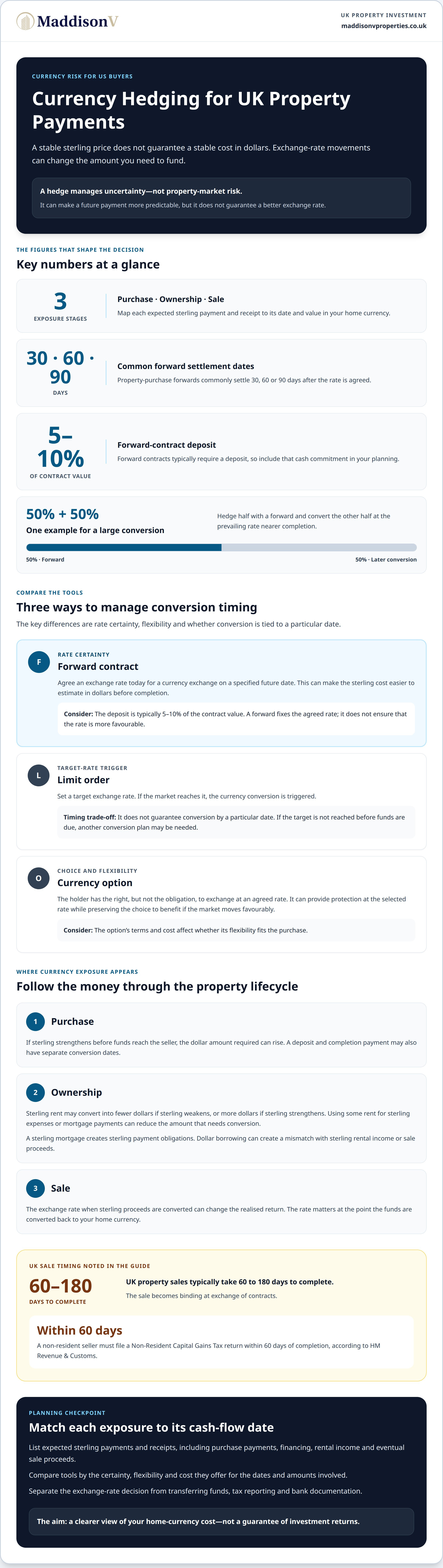
Currency exposure can arise at three stages: purchase, ownership and sale. At purchase, sterling may strengthen before funds reach the seller, increasing the dollar amount required. The same sterling price can therefore result in a different cost in your home currency.
For US investors, how do UK property prices and rental yields compare across London and other regions? London generally has higher purchase prices, while other UK regions can offer lower entry costs. Rental yields depend on the property’s price, rent and location, so compare expected income with the cost in dollars, not sterling alone.
A hedge can also matter during ownership. Rental income received in sterling may convert into fewer dollars if sterling weakens, while a stronger pound may increase its dollar value. If expenses or mortgage payments are also due in sterling, using some rental income to cover those outgoings can reduce the amount you need to convert. The right balance depends on your currency needs.
How do UK mortgage options and interest rates affect currency risk for foreign property investors? A sterling mortgage creates sterling payment obligations, and interest rates affect the size of those payments. Exchange-rate movements then change their cost in dollars. Borrowing in dollars instead can create a mismatch between dollar debt and sterling rental income or sale proceeds.
On sale, the investor converts sterling proceeds back into their home currency, so the exchange rate can change the realised return. UK property sales typically take 60 to 180 days to complete, and the sale becomes binding at exchange of contracts. A non-resident seller must file a Non-Resident Capital Gains Tax return within 60 days of completion, according to HM Revenue & Customs.
Hedging decisions should account for timing and cash flow. A buyer expecting to pay a deposit before completion may face separate conversion dates, while an owner receiving rent has recurring exposure. Map each expected sterling payment and receipt against its date and value in your home currency. This helps identify which exposures matter most and where a hedge could make costs more predictable.
Forward contracts, limit orders and currency options
Three common tools help overseas buyers manage conversion timing: a forward contract, a limit order and a currency option. Each handles uncertainty differently. A forward prioritises a known rate for a future payment; a limit order waits for a chosen rate; an option gives the buyer a choice. The right fit depends on the payment date, amount and flexibility you need.
A forward contract agrees an exchange rate today for a currency exchange on a specified future date. Property-purchase forwards commonly settle 30, 60, or 90 days after the rate is agreed. This can help an investor estimate the sterling cost of buying before completion. Forward contracts typically require a deposit of 5-10% of the contract value, so the buyer must account for that cash commitment.
A limit order sets a target exchange rate. If the market reaches that level, the currency conversion is triggered. For example, a US buyer who needs sterling could set a target rate and wait rather than convert immediately. Unlike a forward, a limit order doesn’t guarantee that the payment will be completed by a particular date. If the target isn’t reached before the funds are due, you may need another conversion plan.
A currency option gives its holder the right, but not the obligation, to exchange at an agreed rate. It can preserve flexibility if the market moves favourably, while offering protection at the selected rate. The option’s terms and cost affect whether that flexibility suits the purchase. A buyer may also divide a large conversion: one example hedges 50% with a forward and converts the remaining 50% at the prevailing rate nearer completion.
For UK currency controls and repatriation, separate the exchange-rate decision from the movement of funds. A hedge sets terms for converting currency; it doesn’t itself transfer sale proceeds or determine tax reporting and bank documentation. Plan the intended route for sterling proceeds, the receiving account and the timing of any conversion. These details matter especially when rent or sale proceeds will support payments in another currency.
How do UK rental income and property-sale proceeds get taxed in the UK and the US? The UK taxes non-residents on gains from property sales. According to the Internal Revenue Service, US citizens owe tax on worldwide income, including profits from UK property; rental income and sale gains should be treated as distinct reporting items.
Where rental receipts need ongoing oversight, property management for UK rental income can help keep the property’s operating cash flow in view alongside currency planning.
How exchange-rate movements affect UK property costs for US buyers
For a US buyer, the dollar budget for a UK purchase changes with the GBP/USD exchange rate. The final amount depends on the rate when each sterling payment is converted.
Exchange-rate effects on property costs
An exchange-rate movement changes the dollar amount needed to pay a fixed sterling price. Movements of 10-15% over a property transaction are not unusual, so a budget based on the offer-date rate may not cover completion. A 5% rate change can mean thousands of dollars difference. Allowing for the rate at each payment date helps separate the agreed property price from its changing dollar cost.
Consider the payment schedule, not just the purchase price. You may need to convert funds for a deposit, later instalments and completion, each at a different exchange rate. If sterling strengthens between those dates, each remaining payment requires more dollars; if sterling weakens, fewer dollars may be needed. Mapping expected payment dates against available funds shows where the greatest exposure lies.
Property costs can extend beyond the seller’s price. Stamp Duty Land Tax, legal expenses and property-related charges may be payable in sterling, creating additional conversion needs. A US investor can build a dollar budget by listing each expected sterling outlay and its due date. This helps assess how much working cash to keep available if the exchange rate moves before payment.
Conversion and international transfer costs
Currency conversion and transfer costs include the exchange-rate spread and any transfer fee. For a property purchase, both reduce the funds ultimately received in sterling, so compare the total amount delivered rather than the advertised rate alone.
Digital banks may offer spreads of 0.0-0.5% within limits. Large international transfers may need at least 3-5 business days to clear, while specialist services can sometimes complete in one to three business days.
Those timings affect when a buyer should arrange conversion. A conveyancer’s completion date and the receiving account’s processing time both matter; funds arriving late can disrupt a scheduled payment. Build the transfer window into the purchase timetable, and allow time for identity checks when opening an account with a specialist foreign-exchange provider. Verification can take 2-3 business days.
For a clearer comparison, calculate the dollars required, the sterling amount to be received, the quoted rate, all transfer charges and the expected arrival date. A forward contract may suit a known future payment, while a spot conversion leaves you exposed to the rate until the transfer is made. Matching the method to each payment date helps keep your funding plan on track.
Managing forex risk in property portfolios and development projects
A single exchange can affect more than the purchase price. For global investors, currency volatility may alter project costs, rental income, debt payments and eventual sale proceeds. A portfolio review should map each foreign-currency asset against its expected cash flows, then identify where sterling movements could change the investment outcome.
Consider a developer funding a UK project from overseas. Land acquisition, construction payments and later rental receipts may fall on different dates, so one conversion decision won’t cover every exposure. A practical review separates committed costs from future income, records each currency and payment date, then considers which amounts need a known exchange rate. This keeps project budgeting aligned with the actual schedule.
Historical returns show how currency can reshape property performance. In 2016, unhedged Japanese investors received a -16% return on UK property when measured in yen. The underlying asset’s sterling performance and the yen exchange rate both influenced the result. For a global portfolio, reviewing returns only in the property’s local currency can therefore miss the outcome experienced by the investor.
Different hedge ratios offer different balances between certainty and flexibility. An international property investor may hedge 60% or 80% of overseas investments rather than 100%; some real estate managers have used a 100% capital-hedged approach. A partial hedge leaves some exposure to market movements, while a full hedge prioritises a more predictable home-currency value. The decision should reflect cash needs, investment horizon and tolerance for volatility.
A currency swap can help manage longer-term exposure. In one example, one party receives £100m while the other receives $125m, exchanging at $1.25 to the pound. A swap can also exchange currencies back at the original rate when the agreement matures. Depending on its structure, it may protect equity value and provide periodic investment returns. Its terms need to match the project’s funding and expected cash flows.
Portfolio-level decisions should also account for hedge costs and the property’s income profile. Staffordshire Pension Fund considers hedging overseas property unsuitable for efficiency and simplicity, partly because valuations are volatile and hedging has a cost. It considers certain overseas long-lease property funds suitable for hedging based on their income streams. This illustrates why asset type and cash-flow reliability matter alongside exchange-rate views.
For a development or portfolio review, group exposures by purpose: committed capital, operating income, debt and planned exit proceeds. Then compare a fully hedged position with partial coverage and no hedge across the investment horizon. Over 20+ years, the difference between fully hedged and unhedged returns can compound into a significant disparity. A consistent policy makes those trade-offs visible before each transaction.
What are the historical GBP/USD exchange-rate trends and forecasts relevant to UK property investment?
GBP/USD has moved through wide ranges, making historical context useful when planning a UK purchase. In the past decade, the pair ranged from approximately 1.04 to over 1.40, a range described as 35%. For a US investor, that movement changes the dollar value of sterling property prices, rental receipts and sale proceeds. A past rate can provide context, but it doesn’t set the rate for a future transaction.
Major events have coincided with sharp changes. The 2016 Brexit referendum triggered a 15-20% fall in sterling against the US dollar and euro. During the 2022 mini-budget crisis, GBP/USD briefly fell below 1.04. These examples show why a purchase budget built around one historical exchange rate may become outdated before funds are converted.
The relationship between GBP/USD and purchasing power parity also deserves attention. During the 16 years discussed in the report, the exchange rate deviated substantially from the rate implied by purchasing power parity. For property investors, this means a comparison based only on long-term economic benchmarks may not reflect the rate available when a deposit or completion payment is due.
Forecasts are most useful as planning scenarios, rather than as a single rate to rely on. A buyer can model the sterling purchase price at several exchange rates, then see how each scenario changes the dollar budget. Apply the same approach to staged payments, mortgage obligations, rental income and eventual sale proceeds. This makes the effects of a stronger or weaker pound visible across the investment lifecycle.
Timing matters because property cash flows are linked to specific dates. A buyer with a known completion date can compare the rate available now with the rate needed for the future payment. For investors tracking currency momentum, educational resources from TradingPRO can help clarify broader trend direction and price structure. For a longer project, review each expected funding stage separately rather than assuming one forecast will remain relevant throughout. The property’s sterling value and the investor’s dollar return are related, but they are not the same measure.
A disciplined review can focus on three questions: how much sterling must be paid, when each payment falls due, and how much dollar movement the budget can absorb. If a 5% exchange-rate change would materially alter affordability, rate protection may deserve consideration. If the investment horizon is long, the plan should also account for future income and exit proceeds, not just the initial purchase.
Use these historical ranges to shape a clear funding strategy, then align the property search with the budget and investment horizon. Explore UK property investment opportunities with a plan that accounts for currency exposure as well as the asset itself.
MaddisonV Properties: Off-Plan Investment Opportunities
MaddisonV Properties helps overseas buyers explore off-plan investment opportunities in London and assess how a property fits their investment plans. For buyers exposed to exchange-rate movements, aligning the expected purchase timetable with currency funding decisions can clarify the sterling budget and payment schedule.
Property sourcing can help identify a suitable investment, while mortgage consultations can help buyers consider financing alongside their available funds. After purchase, property management can provide ongoing oversight of the asset. These services support property decisions and ownership needs; currency conversions and hedging remain separate financial considerations.
If you’re considering a UK property purchase and want support with the property side of your plans, contact MaddisonV Properties.
Turn your currency plan into an investment decision
A thoughtful plan for currency risk in UK property investment starts by connecting your financial position with the property decision itself. Set the level of sterling exposure you can accommodate, the cash flow you need to preserve and the role the asset should play in your wider portfolio. This gives you a clear framework for assessing opportunities without letting short-term exchange movements dictate every decision.
MaddisonV Properties offers Property Sourcing to help identify suitable opportunities, Mortgage Consultations to inform financing decisions and Property Management for ongoing ownership needs. These services can support different stages of an investment, while your currency strategy remains tailored to your financial arrangements.
Take the next step with a clear view of your priorities and investment horizon. Contact MaddisonV Properties to discuss the property support that may fit your plans, and move forward with a more considered investment strategy.
Frequently Asked Questions
How does GBP exchange-rate volatility affect returns on UK property investments for US investors?
GBP volatility affects a US investor’s return when sterling results are translated into dollars. A property can rise in sterling while a weaker pound reduces the translated gain; a stronger pound can increase it or raise the dollar cost of funding. Assess property performance and currency movements separately, then combine them to understand your result. This distinction is central to currency risk in UK property investment.
How can US investors hedge currency risk when buying UK property?
US investors can align currency protection with the property’s payment schedule rather than treating the purchase as a single conversion. A known completion obligation may suit a forward, while a flexible target can inform a limit order or option strategy. After choosing an approach, compare the amount hedged with the actual sterling obligation. This helps avoid leaving a payment exposed or committing more dollars than the purchase requires.
How do GBP movements affect UK property purchase affordability, rental income, and resale proceeds in US dollars?
A weaker pound can reduce the dollar cost of a UK purchase, but it can also reduce the dollar value of rent and sale proceeds. A stronger pound has the reverse effect. To assess the whole investment, calculate rental cash flow after sterling expenses and estimate sale proceeds after outstanding sterling debt and disposal costs. This gives you a more useful dollar view than comparing rent or resale price alone.
What currency-risk scenarios should investors model before investing in UK property?
Model a stronger and a weaker pound at purchase, during ownership and at exit. Include a delayed completion, because the conversion date may shift while the sterling obligation remains. For a rental property, test whether dollar income still meets planned needs after sterling costs. For a sale, compare how different exit rates change the dollars available after repaying sterling debt and meeting sale-related outgoings.

Sign Up Now
Want to read more great articles and blogs subscribe to our newsletter