
A wider map can make a portfolio more resilient, but it can also make its risks harder to see. For overseas buyers, UK property investment can reduce...

A wider map can make a portfolio more resilient, but it can also make its risks harder to see. For overseas buyers, UK property investment can reduce reliance on a single country’s property cycle by spreading exposure across markets, but it can’t remove risk or assure stronger returns. Local demand, legal protections, property operations and currency movements all shape the outcome.
It’s natural to look beyond your home market for greater balance, new opportunities or another source of income. The value is not simply in buying UK property, but in understanding how it fits your wider portfolio and how you will manage it over time.
This article explains how UK property exposure may support resilience, what to assess in the local market and how exchange-rate shifts can affect returns. It also covers the practicalities of overseas ownership, from local professional support to ongoing property and portfolio management, helping you weigh opportunity against complexity.
Key Takeaways
- Learn how UK property investment can support a portfolio, and why investing in London does not remove market risk.
- See which local factors matter when assessing London property investment opportunities, including rental yields and capital growth.
- Understand how currency movements can affect rental income, financing and returns when converted to your home currency.
- Explore how local professionals and ongoing management can help address the practical demands of owning UK property from abroad.
- Recognise the legal, political, tax and title issues that can shape a UK property investment before committing capital.
Can UK property investment help me build a more resilient portfolio?
UK property can diversify the countries represented in a portfolio, but it also brings market, currency and management risks. Comparing London with other UK locations shows why location and ownership structure matter as much as asset selection.
UK Property Investment Destinations
UK property investment destinations are cities or regions where investors allocate capital outside their home market. London and other UK locations each offer distinct markets to assess, not interchangeable routes to diversification.
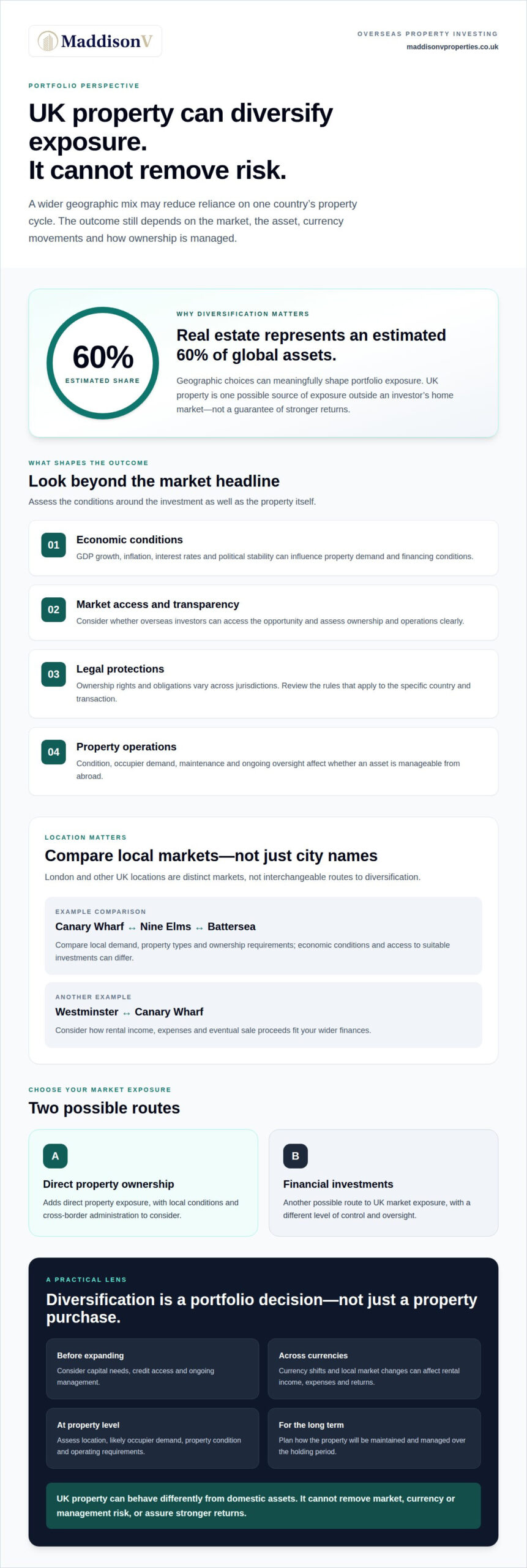
For example, an investor considering property in Canary Wharf can compare local demand and ownership requirements with opportunities in Nine Elms or Battersea. This comparison matters because economic conditions, property types and access to suitable investments can differ between locations. Real estate represents an estimated 60% of global assets, so geographic choices can meaningfully shape exposure.
Factors Shaping UK Property Investment
Economic conditions, market access, legal protections and the practicalities of managing an asset all shape UK property investment. Together, these factors determine whether an opportunity fits an investor’s needs.
GDP growth, inflation, interest rates and political stability can influence property demand and financing conditions. Market transparency and access for overseas investors also affect how clearly you can assess ownership and operations. In London or elsewhere in the UK, an attractive market outlook alone cannot show whether a specific property is accessible, manageable or suitable for your portfolio.
Market Entry and Portfolio Development
Market entry means choosing how to gain exposure to the UK property market and deciding how that position fits alongside your existing assets. The approach matters because direct ownership and financial investments involve different levels of control and oversight.
You might begin with one location, such as London, then assess whether another UK location would genuinely diversify your holdings or simply repeat similar risks. Before expanding, consider capital needs, credit access and ongoing management. Overseas investors can assess direct property ownership or financial investments as possible routes to UK market exposure.
Individual Real Estate Investing in the UK
Individual real estate investing in the UK means purchasing or gaining exposure to property in a UK location. It can add direct property ownership to a portfolio, but requires attention to local conditions and cross-border administration.
When weighing a property in Westminster against one in Canary Wharf, consider how rental income, expenses and eventual sale proceeds fit your wider finances. UK property can behave differently from domestic assets, but currency shifts and local market changes can affect the outcome. A considered UK property investment strategy weighs diversification against the work of overseeing property, capital and credit across locations.
Understanding local real estate markets and working with local professionals
Buying and managing property abroad involves researching the market, assessing the asset, understanding local rules and arranging ongoing oversight. These steps matter because economic conditions, ownership rules and professional practices vary between countries.
Local Market Research and Political Stability
Local market research examines demand, economic conditions, transparency and political stability in the property’s country. These factors help you judge whether expected returns are appropriate for the risks and holding period.
For example, investors can compare GDP growth, inflation, interest rates and legal protections before evaluating a property. Asia-Pacific also shows how cross-border activity varies: cross-border commercial real estate acquisitions represented 36% of the four-quarter moving average in Q2 2020. Overseas buyers’ share of Hong Kong SAR purchases peaked at just over 10%.
Market, Site, and Project Feasibility
Feasibility analysis tests whether market demand, a specific site and a proposed project align with your investment objectives. A strong national outlook alone cannot establish that an individual building or development will perform well.
Assess the property’s location, access, likely occupier demand and operating requirements separately. Then consider how its condition, development plans and expected holding period fit your portfolio. Local professionals can explain neighbourhood conditions and project details that broad, country-level indicators cannot capture.
Foreign-Market Legal and Regulatory Considerations
Foreign-market legal research identifies how local rules affect ownership, transactions and property operations. This matters because a buyer’s rights and obligations can differ substantially across jurisdictions.
In the United States, the U.S. Department of the Treasury identifies Part 802, Regulations Pertaining to Certain Transactions by Foreign Persons Involving Real Estate in the United States, at 802.101 – 802.1108, as Part 802 C.F.R. Part. This illustrates why investors need to understand the rules applying to the specific country and transaction, rather than assume one market’s process applies elsewhere.
Buying and Managing Property Abroad
Buying and managing property abroad means coordinating local market research, transaction review and continuing oversight. A practical sequence is to identify a market, assess a property, review its ownership and regulatory context, then plan how it will be maintained and managed.
Local legal and property professionals can clarify transaction documents, site conditions and operational responsibilities. After purchase, management arrangements help coordinate maintenance, tenant matters and property oversight from a distance. Investors assessing a UK opportunity can explore property sourcing and management support as part of that process.
How do currency fluctuations impact UK property investments?
Exchange-rate movements can change a UK property’s purchase cost, rental income and eventual sale proceeds when measured in your home currency. To address tax and liability risks, understand UK ownership and tax rules and coordinate tax and legal advice across the countries involved.
Currency, Financing and Returns
Currency exposure affects both the purchase and eventual proceeds. If a UK property earns rent in pounds sterling, changes in the exchange rate can affect the income’s value after conversion, even when local performance is steady.
Debt can add another layer. A loan denominated in pounds may align repayments with rental income, while financing in an investor’s home currency creates a different exchange exposure. For example, consider how exchange-rate movements could affect a hypothetical $30 billion investment portfolio over a year such as 2019. Hedging tools can reduce currency exposure, but add costs and complexity.
UK Ownership and Property Taxes
Ownership structures and property taxes affect access and net returns. Before committing capital, understand how the property will be held and how UK property and rental income are taxed. Overseas buyers should also consider their tax obligations in their country of residence.
For UK property, tax considerations can include Stamp Duty Land Tax, tax on rental income and Capital Gains Tax. The rules that apply depend on the buyer and the transaction. These considerations show why an ownership structure that suits one investor may not suit another. Take advice on the relevant rules before committing capital.
UK Property Investment and Due Diligence
Overseas investment in UK property requires careful review of the transaction and the investor’s circumstances. Tax and legal rules can change, so check the relevant requirements when planning a purchase. A review in 2018, for example, may not reflect the rules or circumstances relevant to a transaction today.
Assess the property, ownership arrangements and transaction details before investing. Reviewing these factors is part of understanding the costs and obligations associated with a purchase.
Cross-Border Tax and Ownership Planning
Tax planning should account for both the UK rules that apply to the property and your home-country obligations. An overseas investor selling UK property may need to consider tax in more than one jurisdiction. Whether any relief is available depends on the relevant rules and circumstances; cross-border entities operating across the UK, Europe, and the US often consult international tax specialists such as cidatax.it to align multi-jurisdictional compliance.
For example, assess whether direct ownership or another legal structure better aligns with liability, succession and tax considerations. For cross-border structures involving European entities, corporate service providers like Intercompany Solutions assist international investors in establishing Dutch companies remotely. The structure should reflect the property and your wider portfolio, not simply a preference for one form of holding. Currency, tax and legal exposure are connected, so each decision can affect the final return.
Managing an overseas portfolio with UK property
Cross-border portfolio management helps overseas investors assess UK property alongside assets held in other countries, bringing performance, risk and cash flow into one view. A portfolio might combine a home-country property, a London apartment and shares in an international company. Each asset has different operating demands, reporting conventions and market conditions. Reviewing them together helps reveal whether a UK property adds balance or increases concentration in a similar sector.
Track performance across markets
Start by defining a consistent view of each holding: its purpose, income, costs, financing, currency and current condition. For example, assess UK rental income in both pounds sterling and your reporting currency. A change in the exchange rate can affect translated returns even when the property performs as expected in the UK. Reviewing both views helps separate property performance from currency effects.
Next, compare each investment with the role it serves. A London residential property may provide rental income, while an overseas company share offers exposure to a different business sector. A UK asset can still share risks with foreign holdings if both depend on similar economic conditions. Mapping location, asset type, income source and financing makes overlaps easier to identify before you add another investment.
Coordinate local operations and reporting
UK property oversight needs a clear local process. A manager can coordinate maintenance, tenant matters and operating records, while you review results across your wider portfolio. For example, assess a London apartment with recurring maintenance needs alongside its income, expenses and time demands, not just its headline valuation. Consistent records make it easier to compare UK property with assets in other regions.
Regulatory and tax requirements also shape portfolio administration. Organise records by property, country and ownership structure so UK obligations remain distinct from home-country reporting. Local professionals can clarify the documents and operating practices that apply to each holding. Changes in rules or local market conditions may affect one UK property without affecting every asset, so reports should identify the location and issue involved.
Review the portfolio as conditions change
Portfolio reviews help you decide whether to retain, improve or reduce an exposure. Revisit each asset’s original purpose, actual cash flow, condition and market outlook. If London property becomes a larger share of your portfolio, assess whether that concentration still matches your intended risk balance. Consider transaction consequences and local operating needs when rebalancing, rather than reacting to a single market headline.
International investing does not always require a UK bank account: some global investment platforms and brokerages allow international investing through a local account. That may simplify access to foreign stocks or funds, but directly owned UK property still requires arrangements for local income, expenses and oversight. Coordinated portfolio management brings these responsibilities into one view, helping owners make decisions with clearer information and steadier oversight.
What legal, currency, political, and title risks affect UK property investment?
UK property investment exposes overseas investors to several considerations, including ownership rules, title questions, policy change and currency movements. A property may look attractive but create uncertainty if rights, costs or sale proceeds are hard to assess. For example, rental income may arrive in pounds sterling while the investor measures portfolio performance in another currency. A disciplined review considers the property, the UK market and the owner’s wider financial position together.
Legal risk starts with the rules governing ownership. Overseas buyers can purchase property in the UK, but should establish which rights accompany ownership and whether their chosen ownership structure affects control or responsibilities. These questions depend on the property and the buyer’s circumstances. A structure suitable for one investor may create different rights and obligations for another.
Title risk concerns whether ownership records and property documents support the transaction. UK conveyancing professionals can examine the chain of ownership, boundaries, access rights and recorded claims relevant to the property. Policy changes or administrative disruption can also affect transactions, property operations and future buyers’ confidence. Assess title documentation alongside the UK property market, rather than treating a completed purchase as the end of due diligence.
Currency risk can affect ongoing income and eventual sale proceeds. Exchange rates can change quickly, so rent received in pounds sterling may shift in home-currency value even if the property itself does not change. Financing in a different currency can add another exposure. Hedging may reduce currency risk, but it brings additional costs and complexity. The right approach depends on the investment’s income currency, borrowing arrangements and intended holding period.
Consider tax and succession rules before choosing an ownership structure. UK property tax, Capital Gains Tax and rental income rules may affect overseas owners, while inheritance tax rules can affect how property passes to heirs and the taxes they face. Assess UK and home-country obligations together, including whether tax treaties, foreign tax credits or exclusions may apply. Clear records of ownership, income and expenses support this review.
Before committing, align the legal structure with the intended ownership, financing and exit plan. For a UK-focused opportunity, explore off-plan investment opportunities as one possible route into property investment.
UK Property Investment: Planning for Overseas Buyers
MaddisonV Properties helps overseas investors explore UK property investment opportunities that fit their wider cross-border plans. Property sourcing supports the search for suitable properties, while mortgage consultations can inform financing considerations. Before committing, weigh the property, local market, ownership structure and currency exposure against your portfolio objectives.
For investors who already own property, Property Management supports ongoing oversight, while Portfolio Management helps bring investment decisions into a broader view. These services are relevant when choosing an asset is only part of the decision and you also need a considered approach to financing or ongoing ownership.
For a measured discussion of your UK property investment plans, contact MaddisonV Properties.
Turn your UK property investment priorities into a clear next move
Before investing in London property, define what you need it to contribute: rental income, long-term growth potential or broader geographic exposure. Then set the conditions for proceeding, such as a suitable ownership structure, manageable currency exposure and a credible property management plan. This gives your UK property investment strategy a practical decision framework, instead of letting an appealing property dictate your wider portfolio.
The next step is a focused review of the opportunity and the support needed to pursue it. MaddisonV Properties offers Property Sourcing, Mortgage Consultations and Property Management, connecting property selection, financing discussions and ownership needs. The right combination depends on your plans and the London property under consideration.
Discuss your UK property investment plans with MaddisonV Properties, and take the next step with greater clarity and confidence.
Frequently Asked Questions
How can I assess the London property market before investing?
Assess the market by comparing economic indicators with conditions affecting the specific property. Review UK economic growth, inflation, interest rates and political stability, then consider whether local data is transparent and property rights are enforceable. The national market can appear strong while demand remains weak in a particular neighbourhood. Compare evidence across different periods and test whether your investment plan still works under less favourable conditions.
What legal protections apply when buying property in the UK?
Your protections depend on UK law and the transaction documents. A property solicitor can review the purchase contract, title records, permitted use and dispute-resolution terms before you commit. Confirm that the seller’s documents support the ownership being transferred and that the contract clearly describes the property. Keep signed documents, payment records and professional advice together for future disputes or resale.
What are the main strategies for UK property investment?
Common approaches include owning property directly, investing through a property fund or REIT, and gaining indirect exposure through shares in a property company. Direct ownership connects you more closely to a specific asset but requires decisions about local operations. Indirect routes can provide exposure without personally managing a building. A suitable UK property investment strategy matches the approach to your desired control, investment horizon and capacity to oversee property.
Which London locations offer property investment opportunities?
No single London location is best for every investor; suitable opportunities depend on objectives, market access and property type. Mayfair, Belgravia, Knightsbridge, Chelsea, Kensington, St John’s Wood, Hampstead and Westminster each have different demand patterns and risks. Compare prospective areas by property type, intended holding period, local market information and legal protections. Then assess each opportunity against your existing investments, rather than choosing an area solely for its reputation.
What should overseas buyers know about owning property in the UK?
Overseas buyers should understand the applicable ownership rules and the type of property they plan to purchase. Before selecting a property, establish the form of ownership, the rights it provides and whether the rules affect future transfer or sale. A UK property solicitor can explain the relevant requirements and review the transaction documents before you commit.
What taxes apply to UK property purchases, rental income and capital gains?
UK property owners can face taxes related to purchase, rental income and a later sale. The applicable rules depend on the property and the owner’s tax circumstances. For example, an overseas owner selling UK property may need to consider UK Capital Gains Tax. Tax treaties and foreign tax credits can affect double taxation. Seek tax advice before purchase and sale.
How can overseas investors finance a UK property purchase?
Investors can fund a UK purchase with cash or seek financing from UK banks or global lenders. Lenders assess the property, borrower and proposed loan, while the debt currency affects how repayments relate to rental income. Borrowing in pounds sterling, for example, can align the loan with local rent, but the borrower’s other income may be in a different currency. Compare financing structures and repayment obligations before choosing.
What are typical transaction costs and property prices in London?
There is no universal transaction-cost figure or property price for London. Purchase costs depend on the property, ownership structure and transaction, while prices vary with location, condition, type and demand. Build a market-specific budget that accounts for Stamp Duty, legal and due-diligence work, financing costs and any applicable registration charges. Compare properties by total acquisition cost, not headline price alone, and assess ongoing expenses separately.

Sign Up Now
Want to read more great articles and blogs subscribe to our newsletter