
The most affordable location isn’t automatically the better investment. The ROI on a London apartment investment has a clear benchmark: an average...

The most affordable location isn’t automatically the better investment. The ROI on a London apartment investment has a clear benchmark: an average gross rental yield of 5.5% per year for long-term residential and corporate leases.
Both London and regional UK locations may appeal to investors, but their investment profiles differ. London offers an established property market, while regional locations may have a lower average entry price for a one-bedroom apartment. Compare more than headline yield: purchase price, rental strategy, ownership costs and the specific unit all shape the return.
This article compares London and regional UK locations by apartment prices, rental yields, ownership, location and unit choice. It also explains the difference between gross yield and net return, helping you assess which market better fits your investment priorities and holding plans.
Key Takeaways
- Compare UK locations by total investment profile, not rental yield alone: entry cost, ongoing expenses and likely rental strategy all influence returns.
- Assess London property prices by bedroom count and property type to identify where your budget and investment goals align.
- Understand how property ownership applies to overseas investors in the UK before deciding where to purchase.
- Factor in location and property characteristics, since these shape the appeal of a home to potential tenants and buyers.
- Consider property sourcing, mortgage consultations and management support when planning a new-build investment or building a more hands-off approach.
Dubai Islands vs Palm Jumeirah: Which is the Better Investment?
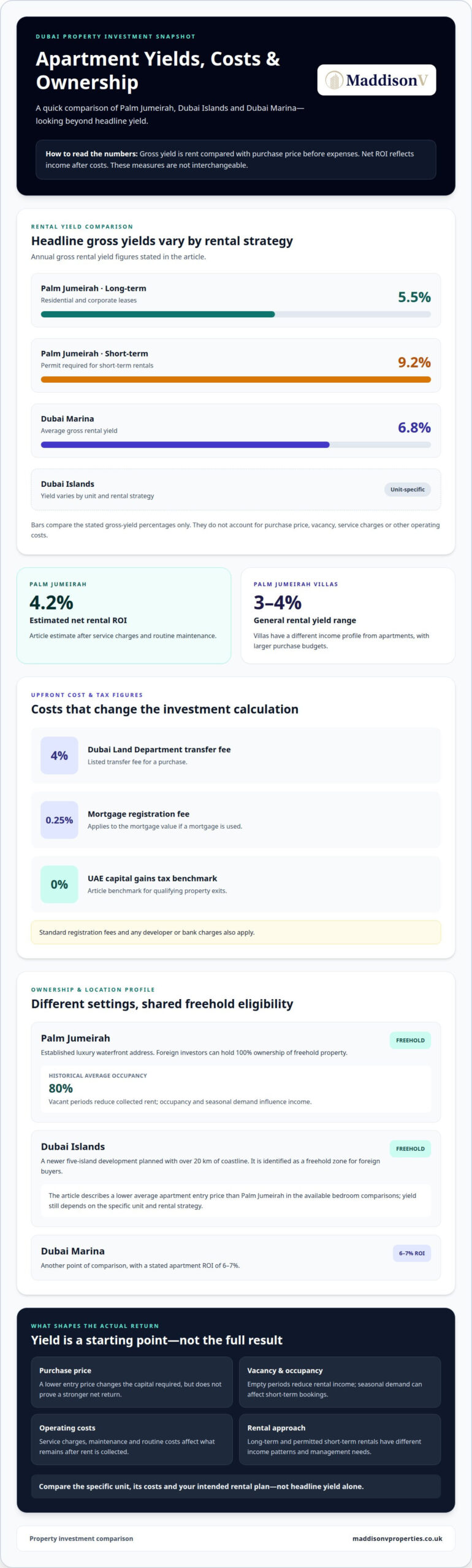
Palm Jumeirah offers a luxury, established address, while Dubai Islands presents a newer real estate option. Palm Jumeirah apartments have an average gross rental yield of 5.5% per year for long-term residential and corporate leases. The stated gross short-term rental yield is 9.2% per year, while estimated net rental ROI is 4.2% after service charges and routine maintenance.
Dubai Islands has a lower average apartment entry price in the available bedroom comparisons. These price differences affect the capital required, but do not show which unit will deliver the stronger net return.
For a concrete example of Palm Jumeirah apartment prices over the past five years, consider a named development. This illustrates the change for that unit, not a guaranteed result for every apartment.
For a purchase, the listed Dubai Land Department transfer fee is 4%. If a mortgage applies, its fee is 0.25% of the mortgage value, according to the Dubai Land Department; standard registration fees and any developer or bank charges also apply. The UAE capital gains tax benchmark for qualifying property exits is 0%.
Palm Jumeirah’s historical average occupancy rate is 80%. Occupancy and seasonal demand influence collected rent: vacant periods reduce income, while high-demand dates can support short-term bookings. Short-term rentals require a DTCM permit. Long-term leases offer a different income pattern, so the choice should reflect expected operating costs and the investor’s preferred management approach, with many holiday property investors drawing on the operational models of hospitality management providers like Crucial Hospitality to balance guest services and net yields.
Dubai Marina offers another point of comparison: its average gross rental yield is 6.8%, and its apartment ROI is stated at 6-7%.
| Option | Rental yield or ROI | Average price comparison | Rental approach |
|---|---|---|---|
| Palm Jumeirah | 5.5% long-term gross; 9.2% short-term gross; 4.2% estimated net | Higher entry cost for established luxury | Long-term or permitted short-term |
| Dubai Islands | Yield varies by unit and strategy | Lower average apartment entry price | Compare unit-level rental potential |
| Dubai Marina | 6.8% gross yield; 6-7% ROI | Mid-to-high comparative pricing | Compare expected income with purchase cost |
Choose Palm Jumeirah for an established luxury setting, assessing net yield after costs. Consider Dubai Islands for a lower average apartment entry price, or Dubai Marina for its stated yield and per-square-foot benchmark.
Palm Jumeirah rental yields and property prices
Palm Jumeirah apartment values vary considerably by size and specification.
For apartments, gross rental yield is a starting point, not the final return. It compares annual rent with the purchase price before expenses. When assessing a residence, distinguish headline yield from the income left after operating costs and vacant periods.
Villas have a different income profile from apartments: Palm Jumeirah villa rental yields are generally 3-4%. Their larger purchase budgets make rent and periods without tenants especially important to the investment calculation. A beachfront setting may support luxury appeal, but it doesn’t determine the income a particular property will produce.
Established homes and off-plan projects involve different considerations. With an existing apartment, you can assess its condition and current rental potential. For an off-plan project, consider the development, unit specifications and expected completion. Launch prices can provide a comparison with established properties.
These examples show why “off-plan” is not a single price category: the project and residence type materially affect the capital required.
A five-year projection offers another way to frame a potential investment. It estimates gross annual income of $44,000 and net monthly cashflow of $2,800 for that example, so the assumptions behind the projection matter when assessing its relevance to a specific purchase.
What risks could reduce the ROI of a Palm Jumeirah apartment investment? Vacancy, maintenance and a high purchase price can constrain returns. For holiday or short-term rentals, occupancy and applicable permit requirements also shape the operating strategy.
Investors weighing established homes against off-plan investment opportunities can assess project choice alongside their intended holding period, rental approach and management needs.
Freehold ownership for foreign investors
Foreign investors can hold 100% ownership of freehold property on Palm Jumeirah. Dubai Islands is also identified as a freehold zone, where foreigners can buy, own and resell property. For international buyers, both locations therefore offer a route to direct property ownership rather than limiting the comparison to rental returns alone.
That shared ownership basis doesn’t make the two investments identical. Palm Jumeirah is an established waterfront address, while Dubai Islands is a five-island development planned with over 20 km of coastline. A buyer seeking a completed residence and a buyer considering a newer development may weigh different property choices, timelines and rental plans.
For a property investment, separate the ownership decision from the income forecast. Freehold eligibility addresses whether a foreign buyer can own in these locations; it does not determine a unit’s rent, occupancy or resale value. Those outcomes depend on the apartment, its condition, purchase terms and intended rental strategy.
A practical comparison can begin with three questions:
- Where is ownership available? Palm Jumeirah and Dubai Islands are both identified as freehold locations for foreign buyers.
- What property is under consideration? Compare the specific apartment or project, not only the destination name.
- How will the investment be used? A long-term rental plan and a resale-focused plan place different emphasis on income and exit potential.
For example, a global investor comparing an established Palm Jumeirah apartment with a Dubai Islands project should assess each property’s purchase terms and intended use. The 100% ownership figure applies to eligible freehold property on Palm Jumeirah; Dubai Islands is likewise identified as freehold for foreign purchasers. Neither statement establishes identical property conditions or investment performance.
A sound comparison also keeps ownership, financing and operating costs distinct. Ownership eligibility does not settle mortgage arrangements, ongoing charges, maintenance or rental management. These expenses affect both the capital required and the income retained, so include them in the calculation for each property.
Resale is part of the ownership comparison: foreigners can resell property in Dubai Islands, and Palm Jumeirah permits foreign freehold ownership. If flexibility matters, consider your likely holding period and exit plan alongside location, unit type and tenant demand. A waterfront setting may influence a property’s appeal, but does not replace an assessment of the individual unit.
For foreign investors, the key distinction is not whether only one destination permits ownership. Both Palm Jumeirah and Dubai Islands offer freehold ownership to overseas buyers. The next step is matching the ownership option to the specific property, available capital and intended investment strategy.
Palm Jumeirah location and unit selection
Palm Jumeirah’s location shapes both the resident experience and an apartment’s investment profile. It is 10-15 minutes from Dubai Marina, connecting a waterfront setting with access to another established Dubai district. For international buyers, that relationship can help frame tenant demand, daily living preferences and the appeal of the address.
Palm Jumeirah was completed in the mid-2000s, so investors can assess an established destination alongside newer projects. Location within the development still matters: compare the specific building, access, outlook and unit layout. Those characteristics influence who may find an apartment suitable, from long-term residents to tenants seeking a luxury stay.
Choose a unit by matching its size and configuration to the intended tenant. A three-bedroom residence at One at Palm Jumeirah measured 3,541 square feet in 2021. That example highlights the importance of usable space: larger layouts may suit different households than compact apartments, but additional area also affects the capital required and ongoing costs.
When selecting an apartment, distinguish practical living features from premium presentation. A clear layout, functional bedrooms and appealing views may support tenant interest, while building condition and service charges affect the financial calculation. Assess each feature against the likely rental plan rather than assuming every luxury specification will improve returns.
- For rental income: Compare apartments with similar bedroom counts and rental strategies, then assess expected rent against purchase and operating costs.
- For capital appreciation: Consider the building’s condition, unit layout and location within Palm Jumeirah, rather than relying on the district name alone.
- For personal use: Prioritise the details that matter for living, including space, access and the apartment’s outlook.
Villa plots offer a useful contrast, even for apartment-focused investors. Palm Jumeirah Signature Villas sit on plots averaging 13,000 square feet; Garden Homes occupy roughly 6,500 to 7,000 square feet. These larger property formats require a different capital commitment and should not be compared directly with apartment returns.
Dubai’s population is over 80% expatriates, a factor associated with rental demand across the city. It doesn’t establish demand for any specific Palm Jumeirah apartment. A sound unit-level assessment connects the target tenant, location, layout and operating costs, then tests whether the expected income supports the purchase.
For a balanced decision, first shortlist comparable units. Then assess their location, floor plan, condition and intended use together. This disciplined comparison helps clarify a property’s financial role, whether your priority is rental income, capital appreciation or a refined place to live.
London property investment ROI
Use a consistent framework to compare London properties. Net ROI assesses a property’s overall operating performance, while cash-on-cash return focuses on the investor’s cash contribution. Both measures are more useful when you record inputs, assumptions and time periods consistently.
Net ROI
To calculate net ROI, establish the period’s rental income and subtract the expenses attributable to operating the property. Divide the resulting net income by the total investment cost, then multiply by 100. Keep the numerator and denominator aligned to the same property and period so the result remains comparable across residential developments.
For a reliable comparison, separate recurring operating expenses from one-off acquisition costs. Specify which cost categories the calculation includes, and use the same method for each property. Net ROI helps compare operating performance, but does not by itself show how financing changes the investor’s cash commitment.
Cash-on-Cash Returns
Cash-on-cash return compares the property’s annual cash flow with the investor’s cash invested. Divide the cash flow available to the investor by their cash contribution, then multiply by 100. Unlike net ROI, this measure reflects the capital structure, so two investors assessing the same property may calculate different results.
Base the calculation on actual cash flows. Record the investor’s contribution and the period’s income and expenses, then include financing payments where applicable. This shows how the investment performs against the cash deployed, rather than against the property’s full cost alone.
Before comparing results, decide whether the calculation is annual or covers a longer holding period. Do not combine an annual income figure with costs accumulated across several years. If the investment includes a resale assumption, show it separately from operating income so the basis of any projected return is clear.
For each property, keep a simple schedule of assumptions: expected rent, periods without rent, operating expenses, acquisition outlay and financing inputs. Use the same format for every shortlisted property. This helps identify whether a different result comes from the property, rental assumptions or financing structure.
For a clear decision, read both measures together. Net ROI supports comparison of property-level operating performance; cash-on-cash return shows how the investor’s capital is working. Neither figure replaces careful review of the underlying assumptions. Discussing your investment criteria through a tailored property sourcing discussion can help connect the calculation approach with the property search.
MaddisonV Properties: London Property Investment Opportunities
MaddisonV Properties can help investors explore London property investment opportunities, including new-build developments. This may suit buyers considering a property purchase and weighing its potential income against the purchase structure and intended holding period.
Property sourcing can help identify opportunities aligned with your investment priorities, while mortgage consultations can clarify financing considerations. After purchase, property management can support ongoing ownership needs. Together, these services connect the investment decision with the practical steps of selecting and managing a property.
If you’re considering a London property purchase or want to discuss how your investment priorities can guide your search, contact MaddisonV Properties.
Turn your London property comparison into a considered next step
Before moving from research to a purchase decision, define what would make a London property suitable for your portfolio. Clarify your preferred investment horizon, the property’s intended role and the financial assumptions you are prepared to use. Written criteria can keep your decision focused as you assess individual opportunities.
Use those criteria to separate essential requirements from preferences. For example, decide which trade-offs you would accept between projected income, personal use and future resale plans. Applying the same framework to each opportunity makes comparisons more consistent and helps keep an eye-catching feature from overshadowing the investment case.
A considered approach to London property investment starts with clear priorities, then tests each opportunity against them. For support with your next property decision, contact MaddisonV Properties.
With your objectives defined, you can proceed deliberately and choose the opportunity that best fits your plans.
Frequently Asked Questions
What are current apartment purchase prices on Palm Jumeirah by size and building?
Average prices differ by apartment size, while individual building listings may sit well above those averages. Treat averages and project examples as separate comparisons.
What are long-term and short-term rental rates for Palm Jumeirah apartments?
Available market benchmarks express rental income as yields, rather than fixed rent rates. Long-term residential and corporate leases have an average gross yield of 5.5% per year, while the stated gross short-term yield is 9.2% per year. To estimate rent for a specific apartment, apply the relevant yield to its purchase value, then account for costs and occupancy. Short-term rentals also require a DTCM permit.
How do Palm Jumeirah apartment returns compare with other Dubai neighborhoods?
Returns vary across Dubai locations and property types. The listed average gross rental yield is 7.8% in Jumeirah Village Circle, compared with 6.8% in Dubai Marina and 5.5% for Palm Jumeirah long-term rentals. These figures use gross yields, so they don’t show the income remaining after expenses. Compare similar units and rental strategies, then assess costs before using neighborhood averages to guide a purchase.
Can foreign buyers own freehold apartments on Palm Jumeirah, and what rules apply?
Yes. Foreign investors can hold 100% ownership of freehold property on Palm Jumeirah. The ownership status relates to the property, not an automatic right to residency or a particular rental return. Purchase costs remain part of the transaction: the Dubai Land Department transfer fee is 4%, and standard registration fees may apply. If financing is used, the mortgage fee is 0.25% of the mortgage value, according to the Dubai Land Department.

Sign Up Now
Want to read more great articles and blogs subscribe to our newsletter