
A prestigious address is only part of an investment case. Investing in Dubai Hills Estate means weighing the appeal of its master-planned setting...

A prestigious address is only part of an investment case. Investing in Dubai Hills Estate means weighing the appeal of its master-planned setting against each property’s type, rental potential and longer-term prospects.
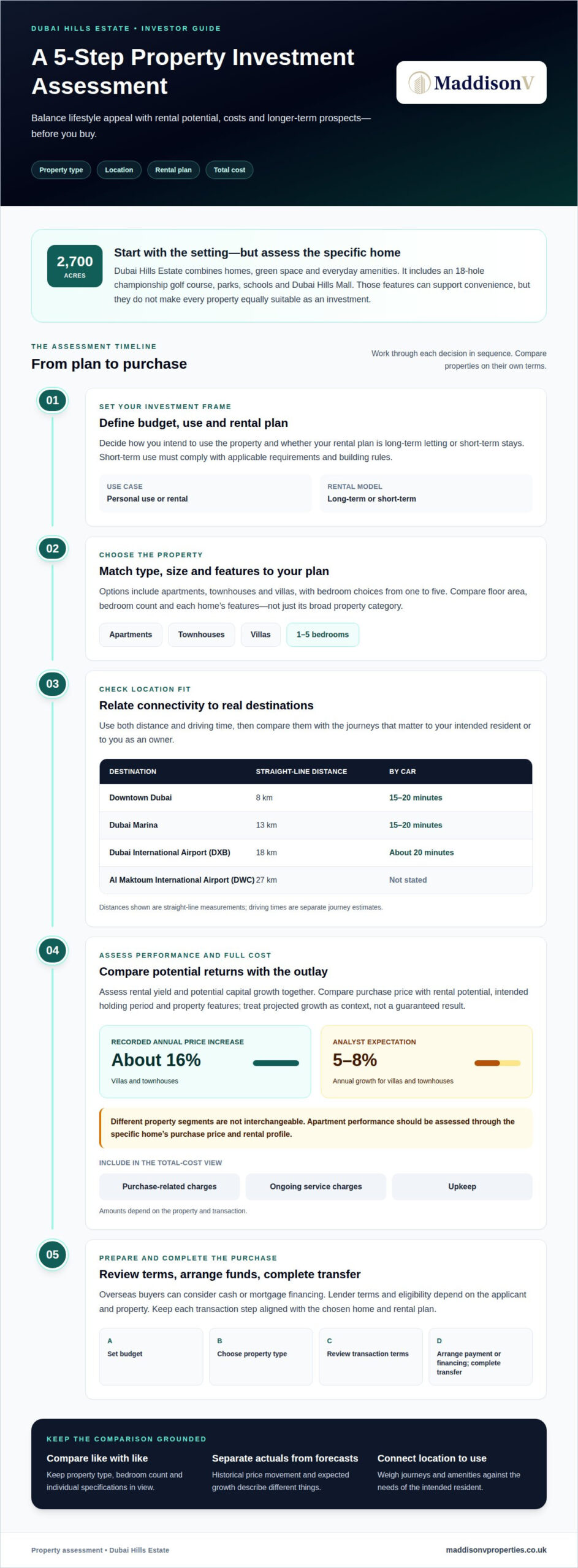
Its combination of homes, green space and everyday amenities helps explain why buyers consider the community. Dubai Hills Estate features an 18-hole championship golf course, parks, schools and Dubai Hills Mall, with Downtown Dubai and Dubai Marina about 15–20 minutes away. Those features support a convenient lifestyle, but they don’t make every property an equally suitable investment.
This guide explains what to assess before buying, from apartments and villas to townhouses with one to five bedrooms. It explores how location and amenities can influence tenant appeal, and how rental yield and potential capital growth fit into an investment assessment. You’ll come away with a clearer sense of which property characteristics matter and how to balance lifestyle appeal with financial considerations in Dubai Hills Estate.
Key Takeaways
- Compare floor area and property features when assessing a UK investment.
- Factor transport into your location assessment: convenient connections can influence a property’s appeal to residents and potential tenants.
- Consider nearby daily essentials, including schools, healthcare and shopping, when assessing a home’s suitability for residents and potential tenants.
- Choose a property type and bedroom count that align with your intended use; options may range from apartments to homes with one to five bedrooms.
- Assess investment performance through both rental yield and potential capital growth, and compare assumptions carefully across property types.
Why Invest in UK Property?
The UK offers apartments, townhouses and houses at varied price points. Compare entry prices with recent market trends and your rental plan to identify which type of home best fits your investment goals.
Prices by Property Type and Bedrooms
ft. ft.
Price Trends and Ranges
Price per square foot provides one way to compare property types, but it doesn’t show total purchase outlay. In Q1 2025, the apartment average sat below the combined townhouse and villa average. Consider bedroom count, home type and total price together when comparing listings.
These figures describe different segments, not interchangeable estimates. For example, a three-bedroom apartment’s listed range is distinct from the three-bedroom villa range. A townhouse buyer can use the Q1 2025 combined townhouse and villa rate as context, while comparing individual homes on their own specifications.
Expected Long-Term Price Growth
Villas and townhouses recorded an annual price increase of about 16%. Analysts expect villa and townhouse prices to grow by 5–8% annually. These figures give investors a performance context, not a guaranteed outcome. Compare the purchase price with rental potential, intended holding period and the property’s features before deciding whether projected growth supports your plans.
For apartments, assess each home’s purchase price and rental profile rather than assuming every property will follow the same growth trajectory. A considered approach to UK property investment separates historical price movements from expectations about future performance.
Ownership and Rental Rules
Overseas buyers can purchase property in the UK, whether for rental returns or personal use. For investors planning to establish business residency or relocate alongside their property acquisition, advisors such as 360 Global Immigration assist with navigating talent and business visa programs. Long-term letting and short-term stays are different rental models, and short-term use must comply with applicable requirements and building rules. Decide how you intend to use the property before buying.
Allow for purchase-related charges, ongoing service charges and upkeep when assessing the total cost. The amount depends on the property and transaction. Overseas buyers can consider cash or mortgage financing, with lender terms and eligibility depending on the applicant and property.
A practical buying sequence is to set your budget, choose a property type, review the transaction terms, arrange payment or financing, and complete the purchase transfer. Make sure each step reflects your chosen home and rental plan.
Dubai Hills Estate location and connectivity
Dubai Hills Estate covers 2,700 acres in Mohammed Bin Rashid City. It sits between Downtown Dubai and Dubai Marina, giving residents access to two prominent city destinations. For buyers assessing residential real estate, this position offers a useful starting point for mapping regular journeys. The community’s location can be considered alongside work, school, shopping and travel needs. Those daily destinations help determine whether a home’s setting suits its intended use.
Downtown Dubai is 8 km from Dubai Hills Estate in a straight line. Dubai Marina is 13 km away by the same measurement. By car, residents can reach either destination in about 15–20 minutes. These figures describe different measures: straight-line distance indicates geographic proximity, while driving time provides a practical journey estimate. Use both when comparing locations, and consider which destination matters most to your routine.
Dubai International Airport (DXB) is 18 km away in a straight line, and about 20 minutes by car. Al Maktoum International Airport (DWC) is 27 km away in a straight line. The two airports therefore offer different geographic relationships to the community. Frequent travellers can consider which airport they use most, then weigh that journey against their regular trips to Downtown Dubai or Dubai Marina.
Start your location assessment with specific destinations. List the places that shape your routine, such as an office in Downtown Dubai or regular plans in Dubai Marina, then compare available distance and driving-time information. This makes the decision more personal than relying on a broad label such as “central” and helps you weigh convenient access against a home’s other qualities.
For an investment property, connectivity matters in relation to the people the home is intended to serve. A resident working near Downtown Dubai may value that 15–20-minute drive differently from someone travelling regularly to Dubai Marina. An international owner may place more weight on the approximately 20-minute car journey to DXB. Matching the location to a clear use case helps focus your property assessment.
Dubai Hills Estate’s position within Mohammed Bin Rashid City gives buyers a defined geographic frame: 2,700 acres between Downtown Dubai and Dubai Marina. Compare the 8 km and 13 km straight-line distances with the stated driving times, then relate them to your own destinations. This measured approach helps you assess connectivity without treating every journey, airport or residential requirement as the same.
Nearby transport, schools, shopping and healthcare
When assessing a London property, consider how nearby public transport, schools, shopping and healthcare could support residents’ daily needs. The relevant amenities will depend on the specific home and its location.
Nearby Transport
Metro or rail access may require travel from a property to a nearby station. A station 5.2 km away in a straight line illustrates why proximity is not the same as doorstep access. Consider how residents would travel between the home and the station, as well as their regular destinations. This helps clarify whether public transport forms a practical part of the property’s location appeal.
Transport needs vary between residents. A household using public transport may value a station differently from one relying on other travel arrangements. Check the route from the specific home rather than treating a stated distance as a door-to-station measurement. This helps set realistic expectations about convenience for a future resident or tenant.
Schools and Shopping
A school 0.8 km from a property and a shopping centre within its neighbourhood can offer useful context. Another shopping centre 3.3 km away may also be relevant. For families, proximity to schools can shape everyday routines. For other residents, nearby shopping adds another practical consideration when comparing London homes.
These distances offer context, not a complete journey description. A buyer can assess a specific home against the school or shopping destination most relevant to its intended occupants. For example, a household prioritising a school may weigh its 0.8 km proximity differently from a resident focused on nearby shopping. Compare amenities according to actual use.
Healthcare
A hospital 1.4 km from a property can provide a local reference point when assessing healthcare access. This can be a useful factor for households planning a longer stay, as well as investors considering the needs of future residents. The distance alone does not describe the practical route, which will depend on the specific property and destination.
Assess amenities together rather than as isolated selling points. A prospective resident may value a nearby school, shopping and a hospital for different reasons, depending on household needs and routines. Mapping those needs against relevant local amenities gives you a concrete way to assess everyday convenience.
Use a simple comparison for each property: identify the closest relevant amenity, note its stated straight-line distance, then consider how it fits the intended resident’s routine. For example, record the 1.4 km distance to a hospital separately from the 0.8 km distance to a school. This keeps school, healthcare, shopping and transport considerations distinct when comparing homes.
Property types and bedroom options
London offers apartments, townhouses and houses, with homes ranging from one to five bedrooms. The right format depends on intended use, household size and investment strategy. Decide whether you prioritise a compact apartment, a multi-level home or a larger house, then compare bedroom count, layout and likely tenant appeal before assessing potential returns.
Apartments come in a range of bedroom configurations, from one-bedroom homes to larger three-bedroom options. A one-bedroom layout may suit a single occupant or couple, while a larger apartment can accommodate more household needs. London apartments include modern developments and period homes, such as mansion blocks and warehouse conversions. Compare room arrangement and usable space, not bedroom count alone: homes with the same number of bedrooms can suit different lifestyles and rental audiences.
Townhouses offer an option for buyers seeking a home between apartment living and a larger house. Consider how the layout supports everyday routines, particularly for households that need separate spaces. Compare townhouses with apartments and houses using the same criteria: bedroom count, location, budget and intended occupancy. This makes the property-type decision more deliberate.
London homes include Georgian, Victorian and Edwardian properties, as well as new-build developments. A three-bedroom home may suit a smaller household seeking more space, while four- and five-bedroom homes provide additional room for larger households. These are practical use cases, not guarantees of tenant demand. Compare property configurations according to the intended resident and each home’s layout.
Bedroom count is a starting point, not a complete investment assessment. Consider how each home’s rooms function, whether the layout suits the intended occupant and how the location supports daily life. For example, when comparing a two-bedroom apartment with a three-bedroom townhouse, weigh the extra room against purchase and ongoing costs.
London’s range of homes includes period properties dating from the 18th century, alongside contemporary apartments and new-build developments. Architectural style can form one part of a home’s appeal, alongside property type and bedroom configuration. Avoid assuming that a particular style alone determines rental performance. Instead, consider whether the property matches the prospective resident’s preferences and whether its overall profile supports the intended tenancy.
To compare options, shortlist the property type and bedroom range that suit your investment plan. Then assess layout and location, and compare projected rental income with the total purchase outlay. This gives you a consistent basis for evaluating potential returns across apartments, townhouses and houses, and separates lifestyle preferences from the financial factors behind each decision.
Dubai Hills Estate investment performance
Investment performance depends on rental income, purchase price and potential price growth. Compare like-for-like figures before assessing Dubai Hills Estate against other communities.
Comparison With Other Dubai Communities
ft. ft. during the period discussed for 2025. These figures suggest a higher apartment price per sq. ft. in Dubai Hills, but their periods differ, so they aren’t a direct like-for-like comparison.
When comparing communities, assess each property’s price, rent and intended tenant profile. Dubai Marina and homes near Dubai Hills Mall serve different locations and resident preferences. Compare specific property types and rental assumptions instead of treating a community-wide average as a forecast for an individual home.
Reported Dubai Hills Estate yields also vary. One range is 5.2% to 6.5%, while another guide reports an average of 8.1%. Studio yields can vary, so compare them using the same calculation basis. Gross yield doesn’t account for expenses, so identify the calculation basis before comparing these figures.
Rental figures provide useful context. Compare rent with the specific property’s purchase price and ongoing costs, not just a broad community estimate. For investors seeking to secure their returns in the UAE market, rental guarantee platforms such as Takeem can help protect cash flow against vacancy and payment defaults.
Investment Risks
The main risks include relying on a yield estimate that doesn’t match the property, assuming rents will remain unchanged, and paying a price that leaves little room for costs. Villas and townhouses recorded an annual price increase of about 16%, but past movement alone doesn’t establish future performance. Analysts expect growth of 5–8% annually for these types, which remains an expectation.
Supply also deserves attention. Dubai Hills Estate’s master plan includes over 40,000 residential units, with seven developers active in the community. This scale makes property type, location and competing homes important parts of an investment assessment. Compare the home’s likely tenant appeal with similar options before relying on a rental projection.
For a balanced decision, record the purchase price, expected annual rent and recurring ownership costs for each candidate property. Calculate gross yield by dividing annual rent by purchase price, then consider net income after expenses separately. Assess price-growth assumptions independently, especially for off-plan purchases, where completion timing affects when rental income can begin.
MaddisonV Properties
MaddisonV Properties can help turn your UK property investment priorities into a considered plan. Property Sourcing can shape a search around your criteria, while Mortgage Consultations can support financing discussions. If you own a property and need ongoing oversight, Property Management and Facilities Management can help with practical responsibilities after acquisition.
The right support depends on your next decision, whether you’re refining a London property brief, considering financing or organising ownership responsibilities. A clear view of your goals and preferred property type helps make the next conversation more focused.
Contact MaddisonV Properties to discuss your UK property investment plans.
Make Your Next Move With Clarity
A property decision is easier to manage when your investment priorities are clear. Before moving forward, define what you need the property to achieve, how you expect to use it and which trade-offs matter most. This framework helps you assess opportunities consistently instead of relying on one appealing feature or headline figure.
If you’re considering London property investment, turn your research into a focused brief. Set out your preferred property type, intended ownership approach and investment horizon, then use those priorities to evaluate how each opportunity fits your plans. A thoughtful decision starts with alignment between the property and the outcome you want.
Contact MaddisonV Properties to discuss your options and take the next step with a clear investment direction.
With a well-defined brief, you can assess the market with greater confidence and make your next move with purpose.
Frequently Asked Questions
Can overseas buyers purchase ready homes or off-plan properties in the UK?
Overseas buyers can consider both completed homes and new-build properties, subject to availability. Check the status and expected completion date of each property before choosing. For off-plan purchases, confirm the handover schedule and consider how it fits your intended occupancy or rental plans. Dates such as Q1 2029 and Q1 2027 should be verified against the relevant development information.
What is the starting price for homes in the UK?
Prices depend on location, property type and condition. A starting price for a named development is not a guide to the price of every available home, so compare current listings and seek advice before making a decision.
What should overseas buyers know about buying property in London?
London offers a range of property types and neighbourhoods, from apartments to family homes. Consider the location, transport links, ongoing costs and your intended use. Check any figures about a property or local amenities, including quoted areas such as 180,000 square meters, against reliable information before relying on them.
How do UK property prices vary by type and size?
Prices vary by location, property type, size and bedroom count. Compare homes with similar features, since broad averages can conceal important differences between individual properties.
What rental yields and capital growth can UK property investors expect?
Rental yields and price growth vary by property and location, and past performance does not guarantee future returns. Treat rental yield and capital appreciation as separate measures. Figures such as 5.2% to 6.5%, 8.1%, 16% or 5–8% should be checked against current, property-specific evidence. A useful comparison considers expected rent alongside the purchase price, costs and potential risks.
What property types are available to buyers in London?
Buyers can consider apartments, townhouses and houses, with different layouts and bedroom configurations. Compare each home’s condition, location and development status to find options that suit your intended use. A stated range, such as one to five bedrooms, may apply to a particular selection of properties rather than the whole market.
What amenities, schools and transport links should buyers consider?
London properties vary in their proximity to parks, schools, hospitals, shops and public transport. Check the location of each home against your regular destinations and preferred travel options. Verify claims about local amenities, including figures such as 54 km of cycling tracks or an 18-hole golf course, before using them to compare properties.
Can foreign nationals get a UK mortgage to buy property?
Overseas buyers may be able to use mortgage financing, subject to lender criteria. Eligibility and terms depend on the applicant and property, so speak with a suitable lender or mortgage adviser before proceeding.

Sign Up Now
Want to read more great articles and blogs subscribe to our newsletter