
A property's value alone doesn't decide whether it falls within ATED. According to HM Revenue & Customs, the annual tax on enveloped dwellings...

A property’s value alone doesn’t decide whether it falls within ATED. According to HM Revenue & Customs, the annual tax on enveloped dwellings (ATED) applies mainly to UK residential properties worth more than £500,000 when owned by a company; certain other corporate ownership structures can also bring a dwelling within scope. This guide to annual tax on enveloped dwellings (ATED) explained through practical examples begins with the ownership structure: an “enveloped” dwelling is held through a company or another qualifying structure rather than directly by an individual.
It’s understandable to focus first on a property’s value, but its ownership and use matter too. A qualifying property may be eligible for relief, including when it’s let commercially. However, relief doesn’t necessarily remove the requirement to file a return.
Here, annual tax on enveloped dwellings (ATED) explained in clear terms means understanding which properties qualify, how rental business relief and other reliefs work, and when returns and tax are due. This guide also outlines the charge bands and explains the difference between a property within the regime and one that ultimately owes tax, helping you make property ownership and investment decisions with greater clarity.
Key Takeaways
- Start by assessing both the dwelling’s value and its ownership structure: qualifying UK homes held through certain companies or other entities can fall within ATED.
- Commercial letting or property development may qualify for relief, but the activity must meet the relevant conditions, including a commercial profit-making purpose for rental business relief.
- Work out the filing deadline from the property’s circumstances, such as whether it is newly built, acquired during the year or held at the start of the chargeable period.
- Relief does not automatically remove filing obligations. Understand when a relief declaration return is needed, even if no ATED is payable.
- For investment and ongoing ownership planning, consider how property sourcing, management and facilities support fit alongside the tax responsibilities.
What property does Annual Tax on Enveloped Dwellings apply to?
HM Revenue & Customs says ATED is an annual UK tax payable mainly by companies that own UK residential property valued at more than £500,000. The test concerns both the dwelling and how it is held. A home owned directly by a natural person is generally outside this ownership-based charge, while a qualifying company-held home may be chargeable.
ATED can also apply when a UK dwelling is held wholly or partly by a partnership with a corporate partner, or by a collective investment scheme. The relevant interest must be in a UK dwelling, not simply any building or land. Hotels, guest houses and care homes are examples of buildings not classed as dwellings for ATED. For investors seeking annual tax on enveloped dwellings (ATED) explained in practical terms, property classification is an essential part of the scope test.
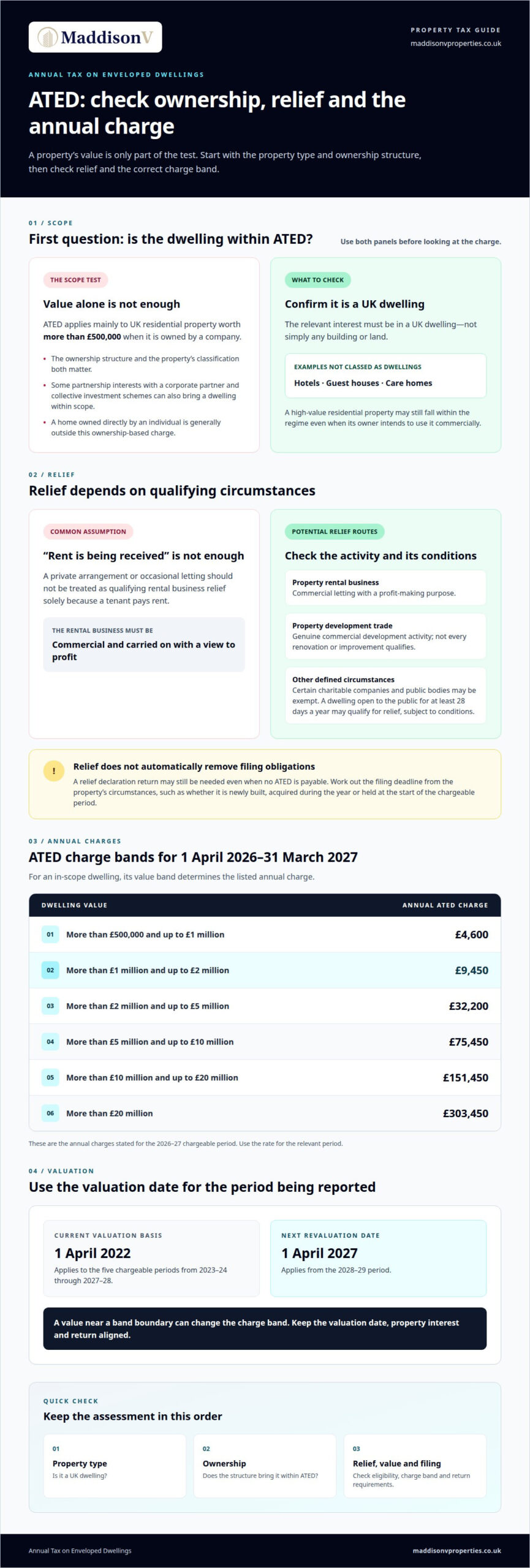
For an in-scope property, its valuation places it in a charge band. The chargeable period runs from 1 April to 31 March, and the charge is set by the dwelling’s value band. For the chargeable period from 1 April 2026 to 31 March 2027, HM Revenue & Customs sets an annual ATED charge of £9,450 for a dwelling valued at more than £1 million and up to £2 million.
- More than £500,000 and up to £1 million: £4,600.
- More than £1 million and up to £2 million: £9,450 annually.
- More than £2 million and up to £5 million: £32,200.
- More than £5 million and up to £10 million: £75,450.
- More than £10 million and up to £20 million: £151,450.
- More than £20 million: £303,450.
These are the annual charges for the chargeable period from 1 April 2026 to 31 March 2027. The prior 2024-25 period had different rates, so use the figures for the relevant period rather than carrying a previous charge forward.
- £500,000 to £1 million: £4,400.
- £1,000,001 to £2 million: £9,000.
- £2,000,001 to £5 million: £30,550.
- £5,000,001 to £10 million: £71,500.
- £10,000,001 to £20 million: £143,550.
- £20,000,001 or more: £287,500.
To calculate the charge, establish whether the ownership structure and property type bring the dwelling within ATED, then identify its taxable value and matching band. The listed annual charge for that band is £9,450.
Valuation matters most near a band boundary, where a small difference can place a dwelling in a different charge band. Use a valuation for the correct chargeable period, and ensure the ATED return reflects the same property interest and valuation basis. Understanding annual tax on enveloped dwellings (ATED) explained through the calculation means separating the scope question from the valuation that determines the charge.
ATED property rental business relief: sole-purpose requirement?
Yes. Relief may apply to qualifying property rental and development businesses, alongside exemptions for certain owners. For rental business relief, the activity must be commercial and carried on with a view to profit. A property’s use and the nature of the business matter, not simply the fact that rent is received.
Section 133 of the Finance Act 2013 provides relief for a qualifying property rental business. The definition refers to Chapter 2 of Part 4 of the Corporation Tax Act 2009. In practice, assess whether the letting forms part of a commercial business and has a profit-making purpose. A private arrangement or occasional letting shouldn’t be treated as qualifying solely because a tenant pays rent.
Relief is also available for genuine commercial property development trades. The key distinction is between commercial development activity and holding a high-value UK residential property without such a trade. The rules identify qualifying activities, but not every renovation or improvement amounts to a development business. The activity’s purpose and commercial character remain central.
Other reliefs and exemptions apply to defined circumstances. Charitable companies and public bodies are among the categories eligible for ATED exemptions. A dwelling open to the public for at least 28 days a year may qualify for relief, subject to conditions. These routes have different criteria, so one category shouldn’t be assumed to cover another.
Some buildings are excluded because they aren’t treated as dwellings for ATED. Hotels, guest houses and care homes are examples. This distinction depends on the building’s classification, not simply its value or ownership through a company. A high-value residential property, by contrast, may remain within the regime even when its owner intends to use it commercially.
Valuation is another important part of the relief assessment. ATED properties are revalued every five years. The valuation date for the five chargeable periods from 2023-24 through 2027-28 is 1 April 2022. The next revaluation date is 1 April 2027, applying from the 2028-29 period. A revised value can affect which charge band applies, so keep the relevant valuation date aligned with the period being reported.
For a property rental business, consider three separate questions: is the building a dwelling, does its ownership bring it within ATED, and does a relief category apply? Then assess the commercial purpose, qualifying activity and relevant valuation date. This keeps the relief analysis separate from the initial scope test and avoids treating relief as an automatic result of renting or developing a property.
When must ATED returns be filed and the tax paid?
ATED filing dates depend on whether the dwelling is newly built, newly acquired or already held. The return deadline still matters when relief means no tax is payable.
Return Filing and Payment Deadlines
For an existing property, submit the ATED return and pay any charge by 30 April of the chargeable period. Returns can be submitted on or after 1 April. For the period from 1 April 2026 to 31 March 2027, file between 1 and 30 April 2026, with payment due by 30 April 2026.
A property acquired during a chargeable period has a separate filing window: the return and payment are due within 30 days of purchase. For a newly built property, the deadline is within 90 days of whichever happens earlier: first occupation or the property becoming a dwelling for Council Tax purposes. These dates mean a purchase or first occupation can create a filing deadline outside the usual April window.
Late filing triggers penalties. The fixed penalty immediately after the filing deadline is £100. Further penalties may be charged three and six months after the missed filing date. Non-compliance can also carry a penalty of 5% of the tax due. Because the return records the property and its chargeable position, accurate details matter; the amount due and the filing obligation are related, but not identical.
Keep the relevant chargeable period clear in property records. For example, the period ending 31 March 2027 begins on 1 April 2026, and its ordinary return deadline falls on 30 April 2026. A dwelling bought during that period instead follows the 30-day acquisition deadline. That distinction helps prevent an annual filing date being mistaken for the deadline after purchase.
Returns When No Tax Is Due
A qualifying company-owned residential property valued over £500,000 still requires an annual ATED return when no tax is due. Relief can remove or reduce the charge, but it doesn’t automatically remove the filing requirement. The return remains the formal record of the property’s position for that chargeable period.
Where relief applies, file a relief declaration return to claim it. Keep the basis for relief and the property’s valuation information aligned with the period being reported. The valuation date of 1 April 2022 applies to the five chargeable periods from 2023-24 through 2027-28, so the return should reflect the applicable valuation framework rather than an unrelated figure used for Stamp Duty or another individual tax matter.
Record each dwelling’s ownership, valuation and return status separately, including when an entity holds several properties. Filing a return for one property doesn’t establish the filing position for another. For companies and other relevant bodies, recording each property’s deadline and relief claim helps keep a clear account of tax paid and tax not due.
ATED reliefs and relief declaration returns
ATED reliefs and exemptions can reduce or remove a charge when a dwelling meets a category’s conditions. Examples include qualifying commercial property rental or development activity, certain charitable companies and public bodies, and some dwellings open to the public.
A relief declaration return is required to claim available reliefs. A corporate owner should therefore distinguish the amount payable from the filing requirement: eligibility for relief doesn’t, by itself, record the claim. The declaration sets out the relevant relief position for the UK residential property and chargeable period.
Reliefs depend on the property’s use, ownership and activity. They aren’t general concessions for all residential property held by a company. For commercial letting, the qualifying rental business must operate commercially with a view to profit. For development relief, the activity must form part of a genuine commercial property development trade.
These distinctions matter when a company has several purposes. For example, don’t treat a property held partly for private enjoyment as qualifying commercial letting solely because it also generates rent. The question is whether the activity meets the relevant relief conditions. Relief for one dwelling also doesn’t establish eligibility for another property held by the same corporate owner.
Some exemptions relate to the owner’s status. Charitable companies and public bodies are among the categories eligible for ATED exemptions. However, the category alone doesn’t replace the need to apply its conditions to the ownership and property concerned. A national or public body should identify the basis for exemption separately from any commercial relief claim.
Property use can also be relevant. A dwelling open to the public for at least 28 days a year may qualify for relief, subject to conditions. The 28-day figure is a qualification point, not an automatic exemption: the other requirements for that relief still matter. A property’s actual access arrangements and use should align with the basis claimed.
For a clear claim, classify each property by relief route before preparing its declaration. Separate commercial letting, development trade, public access and owner-status exemptions rather than combining them under a broad label. Then match the property and its use to the relevant criteria. The UK ATED technical guidance discusses relief criteria in sections 30 to 41, providing the detailed framework for these categories.
Keep the declaration consistent with the chargeable period and the property’s circumstances during that period. A change from commercial letting to private use, for example, can affect which relief applies. Maintain a clear record of ownership, use and qualifying activity so the claim accurately reflects the dwelling’s position.
Meaning of an enveloped dwelling
An “enveloped dwelling” is a UK home held through a company or another qualifying non-natural structure, rather than directly by an individual. The term describes the ownership route, not a special type of building. A London flat can be an ordinary residential dwelling, yet its ownership structure may bring it within ATED.
Consider two owners of the same flat. Direct ownership by an individual differs from ownership through a company. ATED can also apply when a partnership has a corporate partner or a collective investment scheme holds the dwelling. The important distinction is who holds the property interest, wholly or partly.
The term doesn’t mean that every property held by a company is an enveloped dwelling. The property must be a UK dwelling, and its ownership must meet the relevant conditions. Hotels, guest houses and care homes are examples of buildings not treated as dwellings for ATED. A company’s ownership of one of these buildings doesn’t make it a dwelling simply because people stay there.
ATED was introduced on 1 April 2013 and applies to relevant high-value UK residential property held by non-natural persons on or acquired after that date. The acquisition date can also matter for valuation. Where a property was acquired after 1 April 2022, its acquisition date is used for ATED valuation purposes. This is distinct from the five-year revaluation framework and its revaluation date.
Ownership through a company doesn’t, by itself, determine the final ATED charge. A property can fall within the regime and qualify for relief based on its use or activity. Commercial letting or a property development trade may be relevant to relief, while an individual’s direct ownership follows a different route. The ATED charge depends on the property’s taxable value and any applicable relief.
Keep the ownership question separate from other property taxes. Stamp Duty Land Tax applies to a property transaction, while ATED is an annual charge on qualifying dwellings held through specified structures. A transaction involving a company-held property may therefore raise distinct questions about acquisition and ongoing ownership. Neither tax determines the other: Stamp Duty Land Tax doesn’t establish whether a dwelling is enveloped.
For a property acquired by a company, establish the legal owner, identify whether the asset is a dwelling, then assess the applicable valuation basis and relief position. This sequence clarifies why an identical home can have different ATED treatment under different ownership structures. For investment searches where ownership plans form part of the decision, explore UK property sourcing as one element of the acquisition process.
MaddisonV Properties
MaddisonV Properties helps property investors connect ownership decisions with their wider investment plans. When ATED considerations affect a potential purchase, Property Sourcing can help identify suitable opportunities, while Portfolio Management supports oversight of existing holdings. Property Management and Facilities Management can help with the practical responsibilities of residential property ownership.
ATED rules depend on ownership structure, property value and use. MaddisonV Properties supports the property decisions involved, while a qualified tax adviser can address the tax treatment. This separates finding and managing an investment from determining its tax position.
If you’re considering a UK property investment or reviewing an existing portfolio, contact MaddisonV Properties to discuss your requirements.
Plan your next property decision with clarity
Use this explanation of annual tax on enveloped dwellings (ATED) as one part of a broader ownership plan. Before committing to a purchase or changing how a property is held, consider how the structure aligns with your investment objectives, financing arrangements and ongoing property responsibilities. Tax treatment should be part of that decision from the outset.
MaddisonV Properties can support your property decisions through Property Sourcing, Property Management and Mortgage Consultations. These services cover different stages, from identifying an opportunity to discussing finance and managing an investment property. For advice on the tax treatment of your ownership structure, consult a qualified tax professional.
Take the next step at a pace that suits your plans. Contact MaddisonV Properties to discuss your property requirements and move forward with a clear perspective.
Frequently Asked Questions
Who needs to pay ATED?
ATED liability generally falls on an entity holding a qualifying UK dwelling, rather than on an individual who owns it directly. HM Revenue & Customs describes the tax as an annual tax applying mainly to companies owning residential property valued at more than £500,000. A partnership with a corporate partner or a collective investment scheme can also be within scope. The ownership structure and property type both matter.
Do I still need to file if I qualify for a relief?
Yes, a relief claim generally still requires a return. An eligible owner uses a relief declaration return to claim the relevant relief, even when the claim means no ATED is payable. For example, a company letting a dwelling commercially should distinguish its rental business relief claim from its filing obligation. Ensure the declared relief matches the property and period it covers.
Does ATED affect how I pay tax when I sell the property?
ATED concerns a dwelling’s chargeable ownership period, while a sale raises separate questions about the disposal. The facts here don’t establish how a particular sale is taxed, so don’t treat an ATED return as a calculation of tax on sale proceeds. A substantial disposal of part of a dwelling can trigger revaluation when chargeable consideration is £40,000 or more, making the transaction details relevant.
How is the ATED rate determined, and are there any tax bands?
The charge is determined by the dwelling’s taxable value band for the relevant chargeable period. For example, HM Revenue & Customs sets an annual charge of £9,450 for a dwelling valued at more than £1 million and up to £2 million for the period from 1 April 2026 to 31 March 2027. Other bands cover higher and lower values, so the applicable period and valuation both matter.
Is it necessary to file an ATED return if no tax is due?
Yes, a qualifying company-owned residential property valued over £500,000 can require an annual ATED return even when no charge is due. The return records the property’s status for that period; a relief claim should be made through the appropriate relief declaration return. For a portfolio, consider each dwelling separately, since one property’s relief or filing position doesn’t determine another property’s requirements.
What is the penalty for missing the ATED deadline?
The fixed penalty immediately after the filing deadline is £100. Further penalties may apply three and six months after the missed date, and non-compliance can carry a penalty of 5% of the tax due. These consequences make it important to distinguish the normal annual filing date from deadlines triggered by a purchase or a newly built property becoming occupied or a Council Tax dwelling.
What is the Annual Tax on Enveloped Dwellings (ATED), and who is liable?
ATED is an annual UK tax on qualifying residential dwellings held through certain non-natural ownership structures. Companies are the principal owners affected, but a partnership with a corporate partner or a collective investment scheme may also fall within the regime. Liability isn’t determined by the owner’s nationality alone: the UK property, its value and how its interest is held are central considerations.
Which UK residential properties are subject to annual ATED, and what is the £500,000 valuation threshold?
The threshold applies to a qualifying UK dwelling held wholly or partly through an in-scope ownership structure. HM Revenue & Customs describes the main threshold for the annual tax as residential property valued at more than £500,000, so a value exactly at £500,000 isn’t “more than” that amount under this wording. Property classification also matters: hotels, guest houses and care homes aren’t classed as dwellings for ATED.

Sign Up Now
Want to read more great articles and blogs subscribe to our newsletter