
Hands-off property investment in the UK can reduce day-to-day work, but it does not make returns automatic or ownership entirely passive. Your income...

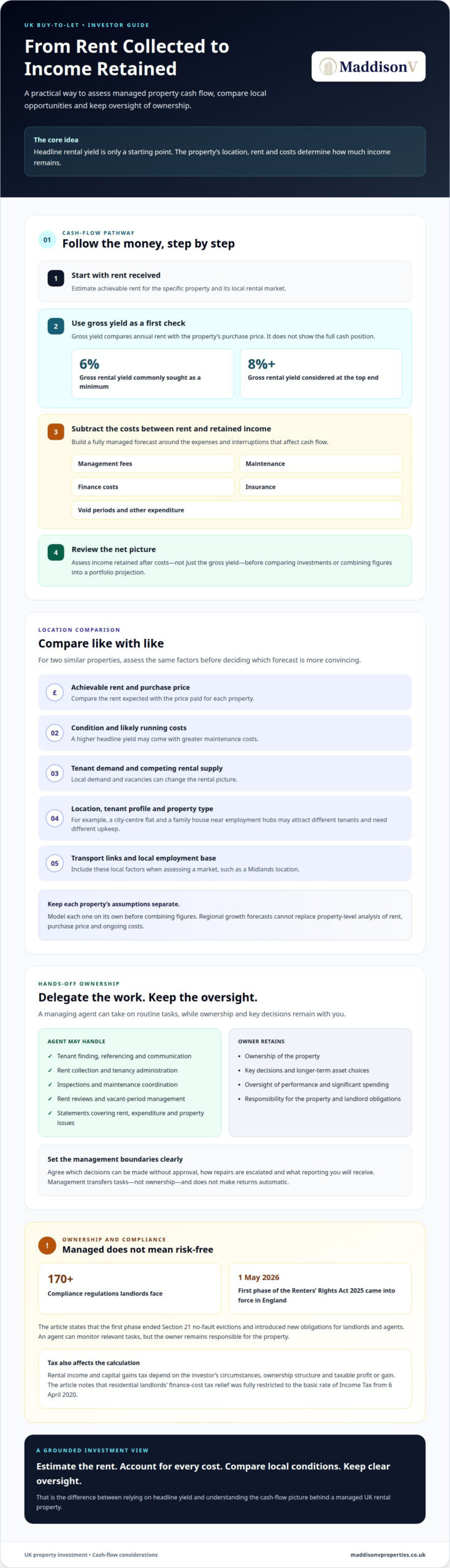
Hands-off property investment in the UK can reduce day-to-day work, but it does not make returns automatic or ownership entirely passive. Your income depends on the property, its local rental market and the costs between rent collected and income retained.
It is reasonable to want a steadier investment without managing tenants and maintenance yourself. Professional management can take on much of the operational workload, while you remain the owner and oversee key decisions. When calculating returns, account for management fees, finance, maintenance, insurance and vacant periods rather than relying on headline rental yield alone.
This guide explains how managed buy-to-let works, what shapes cash flow and how local comparisons can change the investment picture. It also covers how to weigh expected returns against potential capital growth, reporting and your intended exit timeline. The aim is to clarify the trade-offs so you can decide whether a more hands-off approach suits your priorities and how much oversight you want to retain.
Key Takeaways
- Professional management can handle tenant communication, rent collection and maintenance coordination, while you retain ownership and decision-making control.
- Estimate cashflow from net income, accounting for finance, management, maintenance, insurance and potential void periods rather than relying on gross yield alone.
- Compare locations by achievable rent, property condition and ongoing costs to understand how local differences may affect returns.
- Agree on clear reporting and oversight so you can track performance and make informed decisions without managing every daily task.
- Consider whether managed ownership or property crowdfunding better matches your desired level of involvement, investment structure and exit plans.
Fully managed buy-to-let
A hands-off property investment in the UK usually means appointing a managing agent to handle routine landlord responsibilities. Depending on the agreement, this may include finding and referencing tenants, collecting rent, handling tenant communication, arranging inspections and maintenance, reviewing rent and managing vacant periods. You still own the property and retain control of key decisions: management transfers tasks, not ownership.
For example, when a tenant reports a repair, the agent can receive the issue, arrange a suitable contractor and update the landlord. When a tenancy ends, the agent can coordinate marketing and viewings. For vacant UK rentals, tenant placement typically takes from a few days to a few weeks, depending on location and demand. A pre-let property may begin generating rental income immediately.
To check whether a property crowdfunding platform is FCA-authorised, search its legal name on the Financial Conduct Authority Register and review the firm’s listed permissions. Check that the platform’s identity and contact details match the register. FCA authorisation does not guarantee that an investment will perform well.
Assess crowdfunding and property fund risks by examining the investment structure, underlying properties, borrowing, fees, exit terms and how funds are held. Consider whether returns depend on rent, a property sale or both, and what happens if a sale is delayed. A platform may manage daily operations, but property, market and liquidity risks remain.
Professional tenancy and asset management also involves maintaining records and tracking landlord obligations. Landlords face more than 170 compliance regulations. In England, the first phase of the Renters’ Rights Act 2025 came into force on 1 May 2026, ending Section 21 no-fault evictions and introducing new obligations for landlords and agents. A managing agent can monitor relevant tasks, but the owner remains responsible for the property.
- Tenant management: referencing, communication, rent collection and tenancy administration.
- Property oversight: inspections, maintenance coordination, rent reviews and void-period management.
- Reporting: statements that help the landlord follow rent received, expenditure and property issues.
Before appointing an agent, define which decisions they can make without your approval, how repairs are escalated and what reporting you will receive. An agent can manage one buy-to-let property or an entire portfolio. If you want less day-to-day involvement, you can delegate operations while retaining oversight of performance, significant spending and longer-term asset decisions.
Even when professional management handles day-to-day work, UK property ownership is rarely completely passive. Turnkey property services may help investors find and assess a property, negotiate its purchase, coordinate solicitors and finance, manage refurbishment, find tenants and oversee the tenancy.
Cashflow projections and local market comparisons
A useful projection separates rent received from income retained. Buy-to-let investors commonly look for a gross rental yield of at least 6%, with 8% or more considered at the top end. Gross yield compares annual rent with the property’s purchase price, but it doesn’t show the full cash position. A fully managed forecast should also account for management fees, maintenance, finance costs, insurance, void periods and other expenditure.
Compare properties on a like-for-like basis, considering location and type. For example, assess two similar flats by achievable rent, purchase price, condition, tenant demand and expected running costs. A higher headline yield may come with greater maintenance costs or more frequent vacancies.
UK tax on rental income and capital gains depends on the investor’s circumstances, ownership structure and taxable profit or gain. According to UK Government, residential landlords’ finance-cost tax relief is restricted to the basic rate of Income Tax, and the restriction was fully in place from 6 April 2020.
For a Midlands property, compare the local employment base, transport links, tenant profile and competing rental supply. A city-centre flat and a family house near employment hubs may attract different tenants and require different levels of upkeep. Model each property separately before combining figures in a portfolio projection. Regional growth forecasts cannot replace property-level cash-flow analysis: rent, purchase price and ongoing costs determine the income calculation.
Off-market opportunities may be considered before a property is widely advertised. Apply the same assessment: review the asking terms, rental potential, condition, location and likely costs. An off-market introduction is a way to consider a property, not evidence that its value or yield is superior. Record the assumptions behind each projection so you can compare later changes in rent or costs with your original estimate.
To invest through a REIT or property fund, first choose a structure that matches your desired exposure. Review its investment mandate, property holdings, borrowing, charges, distribution approach and exit terms. Understand how to buy and sell units, and whether withdrawals depend on a market sale or a fund process. Compare this with direct ownership: a fund offers property exposure without buying an entire rental home, but its performance depends on its assets and structure.
For a tailored comparison of UK locations and property types, property sourcing support can help shape a shortlist around your investment criteria.
Hands-off property investment and investor oversight
Delegating operational tasks can reduce day-to-day involvement, but it does not remove the need for oversight. A clear reporting schedule helps you track demand, property condition and portfolio performance.
Investor Oversight
Agree on written reporting before management begins. Quarterly written updates provide a practical basis for reviewing rent received, tenancy changes, maintenance activity and upcoming decisions. A consistent format makes it easier to compare periods and spot issues such as repeated repairs or a prolonged vacancy.
Agree which decisions need your approval, how urgent issues are escalated and what records you will receive. For example, a maintenance report can separate completed work from open items and explain their effect on the property. This keeps you in control of the asset while reducing routine work.
Remote Investment for Overseas Buyers
Overseas and non-UK resident investors can oversee UK property remotely by setting up a reliable process for sourcing, documentation, tenancy updates and maintenance reporting. Before completion, organise property documents, investment assumptions and key contacts in one place. This gives you a clear reference when decisions arise across time zones.
Remote ownership still calls for attention to the property’s price, achievable rent, location, condition, finance costs and ongoing expenditure. For instance, a tenant’s report of recurring damp should prompt a review of inspection findings and maintenance records, not just the rent statement. Local management can handle operational follow-through while you oversee significant decisions.
Make oversight useful rather than burdensome by connecting each update to a decision. A rent statement shows income; an arrears note should explain the action being taken; an inspection report should identify changes in condition. When a tenancy ends, vacancy updates can show marketing progress and viewing feedback. These details help you distinguish a temporary issue from a pattern affecting the property.
Demand also shapes priorities for remote management. If a property attracts fewer suitable applicants than expected, review the asking rent, presentation, location and tenant profile together. Sourcing a property against a defined investment objective helps establish which performance assumptions matter from the start. Later, compare actual results with those assumptions instead of relying on headline yield alone.
For a portfolio, use the same reporting categories for every property, even when locations or tenant types differ. Consistent records make it easier to spot rising maintenance costs, interruptions to income or increasing operational demands. They also help you decide whether to retain, improve or sell an asset without managing every tenancy day to day.
Hands-off and passive property investment
“Passive” describes the level of operational work, not the absence of investment decisions. The key distinction is whether you own a rental property directly or invest through a pooled structure.
Passive Investment Approaches
Direct buy-to-let gives you ownership of a specific home and its rental income, while a managing agent can handle daily tenancy tasks. You still choose the property, approve important decisions and remain responsible for its costs and vacancies. Property crowdfunding offers another route: investors contribute without buying an entire property.
To find an approach that suits you, start with the capital available, the control you want and how readily you need access to investment proceeds. For example, an investor seeking direct ownership may favour managed buy-to-let, while someone who wants property exposure without managing a home may consider a fund or crowdfunding structure. Compare the underlying assets and exit terms, not just the label “passive.”
Comparing Funds, REITs and Buy-to-Let
UK property funds and REITs provide property exposure through an investment structure rather than ownership of a single rental home. Buy-to-let offers direct control and property-specific rental income, but brings landlord responsibilities, property-level costs and decisions about tenants and maintenance. Funds and REITs shift those operational tasks to the investment structure, while performance remains linked to its holdings and terms.
Funds, REITs and buy-to-let differ in ownership, liquidity and control. Compare these features with your goals before choosing, and review each option’s assets, income approach, charges, borrowing and exit process. A fund’s withdrawal terms may differ from selling a directly owned property, so understand how you can access your capital before investing.
For a passive investor, the practical comparison begins with the source of returns. Direct ownership may generate rent from a specific tenant, while a fund or REIT reflects a portfolio of property assets. Crowdfunding lets you participate without buying a whole home, but the investment terms determine how income and proceeds are handled. Each structure requires a different kind of review.
Next, consider which decisions you want to retain. A buy-to-let owner can influence property choice, letting strategy and major improvements, even with management support. A pooled investment involves less property-level work but gives investors less direct control over individual assets. If direct oversight matters most, ownership may suit you; if simpler operations matter more, pooled exposure may be a better fit.
Passive investing still requires periodic attention. Review investment statements, changes to the underlying portfolio and notices about income or exit arrangements. With direct ownership, track tenancy performance and significant property issues. For a fund or REIT, focus on its asset mix and investment approach. These checks distinguish reduced daily work from an investment that requires no decisions.
The clearest takeaway is to match the structure to your priorities: direct ownership for property-level control, or a fund, REIT or crowdfunding arrangement for less hands-on exposure. Before committing, compare how each handles rental income, ongoing costs and access to capital.
What are the best hands-off property investment options in the UK?
The right fit depends on how much control you want, how income is generated and how readily you need access to your capital. In the UK, options include managed buy-to-let, pre-let properties, property funds, REITs and crowdfunding.
Managed buy-to-let suits investors who want to own a specific home but prefer to delegate daily tenancy operations. A managing agent can coordinate letting, rent collection and maintenance, while you retain responsibility for major decisions. Returns are tied to one property’s rent, costs, location and condition. Review how the agent reports on the asset and handles issues.
Pre-let property may appeal to buyers who want a tenancy in place at purchase. Rental income can begin from the start of ownership. Before committing, understand the tenancy terms, rent assumptions and property condition. A pre-let may reduce the initial work of finding a tenant, but does not remove ownership responsibilities or property-specific risks.
Funds and REITs provide property exposure through an investment vehicle rather than direct ownership of a rental home. Their structure, underlying assets, income approach and exit terms shape the investor experience. Review how returns are generated and how proceeds can be accessed. These options may suit someone seeking property exposure without managing an individual tenancy, but offer less control over specific buildings.
Property crowdfunding lets investors contribute a set amount without buying an entire property. The platform manages day-to-day operations, making this route less hands-on than direct ownership. Read the project terms closely: the property, funding structure, income arrangements and exit process all affect the investment. A focused project and a pooled portfolio can carry different concentrations of property risk.
Use these steps to narrow the choice:
- Set your involvement level: decide whether you want direct ownership or pooled exposure.
- Identify the income source: distinguish rent from a specific tenancy from distributions tied to a fund or project.
- Review access to capital: understand the stated exit process before investing.
- Compare the underlying assets: consider location, condition, tenant demand and ongoing costs.
No option removes investment risk. For example, a managed flat can still be vacant, while a fund’s value depends on its holdings and structure. Match the option to your priorities, then compare its operating model with the time and oversight you are prepared to provide.
Explore UK property investment opportunities to consider a route aligned with your investment objectives.
MaddisonV Properties: Off-Plan Investment Opportunities
MaddisonV Properties helps investors explore off-plan investment opportunities alongside their investment objectives. Property sourcing can support the search for a suitable opportunity, while mortgage consultations can clarify financing considerations. For owners planning to let a property, Property Management can support ongoing tenancy operations after acquisition.
Off-plan investment still requires careful consideration of the development, purchase terms, expected rental demand and intended holding period. The support you need depends on where you are in the process, from identifying a property to managing it after completion.
Contact MaddisonV Properties to discuss your UK property investment plans and the support you need.
Choose the next step with clarity
A hands-off property investment in the UK works best when the ownership model reflects your priorities, not just the promise of convenience. Before moving forward, decide how much control you want to retain, what role property should play in your wider plans and which trade-offs you are comfortable accepting. This perspective can turn a broad investment idea into a focused decision.
If you’re ready to explore a suitable direction, make the next conversation about your objectives, preferred level of involvement and investment horizon. Contact MaddisonV Properties about your investment to discuss your plans and consider the next step at your own pace.
A considered approach creates a stronger foundation for your next steps. Move forward with purpose and confidence.
Frequently Asked Questions
What Returns Can Investors Expect?
There is no single return that applies to every UK property investment. Rental income depends on achievable rent, occupancy and running costs, while capital growth depends on future market conditions and the property’s appeal to buyers. For a practical estimate, model rent and expenses separately, then consider how a vacancy, repair or change in borrowing costs would affect the result. Treat projected returns as scenarios, not guarantees.
What returns and fees can UK property investment platforms offer?
Platform returns and charges depend on the investment structure and underlying assets; there is no universal rate or fee schedule. Before investing, distinguish projected income from realised performance and identify how platform charges, management costs and exit expenses affect proceeds. A project funded through rental income differs from one relying on a property sale. Review the terms for withdrawals, delays and potential loss of capital.
What UK rules apply to buy-to-let landlords using a letting agent?
Using a letting agent doesn’t remove a landlord’s legal responsibilities; the management agreement should define delegated tasks and reporting. In England, the first phase of the Renters’ Rights Act 2025 came into force on 1 May 2026, ending Section 21 no-fault evictions and introducing new obligations on landlords and agents. Keep clear records of instructions, tenancy decisions and unresolved compliance matters, especially when the agent handles day-to-day administration.
How do UK property investment returns vary by region and city?
Returns vary with local rents, property values, tenant demand, condition and ongoing costs, so regional averages can conceal important differences. Compare similar property types within each city, then examine likely tenant profiles and competing rental supply. For example, a city-centre flat aimed at professionals has different letting considerations from a family home near employment or transport links. Assess net income alongside potential resale demand rather than ranking locations by rent alone.

Sign Up Now
Want to read more great articles and blogs subscribe to our newsletter