A tenancy can be professionally managed without leaving every day-to-day decision to the landlord. With fully managed property management in London,...

A tenancy can be professionally managed without leaving every day-to-day decision to the landlord. With fully managed property management in London, an agent can coordinate tenant administration, rent collection, maintenance and property oversight, giving owners a clearer route to hands-off management.
This support can be especially useful if you live overseas, manage several properties or want tenants and maintenance requests to have a consistent point of contact. A well-defined service also brings routine responsibilities together, from tenancy paperwork to monitoring the property’s condition.
This guide explains what fully managed services can cover, how property visits and compliance records fit into the process, and what overseas landlords can expect from ongoing support. It also considers portfolio reporting and management costs, so you can assess the service against your property and priorities.
Key Takeaways
- Understand which tenancy tasks a fully managed arrangement can take off your hands, from tenant administration to rent collection and maintenance coordination.
- See how property visits and keyholding can support oversight when a home is vacant or you’re based elsewhere.
- Learn how compliance records and safety certificates fit into the management process, including the Energy Performance Certificate requirement.
- Explore how remote support can help overseas landlords stay informed without handling every day-to-day tenant issue themselves.
- Discover what portfolio reporting can help you monitor across your properties and which details to consider when choosing a management arrangement.
Check-in inventories and tenancy administration
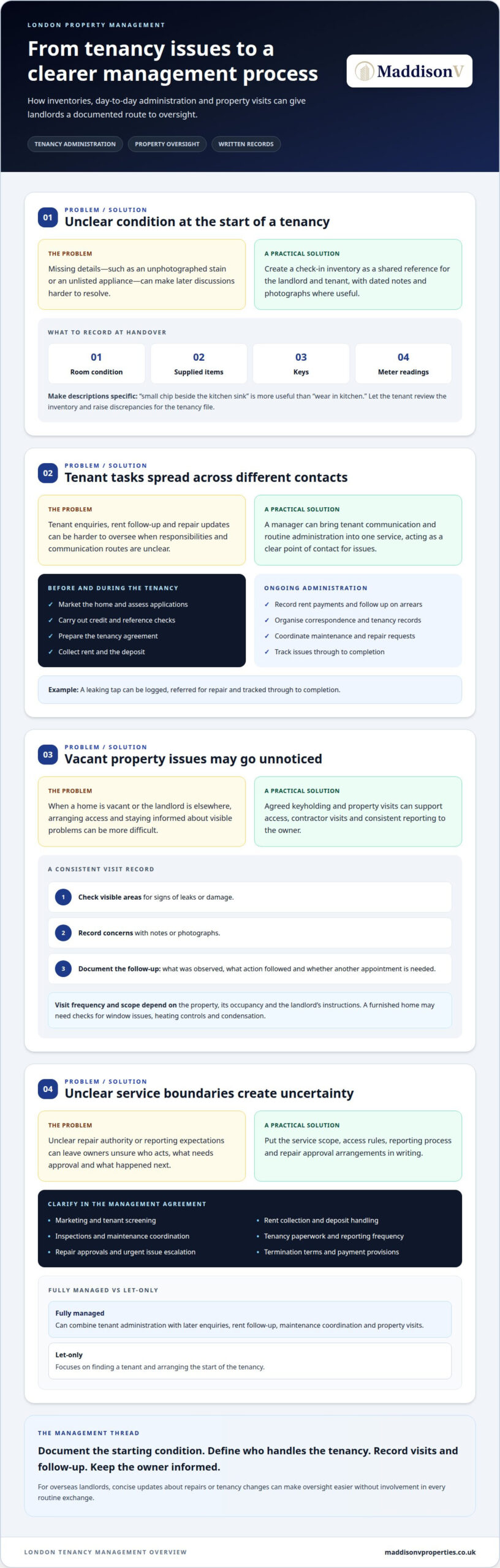
A check-in inventory records a London property’s condition at the start of a tenancy. It gives the landlord and tenant a shared reference for fixtures, furnishings, cleanliness and existing marks. For example, a photograph of a scuffed hallway floor helps distinguish an existing mark from damage that occurs later. Specific descriptions matter too: “small chip beside the kitchen sink” is more useful than “wear in kitchen.”
At handover, the inventory can record each room’s condition, supplied items, keys and meter readings. The tenant can review it and raise discrepancies, creating a dated record for the tenancy file. A thorough inventory also makes the eventual check-out comparison more precise. Missing details, such as an unphotographed stain or an unlisted appliance, can make later discussions harder to resolve.
For tenant sourcing, a property manager can market the home, assess applications and carry out credit and reference checks. They can prepare the tenancy agreement, collect rent and the deposit, then manage tenant enquiries and maintenance requests during the tenancy. For example, a leaking tap can be logged, referred for repair and tracked through to completion.
Before signing a management agreement in London, read the service scope, termination terms and payment provisions. Check whether the written duties cover marketing, tenant screening, rent collection, deposit handling, inspections, maintenance coordination and tenancy paperwork. Clarify how repair approvals work, how often you will receive reports and which services may incur separate charges. The agreement should also explain who communicates with tenants and how urgent issues are escalated.
When assessing an agent’s credentials and client reviews, ask about relevant professional memberships, training and complaint-handling arrangements. Review recent feedback across independent platforms, focusing on specific comments about communication, accounting and repair follow-through. A pattern of detailed, consistent reviews is more informative than a single rating. Compare that feedback with the responsibilities in the proposed agreement.
Tenancy administration involves more than collecting rent. A manager can record payments, follow up on arrears and keep correspondence, agreements and maintenance updates organised. Clear records help owners see what happened, when it happened and what action followed. For landlords living overseas, a concise update about a repair or tenancy change makes oversight easier without requiring involvement in every routine exchange.
For landlords seeking fully managed property management in London, a useful handover starts with an accurate inventory and a written division of responsibilities. Together, these establish the property’s starting condition and the practical framework for managing the tenancy.
With a fully managed letting in the UK, an agent can oversee practical tenancy administration: marketing the property, finding suitable tenants, carrying out credit and reference checks, preparing tenancy agreements, collecting rent and deposits, and coordinating maintenance or repairs. Agents can also handle tenant enquiries on the landlord’s behalf, giving tenants a clear route to raise issues while the agent manages the response. This brings tenant communication and property administration into one service.
Keyholding and vacant-property visits
Keyholding means a property manager retains authorised access arrangements for the home. At a vacant London flat, this can make it easier to arrange a visit, meet a contractor or respond to a reported issue. Access should be recorded clearly, with keys identified by property rather than by an exposed address label. The agreed process should also specify who may enter and how visits are logged.
A useful vacant-property visit follows a consistent process. The visitor checks visible areas, looks for signs of leaks or damage, and records concerns with notes or photographs. For example, a damp patch beneath a bathroom basin may prompt closer inspection and a maintenance report. The visit record should state what was observed, what action followed and whether another appointment is needed.
Visit frequency and scope depend on the property, its occupancy and the landlord’s instructions. A furnished home may need checks for window issues, heating controls and condensation; an empty apartment undergoing repairs may need progress updates. An agreed schedule sets expectations, while clear reporting helps the owner distinguish a routine observation from an issue requiring a decision.
When comparing fully managed property management companies in London, look at the written visit scope, reporting process, repair approval limits and tenant communication arrangements. Focus on what happens after a problem is found, not simply whether visits are offered.
A fully managed service generally combines tenant administration with ongoing property oversight. Let-only service focuses on finding a tenant and arranging the start of the tenancy. The practical difference is who handles later enquiries, rent follow-up, maintenance coordination and property visits.
Keyholding reduces the need for an owner to arrange every routine entry, but it does not remove all risk. Poor access records, unclear repair authority or inadequate visit reports can delay action or leave owners unsure what happened. Set out authorised visitors, reporting expectations and spending authority in writing. For example, agree whether a contractor can assess a dripping tap and who approves the repair itself.
Switching managers starts with reviewing the current agreement’s termination terms and notice process. Then arrange a documented handover of keys, access instructions, tenancy records, outstanding maintenance, rent information and relevant correspondence. The incoming manager can record unresolved items, such as a pending repair, and set the next visit plan. Keep tenants informed about their new contact and how to report issues.
A clear keyholding process turns access into accountable oversight, rather than an informal exchange of keys. Landlords planning a change can use these steps to shape London property oversight arrangements around access, reporting and maintenance decisions.
Legal compliance and safety certificates
A property file brings compliance documents, inspection records and follow-up actions together. For a London flat, this might include the Energy Performance Certificate (EPC), contractor reports and repair correspondence. A property manager can track which documents relate to the home and note when actions are completed. This makes relevant records easier to retrieve when a tenancy begins or a question arises.
The EPC is a specific document to track. According to the UK Government, landlords are legally required to have an Energy Performance Certificate for their property. A manager can keep the certificate with the property records and ensure it is available during relevant tenancy administration. For example, if a prospective tenant asks about the flat’s energy rating, the record provides a clear reference instead of relying on memory.
Safety documentation also needs careful organisation. Property records can include contractor findings, equipment servicing paperwork and evidence of completed repairs. Because these documents serve different purposes, a dated register helps distinguish a visit report from a certificate or invoice. If a contractor notes a faulty extractor fan, the file can record the observation, proposed action and repair outcome.
Start a practical review with a document list for each property. Identify available certificates, note their dates and record any follow-up described in the paperwork. If a document refers to a particular appliance or installation, make that connection clear. This helps avoid confusing, for example, a boiler service document with paperwork for another system in the same London building.
Next, assign and track outstanding actions. A report recommending further investigation should remain open until the next step is recorded. The file might note that a contractor attended, explained the issue and provided a report for the owner’s decision. Keeping the sequence together helps prevent a recommendation from getting lost among routine tenant messages and maintenance updates.
Owners should understand how the management agreement covers document collection, contractor coordination and repair approvals. The written process can explain who requests paperwork, where records are stored and how owners receive updates. For example, an owner may want a copy of a new report after a heating system inspection. Clear arrangements help the manager and owner work from the same property record.
For a portfolio, a central register can show each property, its available documents and open actions. It should distinguish completed tasks from items awaiting a decision. This overview helps owners identify where records need attention without treating every property as identical. A London apartment with a recent contractor report may need different follow-up from a home with an unresolved recommendation in its file.
Overseas landlord support
Remote ownership works best when decisions follow a clear process, rather than relying on messages arriving at convenient times. An overseas landlord can nominate a primary contact and a backup, and define the decisions each may make. For example, a representative might handle routine access questions while the owner retains decisions about tenancy changes. Recording these boundaries prevents confusion when London and the owner’s location operate on different schedules.
Time-zone differences can affect how quickly an owner sees a request. Set out preferred contact methods, suitable hours for calls and how urgent decisions are identified. If an owner is usually unavailable during London mornings, the manager can send a written summary for later review. The summary should state the decision needed clearly, rather than burying it in a long message thread.
A decision brief can follow a consistent format: the issue, available options, relevant context and the owner’s required instruction. For a proposed tenancy change, the brief might explain the request and specify what needs approval. Consistency helps overseas owners assess unfamiliar situations without searching through unrelated correspondence or asking for the background again.
Before a tenancy begins, owners can decide which choices to reserve for themselves and which routine matters can proceed under standing instructions. For example, an owner may require direct approval for any change to the agreed tenancy terms. The manager can keep those instructions with the property’s records and refer to them when a decision arises.
Remote ownership also benefits from a reliable record of decisions. A short decision log can capture the date, instruction, person who gave it and resulting action. If an owner later asks why a particular choice was made, the log provides a clear reference. Unlike a general property update, it records authority and the history of the decision.
Owners with several properties can set a shared review schedule around their availability. A planned discussion can cover upcoming tenancy milestones, decisions requiring attention and changes to the owner’s instructions. For instance, an owner travelling for an extended period can update contact preferences before departure. A scheduled review helps avoid last-minute coordination across time zones.
Remote landlords should keep essential management contacts and instructions accessible to authorised people. A concise contact sheet might identify the owner, nominated representative and preferred communication route. It should distinguish current instructions from superseded ones, so outdated contact details or approval processes do not create confusion. These arrangements let overseas owners focus on important decisions without being drawn into every routine exchange.
Fully managed letting can suit landlords who live outside the local area or lack the time or expertise to manage their properties. Define its scope alongside the owner’s contact preferences and decision boundaries. This gives the owner a clear basis for understanding which tasks are covered and which choices still require personal input.
Portfolio management and reporting
Portfolio oversight helps landlords assess how individual properties contribute to their wider investment aims. A home held for long-term income may need different attention from one intended for future sale. Recording each property’s purpose gives portfolio discussions a useful framework, rather than treating every address as interchangeable.
Consistent categories make comparisons more meaningful. Properties can be grouped by location, type, investment purpose or stage in the ownership cycle. A London apartment nearing refurbishment can then be compared with similar assets, rather than without context to a newly acquired home. This supports clearer planning across the portfolio.
A portfolio review can also reveal concentration. If several properties share a location, building type or investment strategy, the owner can consider how much of the portfolio depends on that common factor. This is not a forecast or guarantee of performance. It is a structured way to understand the mix of assets and decide whether it still reflects the owner’s priorities.
Long-term planning benefits from tracking milestones such as tenancy renewals, planned upgrades and ownership reviews. A forward-looking calendar helps owners prepare decisions in advance. For instance, coordinating improvements across properties may help organise access and avoid clashes between project schedules.
Useful portfolio reporting distinguishes comparable properties from those with different characteristics. Comparing similar homes can highlight meaningful differences, while comparing dissimilar assets may obscure them. A consistent approach might group properties by location and type, then record how each fits the owner’s stated objective. Clear definitions matter: “planned improvement” should mean the same thing across the portfolio.
Management fees are often calculated as a percentage of rental income, with additional charges potentially applying to services such as inspections or repair coordination. For a portfolio, the written agreement should explain how fees apply to each property and identify which tasks may be charged separately. This makes it easier to review management costs across different arrangements.
Owners can revisit their priorities as circumstances change. A growing portfolio may need more consistent records; a change in investment plans may call for a fresh assessment of each asset’s role. Keeping the discussion focused on the portfolio’s purpose helps owners make deliberate choices rather than reacting to each property in isolation.
For a structured view of your London holdings, discuss portfolio management support centred on your investment objectives and property mix.
MaddisonV Properties: Property Management
MaddisonV Properties provides Property Management for landlords seeking structured oversight of London tenancies. Consider this service when tenant administration, property visits, maintenance and ongoing records become difficult to coordinate, particularly from overseas or across several properties.
For a broader investment plan, Property Sourcing can support your search for suitable opportunities, while Mortgage Consultations can inform financing decisions. Facilities Management covers the practical oversight of property operations in London. The right support depends on your priorities, from managing an existing tenancy to considering a future purchase.
Discuss your property and management requirements with MaddisonV Properties to explore a suitable next step.
Set the right level of oversight for your next step
Your next decision is not simply whether to delegate, but how much involvement you want to retain. Consider your preferred role in tenant communication, maintenance approvals and decisions across your property. A clear view of these priorities can help shape a practical management arrangement that suits your circumstances.
For landlords considering fully managed property management in London, a conversation can turn broad expectations into a defined approach. Discuss what you want handled, how you prefer to receive updates and which decisions should remain yours. MaddisonV Properties can talk through your requirements and help you consider the next step for your property.
Contact MaddisonV Properties to discuss your property management needs. With a considered plan in place, you can move forward with greater clarity and confidence.
Frequently Asked Questions
What does fully managed property management include in London?
A fully managed property management service in London can coordinate a tenancy from marketing and tenant selection through rent administration, maintenance requests and property oversight. The management agreement defines included tasks, approval points and any separately charged work. For example, it should clarify whether contractor coordination is included and who authorises a repair. This lets you delegate routine coordination while retaining agreed decisions about your property.
What are typical London letting agent management fees and extra charges?
Management fees are often calculated as a percentage of rental income. Additional charges may apply for services such as inspections or repair coordination.

Sign Up Now
Want to read more great articles and blogs subscribe to our newsletter