
Property sourcing is legal in the UK, but it is regulated: according to the UK Government, sourcing property for clients is estate agency work under...

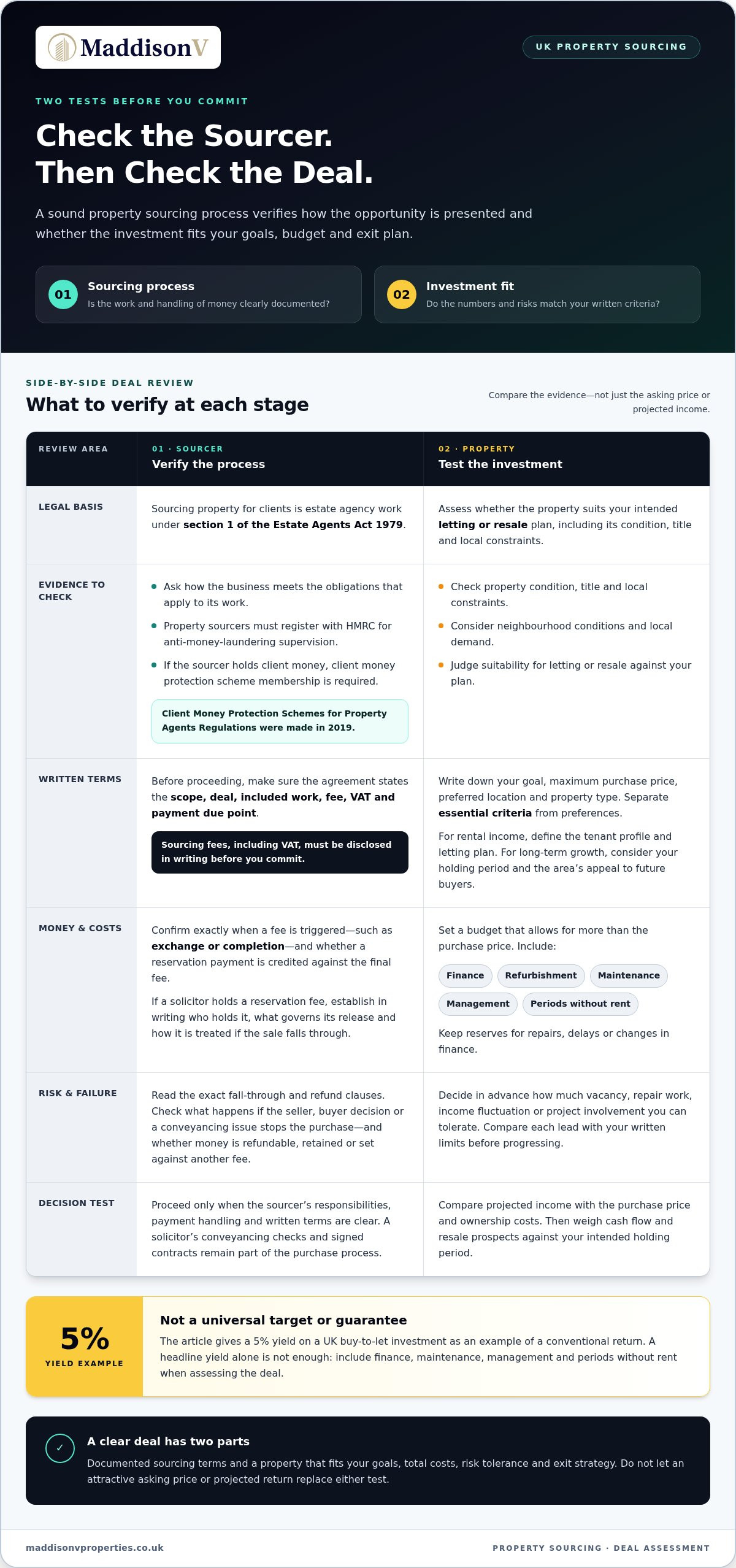
Property sourcing is legal in the UK, but it is regulated: according to the UK Government, sourcing property for clients is estate agency work under section 1 of the Estate Agents Act 1979. A sound UK property sourcing process starts by assessing the sourcer’s compliance, then examining whether the opportunity fits your investment goals.
It’s reasonable to look beyond an attractive asking price. The deal also needs to make sense against your budget, preferred location, likely costs, rental potential and plans for selling or holding the property.
This guide explains how to assess legality, set clear investment criteria, identify local opportunities and evaluate the numbers and exit strategy. Follow the steps to approach each deal with greater clarity and make a considered decision before committing.
Key Takeaways
- Confirm a property sourcer’s legal obligations and review written terms before committing to a deal.
- Set your investment goals, budget and risk tolerance first so you can assess opportunities against a clear strategy.
- Use local market knowledge to evaluate area demand, neighbourhood conditions and the property’s potential.
- Look beyond headline rental yield by accounting for finance, refurbishment and other costs alongside your exit plan.
- Assess each property’s condition, title, local constraints and suitability for letting or resale before deciding whether to proceed.
Is property sourcing legal in the UK?
Yes. According to the UK Government, sourcing property for clients is estate agency work under section 1 of the Estate Agents Act 1979. Legal sourcing still requires clear conduct, transparent terms and careful handling of investor money.
The UK Government made the Client Money Protection Schemes for Property Agents Regulations in 2019. Use these steps to assess a sourcer’s compliance and understand how fees, reservation payments and fall-throughs should be handled.
To see how investors can assess a property deal before making an offer, watch this video:
- Confirm the sourcer’s regulatory position. Because sourcing property for a client falls within estate agency work, ask how the business meets the obligations that apply to its activity. Property sourcers must register with HMRC for anti-money-laundering supervision. Where a sourcer holds client money, membership of a client money protection scheme is required. These checks help distinguish a documented process from an informal promise.
- Request written terms before proceeding. The terms should explain the sourcer’s scope, the property deal being presented, and what work is included. They should also state the fee, whether VAT applies, and when payment becomes due. Sourcing fees, including VAT, must be disclosed in writing before an investor commits. Read the whole agreement, not only the headline fee or projected income.
- Identify the payment trigger precisely. A fee may become payable at exchange or completion, depending on the written agreement. Ask what event triggers payment and whether a holding or reservation payment is credited against the final fee. The agreement should set out what happens if the transaction changes, a condition is unmet, or the purchase does not proceed.
- Clarify payment timing and handling. Sourcers commonly receive their fee on completion, although some agreements require a holding deposit earlier. A solicitor may hold an investor’s reservation fee and handle anti-money-laundering checks. If that arrangement is proposed, establish in writing who holds the funds, what instructions govern release, and how the payment is treated if the sale falls through.
- Read the fall-through and refund provisions. Before paying, find the exact clause covering a failed transaction. It should distinguish between a deal that fails because of the seller, a buyer’s decision, or an issue found during conveyancing. Check whether money is refundable, retained, or set against another fee, and whether the sourcer has completed the agreed work. A solicitor’s conveyancing checks and signed contracts remain part of the purchase process.
Investor goals, budget, risk tolerance and strategy
Before reviewing opportunities, define what success means for your property investment. A written brief helps rule out unsuitable properties based on budget, location, income needs and risk tolerance.
-
Define Investment Goals and Property Criteria
Write down your investment goal and turn it into practical property criteria. For rental income, specify the tenant profile, property type and letting plan you can manage. For long-term growth, consider your holding period and the area’s appeal to future buyers. Set a maximum purchase price and allow for finance, refurbishment and ongoing ownership costs.
Separate essential requirements from preferences. Access to transport, for example, might be essential, while a particular interior finish may be negotiable. Record your tolerance for vacancy, repairs and changes in income. A clear brief gives a property sourcing professional useful parameters and helps keep attractive presentation from overshadowing the fundamentals.
-
Choose a Strategy and Assess ROI
Compare strategies against your goals, available capital and appetite for active involvement. A conventional buy-to-let may suit an investor seeking rental income, while a refurbishment-led purchase involves more project oversight and cost exposure. A 5% yield on a UK buy-to-let investment is an example of a conventional return, not a universal target or guarantee.
Compare projected income with the purchase price and all relevant ownership costs. Include finance, maintenance, management and periods without rent in your assumptions. Then assess the resulting cash flow and potential resale prospects against your intended holding period. Don’t choose a strategy solely because its headline return appears higher.
-
Set a usable budget and risk boundary.
Calculate how much capital you can commit without relying on optimistic rental assumptions. Separate purchase funds from reserves for repairs, delays or changes in finance. Decide in advance which condition issues, income fluctuations or project demands would exceed your comfort level. These limits make it easier to reject a property that stretches your finances, even if its projected returns look appealing.
-
Agree responsibilities with sellers and investors.
Put the working arrangement in writing before pursuing a deal. Clarify who supplies information, arranges access, reviews offers and communicates changes. For investor partnerships, record each party’s contribution, decision-making role and intended exit. In discussions with a seller, confirm the property details and agreed next steps. Clear responsibilities help prevent confusion if an offer, valuation or finance decision changes.
-
Build a focused lead-generation pipeline.
Define how you’ll identify suitable investment opportunities and sellers. An investor profile can set out preferred locations, property types, funding approach and strategy. Seller outreach can draw on estate agent relationships and local market contacts. Compare every lead with your written criteria before progressing. This filters out mismatches and keeps discussions focused on income potential or the seller’s timing.
Local market expertise and identifying opportunities
Property sourcers find UK investment properties through market research, local relationships and targeted searches. Assess each opportunity against its location, likely demand and your investment criteria, rather than relying on a national trend alone.
-
Research UK Markets and Local Areas
Compare the UK-wide picture with conditions in each area you’re considering. National trends can’t tell you whether a particular street suits your strategy or intended tenant profile. Look for local evidence, such as nearby amenities, transport links, employment centres and competing properties. Consider whether the area complements your portfolio or introduces a location you don’t yet know well.
Be clear about the limits of geographic expertise. A sourcer may know particular towns or neighbourhoods in depth, but not every UK market. Ask which locations they work in regularly and how they gather information about other areas. For a London search, knowledge of places such as Canary Wharf or Nine Elms can help frame useful questions, but each property still needs its own assessment.
-
Identify Off-Market Opportunities
Local relationships with estate agents, landlords and other property contacts can reveal potential deals before or outside broad public marketing. “Off-market” describes how a property is introduced, not whether it offers value. Ask how the opportunity reached the sourcer, whether the seller has authority to discuss a sale, and what evidence supports the proposed terms.
For a negotiated deal, distinguish the seller’s preferred terms from the evidence behind the asking figure. Establish what’s included, what needs clarification and how an offer will be communicated. A personal introduction may provide access, but it doesn’t replace independent evaluation. Record the source and status of each lead so you can compare opportunities consistently.
-
Assess Potential Investment Properties
Use the same screening process for every property sourced for you. Start with location and property type, then assess its intended use, likely occupier demand and fit with your criteria. Where available, compare it with similar local listings and recent market activity. Record the evidence, uncertainties and assumptions that need testing before you proceed.
Next, assess the property’s appeal in its immediate area. A flat near a transport link may suit a different tenant profile from a family house close to schools and everyday services. Check whether local supply appears to match your intended audience. A broad area label alone doesn’t prove that a particular property will attract demand or suit every portfolio.
-
Test the sourcer’s local knowledge.
Ask for a clear explanation of why the area and property match your brief. A useful answer links the location and property type to your strategy, rather than relying solely on a claimed market trend. If a sourcer specialises in one district, weigh that expertise against the scope of your search. A precise local focus can be valuable when its limits are clear.
-
Keep a comparison record.
Log each lead’s location, source, seller position and key reasons for consideration. Apply the same criteria to opportunities introduced through trusted contacts and those found through an estate agent. A consistent record creates a transparent shortlist, reveals gaps in local evidence and keeps a personal introduction from being mistaken for investment merit.
Rental yield, ROI, refurbishment costs and exit strategy
Assess a property’s income, costs and eventual exit together, rather than treating them as separate promises. A clear due diligence process helps show whether the rental plan and investment timeline work as a whole.
- Calculate rental yield and realistic returns.
Start with expected annual rent and compare it with the purchase price to understand gross yield. Some northern UK cities had typical buy-to-let gross yields around or above 8% in 2025. That figure is a market example, not a forecast for every property. Calculate net income separately by accounting for mortgage payments, management, maintenance, insurance and periods without a tenant.
Assess return on investment against the capital required and your intended holding period. A property with a strong gross yield may generate less income after finance and operating costs. Test the figures using cautious rental assumptions, and compare properties on the same basis. Headline yield alone can’t show whether a deal suits your portfolio.
- Define refurbishment scope before making an offer.
List the work needed to prepare the property for its intended rental market. Separate essential repairs, such as addressing a structural concern, from improvements designed to increase appeal. For each item, consider its effect on rental readiness, ongoing upkeep and resale presentation. A dated kitchen may call for a different approach from a property needing extensive repairs.
Include finance requirements and the time needed to complete the work. If refurbishment delays letting, account for the lost rental income in your projections. Record your assumptions and compare the planned scope with the property’s condition. An unclear works plan can make an otherwise attractive purchase difficult to assess.
- Compare strategies against their operating demands.
Buy-to-let, rent-to-rent and HMO-focused approaches have different income structures and management needs. Corporate lets and serviced accommodation are other models investors may consider. Compare each with the property, local demand and your capacity to oversee operations. Don’t assume an alternative model will produce higher returns simply because it uses the property differently.
For a rent-to-rent or HMO strategy, assess the proposed arrangement, likely operating costs and income assumptions before proceeding. Check that the property can support the intended use and that the plan fits your investment criteria. When comparing an active model with a conventional rental, account for the additional coordination it requires.
- Choose an exit strategy before purchase.
Decide whether you intend to hold the property for rental income, sell it or consider refinancing as part of a longer-term plan. Each route depends on different factors: selling relies on buyer demand and resale appeal, while holding depends on sustainable rental income and manageable costs. Set out the conditions that would prompt you to review your strategy.
Revisit those conditions if refurbishment costs, mortgage terms or rental performance change. A documented exit plan helps you judge whether the property still serves its purpose, instead of letting an early assumption dictate your decision.
Buyer criteria and deal analysis
Apply the same documented criteria to every property, tailoring your checks to its UK nation. Rules and transaction processes can differ across England, Scotland, Wales and Northern Ireland, so identify the property’s jurisdiction before reviewing the deal. Before buying, review condition, structure, compliance, title, local constraints and financial potential. Incomplete checks, unclear terms and unsupported assumptions can all create risk.
-
Apply Buyer Criteria to Deal Analysis
Compare each property with your written requirements for location, type, intended use and budget. Check whether the proposed purchase price and likely income align with your strategy, and record the evidence behind each assumption. For example, assess a flat intended for letting for its rental and finance potential, not just its presentation. Reject a deal that misses essential criteria, however attractive it may seem.
-
Make Checks Before Buying a Sourced Property
Review the property’s condition, structural issues, compliance risks and neighbourhood profile. Assess its resale, letting and finance potential, then examine title documents and local constraints. Compare the sourcer’s information with the findings of your conveyancing process. A well-presented summary can guide your review, but it doesn’t replace a solicitor’s checks or the contracts required for a purchase.
-
Request a complete deal package.
Ask for written heads of terms, a clear account of the property and proposed transaction, and evidence of due diligence. The documents should distinguish verified details from estimates, including rental assumptions and planned works. Check that they explain how the opportunity fits your criteria and portfolio. If key documents or explanations are missing, pause until you understand the gap.
-
Review the sourcing process and compliance records.
Check that the sourcer’s paperwork identifies the parties, scope of work and relevant terms. Confirm that the investor’s identity and anti-money-laundering procedures are addressed when you instruct the sourcer, not left until completion. If the sourcer acts on your behalf, clarify who communicates with the seller and who approves changes. Keep copies of correspondence, supporting documents and decisions to maintain a clear transaction record.
-
Identify risks before committing.
A sourcing company may provide incomplete evidence, misjudge a property’s potential or leave responsibilities unclear. A deal may also disappoint if its income assumptions, condition or exit prospects differ from reality. Test claims against documents, distinguish estimates from confirmed facts, and ensure the written terms match the service provided. A sourced opportunity is not a substitute for your own buying decision.
For a structured review of an investment opportunity, discuss your property investment criteria before progressing to a purchase.
MaddisonV Properties: Property Management
MaddisonV Properties provides Property Management for investors seeking structured oversight after a purchase. Once a property is let, ongoing management helps organise routine responsibilities while owners focus on their wider investment plans.
If you’re still assessing opportunities, Property Sourcing can help identify properties that match defined criteria. Mortgage Consultations support your consideration of finance, while Facilities Management covers the practical operation of property assets. Investors with multiple holdings may also find Portfolio Management useful when coordinating decisions across their portfolio.
The right support depends on where you are in your investment journey, from evaluating a purchase to overseeing an existing asset. To discuss your property requirements, contact MaddisonV Properties or visit maddisonvproperties.co.uk.
Turn your investment brief into a confident next step
A considered property decision is about more than choosing a promising asset. It also gives you a clear rationale to revisit as your portfolio evolves. The property sourcing process in the UK is more useful when each decision reflects your priorities and you can explain how an opportunity fits your plans.
Keep your investment brief active after purchase. Review whether the property still serves its intended purpose, and use what you learn to shape future decisions. This steady approach can bring greater consistency to your investment journey.
When you’re ready to discuss your next move, contact MaddisonV Properties. Take the next step with clarity and confidence.
Frequently Asked Questions
What are the steps in the UK property sourcing process?
Start by defining the investor’s goals and property requirements, then identify opportunities that match them. Before deciding whether to proceed, review the location, condition, title information, costs, income assumptions and intended exit. For example, an investor seeking rental income should test expected rent against ownership costs, not just compare asking prices. Keep the sourcer’s written terms and supporting deal documents together for reference.
What qualifications or licenses do UK property sourcers need?
No formal qualification is required to become a property sourcer in the UK, but applicable legal registrations remain mandatory. A sourcer carrying out estate agency work must register with HMRC for anti-money-laundering supervision. For a practical review, ask which business entity you’re instructing and whether its registration covers the activity it performs. A qualification or course certificate alone doesn’t demonstrate that required registrations are in place.
What legal rules apply to property sourcing in the UK?
According to the UK Government, sourcing property for clients is estate agency work under section 1 of the Estate Agents Act 1979. Residential estate agents must also join an approved redress scheme. Where a sourcer holds client money, membership of a client money protection scheme is required. The legal and transaction framework can differ across England, Scotland, Wales and Northern Ireland, so establish the property’s location before reviewing relevant terms.
How do UK property sourcers comply with anti-money laundering and client money rules?
Sourcers register with HMRC for anti-money-laundering supervision and carry out customer due diligence when an investor instructs them. If they hold client money, they must belong to a client money protection scheme. The Client Money Protection Schemes for Property Agents Regulations were made in 2019, according to the UK Government. Investors can clarify who holds any reservation payment; a solicitor may hold it and handle anti-money-laundering checks.
What fees do UK property sourcing companies charge?
Fees may be a fixed amount or a percentage of the purchase price, with the payment trigger set out in the agreement. The fee depends on the case and is provided after a quote request; factors include the scope of sourcing work, property type and deal complexity. Before committing, review the written fee terms, including VAT, when payment is due and what happens if the transaction falls through.

Sign Up Now
Want to read more great articles and blogs subscribe to our newsletter