
Could the most useful property investment resource be the one that answers your next decision, rather than the most popular website? Finding the best...

Could the most useful property investment resource be the one that answers your next decision, rather than the most popular website? Finding the best resources for property investors uk can feel difficult when market data, listings and confident opinions all point in different directions.
Organise your research around decisions, not websites. Official sources such as HM Land Registry and the Office for National Statistics can provide a basis for assessing market data, while property portals show asking prices and available listings. Neither tells the whole story: investment decisions also involve financing, ownership and ongoing management.
This guide explains which resource types can help at each stage, how to compare information and test assumptions, and when professional support may be useful. It also covers practical ways to start assessing costs with mortgage and Stamp Duty calculators, and how property consultancy, mortgage consultations and management support can connect research with the realities of buying and owning property.
Key Takeaways
- Choose the best resources for property investors uk by identifying the decision you need to make, then selecting information or tools suited to it.
- Use HM Land Registry and the Office for National Statistics for market information, and HM Revenue & Customs for property-tax guidance.
- Before relying on a claim, check its source, publication date, geographic scope, definitions and potential commercial incentives.
- Build a repeatable research sequence covering your investment objective, location, property, financing and ownership before acquisition.
- Property Consultancy Services, buying assistance, mortgage consultations and management support can connect research with the practical stages of investing.
Best resources for property investors in the UK: start with the decision
Property research rarely arrives in one neat package. Market reports, listings, mortgage tools and investor discussions each offer a different perspective. Gathering more information can create noise rather than confidence if there’s no clear question behind it. A property investment resource is any source or practical tool that helps you make a particular decision.
You might be deciding where to invest, whether a property suits your objectives, how to approach financing, what to consider before acquisition, or how to manage ownership over time. Resources can clarify options and expose assumptions, but they can’t guarantee rental income, capital growth or a successful investment. The aim is to make a considered decision supported by relevant information.
Which decisions do property investors need to research?
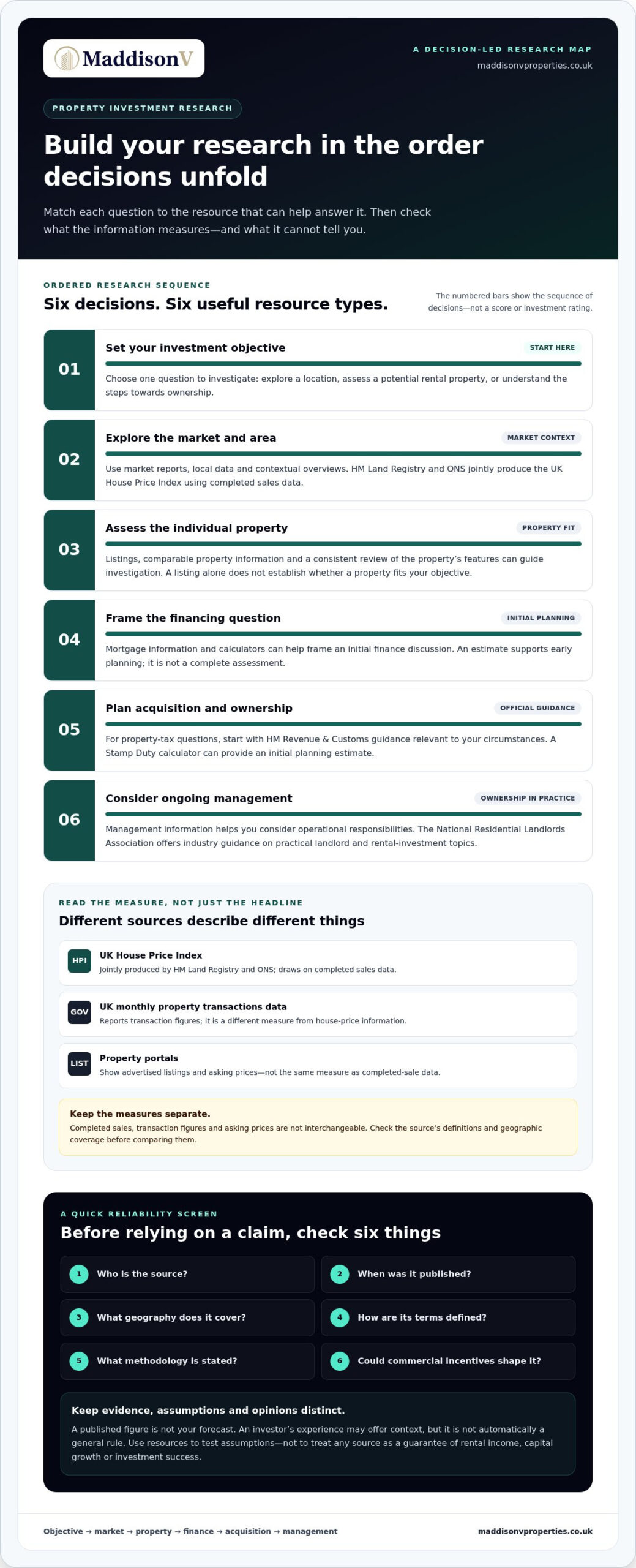
Separate area-level research from property-level assessment. An area that merits further attention doesn’t automatically make every property within it suitable. Finance and ownership planning have their own questions, while management becomes more immediate as you move towards owning and operating a property.
Decision | Useful resource type
Which market or area should I explore? | Market reports, local data and contextual overviews, such as Real estate in the United Kingdom.
Does this property fit my objective? | Property listings, comparable property information and a consistent assessment of the property’s features.
How might I fund an acquisition? | Mortgage information and calculators that help frame an initial finance discussion.
What should I plan before buying? | Tax and ownership guidance, alongside acquisition support relevant to the purchase.
How will I oversee the property? | Management information that helps you consider ongoing operational responsibilities.
This framework keeps each resource in its proper role. A listing can help you identify properties to investigate; it doesn’t establish whether one aligns with your investment plan. An estimate can support early planning without replacing a complete assessment.
How should beginners approach UK property research?
Begin with one objective. Decide whether you’re exploring a particular location, assessing a potential rental property or learning about the steps towards ownership. That focus helps you choose what to read and what to set aside, rather than collecting reports, listings and commentary without a clear purpose.
As you research, label each point as a published fact, an assumption or an opinion. A figure quoted by a source isn’t the same as your forecast; an investor’s experience may be useful context, but it isn’t automatically a general rule. Keeping those categories distinct makes it easier to see where your thinking relies on evidence and where it still needs testing.
Use the best resources for property investors uk as a decision-led toolkit, not a checklist of websites to exhaust. Move from objective to market, then property, finance, acquisition and management. At each stage, ask what you need to decide next and choose resources that address that question. This creates a more structured route through a crowded field of information.
Where to find UK property market, location and ownership information
Once you know what you need to investigate, choose sources with clear roles. HM Land Registry and the Office for National Statistics (ONS) are central public sources for UK housing information. They jointly produce the UK House Price Index, which draws on completed sales data. For a different measure of activity, the UK monthly property transactions data from GOV.UK reports transaction figures. These records describe different things, so don’t treat them as interchangeable.
Which public sources can support market research?
Use public data to understand what has been recorded, then look to other sources for context. HM Land Registry and ONS provide official housing statistics; local and national publications may discuss trends, while property portals show advertised listings and asking prices. Forecasts, investor commentary and promotional material offer interpretation or a commercial perspective, rather than a record of completed activity.
For every source, note its publication date, geographic coverage and stated methodology. Read the definitions on the source itself: an England-focused figure, for example, may not represent the whole UK, and asking prices are not the same measure as completed-sale data. Recording these details makes comparisons more meaningful.
Where can investors research tax and financing questions?
For property-tax questions, begin with HM Revenue & Customs (HMRC), the official source for tax information. Look for guidance that applies to your circumstances and the relevant part of the UK, rather than relying on an old summary or an investor’s anecdote. Keep tax guidance separate from market commentary, as the two answer different questions.
For landlord and rental-investment topics, the National Residential Landlords Association (NRLA) offers industry guidance on practical responsibilities, while comparison platforms such as Commercial Property Insurance UK help clarify policy options and operational overheads. These can complement official information, but they aren’t a substitute for government guidance on tax or other formal requirements.
MaddisonV Properties’ Stamp Duty calculator can provide an initial planning estimate, while its mortgage estimator calculator can help you explore financing assumptions. Treat both as starting points, not confirmation of your full costs or mortgage eligibility. The figures you enter and the assumptions behind them matter. A calculator can help frame questions, but it doesn’t make a lending decision.
Keep a concise source log with the link, date checked, geography, definitions and methodology. Note whether each item is an official record, industry guidance, a forecast or commercial content. This helps prevent a confident prediction or advertisement from being mistaken for established market evidence.
For support connecting research with the next stages of an investment, explore MaddisonV Properties’ property consultancy alongside your own source review.
How to compare property investment resources and spot their limits
Sources are most useful when you understand what they can establish. An official record, an industry guide, a property listing and an investor’s account may all discuss the same area, yet each provides a different kind of evidence. Treating them as equivalent can make an attractive figure seem more conclusive than it is.
Resource type | Best used for | Main limitation
Official records | Understanding recorded activity or published statistics | Coverage, definitions and publication timing shape what the figures represent.
Industry guidance | Exploring sector context and practical topics | Guidance may reflect a particular part of the industry or its perspective.
Property listings | Finding properties to investigate and comparing advertised details | Listings are individual offers, not proof of market-wide prices or achieved returns.
Calculators | Exploring an estimate using stated inputs | Results depend on the information and assumptions entered.
Community discussions | Identifying questions and learning from individual experiences | A personal account may not apply to another investor, location or property.
Forecasts and commentary | Understanding an author’s interpretation or outlook | They express analysis or opinion, not a confirmed future outcome.
How can investors assess whether a resource is reliable?
Start with the publisher. Does it identify where the information comes from and explain the definitions behind its figures? Check the publication or update date, then confirm that the geographic scope matches your question. A claim about one location or property type may not apply to another.
Consider the publisher’s purpose, too. A resource may provide useful information while also promoting a service, listing or investment opportunity. That commercial context doesn’t automatically make the information unusable, but it matters when weighing its conclusions. For broader industry context, Real Estate:UK industry insights can sit alongside official sources and specialist guidance. For an important claim, compare it with a separate authoritative source before relying on it.
What can listings, forums and calculators tell you?
A listing can help you shortlist a property for closer assessment. Don’t use it alone to infer what similar homes have sold for or what an investment will earn. A forum post can raise a useful question, such as how an owner approaches a management issue, but one person’s experience isn’t a universal rule.
Calculators are useful for testing scenarios, not certifying them. Change an assumption and the output may change, so note the inputs and treat the result as an estimate. Gross figures need similar care: a gross rental figure is not the same as a return after costs. A forecast is not a completed result, and an individual story is not a market-wide measure.
The best resources for property investors uk are those whose purpose and limitations are clear. Compare like with like, retain the context behind each claim, and use each source to answer the questions it was designed to address.
A practical research sequence for a UK property investment
A repeatable process turns research into decisions without letting every new report reset your direction. Work through the stages in order, keeping a short record of what you know, what you’re assuming and what still needs investigation. The best resources for property investors uk are most useful when each one serves a clear step in that process.
What should investors do before shortlisting properties?
Start with your objective, not a list of properties. Write down what you want the investment to achieve and the questions that will help you judge whether an option is suitable. Are you comparing areas, considering a rental property or exploring a particular type of development? A focused question keeps early research relevant.
- Set your objective. State the intended role of the investment and the factors that matter most to you.
- Choose locations to investigate. Compare relevant areas using the same measures, definitions and source dates. Don’t place unlike data side by side without accounting for what each figure represents.
- Build location context. Combine published market information with relevant local context before moving to individual listings. For London research, Real Estate in England: The Definitive Guide to the London Market in 2026 can provide a broader frame for understanding the market.
At this stage, the aim is to narrow your questions and identify areas for closer attention, not to prove that a location will deliver a particular result. Keep forecasts and personal expectations separate from recorded information.
How should research continue from shortlist to ownership?
Once you have a shortlist, shift from area-level research to each property. Review how its characteristics relate to your objective, and note unanswered questions rather than treating an appealing listing as a settled investment decision. This connects general market understanding with the specific asset you may pursue.
- Assess each shortlisted property. Use consistent criteria to compare options and identify where further information is needed.
- Review finance assumptions. Consider the mortgage basis of your plans and use estimates as planning prompts, not confirmation of eligibility or final terms.
- Investigate ownership and tax questions. Consult relevant official guidance for the circumstances and location involved, and include unresolved points in your acquisition planning.
- Plan for management. Consider how the property will be overseen after purchase, including the operational support you may need. Treat this as part of the investment decision, not an administrative task to postpone.
If you’re researching off-plan opportunities, add a focused review of the development and its purchase information before progressing. The Sophisticated Investor’s Guide to Off-Plan Property Investment in 2026 is a relevant companion for that route, though it isn’t necessary for every property search.
Property Consultancy Services can connect research with a tailored property search and buying assistance. Explore property consultancy and sourcing support as you shape your next investment decision.
How MaddisonV Properties can connect research with investor support
Research becomes more useful when it leads to a clear next step. MaddisonV Properties’ Property Consultancy Services help investors connect market information with a tailored property search and the practical stages of acquisition. Investors can bring location research, property selection and purchase planning together around their objectives.
When can property consultancy help investors?
Property consultancy can help when you’ve narrowed your priorities and are ready to move from analysis towards a suitable search. MaddisonV Properties supports property search, market analysis and acquisition. Buying assistance can include conveyancing guidance and solicitor referrals. This creates a practical link between understanding the market and progressing a purchase, while each opportunity still needs to be assessed on its own merits.
MaddisonV Properties’ team brings over 50 years of combined experience. Investors exploring sourcing and acquisition can also read Property Sourcing Agents London: The Investor’s Guide to Prime Acquisitions in 2026 for more context on the search process.
How can investors plan beyond acquisition?
Financing and ownership call for different kinds of support. Mortgage consultations can help investors consider financing questions, while the online mortgage estimator offers a starting point for exploring assumptions. It doesn’t establish mortgage eligibility or replace an individual assessment. The Stamp Duty calculator can help with initial purchase-cost planning, but its result is an estimate, not a complete investment assessment.
Ownership planning continues after completion. Property Management and Facilities Management provide ongoing operational support, while Portfolio Management helps investors consider their holdings more broadly. These functions serve different needs: arranging finance is not the same as overseeing a property, and ongoing management is not a substitute for acquisition advice. The Sophisticated Investor’s Guide to Property Management in 2026 offers further context on planning for this stage.
Dependable information, practical tools and tailored guidance can support a more orderly investment journey. The best resources for property investors uk aren’t limited to reports or calculators; experienced support can also connect research with search, finance and ownership. MaddisonV Properties provides these support areas as distinct parts of an investor’s journey, helping you focus on the questions that matter at each stage.
Learn more about the support available at MaddisonV Properties.
Turn your research into a considered next step
The next step isn’t necessarily to gather more information. It may be to identify the unanswered question that matters most to your investment plans, then focus your attention there. A clear brief can help you move forward, whether you’re refining your property criteria, considering financing or planning for ownership.
The best resources for property investors uk can support sound decisions, but their value depends on how you apply them to your objectives. Review the evidence, revisit assumptions and use informed support where it can make the process clearer.
To discuss your investment plans with MaddisonV Properties, explore its property consultancy services.
Frequently Asked Questions
Which resources should a first-time UK property investor use?
Start with resources that answer your immediate investment question, then build a small, organised research file rather than collecting everything you find. The best resources for property investors uk depend on whether you’re exploring an area, reviewing a specific home or planning how to own it. For each item, note what decision it informs and what remains unanswered. This helps you identify gaps before committing time or money.
Can I rely on property investment forums when making a decision?
Use forums to surface questions and perspectives, not as the sole basis for a decision. A landlord describing a repair issue, for instance, may share a useful experience, but the circumstances may differ from yours. Look for context behind a claim, such as the property type and location, and treat unsupported generalisations cautiously. Use forum discussions to guide further research, not replace it, especially for decisions with financial or ownership consequences.
How can I check whether UK property market information is current?
Check the source’s publication or update date and whether the information covers the location and period relevant to your decision. A national figure, for example, may not answer a question about a particular London neighbourhood. Keep a dated record of the material you rely on, including its definitions. When you return to your research, you’ll be able to distinguish a new update from an older figure that still appears in search results.
What happens if two property investment resources give different figures?
Don’t choose the figure that makes an investment appear more attractive until you understand the difference. Check whether both sources cover the same geography, period, property type and calculation basis. One may report advertised figures while another covers completed activity, or their reporting periods may differ. If the distinction remains unclear, label the figures separately and avoid combining them into a single estimate.
Is a property listing a reliable way to judge an area’s investment potential?
A listing can help you identify a property to investigate, but one example can’t represent an entire area. Advertised details describe that particular offer and aren’t proof of typical local performance. If a listing catches your attention, use it to frame follow-up questions about the building, its features and its fit with your objective. Keep property-specific observations separate from broader area research and your own projections.
Can a mortgage or Stamp Duty calculator tell me whether an investment is suitable?
No. A calculator can help you explore how different inputs affect an estimate, but it can’t decide whether a property fits your plans or confirm mortgage eligibility. Changing an assumption may alter the result, so save the inputs alongside the output and review them carefully. MaddisonV Properties’ mortgage estimator and Stamp Duty calculator are useful planning aids; treat their estimates as a starting point for further assessment.

Sign Up Now
Want to read more great articles and blogs subscribe to our newsletter