
What if the most useful clue to the future of the dubai property market is not a confident forecast, but the distance between competing ones? In...

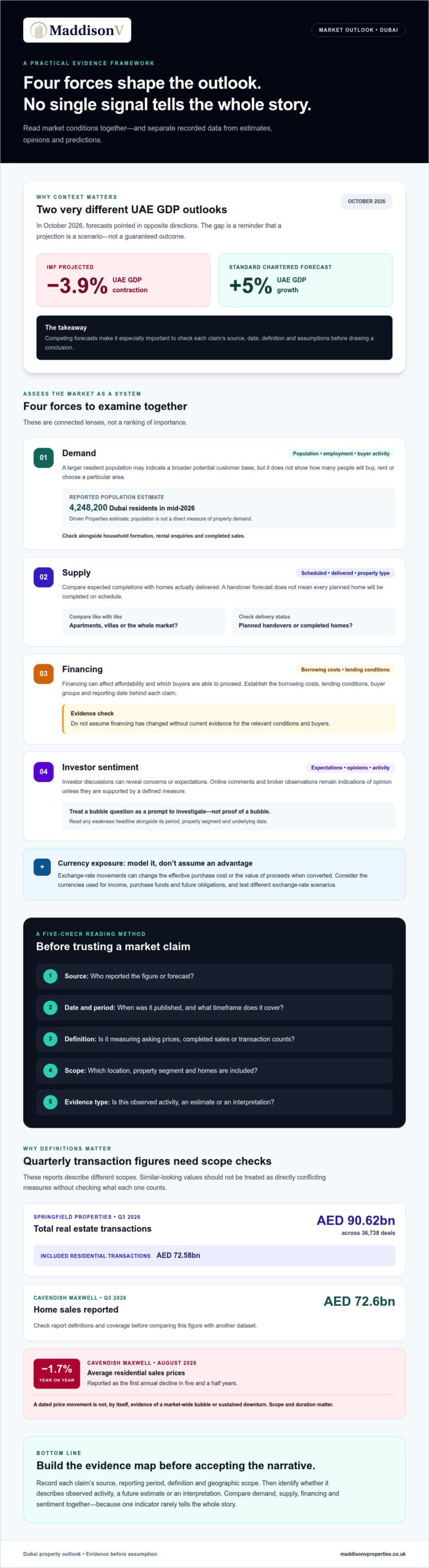
What if the most useful clue to the future of the dubai property market is not a confident forecast, but the distance between competing ones? In October 2026, the IMF projected a 3.9% contraction in UAE GDP, while Standard Chartered forecast 5% growth. Such sharply different outlooks show why market headlines can be difficult to reconcile.
That uncertainty doesn’t make the signals meaningless. It makes it more important to separate reported data from assumptions and predictions, and to consider how economic conditions, new supply, rental trends and buyer activity may affect different property segments.
This article examines the forces shaping Dubai’s property outlook without treating any single forecast as certain. It explains which indicators to monitor, how to read them in context, and why off-plan and established properties may not respond in the same way. The aim is to provide a clearer basis for assessing market developments before making an investment decision.
Key Takeaways
- Read the future of the dubai property market as a conditional outlook, not a promise of prices or returns.
- A bubble label or weakness headline is a prompt to investigate, not proof of a market-wide outcome.
- Before relying on a market report, check its source date, definitions and geographic scope so you’re comparing like with like.
- Assess demand, supply, financing conditions and investor sentiment together. One indicator rarely tells the whole story.
- Match any investment decision to your time horizon and objectives instead of reacting to a single forecast or headline.
What the future of the Dubai property market outlook can, and cannot, tell you
A market outlook is a conditional assessment of how prices or activity might develop if certain conditions hold. It isn’t a promise of future prices, rental income or returns. For investors assessing the future of the dubai property market, that distinction matters: a forecast is a reasoned scenario, not a guaranteed outcome.
Headlines, investor opinions and measured market data are different kinds of evidence. Investor discussions can reveal concerns or expectations, but they don’t establish what the whole market is doing. A question about a bubble invites investigation; it isn’t proof of one. A headline about weakness should also be read alongside the period, property segment and data it describes.
Why Dubai’s property outlook attracts competing interpretations
The same information can lead investors to different conclusions. One observer might read a fall in prices as a temporary adjustment, while another sees a warning of wider weakness. Neither conclusion follows from the movement alone. Historical context, including earlier market downturns, can help frame the discussion. Real estate in Dubai offers a broad overview of that history and the sector’s role. Context informs a view, but it doesn’t determine what happens next.
Look for the evidence behind each claim. Cavendish Maxwell reported that average residential sales prices fell 1.7% year on year in August 2026, describing it as the first annual decline in five and a half years. This is a dated measure of price movement, not, by itself, evidence of a market-wide bubble or sustained downturn. The scope and duration of any change matter.
What a responsible market forecast should include
A useful forecast makes its boundaries clear. It states the period it covers, identifies the source and explains what is being measured, such as asking prices, completed sales or transaction counts. It also separates recorded movement from an analyst’s interpretation of what may follow. Without those details, it’s difficult to compare reports or judge whether a claim applies to a particular property segment.
For example, Springfield Properties reported AED 90.62 billion in total real estate transactions across 36,738 deals in Q3 2026, including AED 72.58 billion in residential transactions. Cavendish Maxwell reported AED 72.6 billion in home sales for the quarter. The figures cover different scopes, so they shouldn’t be treated as directly conflicting measures without checking their definitions.
Good analysis also acknowledges uncertainty. It may describe more than one plausible scenario and explain the assumptions behind each, rather than presenting a single outcome as certain. Treat a forecast as a tool for asking better questions, then weigh it against current, clearly defined evidence before drawing conclusions.
Which forces could shape the future of Dubai’s property market?
The future of the dubai property market will depend on how demand, available homes, financing conditions and investor sentiment interact. No single indicator can settle the outlook. A rise in resident numbers, for example, may signal a larger potential customer base, but it doesn’t show how many people will buy, rent or choose a particular neighbourhood. Treat each driver as a question to investigate, then look for current evidence that matches its scope.
Market direction depends on interacting factors, not one headline. A demand indicator may look supportive while financing becomes less accessible. New supply may also meet a different level of demand than expected. The balance between these forces matters more than any one narrative.
Demand, supply and investor sentiment
Start by asking whether population, employment and buyer activity point in the same direction. Driven Properties estimated Dubai’s resident population at 4,248,200 in mid-2026. That is a population estimate for a specific period, not a direct measure of property demand. To understand its relevance, compare it with evidence on household formation, rental enquiries, completed sales, and the locations and property types involved.
Assess supply just as carefully. Compare scheduled completions with homes actually delivered, and check whether a report covers apartments, villas or the market as a whole. A forecast of future handovers doesn’t show that every planned home will be completed on time. Investor sentiment can also influence activity, but comments, online discussions and broker observations are indications of opinion unless supported by a defined measure.
Financing and external conditions
Financing can affect affordability and the number of buyers able to proceed. Before drawing a conclusion, establish which borrowing costs, lending conditions and buyer groups a report measures, and the date those conditions apply. A change in financing should not be assumed without current evidence on the relevant conditions and buyers.
For investors comparing currencies, exchange-rate movements can alter the effective cost of a purchase or the value of eventual proceeds when converted. Currency exposure is a factor to model, not a guaranteed advantage. Consider the currency used for income, purchase funds and future obligations, and test how different exchange-rate scenarios could affect the investment.
Read the forces together
Build a simple evidence map before accepting a market narrative. Record each claim, its source, reporting period, definition and geographic scope. Then note whether it describes observed activity, a future estimate or an interpretation. If supply estimates disagree, check what each counts and when the homes are expected to be delivered. If sentiment is described as cautious, look for a measurable indicator rather than treating an impression as a market-wide fact.
Investors considering London alongside other markets can use London property investment planning to assess how location and asset choices fit their broader portfolio objectives.
Bubble concerns and weakness signals: how to read the risks in Dubai
A bubble label or a headline about weakness may justify closer analysis, but neither establishes what is happening across Dubai’s entire property market. The evidence could point to pressure in one segment, a short-lived shift in activity or a broader change. Those possibilities shouldn’t be treated as interchangeable. To assess the future of the dubai property market, separate what a source measured from what its headline or commentary suggests.
Build scenarios rather than choosing a single prediction. Ask what the evidence supports, what remains uncertain and what new information would change your view. This keeps a risk assessment measured without dismissing genuine warning signs.
What a bubble claim needs to demonstrate
A bubble claim should explain what appears disconnected from underlying demand and support that argument with evidence. Look for a defined property segment, a clear period and comparable measures, such as sale prices alongside rents or transaction activity. Evidence from one location or property type may identify a local risk, but it can’t automatically establish a market-wide pattern.
Check whether the source shows its data, timeframe and scope. The information in this article isn’t enough to declare that Dubai is, or isn’t, in a bubble.
How to interpret reports of market weakness
A Reuters headline describes early signs of weakness in Dubai’s property sector. A headline alone can’t establish the causes, scale or duration of the reported weakness. Before drawing conclusions, look at the evidence, the period covered and the market measure behind the report’s framing.
A separate, more specific signal comes from Property Finder’s October 12, 2026 report: median advertised annual apartment rents fell in nine out of ten major communities when comparing Q3 2025 with Q3 2026. This measures advertised rents in selected communities, not completed lease prices, sale values or every property type. It warrants investigation, not a blanket conclusion.
Use a simple scenario check to put such reports in context:
- Warning signal: a measured change persists across several reporting periods or appears in multiple relevant indicators. Check that sources use comparable definitions and geographic coverage.
- Interpretation: a claim that one movement proves a bubble, imminent downturn or recovery. Treat it as an argument to test, not a measured result.
- Scenario: a conditional view of what could follow if specified conditions continue. Record what evidence would support or weaken that view.
For an individual property, include Dubai-specific ownership costs, such as applicable service charges, in that property’s assessment. Don’t conflate them with UK property taxes or London service costs. The aim isn’t to force certainty from incomplete information. It’s to make each assumption visible so decisions can respond to evidence as it develops.
How to assess Dubai property market signals before trusting a forecast
A reliable market claim should be traceable, clearly defined and relevant to the decision at hand. Before using a headline to shape your view of the future of the dubai property market, follow a consistent evidence-checking process. This helps separate a genuine signal from a striking but incomplete summary.
A practical sequence for checking a market claim
- Identify the source and date. Find the original report, not just a headline or repost. Record who published it and when, since market conditions and available evidence can change.
- Pin down the scope. Check whether the claim concerns Dubai as a whole, a particular community, or a segment such as apartments, villas, off-plan or completed homes. A narrow measure shouldn’t be presented as a citywide result.
- Inspect the underlying measure. Establish whether the report tracks completed transactions, asking prices, a price index, advertised rents or signed rental contracts. These measures answer different questions. More listings, for example, don’t by themselves show that completed sales have increased.
- Check the comparison period and definition. A monthly movement may differ from an annual comparison, while a change in asking prices may not match changes in transacted prices. Confirm the report’s methodology and what its terms mean.
- Compare independent evidence. Look for another credible source covering a similar period, area and measure. If sources differ, investigate their definitions before deciding that one confirms or contradicts the other.
Test every market claim against its source, date, definition, geographic scope and comparison period before treating it as a trend.
Signals to monitor without overclaiming
When current, reliable data is available, keep transaction activity, prices and rents in separate columns in your notes. For transactions, record both the number and value of deals if reported, along with the property types covered. For prices, distinguish an index from an average or asking price. For rents, note whether a source measures advertised rents or completed agreements. These details help prevent a shift in one measure from being mistaken for a change in all market conditions.
Track each indicator over a period relevant to your investment horizon. A single month can prompt further research, but may not establish a persistent direction. Mark forecasts as estimates and record their assumptions separately from observed data. Avoid applying a threshold or expected return unless the source explains and supports it.
A clear evidence log can be simple: date checked, source, market segment, measure, period, observed result and any interpretation. Updating it as new reports appear creates a calmer basis for comparison and makes changes in the evidence easier to spot.
If you’re assessing how property-market evidence relates to your wider investment objectives, discuss your property investment objectives with MaddisonV Properties’ consultancy team.
What the Dubai property outlook means for investors considering next steps
A market outlook is most useful when it helps you frame a decision, not when it appears to make one for you. The future of the dubai property market can’t be reduced to a single headline or forecast. Use the evidence to test how different conditions could affect your objectives, time horizon and tolerance for uncertainty.
A reported change in prices, transaction activity or rents may matter differently depending on the property type and intended use. A home considered for long-term rental income, for example, raises different questions from an off-plan purchase or a property intended for personal use. None of these scenarios guarantees a particular outcome.
Turn scenarios into questions for your investment review
For each scenario you’re considering, write down its assumptions. Does it depend on demand remaining steady, supply arriving as planned or rental conditions changing? Then ask what new evidence would strengthen or weaken those assumptions. This turns a forecast into a set of questions you can revisit as reports develop.
Bring the review back to the investment itself. Consider the property type, its intended use and the period you expect to hold it. Ask whether the scenario still fits your objectives if the market moves differently than expected. Potential appreciation, rental income or resale conditions are possibilities to assess, not guaranteed performance.
A disciplined review doesn’t require certainty. It requires clarity about what you know, what you’re assuming and which developments could change your view. Avoid making a buy, sell or hold decision solely in response to a headline; one report rarely captures every factor relevant to an individual investment.
Continue your Dubai property research with MaddisonV Properties
For broader context, the Dubai property investment guide and off-plan property investment guide can sit alongside your market review. Use them to explore the distinct considerations of the market and off-plan purchases, while keeping the evidence and assumptions for a specific investment clearly separated. These resources can support further research, but they don’t replace your own assessment of objectives and risk.
As you refine your next steps, property consultancy can help bring the questions together: how a property fits your intended use, how its assumptions align with your time horizon and what information you still need to evaluate. MaddisonV Properties offers personalised property consultancy and investment services to support that process, without promising a particular return or outcome.
To discuss how your property objectives shape your investment review, speak with MaddisonV Properties.
Make your next property decision with clarity
The future of the dubai property market will remain uncertain, but your decision process can still be deliberate. Before acting, decide what evidence would meaningfully change your view, how long you expect to hold an investment and whether the property’s intended use fits your wider objectives. Revisit those questions as reliable information develops, rather than letting a single forecast set the direction.
For investors weighing opportunities, experienced guidance can help translate market research into a considered property strategy. MaddisonV Properties brings over 50 years of combined team experience to its property consultancy, sourcing and investment services, supporting a measured approach without promising a particular outcome.
Explore MaddisonV’s property consultancy services as you shape your next steps. With clear priorities and careful research, you can move forward with greater confidence.
Frequently Asked Questions
Is Dubai’s property market in a bubble?
The information in this article isn’t enough to label Dubai’s entire property market a bubble or rule one out. A useful assessment would compare price movements with measures such as rents and transaction activity over a defined period, while checking whether the data concerns one property type or the wider market. A sharp change in one segment may warrant attention, but it doesn’t automatically describe every location or property.
What are the main risks to the future of the Dubai property market?
Key risks to examine include new supply outpacing demand, shifts in buyer sentiment, financing conditions and regional uncertainty. Property Finder’s October 12, 2026 report said the average daily number of apartments advertised for rent rose 55.1% year on year in September, while renter enquiries grew 15.4%. Those measures may indicate rental-market pressure, but they don’t establish how every property segment will perform.
Will Dubai property prices rise in 2026?
No forecast can establish that prices will rise. ValuStrat’s June 1, 2026 forecast projected a 10% increase in citywide residential capital values for 2026, while SandsOfWealth’s September 21, 2026 forecast suggested a more modest 3% year-end increase. These are different projections, not observed results or guarantees. Their assumptions, timing and definitions matter when comparing them with new data.
Can a report of market weakness predict a wider downturn?
Not by itself. A report can identify a movement in a particular measure, period or segment, but a wider downturn would require evidence showing broader or persistent effects. A decline in advertised rents, for instance, doesn’t automatically demonstrate falling sale prices. Read the underlying report for its data and scope, then compare it with other relevant indicators before deciding whether the signal extends beyond the area or property type measured.
How can investors assess a Dubai property market forecast?
Begin by checking who produced the forecast, when it was published and what outcome it predicts. Then identify its assumptions and whether it concerns prices, rents, transaction activity or another measure. Compare those details with observed data covering a similar period and market segment. If two forecasts differ, note their distinct assumptions rather than averaging them or treating either projection as the definitive outlook.
What should investors monitor before investing in Dubai property?
Track evidence relevant to the property you’re considering: completed sales and prices for comparable homes, rental conditions in the same area, and information about competing supply. Consulting local market professionals such as Golden Bricks Real Estate can provide insight into community-level activity and recent transactions. Review financing and currency exposure as part of your own financial assessment, since both can affect affordability and the investment’s overall costs. Keep a record of source dates and update it as new reports appear, so your decision reflects current evidence rather than an outdated snapshot.

Sign Up Now
Want to read more great articles and blogs subscribe to our newsletter