
Incorporating isn’t automatically the smarter move, even when your property portfolio is growing. If you’re weighing when to incorporate a property...

Incorporating isn’t automatically the smarter move, even when your property portfolio is growing. If you’re weighing when to incorporate a property business, start with your plans for the properties and their income, not the assumption that a company will always be more tax-efficient.
It’s understandable to hesitate. Personal ownership can be simpler to administer, while company ownership may offer different ways to manage rental profits and finance costs. But incorporation can bring additional filings and financing considerations, and transferring properties you already own may have further costs or consequences. The right balance depends on your circumstances, portfolio and plans for the returns.
This guide compares personal and company ownership, explains key tax and financing considerations, and gives you a practical framework for deciding whether to incorporate now, later or not at all. You’ll also find next steps for aligning your ownership structure with your acquisition and portfolio objectives.
Key Takeaways
- There’s no universal point at which to incorporate a property business. Assess whether the structure fits your investment objectives and plans for rental income.
- Compare personal and company ownership across administration, financing and future plans rather than assuming incorporation will always be more tax-efficient.
- Use your acquisition plans, reinvestment intentions and ownership arrangements to assess whether a company structure may suit your portfolio.
- Review your current ownership, financing, tax treatment, administration and future ownership plans before making a decision.
- MaddisonV Properties’ property consultancy, buying assistance and mortgage consultations can help connect property choices with your wider investment strategy.
When to incorporate a property business: understand the decision
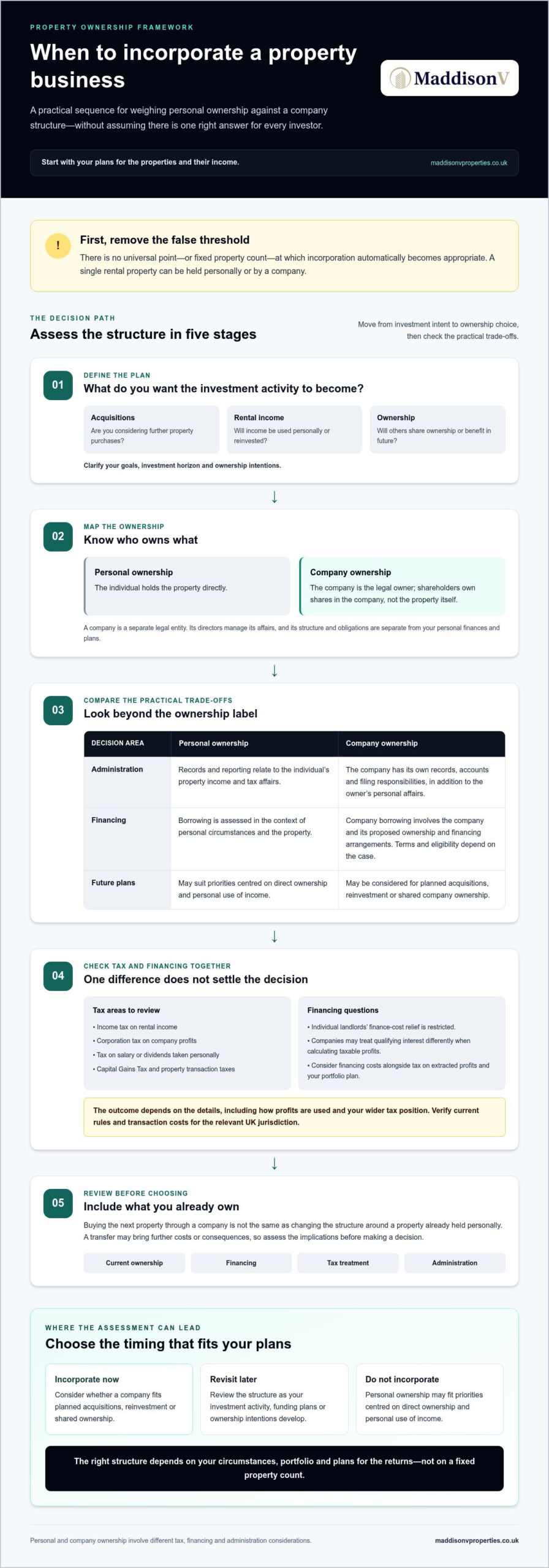
Every investor eventually faces a structural choice: hold a property in their own name or buy it through a company. There’s no universal answer to when to incorporate a property business. It depends on what you want your investment activity to become, how you plan to fund it and who may share ownership or benefit from it in future.
Incorporation is a strategic choice, not a prerequisite for investing in property. A single rental property can be held personally or by a company; there’s no fixed property count that automatically makes incorporation appropriate. What matters is how well the ownership structure fits your plans.
For a closer look at one financing consideration, this video explains limited company mortgages:
What does incorporating a property business mean?
Incorporating means forming a company as a separate legal entity to own and operate property, rather than holding the property directly in your personal name. If a company buys a property, the company is the registered owner. Its shareholders own shares in the company, not the property itself. The company acts through its directors, who are responsible for managing its affairs.
This changes the ownership arrangement, but it doesn’t determine whether an investment will perform well or suit your objectives. You still need to decide what you want from the property, how its income will be used and how much administration you’re prepared to manage. The company’s structure and obligations are also separate from your personal finances and plans.
Why investors consider incorporation at different stages
Timing often reflects the direction of an investor’s plans, not the number of properties they own. Someone considering further acquisitions may want to assess how a company structure fits their intended financing and approach to reinvesting rental income. An investor buying jointly may also consider whether company ownership suits the parties’ planned roles and longer-term arrangements.
An investor planning to hold one property personally may have different priorities from someone building a portfolio. Existing ownership matters, too: changing the structure around a property already held personally isn’t the same as buying the next property through a company. Assess the implications before making a decision.
Think of “property business” as a practical description of your investment activity, not a threshold reached after acquiring a set number of homes. It could mean one rental property held as part of a longer-term plan, or several acquisitions over time. Define your goals, investment horizon and ownership intentions first, then assess which structure offers the clarity and control you need.
Personal ownership vs company ownership: compare the real trade-offs
Personal and company ownership organise an investment in different ways. With personal ownership, an individual holds the property directly. With company ownership, the company is the legal owner and the investor may own shares in it. Neither structure automatically improves returns or makes property management easier.
Neither personal nor company ownership is automatically best for every investor. The right choice depends on tax position, financing, administration and plans for the property. The comparison below is a starting point, not a substitute for checking the rules that apply to your circumstances. Property and tax rules can vary across England, Wales, Scotland and Northern Ireland.
| Decision area | Personal ownership | Company ownership |
|---|---|---|
| Ownership | The individual is the property owner. | The company owns the property; shareholders own shares in the company. |
| Administration | Records and reporting relate to the individual’s property income and tax affairs. | The company has its own records, accounts and filing responsibilities, in addition to the owner’s personal affairs. |
| Financing | Borrowing is assessed in the context of personal circumstances and the property. | Company borrowing involves the company and its proposed ownership and financing arrangements. Terms and eligibility depend on the case. |
| Future plans | May suit an investor whose priorities centre on direct ownership and personal use of income. | May be considered where an investor plans acquisitions, reinvestment or shared company ownership. |
Tax and financing questions to assess
Incorporation isn’t always more tax-efficient. Individuals and companies have different tax treatments. Relevant areas can include income tax on rental income, corporation tax on company profits, and tax on salary or dividends when company income is taken personally. Capital Gains Tax and property transaction taxes may also matter when selling or transferring a property. The outcome depends on the details, including how profits are used and your wider tax position.
Mortgage interest treatment is another point to assess. Individual landlords’ finance-cost relief is restricted, while companies may treat qualifying interest differently when calculating taxable profits. That distinction alone doesn’t show which structure is preferable. Financing costs, tax on extracted profits and your overall portfolio plan should be considered together. For additional borrowing context, see this buy-to-let mortgage guide.
Before acting, verify current tax rules and transaction costs for the relevant UK jurisdiction, especially if moving an existing property into a company. A transfer may have tax consequences, so don’t assume it works like a fresh purchase. MaddisonV’s property consultancy and buying assistance can help relate property choices to wider acquisition objectives. Explore property investment support as part of that planning.
Which property investors may benefit from incorporating?
Incorporation may be worth assessing when your plans go beyond simply holding a property and receiving its income. The useful question isn’t how many properties you own, but whether a company structure fits your acquisition plans, approach to reinvesting proceeds and arrangements with anyone investing alongside you. These are prompts to assess carefully, not signs that incorporation will necessarily be advantageous.
Portfolio plans, reinvestment, and shared ownership
Consider an investor intending to acquire further rental properties over time. They may plan to retain income within the investment structure to support future purchases rather than draw it all for personal use. That intention could make company ownership worth exploring alongside financing, administration and tax treatment. It doesn’t guarantee a better outcome; it helps clarify what the ownership structure needs to support.
Shared ownership raises different questions. If family members or investment partners are involved, consider who will contribute funds, make decisions, receive income and agree to a sale. Holding property through a company may provide a structure in which ownership is represented by shares, but it doesn’t settle how disagreements or future changes will be handled. Those arrangements need clear documentation and appropriate legal review.
Acquisition strategy matters, too. If you’re considering a series of purchases, define the type, location and intended investment role of each property before settling on an ownership approach. Property sourcing in London can help structure the search, keeping property selection connected to your wider portfolio plan.
When personal ownership may remain worth considering
An investor seeking a straightforward individual holding may want to weigh personal ownership carefully rather than assume a company is the natural next step. For example, someone buying one property to hold long term and use the rental income for personal needs may have different priorities from an investor planning to retain proceeds for further acquisitions. Neither example determines the right answer on its own.
Set out your circumstances before comparing structures:
- Holding period: How long do you expect to keep the property, and might your plans change?
- Income needs: Will rental proceeds support personal spending, or are you considering retaining them for investment?
- Future intentions: Do you expect to acquire more property, involve other owners, or eventually sell or pass on your interest?
- Administration: What records and ongoing responsibilities are you prepared to manage?
There’s no fixed portfolio size at which incorporation becomes the obvious choice. Revisit the question as your objectives or ownership arrangements evolve, and assess the full consequences before making a change. MaddisonV’s property consultancy can help connect acquisition choices with your broader investment objectives. Explore property investment support as part of that planning.
How to decide when to incorporate: a practical assessment
A sound decision starts with your investment plan, then tests whether personal or company ownership can support it. Work through the questions in order, noting your assumptions and unresolved points rather than relying on a general rule about portfolio size. Ultimately, when to incorporate a property business is a question of fit: does the proposed structure align with your objectives, funding and intended ownership?
- Set out your objectives and current ownership. List the properties you already own, how each is held and what you want your investment activity to achieve. Add planned acquisitions, anyone else involved in ownership, and whether rental income is intended for personal use or future investment.
- Map the property’s likely path. Consider whether you expect to retain, refinance or sell each property, and how those plans could affect your preferred ownership arrangements. A short-term change in plans may raise different questions from a long-term hold.
- Assess financing separately. Identify how each structure could affect borrowing for a new purchase or refinancing an existing one. Note the terms, eligibility criteria and company or personal arrangements relevant to your circumstances. Verify current information from the relevant lender before relying on an assumption.
- Check tax treatment for your situation. Identify potentially relevant taxes, such as tax on rental profits, gains on disposal and property transaction taxes. Confirm current rules using HMRC and other appropriate official guidance, taking account of the UK jurisdiction and specific transaction. Don’t assume that a general comparison or example applies to your portfolio.
- Account for administration and future ownership. Compare the record-keeping, reporting and ongoing responsibilities associated with each structure. If another person may join, leave or inherit an interest, clarify how decisions and ownership changes would be handled, and obtain appropriate legal advice on the arrangements.
For the operational side of your plan, a property management guide can help you consider how ongoing oversight fits alongside acquisition and ownership decisions.
Check the implications before making a change
Buying a future property through a company and transferring one you already own are different situations. A transfer may have its own tax, financing, legal and administrative implications. Before taking action, verify the relevant rules for the property’s location and ownership, and establish how existing borrowing or agreements could be affected. Don’t treat a transfer as a simple paperwork exercise.
Use this decision summary to identify what still needs answering:
- Objectives: Is the structure consistent with your investment plan and intended use of income?
- Finance: Are borrowing terms and eligibility clear for the proposed ownership?
- Tax and transfer: Have the current rules been checked for this property and jurisdiction?
- Administration and ownership: Are ongoing responsibilities and future decision-making understood?
If an unanswered point could change your choice, pause before committing and resolve it with the appropriate qualified professional. For support aligning property selection with your wider acquisition objectives, explore MaddisonV property consultancy.
How MaddisonV Properties supports informed property decisions
Choosing an ownership structure is one part of a wider investment decision. Your acquisition goals, preferred property and plans for ongoing management all shape how you assess whether and when to incorporate a property business. Keep these questions connected rather than treating company formation as separate from the portfolio itself.
Bring ownership structure into the wider property strategy
Start with the property you want to acquire and the role it’s intended to play. A rental investment selected for long-term income may call for a different acquisition and management plan from a property that forms part of a wider portfolio. Thinking through location, property type, financing needs and management priorities helps you assess the investment before settling on how it should be owned.
MaddisonV Properties provides property consultancy, buying assistance and mortgage consultations to support property decisions across the acquisition journey. These services can help you consider how a property fits your objectives and how financing discussions relate to your plans. The team brings over 50 years of combined experience and offers a personalized, concierge-style approach shaped around investor requirements.
These services support property selection and acquisition planning, not incorporation or tax advice. Company formation, ownership transfers and tax treatment require careful consideration in light of your circumstances and the property’s jurisdiction. For legal or tax conclusions, use appropriately qualified professional guidance based on current rules. Keeping these responsibilities distinct supports clearer decisions.
Explore property consultancy and buying assistance
Property decisions involve several connected details. MaddisonV’s buying assistance supports your property search and helps you assess options against your acquisition objectives. Mortgage consultations provide an opportunity to discuss financing considerations in relation to your intended purchase. The team can also offer conveyancing guidance and solicitor referrals, helping you understand the steps involved while legal advice and representation remain with the appropriate solicitor.
This joined-up perspective can be useful whether you’re assessing a first acquisition or refining a broader property strategy. Bring together the priorities that matter to you, such as the investment’s purpose, preferred location and intended management approach, then consider how each property aligns. No ownership structure or property can promise a particular investment result, so a measured assessment remains essential.
If you’re weighing an acquisition alongside your ownership plans, explore MaddisonV’s property consultancy services for personalized support with property search, buying assistance and mortgage consultations.
Make your next property decision with clarity
Turn your ownership question into a clear brief: what you want your investment to achieve, what kind of property supports that aim, and how you expect to manage it over time. With those priorities defined, you can seek appropriate legal and tax guidance and assess when to incorporate a property business against your specific plans, rather than relying on a general rule.
As your acquisition strategy takes shape, consider how each property fits the wider portfolio. The right structure should support that direction and remain practical as your circumstances evolve. MaddisonV Properties can help you explore property options and acquisition priorities through a personalized approach grounded in over 50 years of combined team experience.
Explore MaddisonV’s property consultancy services and take a considered next step towards a property strategy suited to your goals.
Frequently Asked Questions
When should I incorporate a property business?
There’s no universal point at which incorporation becomes the right choice. Assess your investment objectives alongside current ownership, future acquisitions, financing plans, administration and tax treatment. For example, an investor planning to retain rental income for another purchase may face different questions from someone who expects to use the income personally. Verify current rules for the property’s UK jurisdiction and your circumstances rather than relying on a portfolio-size threshold.
Is it always better to buy investment property through a limited company?
No. A company isn’t automatically superior to personal ownership, and neither structure guarantees savings or stronger returns. Compare how each may affect taxation, borrowing, ownership arrangements and ongoing administration in your situation. For example, consider whether you expect to draw income for personal use or retain it within the investment plan. Treat general comparisons as background, then verify current rules and seek advice that reflects your circumstances.
Can I transfer a property I already own into a company?
It may be possible, but transferring an existing property is a separate decision from buying a new one through a company. Don’t assume it’s a simple change of paperwork or that the outcome will match your expectations. Before proceeding, establish how the proposed transfer could affect tax, property transactions, legal ownership and existing borrowing. The relevant treatment depends on the circumstances and jurisdiction, so verify current rules before deciding whether to explore this route.
Does incorporating a property business change how I arrange a mortgage?
It can change the financing questions you need to consider, but it doesn’t establish that a particular lender or mortgage product will be available. For a proposed purchase or refinance, compare the relevant application requirements, borrowing terms and ownership details with your plans, and confirm current lender criteria for your case. Individual terms vary. For broader context on buy-to-let borrowing, see the buy-to-let mortgage guide.
What administrative responsibilities should I consider before incorporating?
Consider whether you’re prepared to keep company and property records organised, monitor ongoing reporting responsibilities and separate company decisions from your personal finances. The precise duties depend on the company and applicable rules, so verify current requirements with authoritative guidance before forming it. A practical test is to map who will handle routine records and professional support, then decide whether that level of involvement fits your portfolio plans and preferred way of managing investments.
Should I incorporate before buying my first investment property?
Owning just one property doesn’t by itself determine whether incorporation is suitable. Before your first purchase, consider whether you expect to acquire more, how you want ownership arranged, what you’ll do with rental income and how financing fits your plans. Also assess the administration involved and verify relevant tax treatment for the property’s jurisdiction. First-time investors have different priorities, so weigh the whole plan rather than assuming one option is standard.

Sign Up Now
Want to read more great articles and blogs subscribe to our newsletter