
Selling isn’t always the best way to leave an investment property. The right exit strategies for property investors depend on what you need next:...

Selling isn’t always the best way to leave an investment property. The right exit strategies for property investors depend on what you need next: immediate proceeds, continued rental income, released equity or a more focused portfolio. Look beyond the sale price and consider the role the property plays in your wider plans.
If you’re unsure whether to sell or hold, compare the value of a lump sum now with the potential income and responsibilities of retaining the property. Tax, financing and transaction costs can affect the outcome, and a decision about one property can change the balance of your entire portfolio.
This guide compares the main ways to realise, retain or release value, including selling, continuing to let the property and refinancing. It explains the trade-offs to weigh against your timing, financial priorities and appetite for ongoing management, then outlines what to prepare before deciding how to proceed. A clear comparison can help you choose a route that supports your investment objectives instead of treating a sale as the default.
Key Takeaways
- Understand how selling, continued letting, refinancing and staged portfolio changes differ in purpose and trade-offs.
- Use liquidity, income needs, timing, financing and management appetite to assess which route fits your objectives.
- Compare confirmed figures with assumptions, and treat projected outcomes as estimates rather than guarantees.
- Prepare ownership, financing, tenancy and management information before deciding how to proceed.
- Consider how exit strategies for property investors fit into wider portfolio plans and where property, mortgage or management support may help.
Exit strategies for property investors: what counts as an exit?
An exit strategy is a planned route for realising or retaining the value of an investment property. It doesn’t have to mean putting the property on the market. A sale transfers the asset to a buyer, while refinancing may release capital while you retain ownership and responsibility for the property. The right route depends on what you need the investment to do next.
Considering exit strategies for property investors means looking beyond a potential sale price. Your objectives, intended ownership horizon and the property’s role in your portfolio all matter. A property providing rental income may serve a different purpose from one held primarily for capital growth or intended for sale to fund another investment.
For a broader introduction to real estate investing, including the role property can play in an investment plan, see this overview. A key distinction in exit planning is whether you are disposing of the asset or accessing capital while retaining it.
To explore common approaches in more detail, watch this overview of investor exit routes:
A sale disposes of the asset; refinancing is a liquidity event that may release capital while ownership continues. Refinancing doesn’t remove the property from your portfolio and may change your borrowing commitments. A sale ends your ownership and can turn property value into proceeds, subject to transaction costs and your circumstances.
Why plan an investment property exit before acting?
Start with a clear objective, then use it to assess both timing and route. If your priority is ongoing income, keeping a suitable property and continuing to let it may fit better than selling. If you need capital for another purpose, compare a sale with refinancing. In either case, assess the property’s contribution alongside your other holdings, commitments and longer-term portfolio plans.
What does a successful exit mean for your circumstances?
Success isn’t a universal return or a single route. It means making a decision that fits your priorities: access to liquidity, continued rental income and how much ongoing property management you’re willing to take on. An investor looking to simplify a portfolio may judge the outcome differently from one seeking to retain income-producing assets.
Your circumstances can shift the balance. Personal financial needs, ownership arrangements and tax considerations may affect the relative appeal of selling, holding or refinancing. Include these in your comparison rather than leaving them until after you choose a route. Begin with the investment’s purpose, then test each option against that purpose and the property’s place in your wider portfolio.
Four exit strategies for property investors, from selling to retaining
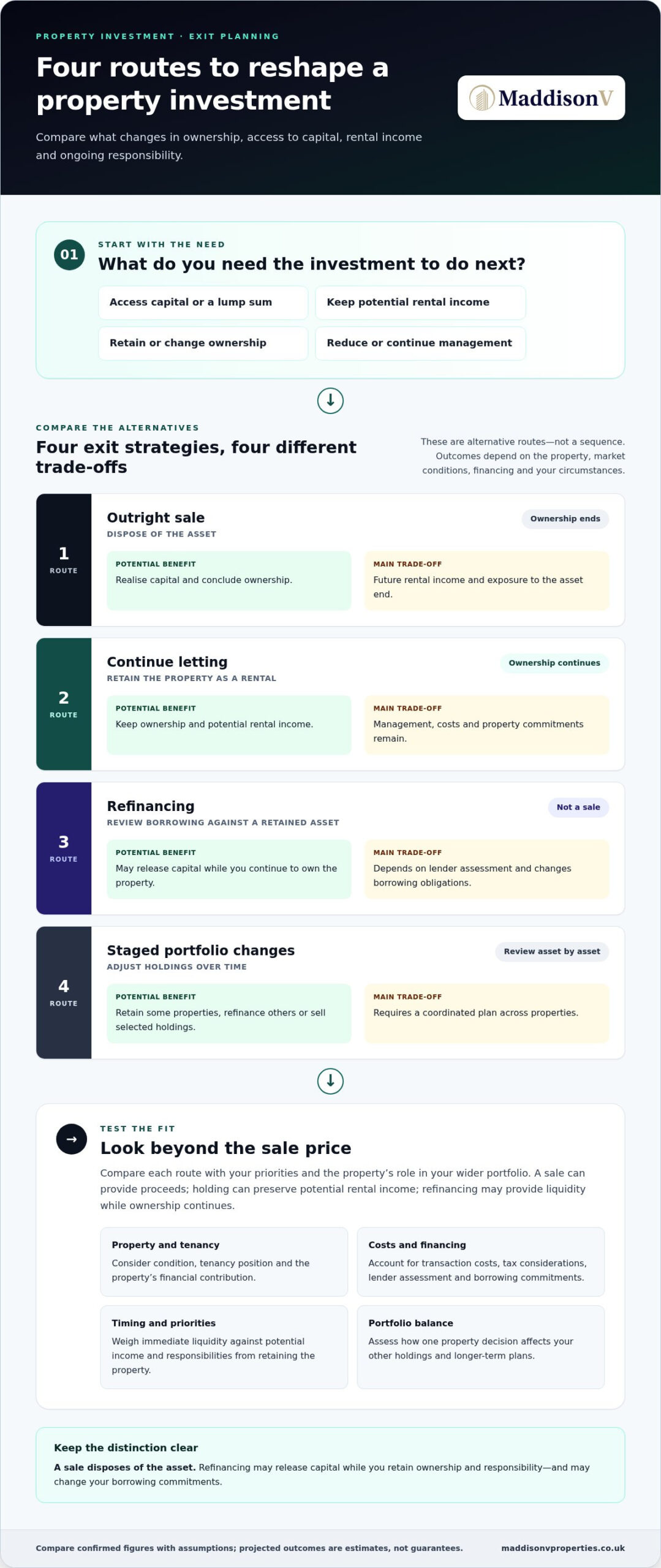
Once you know what you want your investment to achieve, compare the routes by what changes: ownership, access to capital, rental income and the work you retain. These exit strategies for property investors can suit different priorities, but none guarantees a financial outcome. The property, market conditions, financing and your circumstances all influence the result.
| Route | Purpose | Potential benefit | Principal trade-off |
|---|---|---|---|
| Outright sale | Dispose of the asset | Realise capital and conclude ownership | Future rental income and exposure to the asset end |
| Continue letting | Retain the property as a rental | Keep ownership and potential rental income | Ongoing management, costs and property commitments remain |
| Refinancing | Review borrowing against a retained asset | May release capital without a sale | Depends on lender assessment and changes borrowing obligations |
| Staged portfolio changes | Adjust holdings over time | Review assets individually rather than exiting all at once | Requires a coordinated plan across properties |
Selling the property or continuing to let it
A sale can convert an asset into proceeds to support another objective or simplify your holdings. In exchange, you give up the property’s future rental income and its place in your portfolio. Continued letting preserves ownership and the potential for ongoing rent, but you also retain responsibility for the asset, its tenancy and maintenance. A property that looks suitable to hold on paper may feel different when you weigh its demands against your available time and wider plans.
For either route, consider the property’s condition, tenancy position and financial contribution alongside the market context and your personal priorities. A sale price alone doesn’t show the full trade-off. Likewise, rental income alone doesn’t capture the responsibilities and costs of holding the property.
Refinancing, partial liquidity and portfolio changes
Refinancing is a financing decision, not a sale or transfer of ownership. It may provide access to capital while you continue to own the property, subject to lender assessment and the terms available to you. Any released funds come with financing obligations, so compare the potential liquidity with the effect of additional borrowing on your longer-term plans. Reviewing buy-to-let mortgage options can help clarify the financing considerations to include.
For investors with several properties, staged changes offer another route: review each asset over time, retaining some, refinancing others or selling selected holdings. This lets you consider the role of each property instead of treating the portfolio as a single asset. A review of property management and portfolio priorities can help organise the next step. MaddisonV’s property investment support can be tailored to your investment and objectives.
How to compare property investment exit strategies against your goals
Compare each route against the same priorities rather than judging it by one headline figure. A sale may provide liquidity, while retaining or refinancing an asset may preserve exposure to rental income. The right route depends on your objectives and circumstances, including how long you can wait, what financing you have in place and how much ongoing management you’re prepared to take on.
Use the following questions to bring the decision into focus:
- Liquidity: Do you need access to capital by a particular point, or can funds remain invested?
- Income: How important is continued rental income compared with realising value now?
- Timing: Does your preferred route fit your personal timetable and the property’s current tenancy position?
- Financing: What commitments would remain, change or need to be addressed under each option?
- Management: Are you willing to continue overseeing the property, its tenancy and its condition?
Which factors can change the preferred exit route?
A property’s condition and tenancy position can affect the practical choices in front of you. Planned maintenance or an existing tenancy, for example, may influence how you assess timing, workload and the appeal of holding or selling. Consider the wider portfolio, too. If one property represents a substantial share of your holdings, retaining it may leave the portfolio concentrated. Selling it may change the balance and income profile of your remaining assets.
Financing can narrow or reshape your choices. Set out existing commitments and consider how each route would affect them rather than assuming refinancing or a sale will produce a particular result. Record known figures separately from estimates, such as potential proceeds, ongoing costs and expected rental income. Label assumptions clearly and test how your comparison changes if they don’t hold. Projections are planning tools, not guaranteed outcomes.
How do tax and transaction considerations fit the comparison?
Tax treatment depends on your ownership structure, personal circumstances and the rules in force when you act. Transaction costs and financing implications can also affect the amount ultimately available to you. Don’t treat a generic calculation as a personal estimate. Discuss the relevant tax position with an appropriately qualified professional before making a decision. For wider location and market context, the London property investment guide can help frame how an individual asset fits into the market.
As a final check, write down what each route is expected to achieve, which figures support that view and what remains uncertain. This makes trade-offs visible and helps keep the decision aligned with your priorities, rather than letting one attractive projection dominate. MaddisonV Properties provides tailored advisory and portfolio management support as your plans evolve. Explore property investment support in the context of your wider objectives.
Prepare a property investment exit with a clear decision process
A sound decision is easier to put into action when the reasoning and records are in order. Use this sequence to move from a broad intention to a practical plan, whether you’re considering a sale, continued ownership or a change in financing. This framework helps organise the decision; transaction steps, legal requirements and tax treatment still need to reflect current rules and your circumstances.
- Define the objective. Write down what the decision needs to achieve, such as accessing capital, retaining rental income, reducing management responsibilities or reshaping your portfolio. Set a timeframe where possible and separate essential needs from preferences. This gives you a consistent test for each route.
- Review the asset and portfolio. Assemble ownership records, financing information, tenancy documents and property-management details. Note the property’s current use, condition, income and role alongside your other holdings. Separate confirmed information from assumptions, and flag anything that needs an updated valuation or professional review.
- Compare the routes. Consider how each option affects ownership, liquidity, income, financing commitments and ongoing work. Record practical advantages and trade-offs, not just estimated proceeds or projected returns. If the property forms a large share of your holdings, consider how a change would affect portfolio concentration and the contribution of your remaining assets.
- Plan execution. Once you’ve selected a preferred route, list the decision points, responsibilities and documents needed to progress it. Map timing against financing arrangements, tenancy matters and decisions involving other portfolio assets. Keep tax and legal questions separate from the strategic choice, and obtain current specialist advice before acting on them.
Build an informed picture of the property and portfolio
Bring the relevant information together before committing to a route. This might include ownership details, current financing arrangements, tenancy records, management responsibilities and known property issues. Flag gaps rather than filling them with estimates. If your decision depends on current value, future income or a particular legal or tax treatment, mark that point for appropriate professional review. Clear records make comparisons easier and reduce the risk of overlooking a practical dependency.
Turn the preferred route into an orderly plan
Translate your decision into manageable actions, with a named responsibility for each and a clear record of unresolved questions. Consider how the plan interacts with tenants, borrowing and other asset decisions instead of viewing the property in isolation. Preparation won’t remove uncertainty, but it can make next steps more deliberate and easier to coordinate.
If retaining the property remains an option, review how day-to-day responsibilities fit your plan. Professional property management can support rent collection, tenant relations and routine maintenance coordination. For tailored help organising your next decision, discuss your property investment plans with MaddisonV Properties.
How MaddisonV Properties can support an investor’s next decision
Choosing among exit strategies for property investors is part of a wider investment journey. Once you’ve identified a preferred direction, align it with the property’s role, your financing position and what you want your portfolio to look like afterwards. MaddisonV Properties brings property advisory and management perspectives together, tailoring support to the investment and your objectives.
The right support depends on the route you’re considering. If you plan to retain an asset, property management can help organise rent collection, tenant relations and routine maintenance coordination. If you’re reviewing borrowing, a mortgage consultation can help you consider financing questions in the context of your plans. If a sale forms part of a wider repositioning, property sourcing and market analysis can support your consideration of a potential next investment, with due diligence and negotiation as part of the process.
Support for investors retaining or reshaping a portfolio
Keeping a property means keeping its operational needs in view. Property management can bring routine responsibilities into a clearer structure, while portfolio management places individual assets in the context of your wider holdings and objectives. If you’re considering staged portfolio changes, this broader perspective can help you review which properties to retain and how each fits the plan. The aim is informed oversight, not a promise of passive returns or a particular financial result.
For example, an investor weighing whether to keep a tenanted property while changing other holdings may need to consider both ongoing management and the portfolio’s overall direction. MaddisonV’s approach can be tailored to those practical and strategic questions. Property sourcing may be relevant when you’re considering how to redeploy capital into another opportunity, while mortgage consultations can support discussion of financing considerations. Each decision remains specific to the property, the investor and their circumstances.
Discuss your property investment objectives
A focused discussion can begin with a few essentials: your preferred route, the timeframe you have in mind and the questions still to resolve. It’s also useful to outline the property’s ownership, financing, tenancy and management arrangements, along with its role in your wider portfolio. That context helps shape the conversation around your priorities rather than a generic view of what an investor should do.
MaddisonV Properties combines London property advisory and management services with support tailored to the investor and investment. Whether you’re exploring a sale followed by a new acquisition, reviewing a mortgage, retaining a rental asset or reshaping several holdings, begin by clarifying what you want the decision to achieve. Discuss your property investment objectives with MaddisonV to consider a measured way forward.
Set your next property decision in motion
A property exit can also create a new starting point: an opportunity to reconsider how your capital, time and attention should serve your wider plans. Before committing, identify the decision you need to make next and the information that would help you make it with confidence. A measured approach to exit strategies for property investors can help ensure the property’s future fits the portfolio you want to build, not simply the circumstances you’re leaving behind.
If you’re considering a new acquisition, MaddisonV’s property sourcing includes market analysis, due diligence and negotiation support. If retaining an asset remains part of your plans, property management can help coordinate rent collection, tenant relations and routine maintenance. The right support depends on your objectives and the role each property plays.
Take the next step with a clear view of your priorities and outstanding questions. Plan your next property investment decision with MaddisonV and move forward with considered, tailored support.
Frequently Asked Questions
When should a property investor start planning an exit strategy?
Start reviewing your options well before you need to act. Early planning gives you time to identify issues that could affect your choices, such as a financing renewal, upcoming maintenance or a change in investment priorities. If you may need capital for another commitment, consider in advance whether a sale or refinancing could fit your plans. Review the decision periodically, especially when your personal circumstances or portfolio changes.
Is selling an investment property the only way to release capital?
No. Refinancing may release capital while you retain ownership, subject to lender assessment and the terms available. It’s different from a sale: you continue to own the property and remain responsible for its commitments. Compare the funds potentially made available with the borrowing obligations that would follow. If you need to end ownership entirely, a sale may better match that objective. The right fit depends on your financing position and intended use of the capital.
Can you refinance a buy-to-let property instead of selling it?
Yes, refinancing may be an alternative to selling, but approval and terms depend on the lender’s assessment of your circumstances and property. Before exploring it, gather details of your existing mortgage, current rental arrangements and the purpose of any funds you may release. Consider whether changed borrowing commitments remain manageable if costs, income or your plans shift. A mortgage consultation can help you organise the relevant questions, but it can’t guarantee approval or a particular outcome.
How do taxes affect an investment property exit in the UK?
Tax can affect the net proceeds from a sale or the wider consequences of changing ownership or financing. Treatment depends on factors such as your ownership structure and personal circumstances, as well as the rules in force when you act. Don’t rely on a general online estimate as a personal calculation. Before committing to a transaction, have your position reviewed by a suitably qualified tax professional and include relevant transaction costs in your comparison.
Can an investor sell a rental property with tenants in place?
A rental property may be sold while tenants are living there, but the tenancy arrangements can influence the sale process and a potential buyer’s plans. Review the tenancy agreement, relevant correspondence and records of rent and property matters before deciding how to proceed. A buyer may assess the existing arrangement as part of their decision. Don’t make assumptions about notice, access or tenancy rights; these depend on the circumstances and should be checked against current requirements.
Should property investors sell one asset or an entire portfolio?
There’s no universal answer. Selling one property may address a specific need while leaving the rest of your strategy intact; a wider disposal may better suit a decision to simplify or substantially reshape your holdings. Compare each asset’s contribution, financing and management demands, then consider how different sale combinations would affect your remaining portfolio. Selling a lower-priority holding, for example, may affect income and portfolio concentration differently from selling your largest asset.
What information should I gather before choosing an exit route?
Collect ownership and financing records, tenancy agreements, rent information, property condition details and records of ongoing management or maintenance. Include relevant documents for other properties if the decision affects your wider portfolio. Note which figures are confirmed and which depend on estimates, such as an assumed sale value or future rental income. This distinction helps you identify where you need updated information or specialist advice before comparing routes or taking action.

Sign Up Now
Want to read more great articles and blogs subscribe to our newsletter